
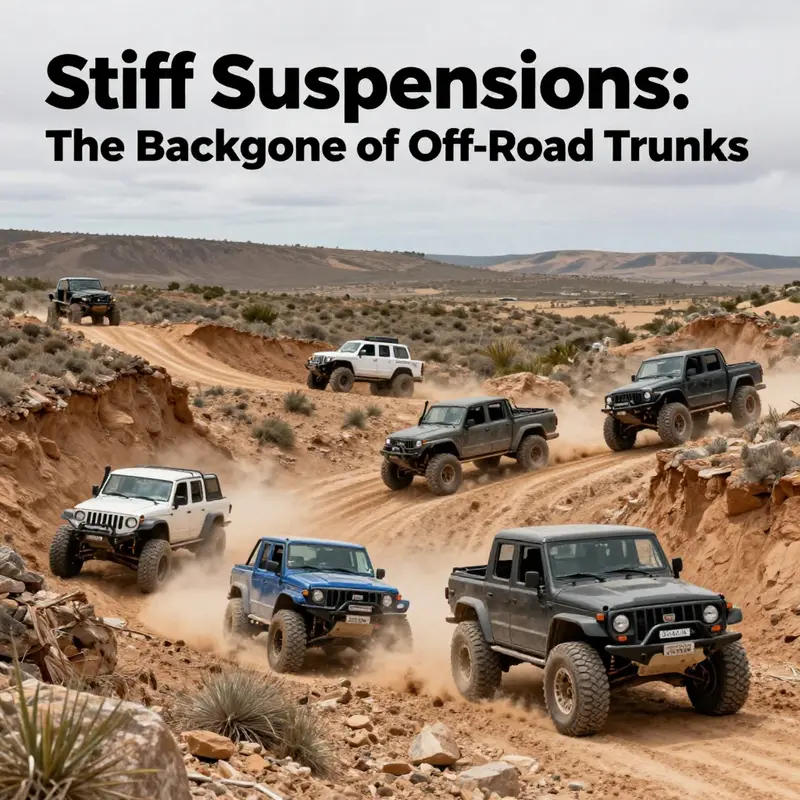
Off-road trucks embody ruggedness and resilience, with their suspensions often characterized by stiffness that bolsters durability on rugged landscapes. As enthusiasts and adventurers hit the trails, the very design of these suspensions plays a pivotal role in their ability to navigate challenging terrains while ensuring stability and safety. This exploration delves into the rationale behind stiff suspensions, the balance between friction and comfort in truck design, and the performance outcomes that arise from these engineering decisions. Each chapter connects the dots, guiding you through the intricate relationship between suspension system stiffness and off-road capabilities.
Stiff by Design: The Engineering Truth Behind Off-Road Truck Suspensions and Traction
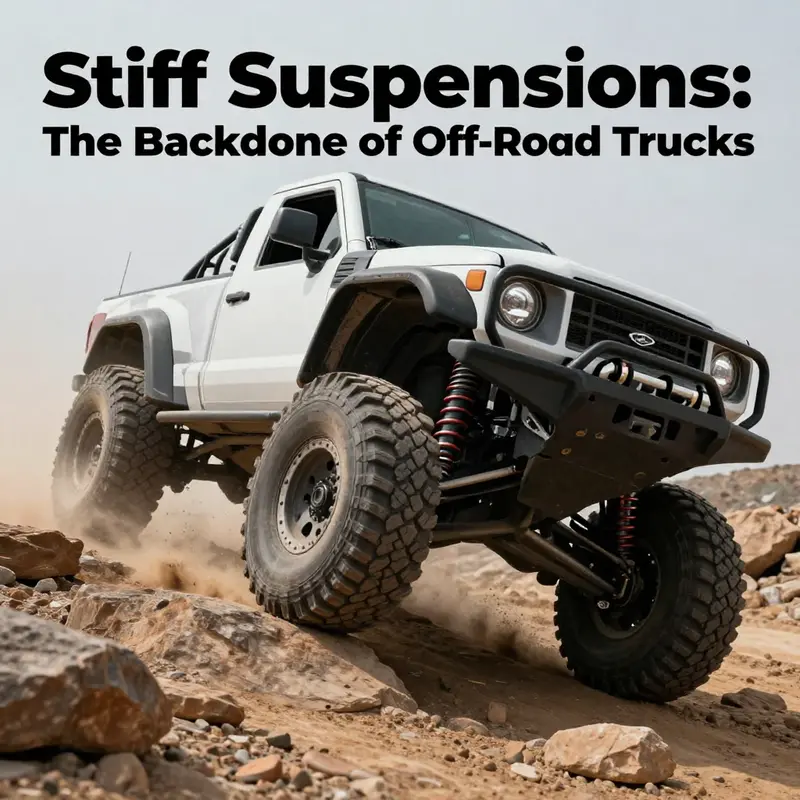
Suspension stiffness in off-road trucks is often misunderstood. To the casual observer, a suspension that feels unyielding on uneven terrain might seem like a hindrance to comfort. In truth, stiffness is a deliberate design choice, one that underpins stability, control, and durability when the vehicle is pressed hard against rocks, roots, ruts, and sudden changes in ground height. The chapter that follows peers beyond the first impression of rigidity and reveals how stiffness, when applied with care, becomes a fundamental ally in off-road performance. It becomes clear that stiffness is not an all-or-nothing attribute but a carefully tuned attribute that interacts with geometry, damping, and the driver’s expectations to shape what the truck can do on a trail and what it can do back on the road after a day of adventure. This nuanced view is essential for understanding why off-road suspensions tend to be stiffer than their on-road counterparts, and why the degree of stiffness varies so widely from one build to the next.
What, precisely, does stiffness mean in a suspension system? It is a characterization of how resistant the system is to deformation when a load is applied. In practice, stiffness manifests through spring rates, the rigidity of control arms, and the resilience of mounting points to resist bending or flexing under load. A stiffer spring rate means the wheel is less likely to dive into a compression when a tire encounters a hard obstacle; it also means the chassis experiences less pitch and roll in response to rapid fluctuations in terrain. At the same time, the damping system—shock absorbers and, in some designs, additional dampers—works hand in hand with stiffness to control how quickly the suspension settles after an impact, and how much energy is returned to the vehicle. In a well-balanced system, stiffness limits excessive body motion while damping prevents a pendulum-like bounce that would degrade tire contact and steering feel. The result is a chassis that maintains a stable platform for the driver, even when the ground is anything but predictable.
The landscape of off-road suspension is diverse, and stiffness is not a single knob that is turned up or down uniformly. Instead, engineers shape stiffness regionally and temporally. Front and rear axles may employ different strategies based on expected loads, weight distribution, and the likely pace of the vehicle. For extreme off-roading, some trucks use rigid rear axles paired with leaf springs or trailing arms. This arrangement provides exceptional durability and load-bearing capacity, which are priceless when the vehicle must perform over rugged terrain and carry equipment, tools, or recovery gear. Leaf springs contribute a straightforward, robust stiffness that resists lateral movement and can tolerate high torque without excessive distortion. Trailing arms and triangulated configurations can likewise be engineered to keep the wheel alignment stable after a rock strike or a heavy landing. In such setups, the emphasis is less on ride comfort and more on maintaining traction and structural integrity when the ground forces the suspension to its limits.
On the other end of the spectrum are independent suspension systems, which can still be tuned for stiffness but offer more articulation and wheel travel. Independent designs allow each wheel to respond to ground irregularities without imposing the same amount of influence on the other wheels. This separation matters on technical trails where one wheel can remain in contact with the ground while another wrestles with a rock or a rut. The stiffness in these systems tends to concentrate in structural components that resist bending under load—things like strengthened control arms, robust pivots, and reinforced mounting points—while the shocks themselves are tuned to manage energy absorption and prevent excessive oscillation. High-performance off-road builds often blend rigid structural emphasis with sophisticated damping to strike a balance that supports both precision on technical lines and enough tolerance to handle everyday variability when the trail ends and pavement begins.
The consequences of stiffness extend beyond raw handling. A stiffer system affects how power is delivered to the wheels, a critical factor when the terrain challenges traction. In conditions where a wheel is momentarily unloaded—such as when carving steep inclines or negotiating a ledge—the truck must quickly reweight the tires to recover grip. A stiff suspension helps limit body roll and keeps the drivetrain aligned with the tires when weight shifts suddenly. This improves the likelihood that available engine torque translates into forward motion rather than wheel spin or bogging down. Conversely, if the suspension is too soft for the terrain at hand, the vehicle can experience excessive body motions that smear weight transfer, degrade tire contact, and reduce the driver’s ability to steer the vehicle predictably through obstacles. For drivers who push the pace on rough trails, precision matters as much as raw power, and stiffness is one of the levers that makes precision possible.
In practice, stiffness cannot be viewed in isolation from other dynamic factors. The interaction between spring rate and damping rate is critical. A very stiff spring without appropriate damping can make the vehicle feel harsh, cause the tires to skip over small undulations instead of conforming to them, and hamper control at the limits. A mismatched damping setup risks either underdamping, which produces sustained oscillations after a hit, or overdamping, which suppresses wheel travel to the point where tire contact becomes inconsistent as the surface changes. Modern off-road suspensions aim for a controlled sense of compliance: enough stiffness to resist chassis distortion during a test like a high-speed run across a rocky shelf, but enough damping and travel to let the wheels articulate and maintain contact with the ground as closely as possible. This is not a matter of choosing between stiffness and comfort; it is about orchestrating stiffness in concert with damping so that the truck remains predictable when the trail throws the most unexpected challenges.
The design language of stiffness also speaks to the geometry of the suspension. The layout—whether it uses a live axle, a multi-link rear, or a sophisticated long-travel independent setup—dictates where rigidity needs to be concentrated. In a rigid-axle configuration, stiffness is essential to prevent axle wrap and to maintain drive-train alignment under torque. Leaf springs, while simple, contribute a predictable stiffness profile and can be tuned by varying the leaf count, the grade of steel, and the arch of the leaves. In independent setups, stiffness is often achieved with reinforced control arms and crossmembers that resist bending; the trade-off then becomes the complexity of the steering linkage and the potential for control-arm binding if the articulation is excessive. Across the board, engineers leverage high-strength materials, larger-diameter axles, and rigid mounting hardware to ensure that the essential load paths remain stiff enough to support the vehicle’s goals without compromising the ability of the suspension to absorb and recover from obstacles.
The everyday question—how stiff is too stiff for a given off-road mission—has no single universal answer. The answer lies in the mission profile. A vehicle built for extreme rock crawling and desert racing will tolerate, and often require, stiffer structural components and aggressive dampers. The driver’s feedback—the telltale signs of a truck that resists being unsettled by a rock, a root, or a fast bump—guides the tuning to a degree that approaches the limits of grip and control. By contrast, a vehicle deployed for overland exploration, with long days on a mix of rough and smooth surfaces, favors a more balanced approach. The goal shifts from maximizing traction on a single, brutal obstacle to maintaining composure, predictable handling, and manageable fatigue over hours of driving. In between these poles sits a wide spectrum of setups designed to harmonize stiffness with travel, weight distribution, and the driver’s desired feel.
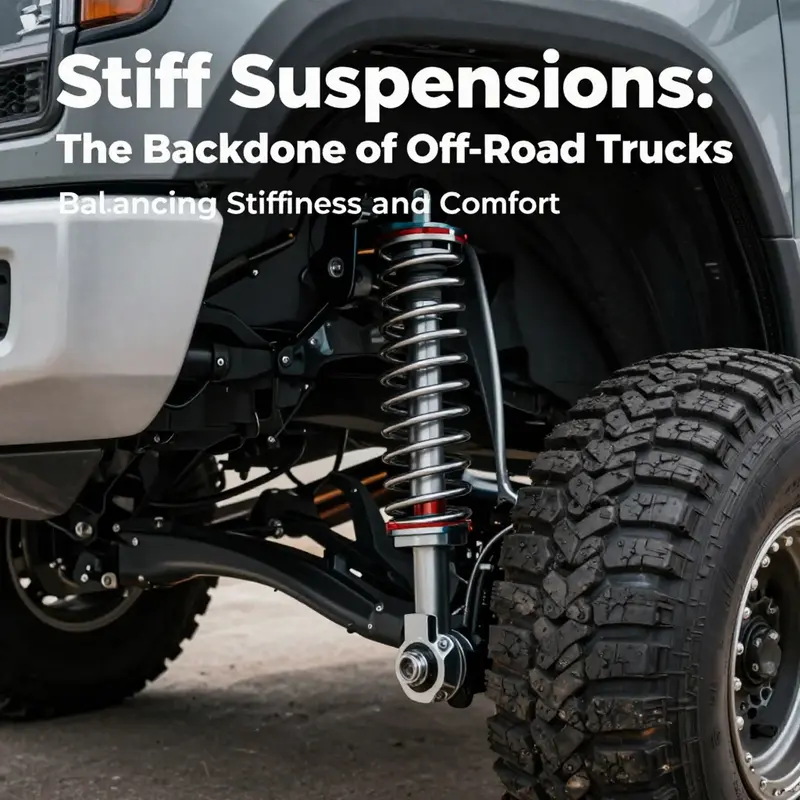
The chapter’s core takeaway is not that stiffness alone guarantees off-road success. Rather, stiffness is a central element of a system designed to withstand harsh conditions while preserving control. The real engineering challenge is to create a framework where stiffness is applied where it is most needed—often in the vehicle’s frame, suspension arms, and mounting points—while leaving enough local flexibility and damping to absorb energy and maintain tire contact. This is achieved through a combination of heavy-duty coil-over shocks, reinforced control arms, and strategic use of bump stops that limit excessive articulation. It is also supported by a careful choice of spring rates that prevent the suspension from becoming a dead weight on the bottom, yet remain responsive enough to keep the tires connected to the terrain. The result is a chassis that can cope with high-stress events like jumps or rapid changes in elevation without shedding traction or losing direction. The aim is not to eliminate movement but to harness it in a controlled way so that the vehicle can respond quickly to the terrain and the driver’s input.
With that understanding in place, it becomes clearer why the stiffness of off-road suspensions varies so much across vehicles and builds. Some configurations emphasize durability and flat, linear behavior under load—traits that serve long-travel, all-day endurance and heavy payloads. Others prioritize high-speed precision on technical trails, where the vehicle must absorb and react to rapid, small-scale ground changes while keeping the tires engaged. In both cases, the structural stiffness acts as a backbone for the suspension’s performance, but the real life comes from how the damping, articulation, and weight distribution are engineered around that backbone. The driver experiences the outcome as a predictable, confident sense of control, even when the trail tries to throw the truck off balance.
This is where the balance finds its mark. The best off-road suspensions do not rigidly resist every motion; they resist the wrong kind of motion. They allow the suspension to compress and extend where it contributes to maintaining tire contact and steering alignment, yet they resist excessive flex that would distort control arms, misalign axles, or throw the chassis into an unstable attitude. The design language is then one of selective stiffness: high stiffness where needed for alignment and durability, moderated stiffness elsewhere to permit necessary travel and energy dissipation. The driver benefits from a setup that feels stable when launching over a crest, confident when negotiating a steep descent, and manageable when encountering a long washboard section that would otherwise shake the teeth out of a rider’s skull. In turn, this translates to a vehicle that can tackle both the most demanding terrain and the occasional on-road segment with a level of predictability that improves safety and reduces the risk of mechanical failure.
The discussion would be incomplete without acknowledging the potential risks of misalignment between stiffness and the terrain. If stiffness is overemphasized without a proportionate increase in damping and travel, the system can become unresponsive to ground irregularities. The result might be a vehicle that refuses to settle after a hit, or one that transmits every bump directly into the chassis and the cockpit. On the other hand, a system that leans too soft fails to keep weight evenly distributed and can suffer from slow steering response, reduced cornering grip, and increased vulnerability to damage from large impacts. The driver’s sense of control rests on a delicate equilibrium, a balance that requires thoughtful engineering and careful testing on representative terrain. This is why manufacturers and builders invest heavily in validating their stiffness choices with real-world trials, telemetry, and feedback from drivers who push the platform to its edges. Experimental testing often reveals where the stiffness distribution works well and where it needs refinement, ensuring that the final product delivers a reliable feel, not a harsh surprise.
In summary, stiff suspensions in off-road trucks are not a simple feature but a design philosophy. They are deployed where rigidity protects the drivetrain, maintains alignment under extreme load, and supports precise power transfer when the surface is uneven or partially lifted. They coexist with sophisticated damping and travel allowances that convert raw stiffness into usable traction and controlled motion. The degree of stiffness is not universal but purpose-built, selected to match the vehicle’s core mission—whether that mission is pure off-road performance on rough, technical trails or a balanced, all-purpose vehicle that must endure long days on a mixed surface. This nuanced approach explains why, in the world of off-road trucks, stiffness is held in high regard as a vital enabler of confidence, control, and durability rather than a mere aesthetic of rigidity. For readers who crave a deeper dive into how stiffness interacts with broader vehicle dynamics and suspension design, a broader technical treatment of the topic can be explored in sources that rigorously examine road holding and tire load across dynamic conditions. Mastering Diesel Mechanics offers a practical pathway to understanding the mechanics that underpin these choices on a more granular level. Mastering Diesel Mechanics
External resource: For a technical treatment of how suspension stiffness affects road holding and dynamic tire load, see https://www.sciencedirect.com/topics/engineering/vehicle-suspension.
The Stiffness Equation: Engineering Off-Road Trucks’ Rough-Terrain Backbone
When people ask whether off-road trucks have stiff suspensions, the question feels simple but the answer proves complex. Stiffness is not a single yes-or-no attribute; it is a design dial that engineers tune to fit the terrain, the loads, and the operator’s endurance over long hours on challenging ground. In the rough world those vehicles are built to conquer, suspension stiffness is a tool, not a badge. It is deployed to keep wheels in contact with irregular surfaces, to preserve control at speed over rocks and ruts, and to maintain structural integrity when heavy payloads hammer the frame. Yet explain it to a driver who spends long days rattling across washboards, and the same stiffness that helps cross-Terrain performance begins to show its other side: fatigue from vibration, fatigue from noise, and the stubborn reality that comfort has a price in the form of subtle compromises in deflection and damping. The most revealing truth is that stiffness exists on a spectrum, and modern off-road trucks live somewhere along that continuum, carefully balancing rigidity with flexibility to meet the mission at hand.
The way stiffness is built into a vehicle starts with the suspension system itself. In the most capable off-road platforms, engineers favor long-travel arrangements because wheel travel translates directly into terrain contact. When a wheel can move significantly up and down without forcing the entire chassis to oscillate in unison, the tire remains on the ground longer, braiding traction with the surface. Long-travel configurations are often realized with coil-over springs or robust leaf-spring packs paired with high-capacity shock absorbers. The goal is to absorb the lion’s share of the terrain’s hits without letting those impacts reverberate through the frame to the cab. This approach helps the vehicle hold steady as it climbs over a jagged ledge or lopes through a series of whoops, where the alternative—short travel and stiff, jarring suspension—would throw the wheel away from the ground and break traction just when it is most needed.
In many modern designs, adaptive or electronically controlled suspensions take the concept a step further. They adjust damping rates in real time, responding to the terrain under the wheels as it happens. On a bumpy trail, softening dampers can smooth the ride and keep the tires planted; at higher speeds on smoother terrain or when the load shifts, stiffening the damping helps retain stability and control. The ability to modulate stiffness on the fly means the same vehicle can negotiate a rock-strewn path with one setting and then, minutes later, cruise on a rough highway with a different, more comfortable tune. The effect is not merely about comfort; it is about sustaining control and reducing the energy transfer that could otherwise fatigue the operator or compromise payload integrity.
Beyond the suspension itself, chassis and frame design play a decisive role in how stiffness is transmitted to the driver and cargo. A rigid frame is essential for maintaining structural integrity under heavy loads and repeated impacts. But excessive stiffness at the wrong junctions can turn every bump into a direct hit felt through the cab. To decouple harsh road inputs from the operator without sacrificing chassis rigidity, engineers employ flexible mounting points. Rubber bushings, hydraulic isolators, and carefully designed anchor points allow the cab to move independently of the frame to a degree. This decoupling reduces vibration transfer and cabin noise while preserving the frame’s ability to resist torsion and twist under load. Some high-end configurations even incorporate cab suspension systems—air or hydraulic mounts that lift the operator slightly off the frame, smoothing inputs before they reach the backrest and the spine of the truck itself. The result is a more sustainable working environment that lets drivers concentrate on line selection and throttle control rather than bracing for the next jolt.
Tire architecture completes the trio of variables that determine perceived stiffness. The tires are not just decorative contact patches; they are a dynamic part of the suspension system. Large, low-pressure tires increase the contact patch, acting as a secondary, passive absorber that cushions the vehicle’s journey through irregular ground. This is not without risk. Lowering tire pressure can invite sidewall damage if the ground is puncture-prone or the vehicle encounters sharp edges. To counter this, engineers specify reinforced sidewalls and tread compounds designed for durability, while maintaining the necessary flexibility to deform without excessive energy transfer into the wheel wells. The tire’s role is twofold: it preserves traction on uneven surfaces by maintaining a greater footprint and it provides an additional layer of compliance that complements the mechanical suspension. Together, tire, suspension, and chassis form a system whose stiffness is not a single constant but a negotiated balance that shifts with the terrain.
Inside the cabin, all this mechanical sophistication translates into a different measure of stiffness: the ride quality, the quietness, and the operator’s ability to absorb the road’s imperfections without losing sense of the vehicle’s behavior. Seats with substantial lumbar support and cushions designed to dampen high-frequency vibration go a long way toward reducing fatigue. Sound insulation isn’t cosmetic; it is an essential part of the feedback loop that allows a driver to interpret what the chassis is telling them. When the cab can isolate a portion of the vibration and the resulting noise, a driver can maintain focus on steering and throttle inputs rather than fighting a constant drumbeat of rattles and hum. The interplay between the cabin’s comfort and the chassis’s stiffness is delicate. If the cabin isolation is too aggressive, the driver loses tactile cues—slippage, traction changes, subtle shifts in road feel—that help anticipate a tricky surface. The art is to preserve enough feedback to be informative while filtering enough to prevent fatigue.
All of these design choices reflect a broader engineering philosophy: stiffness should not be maximized in search of a uniformly rigid platform. Instead, stiffness should be tuned as an ecosystem property—one that includes the suspension’s travel, the frame’s flexibility, the tires’ deformation characteristics, and the cab’s ergonomic and acoustical treatment. This holistic approach is what makes an off-road truck capable in extreme environments yet practical for daily use when the mud is gone, the road is paved, and the payload demands a steady, predictable ride. It is a matter of proportion. A vehicle that is too stiff at every interface will outrun rough terrain only to punish the operator with fatigue and potential injury. A vehicle that is too soft will struggle to maintain precise control, especially when the surface suddenly changes under load. The best designs strike a middle ground where the wheels can follow the ground, the frame can resist distortion, and the operator can perform with confidence for hours on end.
This balance is not accidental. It is the outcome of careful modeling, testing, and iteration. Engineers simulate countless combinations of spring rates, damping curves, and mounting stiffness, then verify them on test rigs that mimic rock gardens and washboard segments alike. They also consider the vehicle’s typical duty cycle: how often it carries heavy loads, how much speed it sustains on varied terrain, and how much time the operator spends in rough conditions versus cruising on smooth pavement. In some applications, the demand for outright ruggedness justifies a deliberately stiff setup. In others, a more forgiving, adaptive suspension can deliver sustained performance without forcing the operator to trade comfort for capability. The unspoken benchmark is not a momentary triumph on a single obstacle but a repeatable, reliable performance over countless miles and thousands of hours in service.
To ground this discussion in the real trade-offs that shape every off-road build, consider how a common dual-path objective plays out. If the goal is maximum rock-crawling capability, stiffness is increased at the chassis-damper interfaces and you’ll see substantial wheel articulation, sturdy struts, and a suspension that can resist bending moments under heavy loads. The downside is an elevated baseline ride height and a harsher ride on a rough highway, where the same parts transmit more of the terrain’s micro-impacts to the cabin. If the vehicle is designed for broad utility—occasional technical trails plus daily driving—the solution is a more nuanced blend: stiffer components where control matters, softer mounts and better damping to absorb minor irregularities, and perhaps an adaptive system that softens the ride on pavement while bringing back stiffness on rougher sections. In this sense, stiffness becomes a carefully calibrated trait rather than a fixed characteristic.
For readers who want to peek under the skin of this subject, there is value in exploring the practical mechanics that connect containment of motion to performance. The nuts-and-bolts of springs, dampers, and mounts are the language through which stiffness is expressed, tested, and refined. If you seek a deeper, more technical grounding, consider the path of mastering diesel mechanics, which covers the way the vehicle’s chassis and powertrain interact with the suspension system over long hours and harsh terrains. You can explore broader mechanical concepts and how they manifest in real trucks through resources such as detailed practical guides that walk through the relationships between shocks, springs, and bushings in heavy-duty applications. mastering diesel mechanics.
The discussion would be incomplete without acknowledging the broader context in which suspension stiffness operates. Off-road trucks exist at the intersection of performance, durability, and operator well-being. The most successful designs acknowledge that stiffness is not an end in itself but a means to an end: getting the tire to stay in contact with the ground, maintaining control through diverse terrain, and protecting the vehicle’s structure under heavy use. The chassis must resist twisting and flexing when a wheel is pushed into a hole or a rock faces a sudden angle. Yet the frame must not whisper every vibration into the cab as if the operator were sitting on a drum. Tire behavior must complement the suspension. The tires’ capacity to adapt through sidewall deflection and tread deformation is essential not only for traction but for the nuanced feel that informs the driver about upcoming obstacles. Interior acoustics and seating contribute to the longer arc of fatigue, enabling a driver to maintain a consistent line, throttle modulation, and steering input across miles of uneven ground. These elements are not independent; they are threads woven into a single fabric of stiffness managed with precision.
The end result is a fleet of off-road trucks that can feel relatively forgiving when the pavement ends and relentlessly capable when the terrain dictates. The stiffness that matters most is not the unyielding stiffness of a rigid shell but the dynamic stiffness achieved through adaptive damping, flexible mounting, and intelligent tire usage. In practice, a well-designed off-road truck will present a driver with a ride that communicates terrain details—texture, traction, and load transitions—without becoming a relentless barrage of bumps. It will also deliver stable, predictable handling across a wide envelope of speeds and conditions. This is the essence of engineering stiffness as a tool rather than a constraint: a capability that respects the roughness of the world while enabling a human operator to do precise, confident work.
External resource: For a detailed technical overview of modern off-road truck suspension systems and chassis design principles, see the SAE publication on Off-Road Vehicle Dynamics and Suspension Design: https://www.sae.org/publications/technical-papers/content/2021-01-0765/.
Stiff by Design: The Performance Tradeoffs of Off-Road Truck Suspensions
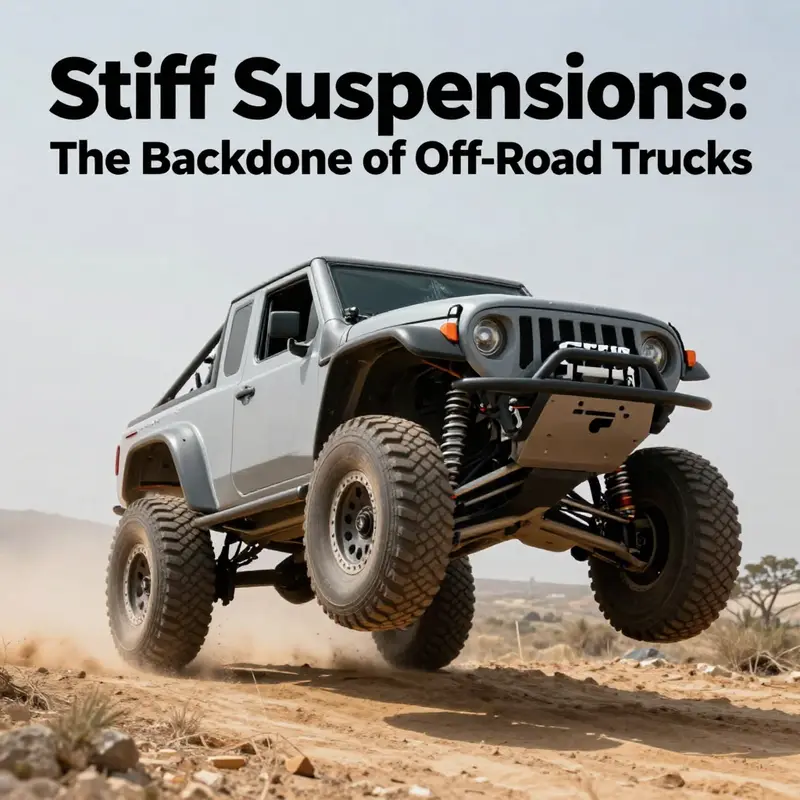
Suspension stiffness is not a single, universal attribute but a design choice that reflects a vehicle’s intended role in the rough and the smooth alike. In the world of off-road trucks, stiffness is often the default posture, yet it is calibrated with a purpose. The overall topic—whether off-road trucks have stiff suspensions—rests on a spectrum, not a binary yes-or-no. Manufacturers tailor the degree of rigidity to the vehicle’s primary mission: is it built for harrowing, obstacle-rich terrain where strength and control are paramount, or is it a more versatile machine that must still perform when the pavement ends but remain livable on the highway? This tension between extreme terrain performance and everyday drivability sits at the heart of suspension design and explains why stiffness is both celebrated and questioned in equal measure.
To appreciate what stiff suspensions do, it helps to think about how a truck uses its wheels to grip, climb, and steer through unpredictable ground. A stiffer setup tends to keep the chassis flatter during rapid changes in terrain and can help the vehicle maintain a straight line when everything beneath the body wants to flex. But that same stiffness can reduce the tire’s ability to conform to irregular surfaces, a dynamic that becomes especially critical on loose or jagged terrain. When a wheel encounters a bump or a rock, the suspension either absorbs this perturbation or transmits it directly to the wheel and, ultimately, to the tire’s contact patch. In off-road contexts, maintaining stable contact with the ground is the difference between crawling up a ledge and slipping into a trough. If the suspension is too rigid, the tire may lose contact momentarily, the grip disappears, and momentum—so essential on a challenging line—fades. This is where the concept of wheel contact, often overlooked in casual discussions, becomes central. A stiff suspension can cause abrupt, unsettling jostling that disrupts the tire’s intimate relationship with the terrain. The vehicle can stall in its own arc, and the driver loses some of the tactile feedback that is needed to adjust line, throttle, and steering in real time.
The most immediate, visible consequence of rigidity is a trade-off in traction. Traction is not simply about surface grip but about how the tire, the pavement, and the suspension communicate under load and through movement. In uneven off-road surroundings, tire contact must be modulated dynamically as surfaces rise and fall, as ruts deepen, or as a rock garden demands precise line selection. A stiff suspension minimizes body roll and dampens chassis motion, which can be an advantage on fast, flowing sections where the driver wants to hold a line with as little disturbance as possible. Yet the same stiffness reduces the tire’s ability to better adapt to the irregularities in the ground. The wheel may ride on a peak instead of finding the valley that would allow continuous traction. The result is often a momentary loss of grip that compounds with each obstacle. In practice, the most capable off-road trucks strike a balance: enough stiffness to preserve chassis control and suspension durability during aggressive maneuvers, but enough give to keep the contact patch planted on varied terrain. The difference between a vehicle that climbs smoothly and one that snaps to a halt on a ledge can hinge on a handful of degrees in wheel articulation and a few fractions of a second in tire contact response.
Another consequence of stiffness is the way a suspension handles energy during impacts. Off-road tracks are not merely rough; they are dynamic. A stiff system does not dissipate energy as efficiently as a more compliant one. Instead, it can transmit shocks directly through the chassis to the driver and to sensitive components. The upshot is twofold. First, the ride quality becomes harsher, especially as speeds increase or terrain features repeat with frequency. The driver experiences a more punishing feedback loop—jolts into the steering wheel, a repeated thud through the seat, and a sense of every rock and rut reverberating through the frame. Second, the repeated high-load impulses can accelerate wear on drivetrain elements, mounting points, and suspension joints. Over time, the consequence is not just discomfort but potential maintenance concerns, as fasteners loosen or bushings wear more quickly under cyclic, high-load stress. The trade-off is clear: a stiff suspension supports predictable geometry and control in severe conditions but exacts a cost in longevity and long-haul comfort. This is why a growing portion of the off-road segment uses tunable dampers and versatile spring schemes that can be dialed toward a stiffer feel for rock gardens and desert runs or softened for cross-country travel. The goal is to maintain resilience under heavy use without turning every expedition into a test of endurance for the driver.
The driver’s experience is a pivotal aspect of stiffness. A harsh ride compounds fatigue, undermining vigilance on long trails and increasing cognitive load. When a route requires hours of sustained attention, a demanding suspension becomes a factor in decision making. If the brain is absorbed by the uncomfortable ride, there is less bandwidth left for line selection, throttle modulation, and turning inputs. This fatigue not only affects performance but can also escalate risk. Smooth, predictable handling, even if it comes at the cost of some on-paper stiffness, often leads to more reliable outcomes in the field. Manufacturers recognize that recruitable torque, gearbox mapping, and chassis stiffness all interact with the suspension to influence how an off-road experience feels over time. Tunability—adjustable shock valving, selectable spring rates, and even air-spring systems—becomes a crucial tool. It gives the operator a practical method to adapt a vehicle to the mission, ranging from a harsh desert race to a mellow weekend trail ride where comfort is a priority.
A discussion of stiffness would be incomplete without addressing how different suspension architectures contribute to the observed performance. In the most rugged, purpose-built off-road setups, rigid rear axles paired with leaf springs or triangular trailing arms are common. These configurations emphasize stiffness, durability, and predictable tire contact under heavy load. They resist axle wrap and maintain alignment in the most punishing conditions, but they offer limited wheel articulation and a comparatively harsher ride on smoother surfaces. The opposite end of the spectrum features more sophisticated independent suspensions that allow each wheel to respond to ground irregularities independently. This independence increases tire contact with uneven surfaces and improves comfort by soaking up small to mid-sized impacts. The challenge here is tuning the kinematics so that the suspension remains stable under lateral load and avoids excessive dive or squat when the vehicle climbs or decelerates. In many modern off-road trucks, a hybrid approach—front independent suspension with a more rigid rear layout or a sophisticated multi-link rear—seeks the best of both worlds. The result is a system that can be tuned to offer a high degree of wheel articulation and traction without sacrificing the resilience needed for long, punishing runs.
One widely observed design principle is the role of springs in conjunction with dampers. Stiffness, in practice, emerges from the interplay between spring rate and damper valving. A high spring rate will resist compression, maintaining form during impact but reducing the wheel’s ability to lower and conform to terrain. A slower, more damped system can absorb energy more gradually, allowing the tire to maintain contact and the chassis to recover gracefully after an obstacle. Yet damping alone cannot compensate for a spring that is too stiff or too soft for the terrain at hand. The tuning problem becomes a matter of what a particular trail demands: deep, rutted sections that require precise throttle and wheel placement, or smooth but extreme obstacles where the driver needs to pilot over with minimal chassis roll. On a technical ascent with uneven footholds, a stiff setup helps preserve line and momentum, provided that the tires remain in contact. On long, sandy runs, a more compliant system helps to keep the tire pressure and footprint stable, aiding flotation and traction. The best-performing teams and drivers learn to adjust both spring and damper characteristics to maintain consistent, predictable handling across a wide range of ground conditions, and many mass-market off-road rigs now offer user-adjustable components or selectable modes to shift toward more stiffness or more compliance as the terrain dictates.
A deeper layer of this discussion lies in the way stiffness influences wear and maintenance. A stiffer suspension will generally transmit higher peak forces through the chassis and linkages when the ground is rough. This can accelerate wear in bushings, joints, and mounting hardware and may necessitate more frequent inspections. It can also produce more dramatic chassis flex under extant loads, which, if not properly managed, can lead to fatigue failures over time. Conversely, a more compliant setup tends to distribute energy more evenly, reducing peak loads on any single component and potentially extending service intervals. The downside is that the vehicle’s geometry can drift more during aggressive maneuvers, placing greater demands on the driver to preserve line and speed, especially in tight rock conditions where tiny variations can be decisive. In practice, teams that operate in demanding environments emphasize not only the stiffness of their suspensions but also the quality of their subframe mounts, control arms, and routine inspection protocols. The resilience of the entire system emerges as a function of how well every part, large and small, can endure the vibrational choreography that off-road driving demands.
Design choices are also guided by the vehicle’s broader purpose and the expectations of its users. A truck intended for high-speed, technical trails—where the line through a groove or over a ledge must be held with confidence—will lean toward stiffer damping and a suspension architecture that resists excessive body roll. The emphasis is on predictable behavior at the limit and robust protection for the chassis when the terrain tests the vehicle’s limits. A truck built for mixed use, where daily driving matters as much as occasional rock crawling, will typically employ a more adaptive strategy. It may feature adjustable or hybrid spring setups, dampers with multiple modes, and even active or semi-active systems that can tailor stiffness in real time. In those cases, the suspension becomes less about brute strength and more about a calibrated response that respects both the highway and the trail.
This pragmatic approach—design for a primary mission while accommodating a secondary one—begins to answer a central question in the debate over stiffness: do off-road trucks need stiffness to perform, or do they need stiffness only as much as the mission requires? The answer, again, lies in the balance. When the goal is to maximize traction on challenging surfaces and maintain directional stability under load, stiffness becomes a practical tool. When the goal shifts toward comfort during long, mixed-use journeys, that same rigidity must be softened through tunable valving, adjustable springs, or adaptive technologies. The farmer’s-test version of off-road suspension would be a brute force system that ensures the wheels stay planted under extreme load, but for most drivers and most missions, a nuanced stiffness profile offers the most reliable performance. The challenge then is not merely to build a stiff suspension, but to design a system that can be stiff when needed and forgiving when that stiffness would otherwise erode control or endurance. In essence, stiffness is a feature to be deployed, not a default to be endured.
For readers who want a more technical deep dive, Four Wheeler’s Suspension Tuning for Off-Road Performance provides a rigorous framework for understanding how spring rates, damper curves, and reach-through geometry influence grip, bump absorption, and vehicle attitude on a variety of terrains. This guide helps translate the intuition discussed here into actionable choices for those who want to tailor stiffness for a given trail or competition rule set. While the guide itself is a broader resource, its emphasis on balancing supple contact with chassis integrity aligns closely with the practical takeaways from this discussion: stiffness should be tuned to the terrain, the vehicle’s weight, and the driver’s skill, with a clear eye toward long-term reliability.
In terms of how this topic threads into the broader narrative of off-road vehicle performance, stiffness is not simply a mechanical spec. It is a lens through which we view vehicle dynamics, control authority, and the experiential reality of driving on rough ground. The vehicle’s reaction to a sequence of bumps, who takes momentum and who loses it, is, in large part, a function of how the suspension is tuned to manage those impacts. The more we understand the interplay between springs, dampers, and chassis geometry, the clearer it becomes that stiff suspensions are neither universally superior nor inherently inferior. They are a design choice that must be aligned with the mission, the expected terrain, and the driver’s tolerance for discomfort and maintenance. Across the spectrum, the most successful off-road trucks are those that make stiffness a controllable variable rather than a fixed constraint, enabling them to persist on the trail when others falter and to stay manageable on the highway when the desert fades into pavement.
As the field continues to evolve, new materials, electronic damping systems, and adaptive suspension technologies promise to refine how stiffness is deployed. The future may bring systems that sense terrain and automatically adjust stiffness in real time, preserving grip while reducing fatigue. Until then, the practical reality remains: stiffness is a core, purposeful characteristic of off-road suspensions, but it is not an end in itself. It is a means to achieve predictable handling, durable performance, and the kind of trust between driver, vehicle, and terrain that makes challenging off-road pursuits possible. That is the core truth behind the question of stiffness in off-road trucks. It is not a simple yes or no; it is a matter of how stiffness is tuned to the mission, how it is managed through maintenance, and how it mediates the relationship between the wheel and ground that ultimately determines whether a trail is conquered or endured.
Internal link for related discussion on how suspension choices intersect with fleet management and maintenance practices: Dispatch Software and Fleet Management. This broader lens helps explain how operators think about suspension in the context of reliability, uptime, and route planning, reinforcing the idea that stiffness is as much a management decision as a mechanical one. For readers seeking deeper technical grounding on suspension tuning, a well-regarded external resource is Four Wheeler’s Suspension Tuning for Off-Road Performance, which offers practical guidance on selecting springs, dampers, and linkages to match terrain and goals: https://www.fourwheeler.com/4×4-technology/suspension-tuning-for-off-road-performance/.
Final thoughts
The quest for understanding why off-road trucks feature stiff suspensions reveals the intricate relationship between vehicle design and the demands of rough terrains. Stiff suspensions serve as crucial engineering choices that enhance durability and performance, helping vehicles withstand the harshest conditions. While there is a constant debate about ride comfort versus support, the advancements in technology and customization allow for tailored options, catering to both adrenaline-seeking racers and everyday adventurers. Ultimately, knowing how these suspensions function empowers off-road enthusiasts to make informed choices that enhance their driving experiences in the wild.