

As an off-road enthusiast, you understand that exploring the wild means navigating unpredictable terrains. One essential component that can significantly affect your recovery strategies is the D-ring. Used to anchor recovery straps and winch cables, D-rings are indispensable tools for safely maneuvering your vehicle out of trouble. In this comprehensive guide, we’ll delve into the art of choosing the right D-rings for your off-road truck, explore various mounting options, examine essential strength and material considerations, and underscore the significance of corrosion resistance and maintenance. Each chapter will provide key insights that empower you to make informed decisions, ensuring that your adventures remain exhilarating without the nagging worry of equipment failure.
Rings of Reliability: Choosing D-Rings That Stand Up to Off-Road Demands
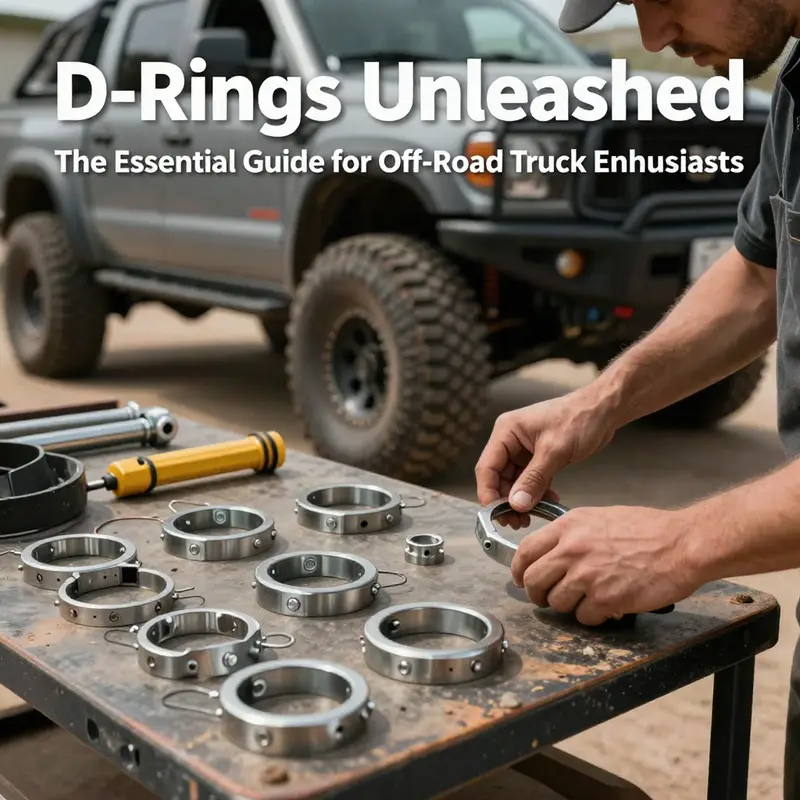
D-rings are essential anchors for off-road recoveries. They must withstand dynamic loads, corrosion, and mounting stresses. This chapter covers material grade, Working Load Limit (WLL), attachment methods, corrosion protection, and maintenance, so you can select a ring that stays strong under repeated recoveries.
Start with the material: forged high-strength alloy steels such as Grade 80 or Grade 100 offer better fatigue resistance than mild steel. Then consider WLL: aim for at least 10,000 lb, with 12,000 lb giving a comfortable safety margin for most recovery setups. Next, choose an attachment method: weld-on rings often provide stronger, more permanent mounting than bolt-on rings, but require proper installation. Location and alignment matter to avoid sharp edge loading.
Corrosion resistance is crucial; look for zinc plating, durable powder coatings, or stainless construction for harsh climates. Ensure the finish protects the underlying metal and that edges around the eye are smooth to minimize wear on straps.
Ensure standards and verification: look for SAE or ISO certifications and traceability. Documentation or third-party testing provides confidence in performance. Finally, maintenance: inspect for cracks, check mounting hardware, re-torque bolts, and test function before outings. A well-designed recovery point balances material strength, mounting integrity, and ongoing upkeep to deliver safe recoveries.
null
null
Strength, Steel, and Safe Recovery: Material Choices and Structural Design for D-Rings on Off-Road Trucks
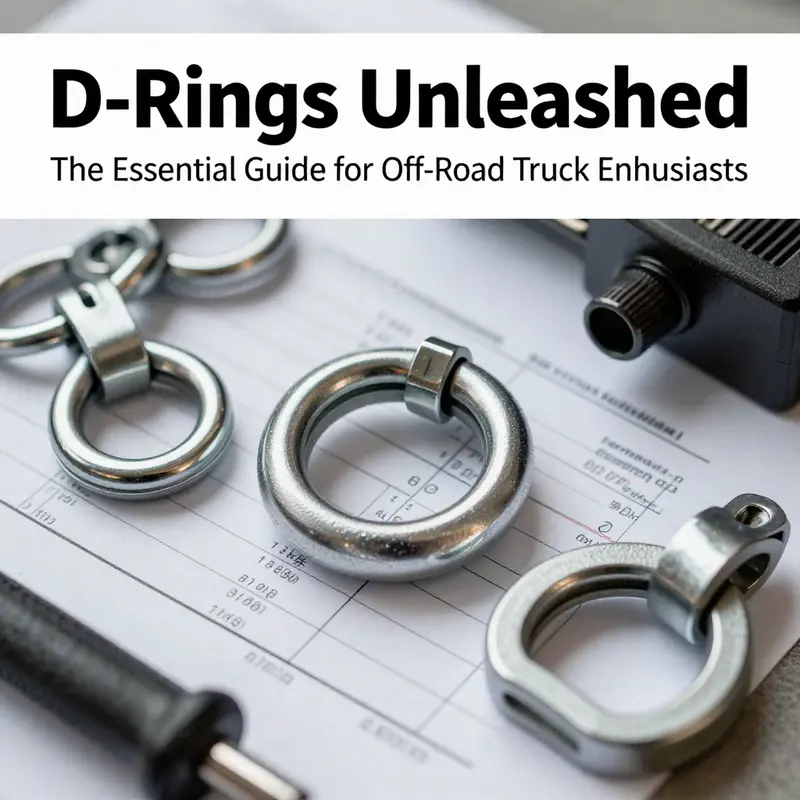
When you head into rough terrain, the right tools and their proper deployment are as essential as horsepower and traction. D-rings sit at the intersection of practical recovery work and vehicle integrity. They are not decorative add-ons but critical load-bearing anchors that must behave predictably when the terrain turns hostile. A well-chosen D-ring, properly mounted, and regularly inspected can turn a challenging pull into a controlled operation and prevent a recovery from turning into a dangerous failure. This chapter unfolds the material science and structural design behind those essential lugs, explaining why certain steel, forging processes, and mounting approaches matter so much in real-world off-road recovery.
At first glance, a D-ring is a simple device: a sturdy loop that provides a secure point for a recovery strap, a shackle, or a winch line. But the simplest view misses the core truth: the strength of the whole recovery system begins with the D-ring itself. In off-road environments, where loads spike suddenly, a D-ring must resist not only static weight but dynamic shock, bending moments, and repeated cycles of tension and release. The material and the way that material is formed create a baseline for safety that triggers every downstream decision—from where you mount it to how you inspect it, and even which accessories you pair with it for grip and stability on slippery surfaces.
Material choice sits at the front of that decision tree. In high-performance D-rings, drop-forged carbon steel is the standard bearer. Forging—especially hot forging—produces a dense, uniform microstructure. The grain structure of the metal is compressed and aligned, which translates into better resistance to fatigue and a higher ability to absorb impact without developing microcracks that could propagate under load. The result is a component that maintains its shape under load rather than yielding, bending, or cracking at the worst possible moment. When you consider the rough, often uneven contact between a D-ring and a recovery strap or winch line, the material must withstand not only axial force but local stress concentrations that can arise at the radius where the loop meets the deck plate.
Another crucial factor is the nominal cross-section. A commonly used size is a half-inch (½”) ring, because it provides a robust balance between strength, weight, and compatibility with commonly available shackles and straps. Real-world testing indicates that properly rated half-inch D-ring shackles are capable of handling the strenuous demands of off-road recovery scenarios, including the surge of tension as the vehicle begins to move or a strap becomes taut after a dig-out. The combination of a substantial cross-section and high-tensile material yields a device that can function as a reliable anchor under dynamic loading, where the force vector may shift as the recovery progresses.
To quantify the baseline strength, industry standards come into play. D-rings used in serious off-road work are designed to meet recognized specifications that translate into provable performance. A common benchmark is a minimum tensile strength in the vicinity of 75,000 psi, associated with standards such as ASTM A668, Class D. This specification is more than an arbitrary number; it reflects a level of material performance that ensures the ring maintains its integrity when subjected to the pulling force of winching, the shock of a sudden release, or the sustained load of pulling a heavy vehicle out of mud or sand. Meeting or exceeding this tensile strength means the ring is capable of handling the load without cracking, deforming, or failing during the recovery process.
But material strength alone does not tell the whole story. The structural integrity of the D-ring is enhanced by the design details that keep the component from deforming under load. Engineering practice often includes local stiffeners in the deck plate. A deck plate reinforced with a thicker section—such as a 6 mm plate with reinforcement—helps distribute the load more evenly and prevents local buckling around the base of the ring. This is especially important when a recovery strap is loaded at an angle or when the line is pulled across uneven mounting surfaces. Such features do more than add rigidity; they preserve the alignment of the ring with the frame or bumper, which in turn maintains the safe angle and trajectory of the recovery gear during operation.
Corrosion resistance also factors heavily into the long-term performance of D-rings. The open, exposed mounting points on a vehicle subject to mud, water, salt, and abrasive debris require finishes that stand up to the elements. Powder coating and galvanizing are common protective finishes. Powder coating creates a tough, uniform protective layer that can resist chipping and surface wear, while galvanizing provides sacrificial corrosion protection that helps prevent rust from progressing beneath the surface. The choice of finish should be aligned with the operating environment. Vehicles that spend extended periods in coastal salt air, winter road salt, or muddy backcountry use will benefit from finishes with stronger corrosion resistance and a maintenance plan that includes occasional re-coating or inspection for coating wear.
Certification and standardization provide another layer of confidence. Reputable D-rings should meet recognized standards from established organizations. While the exact standard terminology can vary, the underlying expectation is clear: the ring has been tested for tensile strength, ductility, and reliability under load, and the product design has been reviewed for safety. For end users, this translates to a practical rule of thumb: buy a ring that is certified to a national or international standard and ensure the rated breaking strength aligns with the loads you anticipate in recovery work. In off-road contexts, this often means seeking products that advertise a substantial breaking strength, commonly exceeding 10,000 pounds and ideally around 12,000 pounds for a broad range of vehicles and recovery scenarios. This tier of rating provides a buffer for unexpected loads, dynamic spikes, and the possibility of multiple simultaneous pulls when a vehicle is stuck and requires more than one recovery line.
Real-world performance data, drawn from field testing, reinforces these design choices. Properly rated half-inch D-ring assemblies have demonstrated resilience under the repeated stresses of arduous recovery work. They maintain their geometry, continue to engage with recovery straps or shackles without loosening or developing dangerous play, and resist deformation that would otherwise compromise the recovery geometry. When a ring remains true under load, it enables safer rigging: easier alignment of straps, cleaner engagement of shackles, and more predictable interaction with winches and vehicle anchors. In short, strength and rigidity are not merely about raw numbers; they translate into safer and more efficient recoveries in the moment they matter most.
Alongside the material and structural considerations, maintenance practices play a central role in preserving performance. Corrosion may not instantly erode strength, but it erodes margins and can lead to sudden failure if left unchecked. A routine maintenance cycle—visual inspections for cracks, deformation, loosening fasteners, coating wear, and signs of corrosion—helps catch issues early. If a D-ring shows any signs of cracking, significant corrosion, or deformation, it should be retired from service and replaced with a properly rated unit. The inspection cadence will depend on use, environment, and exposure, but a practical standard is to inspect before and after heavy recoveries and after any event that places unusual stress on the hardware.
The recovery system around the D-ring matters as well. Accessory pairing, including rugged mounts or tread plates that provide a non-slip interface between the D-ring and the vehicle’s surface, can enhance grip and restore stability during recovery operations. The aim is to ensure the load path remains clean and controlled, minimizing slippage and unintended angles that could lead to dangerous loads. In the context of an off-road vehicle used in muddy or rocky terrains, these considerations extend beyond the D-ring itself. A well-thought-out setup includes not just the ring but a compatible sheath for wear protection on straps, a robust mounting plate, and a mounting location chosen for accessibility and leverage during recovery.
In selecting a mounting strategy, the form factor of the vehicle and the planned recovery scenarios drive the decision. Bolt-on mounting options are straightforward and can be adequate for many setups, but they rely on the strength of the frame or bumper material and the precision of the installation. Weld-in options offer potentially higher resistance to loosening and can create a more rigid anchor point, but they require proper fabrication skills and a clean, sturdy mounting surface. Universal mounting kits, while flexible, may demand careful alignment to maintain the correct load path and to avoid interference with other components or with the body panels. The best choice depends on the vehicle’s design, the expected recovery loads, and the owner’s willingness to perform or commission proper fabrication and installation work. Regardless of the mounting approach, placing the D-ring in a location that maximizes recovery efficiency is key. Front bumper or frame rail positions are common because they provide straightforward alignment with the strap and a direct line toward the intended anchor point, which helps reduce angle-induced loads that can compromise the recovery.
As a practical takeaway, when you plan a recovery kit for your off-road truck, give equal attention to the D-ring, its mounting, and the path of the recovery line. The weakest link in the chain can quickly become the point of failure under load, so insist on a cohesive system where material strength, structural design, corrosion protection, and mounting integrity work in harmony. If you are exploring maintenance resources or deeper mechanical concepts, you may find value in resources that focus on practical truck mechanics and systems. For readers who want to deepen their practical understanding of truck maintenance, consider reviewing material in the diesel mechanics domain: mastering diesel mechanics: step-by-step.
The bigger picture is that D-rings are not stand-alone gadgets. They are a critical part of a robust recovery system that also relies on the vehicle’s chassis, the winch or retrieval gear, and the operator’s knowledge. Material science informs the baseline safety margin, while the design and finishing touches—like local stiffeners and protective coatings—keep that margin intact through years of exposure to the elements and heavy use. A thoughtful integration of these elements makes the difference between a recoverable situation and a dangerous one. In this way, the D-ring becomes a concise expression of effective off-road engineering: a simple loop that embodies a precise, engineered solution to a potentially complex problem, one that keeps you moving when the trail turns tough.
For readers seeking broader context about material grades and performance in rugged, real-world off-road applications, a comprehensive source on off-road vehicle materials and their performance characteristics provides useful insights. This external resource discusses how material grade selection translates into durability in demanding environments and ties into the principles described here regarding tensile strength, forging, and protective finishes. External resource: https://www.army-vehicles.com/off-road-truck-material-grades-performance
Guarding the Recovery Tie-Points: Corrosion-Resistant D-Rings and Care for Your Off-Road Rig
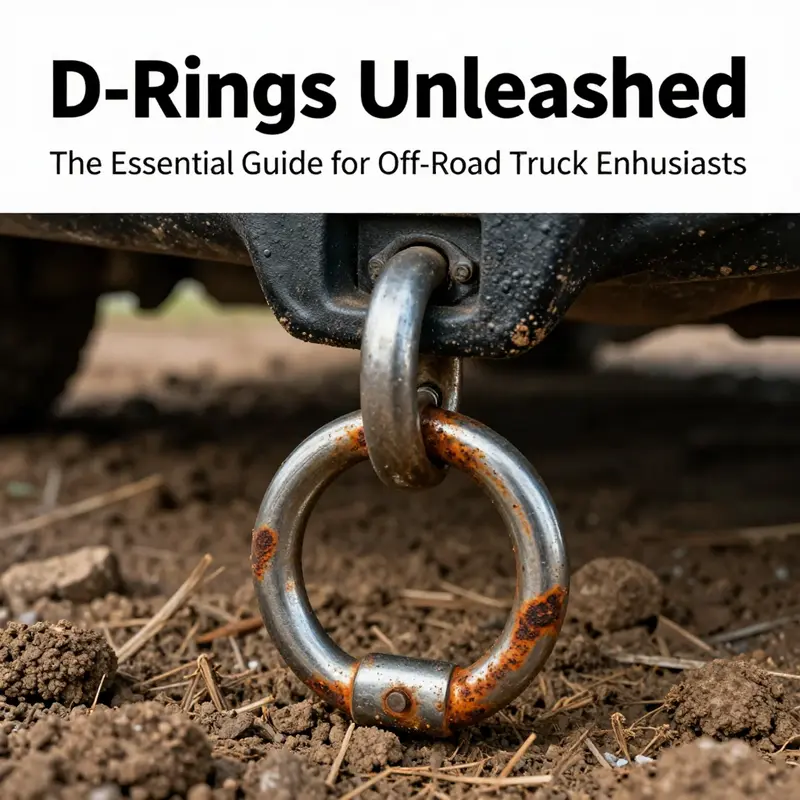
Recovery points are the anchor of every off road excursion, and the D rings you choose to carry that responsibility should be built to endure more than a single trail ride. They sit at the boundary between rugged capability and avoidable failure, facing mud, water, salt spray, dust, and the dramatic temperature swings that come with changing elevations and climates. In this chapter, we explore how corrosion resistance and disciplined maintenance transform D rings from a simple metal loop into a dependable safeguard that keeps your recovery operations efficient and safe, even when the trail throws its worst at you. The goal is not to chase the latest shiny finish, but to understand how material choice, protective coatings, and a practical care routine combine to deliver longevity and reliability in real off road conditions. By integrating corrosion resistance into both selection and upkeep, you protect the frame, preserve recovery efficiency, and reduce the risk of a stuck vehicle turning into a more serious salvage scenario.
When we talk about D rings for off road use, the first consideration is material and strength. D rings meant for recovery are subjected to high loads, impulsive forces, and potentially uneven loading as a vehicle digs through mud or sand. The most common choices are forged steel or high strength alloy versions, designed to withstand substantial breaking forces and repeated cycles without deforming. While a minimum breaking strength of around 10,000 pounds is often cited as a baseline, many off road setups aim higher—12,000 pounds or more—to accommodate heavier vehicles or more demanding recovery scenarios. Beyond raw strength, corrosion resistance becomes a practical, ongoing concern because the recovery point is almost always exposed to moisture, road salt, or mud that can trap grit and accelerate wear. D rings that combine strong, durable cores with protective finishes tend to survive longer and perform more predictably under load.
Corrosion is more than a cosmetic problem. It can erode the ring’s surface and create micro pits where stress concentrates. In severe cases, pitting weakens the ring enough to compromise recovery safety. To counter this, the materials themselves and their protective finishes matter deeply. Stainless steel is a strong ally here, particularly grades 304 and 316. Grade 316 stainless steel is favored in salty or coastal environments because it resists chloride induced corrosion that can attack other metals more aggressively. If the environment is less harsh but the vehicle may see repeated exposure to wet, muddy, or dusty conditions, 304 stainless offers solid corrosion resistance at a more cost effective level. For off road rigs that chase weight savings without sacrificing durability, aluminum alloys are also used. Aluminum is lighter and naturally resistant to corrosion, but it is essential to apply protective measures such as anodization to bolster wear resistance and prevent surface degradation under heavy loads. Anodization forms a protective oxide layer that protects the underlying metal from moisture and abrasion, extending service life where salt spray or muddy riding soils are part of the routine.
Coatings provide another practical layer of defense. PVC coatings or inner surface patches can dramatically slow the ingress of moisture and abrasion at the contact points where recovery straps and hooks repeatedly rub. These coatings help reduce friction and wear, especially in environments where grit or sand can grind away at bare metal during winching operations. When choosing coated D rings, look for coatings that are compatible with the mounting hardware and that can withstand repeated flexing and exposure to temperature swings without cracking or peeling. The coating’s adhesion matters as much as its thickness; a thick but poorly bonded coating may delaminate quickly, inviting corrosion beneath it. In some designs, welded patches on the inner surfaces create a sealed, blister free shield, further reducing corrosion pathways in the most exposed regions of the ring. Taken together, material selection and protective finishes form a comprehensive approach to corrosion resistance that pays dividends in reliability.
But material and coating choices are only part of the story. The real test comes in how you maintain those rings through their life on the trail. Regular, mindful maintenance is the quiet backbone of reliability. Start with routine cleaning after every outing, especially if you’ve plunged through mud or salt spray. Fresh water is usually sufficient to rinse away the loam, salt, and debris that can settle into crevices and under the protective finishes. A soft brush can help dislodge stubborn grit without marring the surface. After washing, dry the ring thoroughly to prevent water from lingering in corners where corrosion can take hold. If you live or ride in a coastal or winter climate where road salt is common, consider a more thorough rinse to neutralize salt residues that can corrode over time.
Inspection should become second nature. After cleaning, examine the ring and its mounting area for signs of pitting, cracking, or coating damage. Pitting often starts as small, barely noticeable specks but can propagate into deeper pockets if left unchecked. Cracking indicates a fatigue failure risk and must be treated as a safety fault. Coating damage is a telltale sign that moisture could have reached the metal beneath, increasing the potential for corrosion. It is not enough to note these issues; address them promptly. If pitting or cracking is detected, the ring should be removed from service and replaced. Similarly, coating damage should be repaired or the ring replaced if the coating no longer seals effectively.
Lubrication is another practical step, but it requires nuance. Some D rings are designed with moving parts or insertion points that benefit from a light application of appropriate lubricant to reduce wear during heavy loading. If lubrication is recommended for your specific ring design, use a product compatible with the coating and the metal. Avoid excessive grease in areas where it can trap dirt or impede the ring’s ability to shed debris that might accumulate during recovery operations. In many cases, keeping the ring dry and clean is the best preventive measure, and lubrication is reserved for moving components rather than the entire exterior surface.
Protective coatings are not permanent, and their endurance depends on how aggressively the environment challenges the ring. Depending on how often you tow through salt, mud, or water, you may find that the protective layer wears thin after a season or two. Reapplication of protective coatings is a straightforward maintenance task that pays back in reduced corrosion risk. When reapplying, follow the manufacturer’s instructions for surface preparation, curing times, and any substrate priming requirements. The goal is a uniform, adherent layer that seals the metal without trapping moisture beneath it. Even with robust coatings, the underlying metal should be inspected regularly and refreshed as needed. If you notice corrosion forming beneath a coating, the ring has likely exceeded its protective window and should be replaced.
From a broader vantage point, it is worth considering your D ring installation and the conditions around it. Mounting types fall into a few practical categories: bolt-on, weld-in, or universal mounting solutions. Each has its own maintenance considerations. Bolt-on rings may allow easier replacement, but the threads and mounting points still require inspection for corrosion and looseness. Weld-in rings are typically more robust and weatherproof, but the welds themselves can corrode if the coating fails or if moisture reaches the frame around the weld. Universal mounting systems offer flexibility but can introduce complexity in ensuring a watertight, structurally sound fit. In all cases, the mounting hardware and the surrounding frame should be cleaned and coated to prevent galvanic corrosion that can occur when different metals meet. A common, preventive practice is to select mounting hardware that matches the ring’s material and coating to avoid mixed-metal corrosion, especially in damp, salty, or dusty environments.
Certification and standardization matter as well. Relying on D rings that meet recognized standards from organizations such as SAE International or ISO adds a layer of safety assurance. Certification often implies that the ring has undergone specific tests for strength, durability, and reliability under foreseeable recovery scenarios. It is not simply a matter of choosing a heavy ring; it is about choosing a ring that has been assessed for performance under the real demands of off road recovery work. When you pair certification with corrosion resistance, you gain a recovery point that remains trustworthy year after year, through seasons of mud, sand, salt spray, and the unpredictable mud holes that test a vehicle and its recovery gear alike.
Maintenance cadence should reflect usage and climate. For a vehicle that regularly tackles wet, muddy, or salty trails, a quarterly inspection cycle paired with after-action cleaning is reasonable. In harsher environments or for expedition rigs, more frequent checks might be warranted, especially after long trips or downpours that leave moisture trapped in crevices. The key is to integrate D ring care into the routine maintenance rhythm of the vehicle rather than treating it as a separate, once-in-a-while check. A simple habit can be to inspect the ring and its mounting points after each off road run, clean it, reapply protective coating as needed, and document any changes observed over time. This living record helps you anticipate when a ring nears the end of its service life and reduces the chance of a failure during a critical recovery operation.
In practice, the combination of robust materials, protective finishes, and disciplined care transforms a D ring from a rugged hardware item into a durable, reliable recovery anchor. The benefits go beyond a single trail ride. When you use a corrosion-resistant D ring that has been maintained with consistent care, you reduce the risk of a failed recovery. You also preserve the frame and hitching points if a heavy pull needs to be made, and you minimize the chance of sudden stuck-situations that require last-minute improvisation. In short, corrosion resistance and maintenance are not add-ons; they are an essential part of responsible off road preparedness.
For readers seeking a pragmatic reference that goes beyond everyday maintenance and into material standards and industrial applications, a detailed guide on D ring specifications and standards offers a broader technical view. This resource complements the practical insights shared here by providing data on material properties, coating performance, and testing criteria that underpin safe recovery gear. It helps you read the signs of wear with a more informed eye and makes it easier to justify choosing higher-grade materials and protective finishes for your setup. Mastering diesel mechanics: a step-by-step path to success can be a useful companion for owners who want to deepen their understanding of maintenance fundamentals as part of a holistic approach to keeping recovery hardware in peak condition.
In sum, corrosion resistance is not just a feature; it is a practice. The right combination of forged steel or high-strength alloys with corrosion-resistant finishes, paired with a thoughtful maintenance routine, translates into safer recoveries, longer service life, and better overall performance on the trail. When you plan your D ring selection with an eye toward material, coating, and certification, and you commit to a regular, pragmatic maintenance schedule, you set your off road truck up for resilient, dependable recovery operations through the many miles and many trails ahead.
External resource for deeper standards and properties of D rings and related hardware can be found here: https://www.mesco.com/understanding-19mm-d-ring-complete-guide-to-standards-properties-and-industrial-applications/
Final thoughts
Choosing the right D-rings for your off-road truck is not just a matter of convenience, but an essential component of your vehicle’s recovery capability. From making informed choices about strength and materials to understanding the best mounting options, your preparedness can significantly enhance your off-road adventures. Regular maintenance and attention to corrosion resistance ensure your D-rings remain reliable companions in the face of challenges. As you gear up for your next journey into the wilderness, remember that the right D-ring can mean the difference between pulling through and being stuck. Equip yourself wisely, and let your adventures unfold with confidence.