
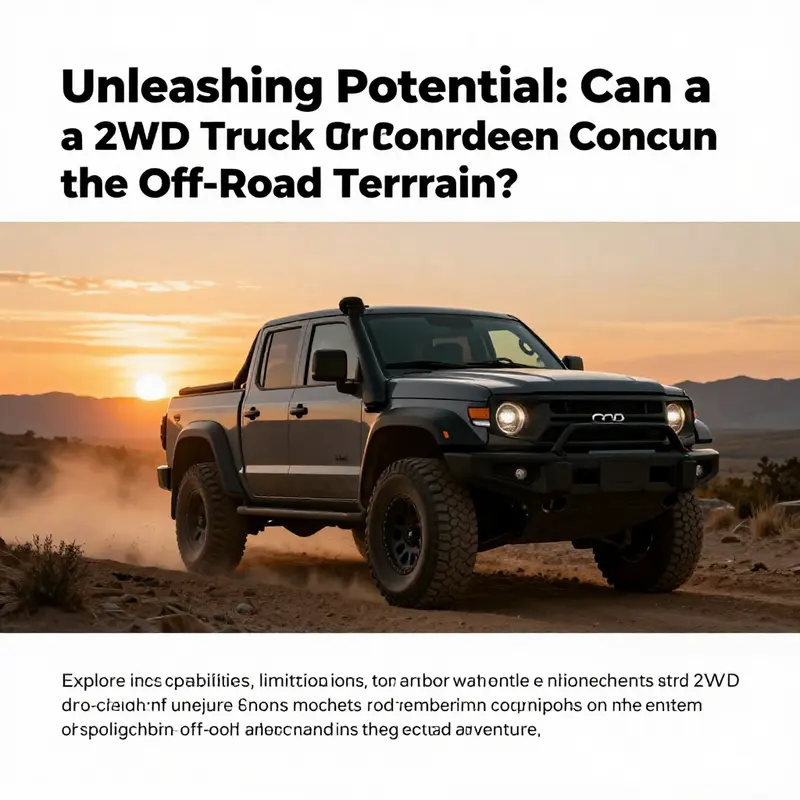
The allure of off-roading sparks excitement in many vehicle enthusiasts, but the question remains: Can a 2WD truck tackle the rugged terrains that many adventurers keenly seek? While most off-road aficionados revere the prowess of 4WD vehicles, 2WD trucks carve out a niche of their own, capable of traversing less demanding landscapes. Throughout this exploration, we will delve into the conditions where 2WD trucks shine, assess their limitations and challenges, identify critical modifications to enhance off-road performance, underline how driver skills influence off-road success, and share practical applications and real-world experiences that demonstrate how these vehicles operate beyond the highway. Each chapter draws us closer to a comprehensive understanding of whether a 2WD truck can truly become a reliable off-road companion.
Light-Tread Trails: How a 2WD Truck Can Tackle Gentle Off-Road Terrain
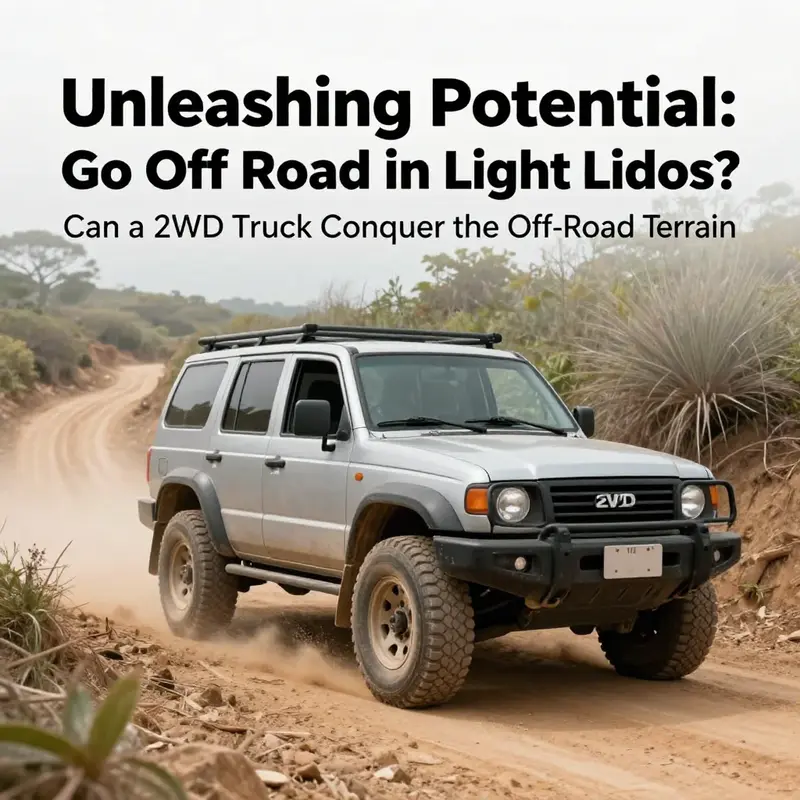
A two-wheel-drive truck can venture beyond paved lanes, but the realm it can safely navigate hinges on terrain that stays within what many drivers would call light off-road. For owners who use their trucks for work in rural zones, camping trips, or backcountry explorations on dirt roads and gravel paths, the call to explore is often irresistible. Yet the reality remains: a 2WD system, which typically drives only the rear wheels, has a built-in limitation when grip evaporates on loose, wet, or uneven surfaces. The front axle, unless it’s engaged in a four-wheel-drive configuration, does not contribute to propulsion. When the rear tires spin on mud, sand, or slick clay, there isn’t a cross-axle pull from the front to pull the vehicle forward. The result is a vehicle that moves with caution or stalls in conditions where a 4WD system would maintain momentum. This is not a verdict against 2WD; it is a clear map of the boundaries and the kinds of preparation that can help you stay within them while still enjoying light off-road adventures.
The operative term here is light. Light off-road means trails that are gently graded, with compacted dirt, gravel, or dust underfoot; it includes rutted two-tracks where the surface remains cohesive enough to hold a tire’s footprint; and it encompasses farm lanes and scenic backroads that become uneven when you roll through washouts or small ditches. In these environments, a 2WD pickup can perform well at modest speeds and with careful throttle control. The key is to balance momentum with traction. Too little speed and you risk getting bogged down in soft spots; too much throttle, especially when a wheel suddenly breaks traction, and you can simply spin the tire without moving forward. The driver’s ability to read the surface—feeling the texture of the dirt, noticing how it shifts with your weight, and adjusting steering to keep the wheels oriented toward stable ground—becomes as crucial as the mechanical setup of the truck itself.
Traction, not power, is the decisive factor in light off-road settings. In a 2WD configuration, the engine’s effort is concentrated on two contact patches rather than all four. This arrangement can still deliver predictable and controllable progress if the terrain offers a solid bite. However, when the surface is slippery—mud that clings to tire treads, wet grass that hides a hard base, or sand that sifts away beneath a tire—the likelihood of wheel spin rises quickly. Without the front wheels contributing to propulsion, the tendency is for the rear tires to slide laterally, losing the straight-line stability that helps you maintain direction on a grade or through a turn. In such moments, even a slight miscalculation can translate into bogging down or a gradual slide into a rut. The absence of four-wheel contact makes the difference between a controlled crawl and a stalled recovery.
What, then, elevates a 2WD’s capability in light off-road? Proper tire choice stands at the top of the list. All-terrain tires with reinforced sidewalls and tread patterns that mold to varying surfaces provide better grip than highway tires on dirt and loose gravel. Tire pressure plays a subtle but powerful role; slightly lowering pressure increases the contact patch and improves traction on soft ground—though the risk of bead slip, pinch flats, or a tire coming off the rim increases if you go too far. Ground clearance also matters. A modest lift or styling that increases the distance between the undercarriage and the surface reduces the chance of scraping over rocks or clumps of exposed earth. Suspension that remains composed over uneven ground helps the rear axle maintain alignment with the surface, which translates into steadier steering and more predictable tire contact. In many cases, the modifications are practical and economical: upgrading tires, ensuring adequate ground clearance, and preserving a robust suspension can markedly improve a truck’s performance without turning it into a full-on mud-destroyer. A note on upgrades is helpful here, because, while the baseline 2WD is simple, the addition of components designed for rugged terrain can tilt the odds in favor of success without abandoning the simplicity that makes 2WD attractive. The idea is not to turn a two-wheel drive into a conversion project, but to provide the two-wheel-drive platform with the tools it needs to grip when the going gets a little harder.
Technique matters almost as much as hardware. In light off-road, a careful, deliberate throttle and steady steering are your best allies. Start with a gentle approach; let the vehicle settle into the surface before applying additional power. If you feel the rear tires begin to slip, ease off briefly and re-establish a solid bite. Avoid abrupt gear changes or sudden accelerations that can excite wheel spin. For manual transmissions, selecting a lower gear can help you control torque and speed as you navigate over small rollers or through shallow ruts. For automatics, a steady throttle and consistent speed in the right gear—often a one-to-two downshift range when you confront a rise or a patch of soft ground—will keep you moving without carving out a deep rut. When you encounter obstacles, choose line choice wisely. The aim is to keep weight balanced over the drive wheels and to avoid turning the rear tires into a pivot that can sling you into a ditch. It may mean taking a longer, more circuitous route to a destination, but the reward is predictable motion and a lower risk of getting stuck.
Ground geometry plays a quieter but critical role. Vehicles with higher ground clearance reduce the chance of hang-ups on rocks or buried Ford-like humps in the path. Approach angles—the line where the bumper first engages a slope—matter because a high approach angle reduces the risk of bottoming out on a forward crest. Departure angles—the tail-end counterpart—help when you leave a trail and rejoin smoother terrain. In light off-road, staying within the vehicle’s available approach and departure angles is a discipline that pays off. The result is a smoother traversal across uneven patches without the sudden, jarring contact that can unsettle a vehicle and compromise traction. The more you understand the geometry of your truck in relation to the surface, the more confident you become in selecting an audacious but safe line through a patch of dirt or a shallow rut.
Preparation stretches beyond tires and geometry. A well-thought-out plan reduces risk and increases the odds of a successful outing. Before you head out, scan the route for potential hazards—water crossings, soft shoulders, or long stretches of loose material that require a particular technique. Check the weather and recent conditions; rain can transform a dry trail into a mud slip-and-slide in a heartbeat. Carrying essential recovery gear—traction aids, a shovel, and a way to secure a winch-like grip on rocks—can be the difference between a simple misstep and a stranded situation. While not every light off-road excursion will require a formal recovery kit, being prepared fosters a calm approach in the field and helps you approach the day with a clearer sense of limits and possibilities. In this regard, a steady maintenance regimen matters as much as any single piece of gear. A reliable vehicle, tuned and verified, performs better under stress, and that reliability is fostered by habit and discipline—an area where the practical wisdom of exploring and learning a mechanic’s craft pays dividends. In that spirit, even readers who are not ready to head into remote country can benefit from a mindset that blends cautious planning with hands-on maintenance. For a deeper dive into how to keep a drivetrain in prime shape and how to navigate the subtle art of diesel-system care, you can consult resources focused on diesel mechanics and preventative maintenance, such as the guide on mastering diesel mechanics—your step-by-step path to success.
Finally, the social and logistical reality of off-road travel matters. A 2WD setup excels when the terrain is forgiving, the weather is stable, and your route remains close to civilization. In those contexts, light off-road becomes a moderate extension of daily driving, not a leap into extreme terrain. The driver’s judgment remains the most decisive factor. You are not choosing a terrain basin where the four-wheel-drive advantage is essential; you are choosing to extend your access to rural areas and scenic backroads in a measured way. In this sense, a 2WD truck, when equipped with sensible tires, a modest suspension upgrade, and a disciplined driving approach, can offer enjoyable and safe experiences in light off-road environments. It is a testament to the idea that capability is not a binary attribute but a spectrum, where the right balance of equipment, technique, and planning allows a two-wheel-drive truck to traverse mild trails with confidence rather than hesitation.
External reference: for a concise comparison of 2WD vs 4WD off-road capabilities, see the discussion at https://www.cars.com/ask-the-experts/2wd-vs-4wd-off-road-capabilities/.
Internal reference: those who want to explore the maintenance and mechanical preparation side more deeply can consult the guide on mastering diesel mechanics—your step-by-step path to success, available at https://dirtantrucks.com/mastering-diesel-mechanics-your-step-by-step-path-to-success/ for practical, field-ready insights that support lighter off-road use without turning the vehicle into a specialist rig.
Off-Road Realities for a 2WD Truck: Navigating Limitations and Challenges
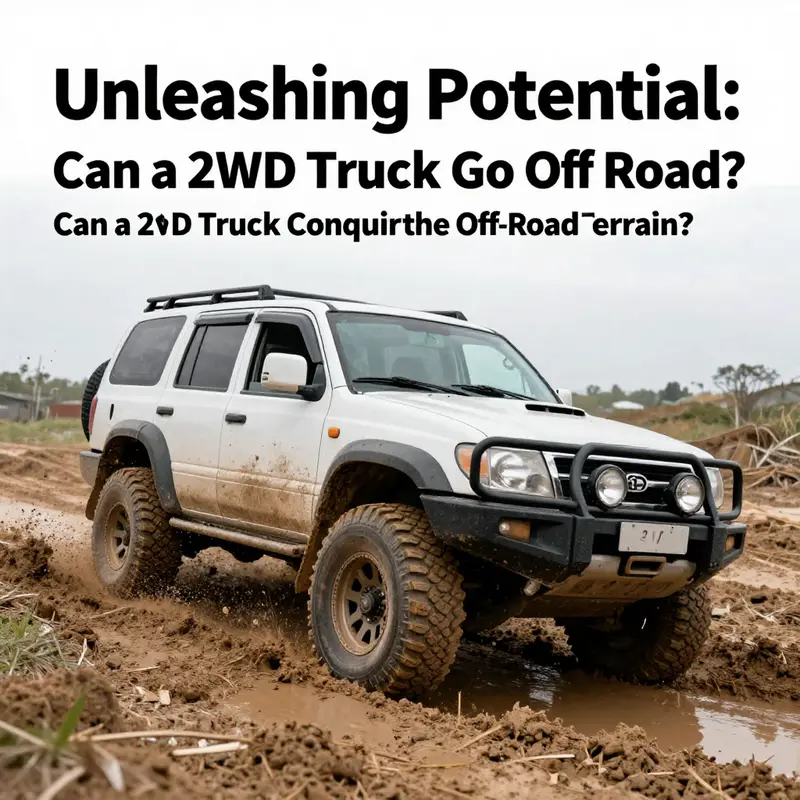
A two-wheel-drive truck can survive off-road conditions, but only up to a point. The key difference between 2WD and four-wheel drive is traction. With 2WD, power reaches only two wheels, which makes grip a decisive, often fragile ingredient. On paved roads, that setup works well and can be economical. On rough trails, it becomes a liability. The vehicle must learn to contend with surfaces that constantly threaten to slip away beneath the driven wheels. The challenge compounds when the terrain alternates between grass, mud, gravel, and sand. The margin for error narrows quickly, and a moment of wheel spin can transform a simple crossing into a difficult extraction. Yet many drivers still enjoy light to moderate off-road adventures in 2WD trucks, provided they choose their routes carefully and stay mindful of limits.
The heart of the matter is traction. In a front- or rear-powered setup, only the powered axle has to pull the truck forward. If that axle loses grip, the other wheels offer little help. Front-wheel drive can struggle on loose surfaces when the back wheels spin, while rear-wheel drive can stall on slick mud if the front tires cannot grab. This is why the most consistent advice for 2WD off-roading emphasizes conservative routes, lower speeds, and deliberate inputs. Slippage is not just a momentary annoyance; it can stall momentum and invite a stuck situation that becomes increasingly difficult to escape. The decision to venture off-road hinges on recognizing that grip is the limiting resource, not simply engine power or tire size.
Tire choice matters as much as engine torque. A 2WD truck benefits from tires designed for traction on mixed surfaces. For light trails, a robust all-terrain tire can improve bite on dirt and gravel. In mud or sand, tread patterns that evacuate clingy material help, but no tire can create grip where there is none. Pressure management can also influence performance. Slightly lower pressures can increase the contact patch and improve grip on soft ground, but they raise the risk of bead compromises and sidewall punctures on sharp rocks. The driver must balance ride quality, fuel economy, and the likelihood of getting through a challenging section without turning the trip into a mechanical pit stop.
Ground clearance and approach angles receive far more attention in off-road contexts when the vehicle is not spreading power to all four wheels. A modest lift or chunky tires might help the truck clear rocks or ruts. However, increasing clearance does not magically restore traction. A 2WD truck with lift blocks and bigger tires can step over small obstacles, but it still relies on the same two driven wheels for propulsion. The improved clearance mainly reduces body damage risk and helps the vehicle traverse uneven terrain with less suspension contact.- but it does not compensate for a lack of grip at the wheels. As a result, drivers should assess the terrain not only for how high they can go, but for how well the vehicle can maintain forward momentum once it commits to a line.
Moderate gains can be achieved through thoughtful upgrades. A lift that raises the body or a leveling kit can provide extra room for larger tires, sometimes up to about 33 inches with a small body lift. These modifications can enhance ability to roll over obstacles and reduce bottom-out episodes. Yet they do not improve traction at the driven axle, which remains the bottleneck on slick surfaces. In other words, you might clear a rock step more easily, but you still must avoid mud holes where the wheels would spin away your forward progress. For a driver, this distinction reshapes risk assessment: clearance helps with obstacles, traction determines whether you can escape a losing situation.
Some drivers explore more advanced features to mitigate 2WD shortcomings. Locking differentials, when available, can force both wheels on an axle to spin together, increasing the chance of moving out of a tight rut or mud pocket. Even with a locked differential, though, the vehicle still depends on the driven axle to provide grip. If one wheel sits on ice and the other on grip, that grip disparity can still stall forward motion. In practice, the effectiveness of such systems rests on the driver’s discipline and the terrain type. For a 2WD truck, these tools improve the odds but do not equal a true four-wheel-drive system designed to send torque to all four corners.
Beyond equipment, driver technique becomes the decisive factor. Smooth, progressive throttle inputs prevent sudden wheel spin, and controlled clutch or brake use can modulate momentum through tricky segments. In soft ground, momentum is a liability if the wheels simply churn. In compacted or rocky passages, committing to a careful line and using engine braking on descents protects the drivetrain and helps maintain control. Reading the terrain ahead remains vital. A chosen line that looks manageable on a map may reveal boggy patches or hidden ditches as soon as the tires touch the surface. Training and experience matter more for 2WD off-roading than for paved driving, because anticipation and restraint determine whether a setback becomes a recoverable moment or a long, tedious recovery.
Preparation is not glamorous, but it is essential. Before leaving the trailhead, secure every loose item inside the cabin and cargo bed. Shifting loads can destabilize handling, especially on uneven grades. A full bed or loose objects may bounce or slide, threatening overall balance and control. The same principle applies to gear stowed under seats or in corners of the cargo area. Safety guidelines emphasize preventing unexpected movement during jostling, as loose items can compromise both driver and passenger safety in a rough stretch. For the same reason, drivers should minimize free-floating accessories in the cab that could become projectiles in a sudden jolt.
Wheel wells and drivetrain clearances are part of the broader safety matrix. A well-maintained suspension and a drivetrain in good condition reduce the risk of a failure that could escalate a minor challenge into a roadside ordeal. Routine maintenance, including tire tread wear, brake performance, and fluid levels, should not be neglected in anticipation of a weekend adventure. Turning a routine trip into a mechanical ordeal is a needless risk that can spoil a day your truck and you could otherwise enjoy. Those who log off-road miles in 2WD setups tend to develop a habit of incremental risk assessment, choosing routes that match their vehicle’s limits and their own skill level. When in doubt, they turn back or seek a safer approach rather than pressing forward into terrain that clearly exceeds capability.
In the broader landscape of off-road travel, even careful planning cannot fully erase the limits of a 2WD system. The practical takeaway is clear: a 2WD truck can participate in light to moderate off-road experiences, but it is not a substitute for a purpose-built 4WD rig in challenging conditions. The appeal lies in the balance—an affordable, capable platform that can handle dirt roads and mild trails with the right tires and a cautious mindset. For those who love the outdoors and want to stretch the boundaries of what their vehicle can do, the journey involves learning where the line lies, what preparations tilt the odds toward success, and how to turn potential setbacks into safe, constructive adjustments.
For a practical look at preserving mechanical readiness and making informed decisions about off-road work, see Mastering Diesel Mechanics: Your Step-by-Step Path to Success. This resource underscores that the core of any off-road effort remains the integrity of the drivetrain and the reliability of essential components, even when the vehicle is only lightly equipped for rugged terrain. As you weigh routes and techniques, remember that the spirit of off-roading with a 2WD truck is stewardship: respect the terrain, respect the machine, and respect your own limits. In that spirit, a 2WD pickup can offer a gratifying taste of adventure without pretending to be more capable than it truly is. External resources and informed practice can help you navigate these boundaries with confidence and care. For further reading, an official guide on off-road driving provides perspectives on technique and safety that translate well to any 2WD setup. Official off-road guidance
Beyond Pavement: Unleashing Off-Road Potential in a 2WD Truck Through Key Upgrades
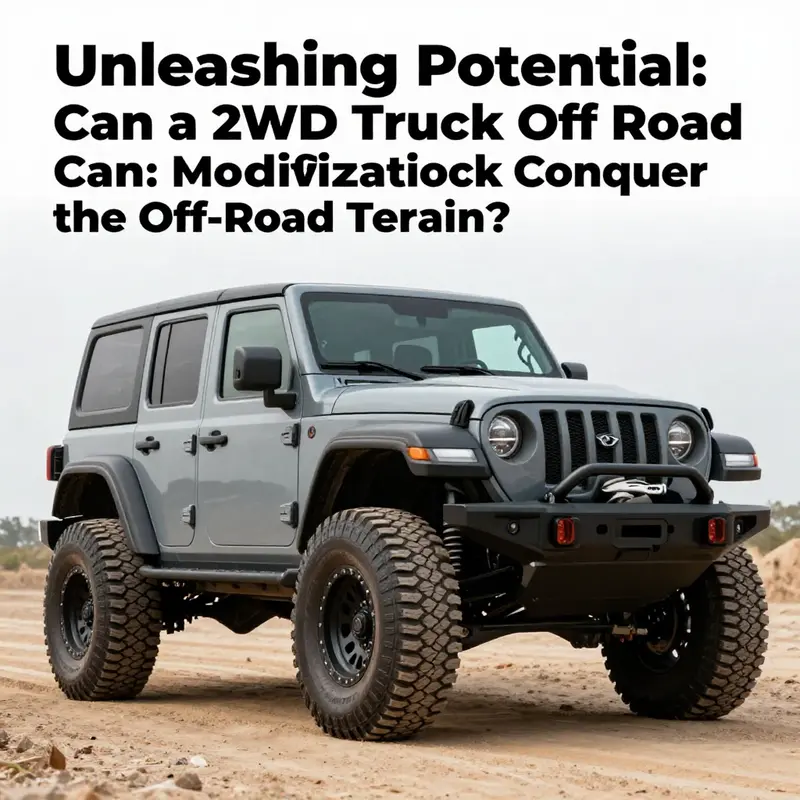
A two‑wheel drive truck is not a blank check for off‑road adventures, but it isn’t a lost cause either. The question—can a 2WD truck go off road?—has as much to do with intent as with capability. On a bright, dry dirt road or a mild backcountry trail, a 2WD can deliver a sense of exploration and satisfaction without the heavy price tag or complexity of a four‑wheel drive system. But as terrain grows rougher, traction becomes the adversary and momentum begins to feel less like a choice and more like a gamble. In this space, the physics of traction tell the story: when only one axle is actively driving, grip is a limited resource, and the front wheels, even with steering prowess, cannot contribute to propulsion the way a powered rear axle can when the surface under all four tires behaves inconsistently. The result is a truck that rides high on potential but must ride carefully on the edge of its limits. Yet there is a thoughtful path forward. With deliberate modifications and practiced technique, a 2WD truck can handle light to moderate cross‑country routes, sandy scrambles, rocky approaches, and thinning snow where the surface presents enough bite for a driven axle to work with the tires rather than against them. The key is understanding two facts: first, that upgrades can push a 2WD closer to its practical ceiling without transforming it into a 4WD, and second, that real off‑road success still hinges on driver judgment, route selection, and preparation. When you marry mechanical upgrades with prudent driving, a 2WD truck can become the versatile companion it was designed to be, even if it never quite achieves the all‑weather, all‑terrain versatility of a purpose‑built 4WD machine. This chapter traces the modifications that matter most, the reasoning behind them, and the way they interact with one another to produce safer, more capable off‑road performance, all while keeping the conversation grounded in the realities of a 2WD system.
The most dramatic gains arise from tires and ride height. Off‑road tires are not just larger; they are designed for contact with loose and unpredictable surfaces. An aggressive tread improves grip on sand, gravel, and mud, and the sidewalls are built to resist puncture when the trail turns rocky or rutted. Widespread experience shows that tires are the single most consequential upgrade for a 2WD’s off‑road capability. In addition to traction, the tire’s overall build pattern influences how quickly a vehicle can shed slip and regain forward momentum when the going gets slick. The choice of tire also shapes how the truck handles on the street, so the decision becomes a balance between the demands of off‑road work and everyday usability. A second major lever is height: a lift kit increases ground clearance, allowing larger tires and more room to absorb obstacles without scraping the undercarriage. There are two primary paths here. A body lift uses spacers to create extra space between the frame and body. It’s a cost‑effective, straightforward route that preserves factory suspension dynamics but does not improve wheel travel or articulation. A suspension lift, by contrast, modifies the suspension components to achieve greater lift and typically better articulation. It’s more expensive and complex, and it can alter on‑road handling, but it directly expands the truck’s ability to maintain tire contact with the ground over uneven terrain. When you pair better tires with a lift, you begin to close the performance gap between a well‑sorted 2WD and a capable 4WD, though the difference remains meaningful in the mud and on steep grades.
An underbody guard is a practical necessity once you start to explore rougher routes. Rocks, stumps, and sharp changes in grade can threaten the oil pan, transmission sump, and differential housings. A skid plate or underbody shield, welded or bolted securely to the chassis, makes a practical difference by absorbing impacts that would otherwise bend a pan or crack a casing. The protection afforded by a well‑designed guard is not just about keeping components intact; it also reduces the risk of a disastrous recovery scenario in remote locations. The installation requires measuring, alignment checks, and periodic inspection to ensure fasteners remain tight and protective panels stay in place after a few gnarly passages. In parallel, brakes and steering deserve attention because bigger tires impose additional load and stress. Upgrading brakes—whether through higher‑performance pads and rotors or a broader rotor surface—helps maintain predictable stopping power when the tires are heavier and the surface is loose. Steering components should be checked against the added side loads and greater leverage created by larger contact patches. Tie‑rod ends and steering knuckles benefit from sturdier joints and proper lubrication. These are not flashy upgrades, but they are fundamental to safe control when the surface refuses to cooperate.
Some off‑load enthusiasts consider a limited‑slip differential (LSD) as part of a 2WD upgrade. In a traditional 2WD setup, the rear axle is the drive source; an LSD can help by diverting torque to the wheel that has more grip if one rear wheel starts to slip. While not as transformative as four‑wheel drive, this adjustment helps reduce wheelspin and improves traction on mixed surfaces, especially when one wheel encounters a slick patch or a short rut. The reality is that adding an LSD to a 2WD truck is not a cure‑all; it complements the tire choice, lift strategy, and overall weight management. It contributes to more confident handling on moderate trails, but it does not conjure traction where there is essentially none. The combined effect of these modifications—tire tread, elevated ground clearance, protective underbody coverage, reinforced braking and steering, and possibly an LSD—creates a chassis that behaves more predictably on challenging terrain. It also asks more from the driver, who must read the surface, adjust speed, select lines, and maintain a steady rhythm rather than relying on an automatic, all‑terrain capability.
Technique matters as much as hardware. The driver’s approach to a rough section can determine whether the upgrades translate into forward momentum or a stuck moment. Deflating tires slightly can increase the contact patch on soft surfaces, improving traction, but it also reduces responsiveness and can lead to pinch flats if the tires are too soft or the rocks are sharp. A careful approach, selecting a line that minimizes abrupt throttle inputs, and using steady, moderate throttle and smooth steering inputs prevent wheel spin from turning into a core problem. Momentum is a double‑edged sword; you want enough, but not so much that you overshoot the obstacle or risk a loss of control on a slope. Tire placement becomes a kind of three‑dimensional calculus—one that involves the angle of approach, the surface profile, and the truck’s center of gravity with its added weight from upgrades. Recovery equipment—traction boards, a winch or winch‑ready recovery points, and a partner who can assist—should be part of the plan whenever you venture beyond familiar dirt roads. The goal is clear: expand capability while preserving the vehicle’s reliability and the driver’s confidence.
All of this sits within a realistic frame: a 2WD truck, even after modifications, cannot equal the reach and resilience of a true 4WD on the most demanding terrain. Mud, deep sand, steep ascents, or rocky, uneven paths can still overwhelm a 2WD’s limited traction distribution. The point of the modifications is not to erase that limitation but to redefine the boundary—allowing safer passage through lighter off‑road conditions, longer gravel paths, and moderate trails where careful technique and well‑chosen hardware can cooperate. This is a philosophy of capability, not a promise of perfection. For readers who want to extend their mechanical confidence beyond peering under a hood, a resource that translates some of these principles into practical, actionable steps can be valuable. Mastering Diesel Mechanics: Your Step‑by‑Step Path to Success offers fundamentals that complement these upgrades by reinforcing the reliability and predictability of the drivetrain when pushed toward rough surfaces. Mastering Diesel Mechanics: Your Step‑by‑Step Path to Success.
The conversation does not end with a single upgrade or a single ride over a simple grade. It remains a balancing act among weight, tires, protection, and the driver’s judgment. If the goal is to enjoy off‑roading on light to moderate terrain without buying a 4WD, you can achieve it through a thoughtful package: robust tires suited to the most likely surfaces, a lift suitable for your ground‑clearance needs, protective underbody coverage, and brakes and steering tuned to the new footprint you carry. Couple this with disciplined driving and prudent planning, and your 2WD becomes a dependable explorer rather than a reluctant bystander. When you compare the overall picture—the cost, the complexity, and the maintenance demands—to a factory 4WD system, the difference is clear. The 2WD route offers a practical, lower‑cost bridge to off‑road capability, with the caveat that the terrain and conditions will always dictate the upper limit of performance. In other words, you gain the ability to go off the beaten path, but you gain that ability within a clearly defined boundary. The boundary is not the absence of adventure; it is the deliberate choice to seek out terrain where a well‑prepared 2WD can thrive without overreaching.
External resource: https://www.4x4tough.com/chevy-silverado-1500-2wd-lift-kit-guide/
Can a 2WD Truck Go Off Road? The Precision of Driver Skill When Traction is Limited

Two-wheel drive trucks are designed with an on-road bias, trading rugged terrain capability for nimble handling, predictable steering, and efficient operation on pavement. Yet the question remains: can a 2WD truck venture off road, and if so, under what conditions do a driver’s skills make the difference between a cautious excursion and getting stuck in a wash or a ditch? The short answer is yes, a 2WD truck can go off road, but its success hinges on terrain, speed, and especially the driver’s finesse in reading the ground and modulating power and momentum. The deeper truth is that the drivetrain shape—two wheels receiving power instead of four—inevitably limits grip on uneven, loose, or slippery surfaces. A rear-drive setup, which dominates many 2WD configurations, pushes power to the rear axle while the front wheels merely steer. When traction is scarce, that split can become a liability: the rear tires spin, the vehicle yaws, and without front-wheel drive to help pull from the front, momentum often evaporates where it matters most. On a dirt road with a light gravel layer, a 2WD truck can maintain forward progress with steady throttle and patient steering. In such environments, the terrain offers enough bite for the tires to pinch through, and careful steering keeps the vehicle on a forgiving line. The moment you encounter slick clay, soft mud, deep sand, or a steep climb, the limits of two-wheel traction appear in sharp relief. In those moments, a single driven axle may not supply enough grip to prevent wheel spin, and the vehicle can lose forward progress even when the accelerator is pressed with intent. The dynamic is intuitive: with power delivered to only two wheels, the potential for grip becomes a race against the traction available at those contact patches. If one wheel begins to slip in mud or loose sand, there is little opportunity for the other wheels to compensate with opposing torque. A 2WD truck’s handling in such conditions is more about managing the probability of losing traction than exploiting any traction advantage of a four-wheel system. This is precisely why many drivers view 2WD off-road jaunts as feasible only in light to moderate conditions, where the ground remains within the vehicle’s comfort zone and the driver’s ability to manage momentum remains decisive. Yet the human factor—the driver’s skill—can tilt the odds toward a successful outing. Experience teaches when to pick a line that minimizes risk, how to read surface texture, and how to optimize weight transfer to squeeze the best possible contact patch from the tires. The vehicle’s weight distribution matters, and seasoned drivers learn to shift weight by adjusting payload, fuel load, and passenger placement to improve grip on uneven ground. In practice, that means choosing routes that favor firmer ground, avoiding ruts that trap tires, and favoring gradual ascents over abrupt climbs. Speed management becomes a tool, not a habit: a slow, controlled pace reduces wheel spin and gives the driver time to react to changing traction. In the moment of descent, careful braking technique—buried throttle early to keep the engine in a stable power band, followed by smooth, progressive braking—helps maintain momentum without overwhelming the tires. In such delicate balance, listening to the truck’s feedback matters more than any single rule. The tires themselves tell a story—the chirp of marginal grip, the melt-in traction as a wheel sinks slightly, the momentary surge as the tire finds a firmer patch. A skilled driver tunes into that narrative and uses it to negotiate obstacles with minimal tire slip and maximal steering control. It is here that the practice of weight distribution becomes practical. Shifting weight forward by adjusting how cargo sits in the bed, or by repositioning a lightweight load, can nudge a rear-driven chassis toward greater forward bite on slippery surfaces. The effect is subtle, but on a challenging surface it can be the difference between creeping through a soft patch and becoming immobilized. Gear selection also plays a role. In low-traction environments, the choice of gearing is less about raw speed and more about predictable power delivery. A lower gear can provide consistent torque without sudden surges that might spin a tire on a slick surface. The driver’s ability to anticipate terrain changes—recognizing the moment to downshift before a climb or to ease off the accelerator on a steep descent—transforms the truck from a follower of terrain to a partner that stays in control. Route planning emerges as a practical manifestation of skill. Rather than pressing straight ahead into the unknown, an experienced driver surveys the course, identifies potential trouble zones such as slick clay pockets, deep ruts, or rocky ledges, and chooses lines that minimize the risk of getting stuck. This proactive approach often involves choosing routes with firmer ground, avoiding high-center hazards, and staying out of terrain where a single wheel’s loss of traction could compromise the entire vehicle. Even with well-chosen lines, a 2WD truck’s limitations remain: without power to all four wheels, there is no inherent guarantee of equal traction across all contact patches. The front axle in a typical 2WD setup is responsible for steering rather than propulsion, and that separation between steering and drive becomes a fundamental constraint on off-road capability. Those who nonetheless embark on off-road ventures with a 2WD truck frequently adopt a conservative philosophy: stay within the vehicle’s light-to-moderate off-road envelope, respect the terrain, and treat the excursion as a controlled, skill-based exercise rather than a test of extremes. For drivers who want to deepen their understanding of the mechanical side, there is value in exploring drivetrain concepts and maintenance practices that can marginally improve performance and reliability. A practical step is to study how different components influence traction and stability, and to translate that knowledge into better in-field decisions. For readers seeking this deeper mechanical context, consider the resource titled Mastering Diesel Mechanics: Your Step-by-Step Path to Success, which offers grounded guidance on drivetrain fundamentals and how to interpret the behavior of heavy trucks under load and on varied surfaces. The interplay between driver technique and mechanical design is not a recipe for turning a 2WD into a 4WD; rather, it is an acknowledgment that human judgment can extend the practical envelope of what a 2WD system can accomplish on forgiving terrain. When these two elements—driver skill and terrain choice—align, a 2WD truck can make steady progress where a novice might choose to retreat. Yet the boundaries of safety, control, and predictability still sit squarely around the two-wheel drive constraint. The discussion also naturally points toward a broader set of considerations, including tire choice, ground clearance, and suspension tuning, which influence a truck’s off-road readiness even before the throttle is touched. While many drivers will upgrade tires to obtain better bite on loose surfaces and to improve sidewall stiffness against rocks, changing tire compounds does not erase the fundamental limitation of having traction delivered to only two wheels. Likewise, a modest suspension lift can clear obstacles and improve approach angles, but it does not impart the all-terrain versatility of a true four-wheel-drive system. These decisions—tire selection, lift height, and suspension tuning—are not substitutes for wheel power; they are complementary adjustments that can improve the likelihood of success in light off-road conditions and reduce the risk of damage on modest trails. The upshot is clear: a skilled driver can push a 2WD truck through mild off-road scenarios with careful planning, measured speed, and a respect for the vehicle’s mechanical limits. For more demanding terrain or unpredictable surfaces, the prudent choice remains a four-wheel-drive platform. In the end, the conversation circles back to the core question: can a 2WD truck go off road? The answer is yes, but with caveats. It is a journey defined by terrain, by the player behind the wheel, and by the willingness to acknowledge the vehicle’s constraints while maximizing every gram of traction and every fraction of a second of calm, deliberate control. External resource: https://www.sae.org/technical-papers/2023-01-0598
Beyond the Pavement: Real-World Off-Roading with a Two-Wheel-Drive Truck

A two-wheel-drive truck is rarely marketed as an off-road champion, yet in the right conditions and with the right technique, it can still tread beyond the city limits. The question isn’t simply whether a 2WD can go off road; it’s where it can go, how it handles the terrain, and what compromises the driver is willing to accept. The reality is nuanced. On paved roads, a 2WD truck shines with predictable handling, straightforward steering, and efficient power delivery. But once the asphalt ends, the same setup pulls its lips back and shows the edge of its design: traction is limited to either the rear or the front wheels, depending on the drivetrain configuration, and the other axle doesn’t lend a hand when grip is scarce. In this sense, the 2WD chassis becomes a study in balance—between capability, caution, and the driver’s skill.
Traction is the central constraint for any 2WD vehicle venturing off pavement. With power routed to a single axle, you’re banking on speed and steering to maximize contact patch and maintain momentum. When a wheel begins to slip on mud, loose gravel, or wet clay, the rest of the tires don’t automatically contribute to propulsion. The result can be spinning tires with little forward progress and, in the worst cases, a stall that requires outside help. This isn’t a flaw so much as a fundamental physics limitation. Four-wheel drive systems, by distributing torque to all four wheels, offer resilience in slippery surfaces that a 2WD simply can’t replicate. Even so, there are practical, safer paths for a capable 2WD to explore beyond the asphalt, provided expectations are aligned with the environment.
Light to moderate off-road scenarios are where the 2WD truck can truly perform. Dry dirt roads that crunch under the tire, well-packed gravel paths, and mild two-track trails are within reach when the driver chooses lines carefully and respects the edge of the traction circle. In these conditions, a 2WD truck benefits from two things: appropriate tires and a thoughtful setup. All-terrain tires, with their balanced tread patterns, can bite into irregular surfaces more confidently than street tires. The level of ground clearance matters here as well. A modest lift or a taller ride height helps the vehicle avoid scrapes and reduces the risk of getting hung up on rocks or ruts, while preserving the vehicle’s approach and departure angles. It’s worth noting that the upgrade is not a universal pass to aggressive off-roading; it’s a measured adjustment that reduces risk on light trails and improves the truck’s ability to roll over moderate terrain without getting stuck.
What makes or breaks a 2WD in off-road settings is technique as much as equipment. The driver’s approach to momentum, line choice, and tire pressure can transform an awkward situation into a controlled slog through a challenging patch. Keeping momentum on a loose surface prevents tire spin from turning a climb into a failure. This doesn’t mean reckless acceleration; rather, it’s about smooth throttle application and maintaining steady speed through the most uncertain parts of a trail. Tire pressure plays a starring role as well. A softer sidewall can increase the tire’s contact patch and grip on loose surfaces, but overdeflation risks bead slip or pinch flats, especially when rocks or hard obstacles appear. The balance is delicate: enough deflection to grip without exposing the wheel to sharp edges. In practice, many drivers find the sweet spot by reducing air pressure slightly in the morning when dirt is dry and firming back up as conditions change with the day, keeping heat buildup in check during longer climbs.
The discussion would be incomplete without addressing the gear and chassis modifications that can expand the 2WD’s off-road envelope. Upgraded tires are often the most accessible benefit, converting a pavement bias toward a more capable tread that can grip uneven terrain. A modest suspension lift can increase ground clearance and reduce the likelihood of undercarriage contact on uneven ground. The upgrade to improved ground clearance should be considered with the other factors in view; it’s not a cure-all, and it doesn’t change the fundamental distribution of power. In some cases, owners explore differential upgrades or locking differentials when available, acknowledging that, in truly slippery conditions, locking a differential on a 2WD can offer a limited but meaningful edge by enforcing equal wheel torque on the axle that powers the drive. It’s essential to recognize that these modifications come with trade-offs, including altered ride quality, potential handling quirks, and added maintenance considerations. The driver must understand their vehicle’s new behavior and adjust accordingly, especially when returning to mixed surfaces.
Beyond the mechanical and physical realities, the broader context matters. Some 2WD applications that land outside the realm of a casual weekend trip involve rural delivery routes, agricultural tasks, or access to remote trails where paved roads end and the path becomes a narrow, stubborn ribbon of dirt. In these settings, a 2WD truck can be a reliable workhorse if it remains within reasonable limits. The key is to recognize when the terrain shifts from accommodating to challenging and to have a plan for retreat or recovery. The reality for many operators is that 4WD is not a luxury but a practical safeguard. Yet there is value in understanding how a 2WD can be leveraged with prudence, especially when resources, time, or budget dictate staying with a rear- or front-driven platform while still performing essential off-road tasks that are not extreme.
An additional dimension that often enters the conversation is the emergence of electric micro-trucks and compact work vehicles. While the research highlights their growing role in urban mobility and efficiency, it also notes that these smaller, sometimes electric platforms are not designed for serious off-road use. Their weight distribution, battery placement, and power management emphasize efficiency and reliability on smooth surfaces, rather than conquering rugged trails. The practical takeaway is clear: electric mini-trucks are not a universal off-road solution, but they can be part of a broader fleet that includes purpose-built vehicles for tough terrain. This distinction underscores a broader theme in off-road work: the right tool for the job matters as much as the willingness to push the vehicle’s limits.
In practice, the distinction between a 2WD and a 4WD truck on rough surfaces often comes down to anticipation, judgment, and recovery readiness. Drivers who venture off-road in a 2WD should carry essential recovery gear, including traction aids, a high-quality tow rope or winch, a portable air compressor, and a basic recovery kit. These tools provide a buffer when the vehicle loses traction or finds itself stuck in acceptable but stubborn ground. Equally important is a plan for risk management: assessing weather patterns, foreseeing ground conditions after rainfall, and recognizing when the terrain has surged beyond the truck’s safe operating envelope. A 2WD driver who respects these boundaries can complete lighter off-road tasks with confidence, while recognizing the moment to call for help if the surface presents a truly challenging obstacle.
Ultimately, the core question remains: can a 2WD truck go off road? The answer is yes, but with careful boundaries. For light, dry, firm surfaces and moderate trials, a 2WD setup, enhanced by thoughtful tires, measured modifications, and disciplined driving, can perform adequately. For anything more demanding—deep mud, loose sand, or steep, treacherous climbs—4WD becomes a meaningful advantage. The chapter’s aim is not to promote an overreach but to illuminate the practical horizons where a two-wheel-drive truck can operate effectively, responsibly, and with an eye toward long-term durability. The negotiation between capability and caution is ongoing, and it is exactly this negotiation that defines the practical use of a 2WD vehicle when the road ends and the track begins.
Final thoughts
In examining the capabilities of 2WD trucks in off-road scenarios, it is clear that while these vehicles can indeed venture into light and moderate terrains, their performance is inherently limited versus their 4WD counterparts. From navigating light trails to recognizing the necessity of modifications for enhanced capabilities, the journey of off-roading with a 2WD truck requires not only the right adjustments but also an experienced and skilled driver behind the wheel. Whether you are an adventurer seeking thrills, a rural landowner needing practicality, or a racing participant looking for that competitive edge, understanding how to best utilize a 2WD truck while off-roading enables you to experience the thrill of the wild responsibly and effectively.