

For off-road enthusiasts and agricultural landowners, the allure of off-road diesel is palpable. This fuel promises enhanced performance for off-road adventures and agricultural machinery. However, the question lingers: can it be safely stored in your pickup truck? This article probes into the complex legal implications, safety concerns, potential penalties, and acceptable usage. From understanding legal frameworks that govern hazardous materials to examining how off-road diesel interacts with vehicle components, we illuminate this subject thoroughly. Each chapter sheds light on these intertwined issues, arming you with vital information about off-road diesel in pickup trucks.
Red Dye on the Road: Navigating the Legal and Safety Pitfalls of Off-Road Diesel in a Pickup

A practical question often surfaces in farms, job sites, and rural settings: can you run off-road diesel in a pickup truck that you drive on public roads? The instinct to save money by using a cheaper, tax-advantaged fuel is understandable, but the legal and safety landscape around dyed or off-road diesel is complex and unforgiving. For most readers, the short answer is: no, not reliably, not legally, and not without risking serious consequences. The longer answer is worth understanding in depth, because the consequences extend beyond a single traffic stop or a small fine. They reach into the realm of regulations, taxes, and potential damage to the vehicle and those around it. In practice, off-road diesel—also known as red-dyed diesel or kerosene in some regions—carries a purpose-specific designation. It is taxed at a lower rate because its intended use is outside highway travel. It powers farm equipment, construction machinery, and certain non-road generators and machines. When that same fuel is put into a pickup or any vehicle registered for highway use, the entire framework around tax compliance and road-safety compliance gets triggered, often with severe penalties for noncompliance.
To frame the issue clearly, think of dyed diesel as a fuel that signals a tax and regulatory status difference. The dye is not just a cosmetic marker; it is a regulatory cue. In many jurisdictions, law enforcement and tax authorities routinely check for the dye as part of roadside inspections. A bottle of red dye in a tank is not merely a curiosity; it is evidence that the vehicle is using fuel designated for non-highway purposes in a vehicle that travels on public roads. And that evidence matters. It is not simply a matter of a ledger entry or a receipt; it is a signal to authorities that the vehicle may be evading fuel taxes and sidestepping the rules that govern hazardous materials transport and safe fuel handling on the road.
The federal dimension is explicit in many countries: using dyed diesel in a highway vehicle is illegal. In the United States, the Internal Revenue Service has clear guidelines that regulate where red-dyed diesel can be used and how it should be accounted for. The penalties are substantial and can escalate with the amount of fuel involved and whether it is a repeat offense. The commonly cited framework describes fines that can run into the tens of thousands of dollars per violation, and the total tax breach can compound with interest and back taxes. In practice, roadside inspections can lead to the impoundment of a vehicle, the assessment of back taxes, and the requirement to settle those accounts before the vehicle can be released. While the exact numbers can vary by jurisdiction and the specifics of the case, the trajectory is consistent: the legal and financial stakes are high enough that contested usage rarely pays off.
States augment the federal picture with their own enforcement tools. Roadside checks are not a rare curiosity; they are a working part of tax compliance programs in many regions. The presence of dye in the fuel system, coupled with a vehicle registered for highway use, becomes strong evidence of misuse. In some instances, individuals have faced criminal charges when their patterns revealed systematic attempts to avoid paying fuel taxes across multiple trips or jobs. Even if a vehicle is used primarily off-road—for farming or ranching, for example—driving it on public roads, even briefly, can trigger consequences. Some states provide narrow exceptions, but those exceptions come with strict conditions, documentation requirements, and limits that many owners will find impractical for everyday use.
From a safety perspective, the justification for avoiding off-road diesel is clear as well. Diesel fuel, in any form, carries flammability risks. The fumes are combustible, and leaks can create a potent fire hazard, particularly in hot weather or in vehicles with aging seals and hoses. Static electricity, a spark from electrical components, or a hot engine can ignite vapors if a leak is present. The danger is magnified when diesel is stored or transported in improvised containers or in spaces not designed to be fuel-safe. The risk isn’t limited to the moment of a leak; prolonged exposure can degrade rubber and plastic components in a truck’s fuel system, potentially leading to leaks, fuel odors, and compromised performance. Even if a person is careful, the combination of heat, pressure, and motive force in a vehicle creates scenarios where a small fault can escalate quickly.
Beyond the immediate hazards, there is a durability concern for the vehicle itself. Diesel stored in nonapproved containers or stored for extended periods inside a pickup bed or cabin can cause material degradation. Seals, hoses, and gaskets are built to handle specific fuels and specific chemical compositions. Off-road diesel, sometimes formulated differently, can interact with the materials in a vehicle’s fuel system in ways that a standard highway diesel does not. The result can range from softening of gaskets to cracks in hoses, and in worst-case scenarios, leaks that are both dangerous and costly to repair. The vehicle’s resale value can also be affected by any documented fuel misusage, particularly if authorities find evidence of improper use of off-road fuel.
The legal framework and the safety considerations are not theoretical. They create practical boundaries for anyone who owns or operates a pickup that they expect to see on public roads. There are legitimate reasons some operators consider off-road diesel: cost savings, availability in certain locations, or a distance between job sites that minimizes the amount of highway driving. Even so, the rules require careful navigation. The safer and more straightforward path is to use the on-road, taxed diesel that corresponds to the vehicle’s highway registration. If a truck is intended exclusively for off-road use, then it should be properly titled and registered for off-road work and not driven on public highways. That separation—between on-road and off-road use—helps avoid inadvertently crossing into illegal territory and minimizes the risk of safety incidents arising from improper fuel handling.
For those who must work in environments requiring off-road diesel, proper planning is essential. Secure, approved containers should be used if any fuel is stored or transported on-site, and those containers must comply with local regulations. The key is to avoid the appearance of impropriety: a pickup traveling with unapproved fuel, or a small quantity stored in an improvised container within the bed, can still raise red flags during inspections. Documentation that verifies the fuel’s intended off-road use can sometimes help, but it does not automatically shield a vehicle from penalties if it is operated on public roads. In many jurisdictions, the act of transporting a load of dyed fuel in a pickup, even for a perceived legitimate purpose, is not simply discouraged; it is prohibited unless one meets very stringent conditions and follows the correct permitting pathways. These pathways are rarely practical for most everyday scenarios, especially for personal use or small-scale operations.
What does this mean for the average pickup owner who wants to avoid penalties while still meeting legitimate needs on job sites or farms? It means a careful, practical approach: avoid using dyed diesel in any vehicle that will operate on public roads. If the vehicle is used only off-road, ensure it is not registered for highway use, and comply with all local restrictions about off-road vehicles. If any highway travel is anticipated, switch to untaxed, road-legal diesel. The moment a vehicle that is registered for on-road use is fueled with dyed diesel, the risk landscape shifts dramatically toward potential fines, impoundment, and additional tax liabilities. The consequences extend beyond money: a roadside stop can become a time-consuming disruption, a potential safety incident, and a reminder that fuel choices are not merely about price but about compliance and responsibility.
For readers seeking to deepen their understanding of diesel systems and how fuel choices interact with engine design and maintenance, there is value in seeing how diesel-grade knowledge translates into practical decisions. A resource that delves into diesel mechanics and the fundamentals of fuel systems can be a helpful companion to this discussion. It offers a structured path to understanding how fuel properties influence performance, durability, and safety in real-world applications. Mastering Diesel Mechanics: Your Step-by-Step Path to Success provides a foundation for approaching fuel-related decisions with technical insight, while keeping in mind the regulatory constraints described here.
In all of this, the overarching guidance remains consistent and straightforward: prioritize legality, safety, and vehicle integrity. Use properly taxed, road-ready fuel for any vehicle that will travel on public roads. If your operation is strictly off-road, make sure your vehicle is appropriately classified and documented for off-road use, and avoid road travel with fuel that does not meet road-use specifications. When in doubt, consult local authorities—ranging from the state revenue department to the department of motor vehicles—to verify how dyed diesel and related rules are enforced in your area. Keeping fuel use aligned with the rules not only protects you from penalties, but also reduces the risk of a fuel-related incident that could threaten your safety or the safety of others on the road.
External reference for regulatory detail: https://irs.gov/businesses/small-businesses-self-employed/use-of-dyed-diesel-fuel
Rethinking Fuel in Motion: The Real Costs and Risks of Storing Off-Road Diesel in a Pickup
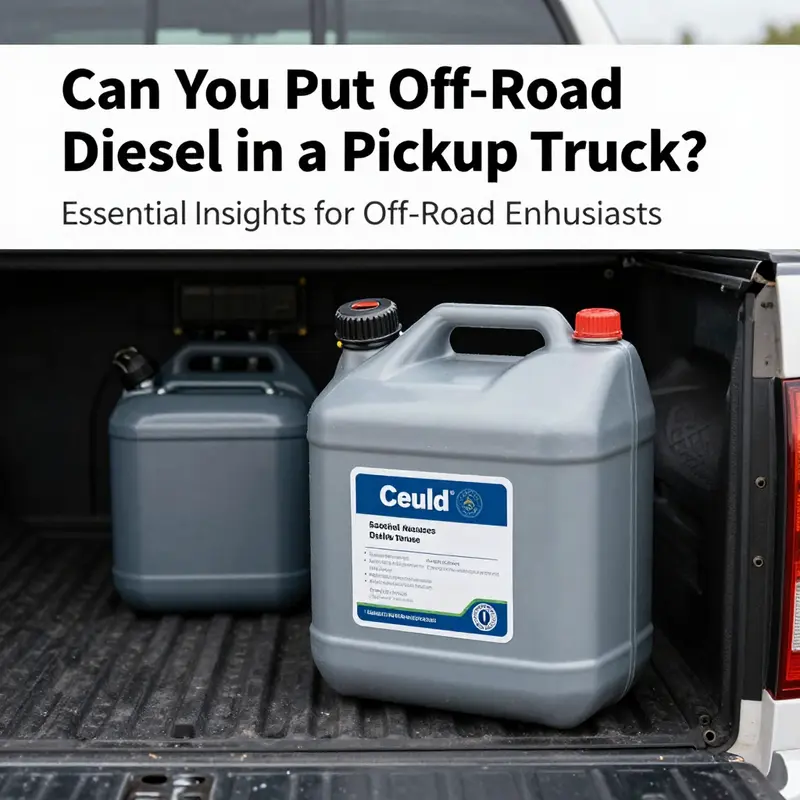
Storing off-road diesel in a pickup may seem like a practical hedge against running out on a remote job site or during long overland drives. Yet the impulse to stash extra fuel in a pickup bed or within a modified fuel system runs headlong into a web of safety hazards, regulatory constraints, and long-term costs that tend to be overlooked in the moment of convenience. The broader discussion around whether you can or should transport diesel in a standard pickup is often framed in legal terms, but the consequences touch fire safety, environmental stewardship, and the mechanical integrity of the vehicle itself. In this context, the core message is clear: while rugged pickups are built to handle tough terrain and demanding tasks, they are not inherently suited or permitted for storing or moving large quantities of diesel fuel outside approved channels. Treating diesel as a benign add-on invites avoidable danger and legal exposure that can eclipse any short-term savings or convenience.
At the heart of the matter lies the classification of diesel fuel as a hazardous material under transportation regulations. This designation is not a formality; it reflects the real risks posed by flammable liquids. Transporting hazardous goods typically requires a vehicle designed and licensed for dangerous goods transport, along with the appropriate permits and safety certifications. A stock pickup, even a heavy-duty variant designed for off-road work, does not meet those requirements. The implications are not academic. If caught moving significant amounts of diesel in a pickup, penalties can be steep—often described in ranges that reach tens of thousands of dollars, and in some cases can climb much higher depending on jurisdiction and circumstances. These penalties reflect both the potential for loss of life in a fire or explosion and the broader environmental and public-safety costs of improper handling.
Beyond legality, the safety case against storing extra diesel in a pickup is rooted in the very physics of fuel and heat. Diesel is more than a liquid in a tank; it releases vapors and can ignite from a spark, a static discharge, or even a hot engine component. When diesel is stored in or on a vehicle, the risks compound. A spark from an electrical fault near the fuel container, the heat absorbed from sunlight on a metal or plastic surface, or a puncture from road debris can all become ignition sources. In high-heat environments or enclosed spaces such as a garage, the threat is magnified. The visual cue is simple: the more fuel you carry and the longer it remains in a non-secure or non-ventilated space, the greater the chance of a dangerous ignition event. The image of a well-ventilated, properly secured container in the truck bed seems straightforward, but the reality is that any external tank, bladder, or larger-than-usual quantity stored in a pickup bed operates in a constrained and variable environment. The temperature swings, exposure to sunlight, and the movement of the vehicle all introduce dynamic stresses that can lead to leaks or failure of seals and hoses in fuel systems not designed for such use.
Leakage and spillage represent another essential risk vector. A container, whether a jerry can, a bespoke external tank, or a modified internal fuel system, is always vulnerable to puncture, seam failure, or gasket degradation. Spilled diesel creates a hazardous puddle on the ground that can ignite, and its environmental footprint can extend to soil and water sources. The durability of materials—steel, aluminum, polymers—matters, but no material is immune to the stresses of vehicle movement, vibration, and long-term exposure to heat and fuel. A small leak may seem inconsequential, but it can quickly become a dangerous, spreading slick that endangers the driver, nearby bystanders, wildlife, and the environment. The combination of a leak with an ignition source, such as a hot exhaust, a friction-generated spark, or a static discharge when fueling or handling containers, is the classic scenario for a devastating fire.
Pressure buildup is another practical hazard many underestimate. Heat from direct sun, particularly in warmer climates or during summer, can raise the internal pressure inside a sealed container. In a confined space, this pressure can cause valve failure or even rupture. What begins as a precautionary measure to carry more fuel can devolve into a situation where the container itself becomes a liability, forcing emergency measures, evacuations, or worse. Even trucks touted for extreme weather performance are not battle-tested for the conditions of sealed diesel storage in a closed or semi-closed space within a vehicle. The emphasis should be on the interplay between heat, pressure, and the integrity of the container system, not on the nominal capacity of the tank.
Vehicle modifications to accommodate extra diesel bring their own set of complications. Adding a large external tank, bladder, or an aftermarket fuel system changes the vehicle’s weight distribution, braking dynamics, and suspension loading. The alterations can degrade handling, increase rollover risk under off-road conditions, and alter fuel-system pressures in unpredictable ways. The structural integrity of the bed and frame can be compromised, introducing points of failure that were not designed by the manufacturer. Warranties can be voided when such modifications are undertaken, creating a longer-term cost that can dwarf any perceived short-term advantage. And because the modification often involves penetrations, fittings, and seals, the likelihood of leaks or accidental releases grows with each mile driven. In short, the everyday realities of off-road usage—rocking, bouncing, mud, and vibrational stress—become the poor guardians of a system not originally designed for extended fuel storage.
Regulatory compliance threads through all of these concerns. In many places, the act of transporting or storing large quantities of fuel in a vehicle without the proper permits, safety certifications, or vehicle designations can be illegal. The practice also intersects with the use of dyed off-road diesel or similar fuels, which are taxed differently and may be allocated for specific uses that do not include on-road driving. The consequences are more than fines; they can include enforcement actions, vehicle impoundment, and legal proceedings that complicate fleet operations, insurance, and personal safety. When viewed through this lens, the “workaround” approach of carrying extra diesel in a pickup moves from a practical nuisance to a decision with real, lasting consequences for individuals and communities alike.
There is, however, a narrow and tightly constrained exception that some people latch onto. For agricultural purposes, there may be allowances for storing small quantities in a properly secured, approved container within the truck bed, and only when the total amount remains for immediate use. Even then, the arrangement is fraught with risk and depends on strict adherence to local laws and regulatory interpretations. It is not a blanket permission and should not be treated as a loophole to bypass permitting or safety requirements. If there is any doubt about the legality of such storage, the safer course is to refrain from carrying extra fuel, or to switch to a purpose-built solution that complies with the applicable rules. In all cases, safety and legality must be the guiding principles, not convenience or cost-saving calculations.
To those who want a practical qualifier for how to think about diesel in vehicles, a simple guideline can help: if the fuel is intended for use in public roads or requires active transport through general traffic, it belongs in a properly certified container and a vehicle designed for hazardous goods, not a standard pickup. For routine fueling needs, plan ahead to minimize the amount carried, keep containers secure and properly closed, and place them in ventilated, shaded areas away from exhaust heat, electrical sources, and ignition points. When in doubt, prioritize a dedicated fuel transport solution or commercial depots that are designed to handle hazardous liquids. The goal is not to discourage rugged work or remote operations but to ensure that every fuel-handling decision respects safety protocols and legal boundaries.
For readers seeking a practical, knowledge-based closer to diesel-system basics, there is a useful reference that explains the fundamentals of diesel mechanics and fuel-system integrity. It is worth a look for context on how diesel systems are designed to function and what goes wrong when the system is altered or mismanaged. Mastering Diesel Mechanics: A Step-by-Step Guide offers a cohesive overview of how fuel, seals, hoses, and fittings interact under ordinary and challenging conditions. This resource is not a substitute for professional safety training, but it can provide a clearer picture of why certain storage approaches are not advisable and why the standard, approved routes for fuel storage and transport exist in the first place. https://dirtantrucks.com/mastering-diesel-mechanics-your-step-by-step-path-to-success/
In practice, the most responsible approach is to rely on proper containers and dedicated transport methods designed for hazardous materials. Keep containers in the truck bed but secure, vented, and kept away from heat sources. Do not store large quantities that require special handling in ordinary vehicles. If you need fuel for remote work, arrange for regular fuel drops, use a designated depot, or utilize a vehicle specifically equipped for hazardous-material transport. The emphasis remains on safety, legality, and environmental stewardship—principles that protect not only the driver but also the surrounding community and ecosystem. The short-term savings of carrying extra fuel are rarely worth the long-term costs when things go wrong.
External resource: https://www.phmsa.dot.gov/hazmat
null

null
Guardrails, Gas Lines, and Regulations: The Real Boundaries of Carrying Off-Road Diesel in a Pickup

On the surface, keeping a can or two of off-road diesel in a pickup can feel like prudent preparation. Work sites drift farther from the nearest pump, weather turns unpredictable, and a spare tank seems like a safeguard against delays. Yet that practical impulse collides with a distant system of rules and risk that most drivers never see until trouble arrives. Off-road diesel, often dyed red to distinguish it from highway fuel, is not simply a cheaper version of the same liquid. It sits in a legal and logistical gray zone that connects taxation, safety standards, and road-use restrictions. In a country built on highways and heavy equipment, the act of moving fuel from a curb to a truck bed without the proper paperwork does more than raise eyebrows. It can trigger penalties, exposure to dangerous situations, and a cascade of consequences that ripple through your license, your wallet, and your responsibility as a vehicle operator.
Under federal transportation rules, diesel fuel is treated as a hazardous material when it is not taxed for on-road use. The color-coding helps inspectors and enforcers, but the rules run deeper than a sticker on a can. Transporting dyed fuel in civilian pickup trucks breaks the chain that links fuel purchases, routing, taxation, and highway safety. The penalties are not theoretical. In the United States, the consequences can include fines that reach into the tens of thousands of dollars per violation, vehicle impoundment, or even criminal charges in severe cases. The exact numbers vary by state and by the seriousness of the offense, but the message is consistent: the risk is real, and enforcement is not merely occasional. Agencies at the federal and state levels collaborate to detect and deter improper use of off-road diesel, often leveraging inspections, fuel sampling, and tip-driven investigations. Even a small quantity stored for convenient refueling on private property can become a flashpoint if it ends up on a public road or if a regulatory officer questions its origin and intended use.
Take a closer look at state practices. In Texas, the penalties begin at several thousand dollars per violation and may extend to the seizure of the fuel and the vehicle itself. In California, the stakes can climb higher, with fines that can reach twenty-five thousand dollars per incident and a real possibility of criminal prosecution. These numbers reflect the state’s posture toward tax evasion and environmental protection, but they also reveal the underlying principle: authorities are watching, and the cost of crossing the line is not trivial. Enforcement is not merely punitive; it is pragmatic. Regulators partner with tax agencies, environmental agencies, and motor-vehicle departments to verify that diesel used in vehicles on public roads is properly taxed and traceable. The red dye that signals non-highway use is a tool as much as a flag; it helps identify misuses, but it also complicates legitimate, small-scale operations that might still fall under the rules. In practice, many drivers find themselves under scrutiny for routine fueling activities that appear ordinary until the context is clarified by an inspector.
Beyond the legal dimensions lies the safety reality. A portable reservoir or a loose container in a pickup bed introduces fresh risks that most drivers do not anticipate. Diesel is fuel, and fuel means fire. Heat, puncture, leaks, or a compromised container can create a scenario where a spark or static discharge ignites fumes in the cargo area or under the vehicle. The fumes themselves drift and concentrate, particularly in warm weather. A small leak can release enough vapor to create a hazardous plume around the truck, and a collision or rollover can transform a contained risk into a catastrophe. The very act of bouncing on rough terrain or sitting in the sun for hours can tax the seals, hoses, and lines inside a truck’s fuel system. Prolonged exposure to diesel, a solvent by nature, can degrade rubber and plastic components, amplifying the chance of leaks, fouling, or unexpected fuel delivery behavior that can impair starting, running, or safe operation. In sum, what might feel like a practical sidestep around refueling becomes a compound threat when the vehicle is not purpose-built to carry and manage such material on the move.
There is, indeed, a narrow exception people sometimes point to: legitimate agricultural use with small amounts stored in approved containers within the truck bed. Even here, the line is thin and the risk remains. Regulations often require that such fuel be secured in compliant containers, protected from heat, and used exclusively for defined non-road applications. The total quantity permissible can depend on jurisdiction, and compliance with labeling, containment, and transportation rules remains essential. Many farmers and contractors operate under the umbrella of registered, secure storage solutions that are designed for the actual equipment they power and the tasks they perform. The moment you try to repurpose a pickup as a makeshift distribution point for dyed fuel, you cross into a space where tax, safety, and road-use concerns all collide. Even when a local exception seems to apply, the practical reality is that the risk of misinterpretation, the temptation to cut costs, and the consequences of a misstep are high enough to merit a conservative approach: do not rely on a pickup as a portable fuel depot for off-road diesel.
So what should a responsible driver do instead? The simplest, safest, and most compliant path is to use fuel as it was taxed for roads and to transport it only in vehicles that meet the regulatory framework. If your work demands off-road diesel for non-highway equipment, refuel those machines at controlled sites and with approved containers, or arrange for delivery to a dedicated storage facility that follows all applicable rules. If you routinely work away from base and need to keep a reserve, consider a purpose-built solution that aligns with local laws and is designed to handle non-road fuels in a secure, compliant way. For readers who want to understand the mechanical reality behind diesel handling and fuel-system integrity, a deeper dive into diesel mechanics can be enlightening. See mastering-diesel-mechanics-your-step-by-step-path-to-success. That resource explores how fuel properties, seals, and hoses interact under real-world conditions, underscoring why the right containment and transport methods matter just as much as the fuel type itself. It’s a reminder that what seems like a small shortcut often hides a larger, more expensive problem later.
In-depth terms, the issue is not a philosophical stance but a practical equilibrium among safety, taxation, and public policy. The use of off-road fuel outside its intended contexts disrupts tax flows, complicates enforcement, and raises the potential for harmful situations on public roads. The law seeks to ensure that penalties, when assessed, serve as both deterrence and education. To stay on the right side of regulations, drivers should always verify the exact language in their jurisdiction and seek guidance when in doubt. The cost of mistaken handling can be far greater than the price of careful compliance, and the best choice—when you are not certain—is to avoid carrying off-road diesel in a pickup under normal conditions. For authoritative details, see the U.S. Department of Energy resource on alternative fuels and diesel regulations: https://www.energy.gov/eere/vehicles/fuel-economy-and-vehicle-technology.
Legitimate Uses for Off-Road Diesel in Pickup Trucks: Navigating Law, Safety, and Real-World Needs

For many readers, the idea of carrying diesel in a pickup feels like a risky shortcut, and in most everyday scenarios it is. The default stance across regulations is clear: do not store or transport diesel fuel in a pickup truck for extended periods or in quantities meant for sale or resale. Yet the same body of rules also recognizes that there are legitimate, non-highway uses for off-road diesel, and that certain operators must move fuel to support essential work where highway rules do not apply. The distinction hinges on purpose, container, and place. The goal is not to normalize an unsafe practice, but to understand where and how off-road diesel can be used lawfully and safely when the work demands it, and to recognize the practical boundaries that protect people, vehicles, and communities alike. When those boundaries are respected, a pickup can play a clear, legal role in supporting activities far from the nearest highway, while the risk of harm remains carefully contained.
In agricultural settings, many producers routinely rely on off-road diesel to power tractors, harvesters, irrigation pumps, and other farming equipment. This is where the practice historically gains its legitimacy: the fuel is dedicated to farming operations and remains in a properly approved container. The key constraint is that the fuel is used for agricultural tasks and is not intended for highway transport or resale. Even within farms, however, there is a strict emphasis on safety and containment. Fuel should be stored in approved, clearly labeled containers, secured so they cannot tip or rupture, and kept in a location that minimizes exposure to heat, flames, and sparks. The pickup bed may serve as a temporary transport point for a small amount of fuel, but it must be secure, sealed, and readily accessible for immediate use on the farm. This is not a license to haul fuel on public roads or to accumulate large stockpiles in a vehicle; it is a structured exception grounded in the farming workflow where risks are minimized and the need is direct and routine.
Construction and mining operations also reveal legitimate contexts for off-road diesel in a pickup. On remote job sites, fuel may be brought in to power generators, portable lights, or small ancillary equipment that cannot rely on a fixed power source. In this setting, the pickup functions as a support vehicle rather than a commercial transporter of fuel on public roads. The critical differences are clear: the work site is not a highway corridor for commercial fuel movement, and the fuel is intended to sustain equipment at the site, not to supply a market. The containment and handling practices must mirror those at the job site—tight seals, fire-safe storage, and secure transport methods that prevent leaks or spills. When these conditions are met, a pickup can help ensure operations do not stall, especially in temporary or mobile work environments where power needs are urgent and travel between locations is limited to off-road or private property corridors.
Emergency and backup power generation represents another legitimate use case. Facilities and communities occasionally rely on off-road diesel to fuel temporary generators during outages, at disaster response sites, or at events without dependable grid power. In these cases, the vehicle’s role is to support a rapid, on-site fueling chain that avoids dependence on public fueling infrastructure during critical windows. The onus is on the operator to maintain strict safety protocols: use approved containers, keep containers away from heat sources, maintain fuel integrity, and avoid mixing fuels that could compromise engine performance or safety. Because outages and disasters stress safety margins, everyone involved must stay vigilant about preventing spills and controlling ignition sources. Even when the purpose is essential, transport remains subject to local rules that often prohibit on-road distribution or sale of off-road diesel in a private vehicle. The emphasis is on controlled, purpose-built application where the vehicle is part of a larger, compliant, non-public-facing operation.
Non-highway vehicles also factor into the legitimate uses of off-road diesel in pickup trucks. Some fleets operate forklifts, skid steers, and similar equipment that runs on off-road diesel at sites where road access is limited or where facility-specific supply chains exist. In these environments, the fuel moves to support off-road machines rather than to serve on-road transportation. The truck’s role is operational rather than commercial hauling, and the practice must remain away from highway routes and public distribution channels. In all these scenarios, the core principle remains: the fuel is used on site or for direct, immediate work, and it is delivered and stored in a manner that emphasizes safety and regulatory compliance rather than convenience.
A critical caveat runs beneath every legitimate use: it is illegal in most jurisdictions to transport off-road diesel on public roads for sale or resale, and the penalties can be severe. A cautionary case from outside some regions—where a farmer faced a substantial penalty for transporting diesel in a private vehicle on public roads—illustrates the sharp line between allowed use and prohibited transport. The legal framework draws a clear line between “using” off-road diesel for a legitimate purpose and “transporting” it through a private vehicle for commercial distribution. This distinction matters because it affects which activities can be executed with a pickup and which require licensed carriers and designated vehicles, properly labeled and permitted for hazardous materials transport. The lesson is not to fear fuel itself, but to respect the legal architecture that governs how fuel moves from point A to point B when it is not intended for sale.
Safety is the undercurrent that keeps legitimate uses from tipping into danger. Diesel fumes are flammable, and leaks can ignite with a spark, a static discharge, or even hot weather. A portable container in a pickup bed must be secured to prevent movement in a crash or sudden stop, and it should be kept away from heat sources, open flames, and electrical equipment that can produce sparks. The fuel system of a vehicle is designed around specific seals and materials that may degrade when exposed to prolonged contact with diesel or to repeated temperature cycling. Prolonged exposure of diesel to certain plastics and rubbers can degrade hoses and gaskets, potentially leading to leaks that are not only costly but dangerous. This is why even when a farmer or contractor finds a temporary loophole to transport a small amount of fuel for immediate use, the risk calculus still favors formal arrangements: approved containers, secured mounting, and compliance with local hazardous materials handling standards.
To translate these principles into practice, operators who genuinely need to carry off-road diesel should pursue a disciplined approach. Use only approved, clearly labeled containers designed for diesel, and ensure the containers are securely fastened in a way that limits movement. Keep quantities small and tied directly to a specific, immediate use rather than stockpiling fuel in a vehicle. If the work involves regular access to fuel at multiple sites, consider establishing a dedicated storage and transport process that uses vehicles and containers designed for hazardous materials, with proper licensing and permits as required by law. Always document the purpose, quantity, and destination of the fuel movement to establish a clear audit trail. And when in doubt, consult local regulations or a knowledgeable authority to confirm that your plan aligns with the rules governing hazardous materials and on-site fueling.
For those who are curious about the mechanics behind diesel systems and want to apply a careful, knowledgeable approach to any fuel-handling task, a practical foundation in diesel fundamentals can pay dividends. A resource like Mastering Diesel Mechanics: Your Step-by-Step Path to Success offers a comprehensive primer on diesel behavior, including common failure modes and safe-handling practices. This deeper understanding helps prevent routine mistakes that can arise from ad hoc fueling in field conditions. It also reinforces the idea that safe fuel handling is as much about understanding the system as it is about following a checklist. By tying the practical realities of off-road diesel use to a solid mechanical base, operators can reduce risk and maintain smoother workflows in environments where the work truly demands mobility and fuel resilience. See the linked guide for context on diesel system basics and maintenance best practices.
Ultimately, the legitimate uses for off-road diesel in pickup trucks exist within a framework of safety, legality, and necessity. The work that requires fuel at the site, the safety controls that protect workers and equipment, and the regulatory boundaries that prevent dangerous public fuel movements all shape how a pickup can be used. When approached with clear intent, proper containers, and strict adherence to permitted activities, a pickup can be part of a lawful fuel solution rather than a liability. The broader takeaway is simple: respect the line between using fuel on site and transporting fuel through public channels. If you follow that line, you can align practical needs with responsible, compliant operation, keeping people and property safe while keeping the wheels turning where they are needed most. For readers seeking further perspective on the broader shift in trucking fuels and infrastructure, a related external resource offers additional context on how the industry is rethinking fuel and propulsion in the modern era: https://dirtantrucks.com/ikea-electric-deliveries-surpass-diesel/
Final thoughts
In the rugged landscape of off-roading and agriculture, understanding how to handle off-road diesel in your pickup truck is crucial. The allure of enhanced performance must be balanced against legal compliance and safety protocols. By digesting the insights from our exploration, you can navigate the complexities of off-road diesel with confidence, keeping your adventures thrilling yet responsible. Remember, whether you’re powering machinery or your trusty truck for a weekend raid, knowledge is your best companion on and off the trail.