
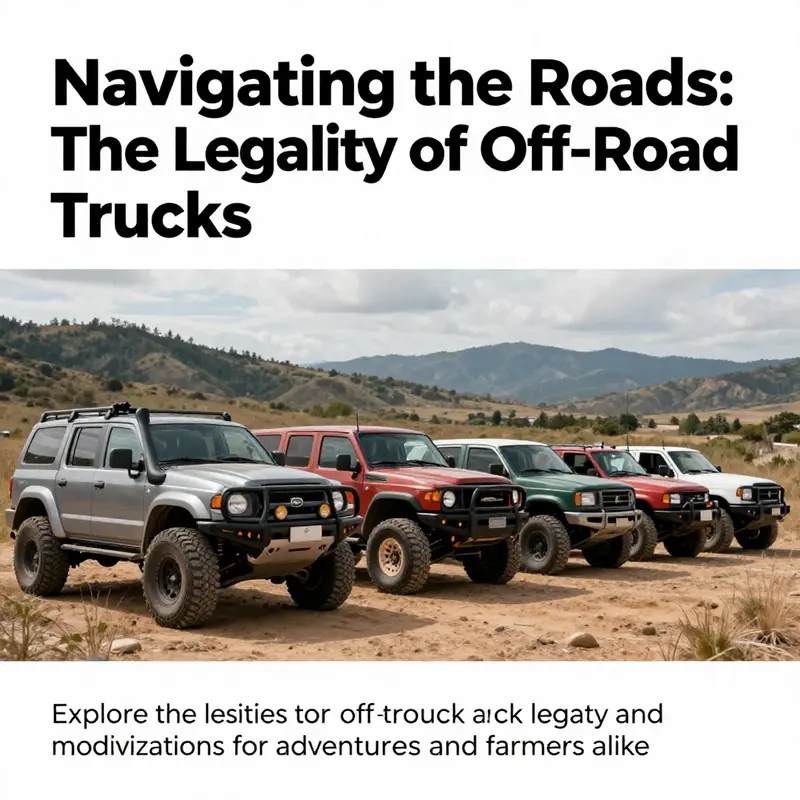
The thrill of traversing rugged terrains in an off-road truck is unmatched, yet the legalities that govern these vehicles on public roads may pose challenges for enthusiasts. While many off-road trucks can legally navigate the highways and byways, specific regulations and safety standards need meticulous consideration. Each chapter within this guide delves into critical aspects: starting with an understanding of their general legal standing, then exploring the impact of various modifications, and finally examining how local regulations can significantly alter the legality of these rebellious machines on public roads.
From Trail-Ready to Road-Ready: Navigating the Legal Landscape of Off-Road Trucks on Public Roads
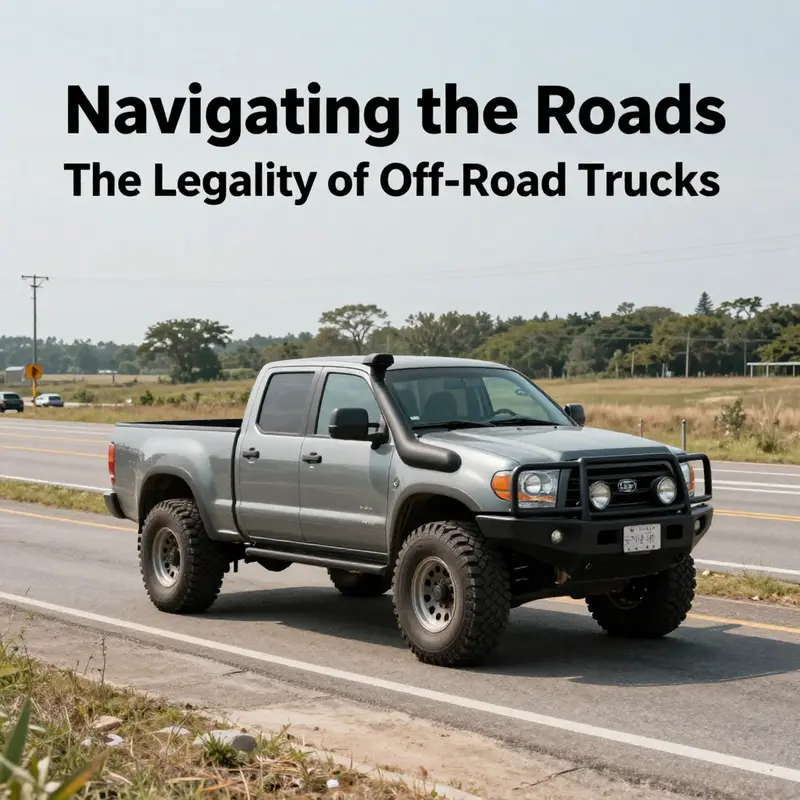
When a vehicle is built with rugged terrain in mind, it often raises the question of whether an off-road truck can be driven on public streets. The answer is nuanced: in many places a stock or mildly modified off-road truck can be road legal, but the path from trail to road is paved with registration, inspections, and local rules. Legality depends on compliance with safety, emissions, and predictable operation on shared roads. Understanding this framework is essential for moving from dirt to public streets without penalties or risk to others. Across jurisdictions, federal guidelines set broad safety and environmental expectations, while state or provincial rules interpret them for local conditions. The result is a spectrum: a stock or lightly modified truck that remains within road-legal criteria on one end, and a purpose-built off-road machine whose extensive modifications render it noncompliant on the other. The goal is to determine where your vehicle sits on that spectrum and what steps, if any, are needed to bridge to street legality. A key entry point is vehicle registration and the associated inspections, which typically verify working lights, mirrors, seat belts, a horn, and often emissions compliance, with some places requiring an approved odometer, speedometer, and certified glass. Modifications matter: the more a vehicle diverges from factory specifications in ways that affect on-road performance and safety, the higher the risk of noncompliance. Heavy lift kits, oversized tires, and specialized suspension changes can alter braking, steering, rollover risk, and stability, potentially triggering regulatory concerns unless they are properly documented and converted. The safe path is gradual: start with modest, homologated modifications and document changes to meet applicable standards, or begin with a vehicle already designed for on-road use. Electric or low-speed vehicles (LSVs) may offer a pathway under specific conditions, but they too must be street-licensed, keep appropriate safety features, and pass ongoing inspections. Jurisdictional variability means some places allow temporary permits or staged conversions, while others restrict nontraditional vehicles altogether. The practical approach is to contact the local department of motor vehicles to understand qualification, equipment lists, inspection schedules, and conversion or certification options. A careful, documented conversion plan that maps every modification to a standard, along with a staged approach to meeting essential road-safety features, can reduce downtime and cost. Public perception also matters: a vehicle that looks like a trail-only rig may attract scrutiny even if it meets technical requirements, while a well-marked, properly equipped vehicle generally blends more smoothly into traffic. For a deeper understanding of how safety testing informs standards, readers can consult crash-test methodologies and government safety guidance, which help explain why lighting, restraints, and structural integrity matter for road safety. Official guidance from regulators and safety agencies evolves with technology, and resources from agencies like the National Highway Traffic Safety Administration provide information about safety standards, LSV regulations, and compliant pathways for nontraditional vehicles. Access to these official resources helps owners align their plans with current expectations and operate confidently on shared roads. External reference: https://www.nhtsa.gov/vehicle-safety
When Modifications Cross the Line: Legality of Off-Road Trucks on Public Roads
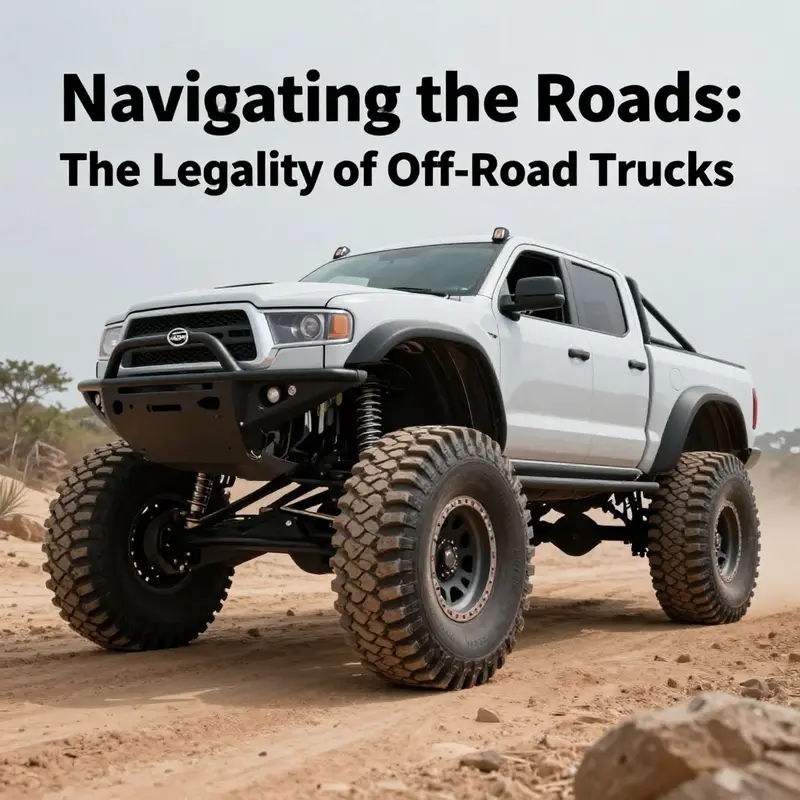
This chapter examines whether off-road trucks are legally operable on public roads and how common modifications affect that status.
Registration, inspection, emission and lighting requirements set baseline roadworthiness regardless of a vehicle’s off-road pedigree. Modifications that alter structure, exhaust, suspension, tires, or weight can push a vehicle out of compliance or trigger stricter inspection.
A practical approach is to treat modifications as regulatory risks, start from the stock baseline, keep documentation, and seek professional assessment to ensure continued conformity with local codes and safety standards.
Ultimately, capability on rough terrain does not guarantee legality on pavement; responsible modification means balancing performance with accountability to keep access to both trails and streets.
Geography of Legality: Navigating Off-Road Trucks on Public Roads Across U.S. Jurisdictions
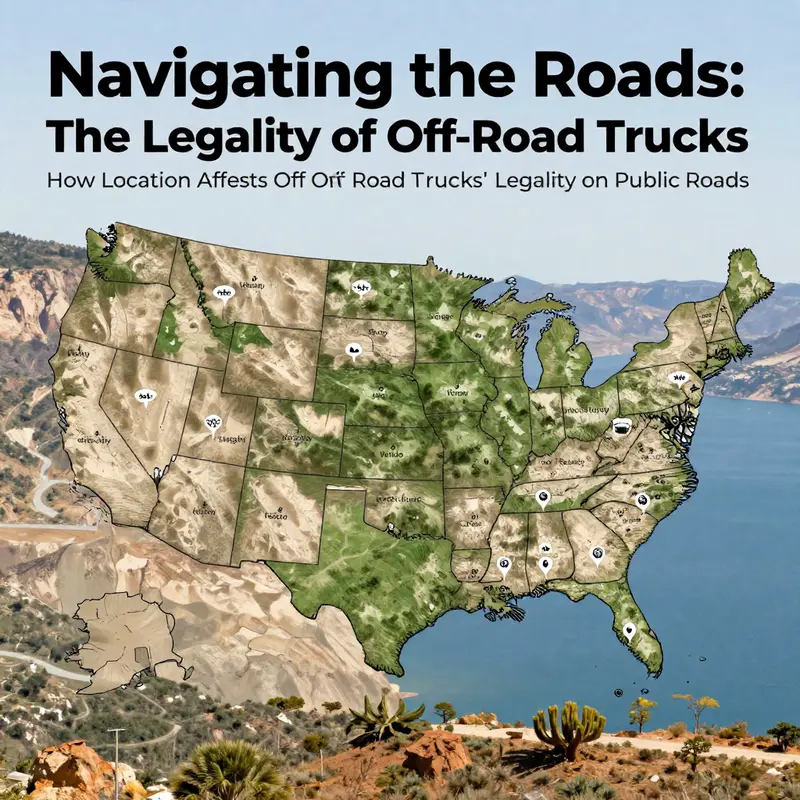
The question of whether off-road trucks are legal on the road does not have a single answer. Lawmakers around the United States have created a mosaic of rules that reflects local histories, land use patterns, and practical concerns about safety, emissions, and resource management. What passes as street-legal in one county can feel like a gray area in the next, and in some places the line between on-road and off-road is explicitly blurred by exemptions, permits, or special-use provisions. This chapter follows that thread of complexity, tracing how location shapes legality and why drivers, owners, and operators must treat the question as a jurisdictional puzzle rather than a universal yes or no. It begins with the most basic building blocks of legality: registration and inspection, which are the gatekeepers that determine whether a vehicle may even appear on a public street. It then moves into the standards that often trip up off-road enthusiasts—emissions, lighting, mirrors, seat belts, and other safety features that are designed for road use even if the vehicle is built for dirt. The discussion progresses to the reality of modifications, a frequent source of disagreement among inspectors, law enforcement, and drivers who want to balance capability with compliance. Finally, the chapter emphasizes how enforcement practices, local ordinances, and state statutes interact to create a practical landscape in which a stock or modestly modified off-road truck can legally operate, while heavily altered machines may be barred or require exemptions that are not always easy to obtain. Throughout, the narrative remains anchored in the central premise: legality is less about the vehicle itself and more about where the vehicle travels and under what conditions it is operated. The aim is to equip readers with a clear, realistic sense of the checks they must perform before taking an off-road truck onto public pavement, while also offering a window into the regulatory dynamics that produce such diversity across communities.
Registration and inspection sit at the heart of the road-legal equation. A truck’s right to use public roadways is, first and foremost, a matter of official recognition. In many jurisdictions, this requires proper registration with the state or national vehicle authority and a pass from the relevant safety inspection regime. The process ensures the vehicle has a verifiable identity, a valid plate, and a baseline level of mechanical reliability. For off-road trucks that are sold as road-legal platforms—vehicles designed to function on pavement as well as trail—the registration process often involves confirming that the vehicle’s critical safety features meet minimum standards. In practice, this means that a stock or only minimally modified off-road truck will more readily clear the registration hurdle than a heavily altered machine. The rule of thumb is simple: if the vehicle cannot meet the basic road-use criteria, it will struggle to obtain or renew registration, regardless of whether it can conquer a mud pit or a rocky incline. The process, however, is rarely uniform across the nation. Different states can enforce somewhat different interpretations of the same safety criteria, and even within a single state, counties or municipalities may adopt their own nuances. The patchwork effect emerges most clearly when a vehicle crosses from one jurisdiction into another, because continuity of compliance can hinge on the specific local standards in effect at the time of inspection or enforcement.
Beyond registration, emissions and safety standards form the next line of scrutiny. The engines, exhaust systems, braking components, lighting, and visibility features are subject to standards that are meant to reduce pollution, improve visibility, and ensure predictable operation in traffic. Off-road trucks are often designed with modified exhausts, different fuel-management systems, and alternative ignition configurations that may conflict with road-use requirements. Even when the underlying engine remains compliant, alterations to the exhaust, intake, or software can push a vehicle outside acceptable limits. Lighting is another area where the bar is set for on-road use: headlights, tail lights, turn signals, and reflectors must perform in a predictable manner under all seasonal conditions. Mirrors are evaluated for the driver’s field of view, a critical factor in safe lane changes and turns. Seat belts and occupant protection play a central role as well; if a vehicle lacks appropriate anchorage or if seats are modified in a way that reduces restraint effectiveness, it risks failing roadworthy tests that are designed to protect occupants and other road users.
Modifications, particularly those visible and dramatic, often trigger the most intense questions about legality. Off-road culture has a long tradition of lifted suspensions, oversized tires, and other performance-oriented alterations. While some modifications exist purely to enhance trail capability, others are chosen to improve on-road dynamics or aesthetics. The challenge is that many of these changes can violate official road-safety standards even if they enhance the vehicle’s performance off-road. Large tires, for example, can affect braking distance, steering geometry, and speedometer accuracy. Lifts and suspension changes can alter tire clearance and bump-stop behavior, potentially compromising alignment and collision avoidance systems. From a legal perspective, the critical point is whether the modifications keep the vehicle within the envelope of road-worthiness defined by the applicable rules. A standard, stock off-road truck is typically passable on public roads, but once the vehicle’s tires exceed a certain size range or the suspension is raised beyond a jurisdiction’s stated threshold, the road-legal status can sharply regress toward non-compliance. Even common upgrades, such as lighting upgrades or the addition of auxiliary equipment, can prompt a vehicle to require re-certification or fail a road-safety inspection if they run afoul of height, weight, or wiring requirements. In other words, the very elements that make an off-road truck more capable off the pavement can become liabilities on the asphalt if they push the vehicle outside established safety envelopes.
To appreciate how location shapes legality, consider the practical reality of enforcement. In some places, the rules are enforced through routine checks, while in others, resource constraints, political priorities, and local enforcement cultures shape outcomes more than the letter of the law. The Iowa experience illustrates this dynamic with particular clarity. Here, a longstanding statewide policy permits certain off-road vehicles to operate on public roadways for agricultural purposes. That framework creates a defined legal pathway for specific kinds of off-road trucks used in farming, a use case that aligns with the state’s agricultural heritage and infrastructure. Yet the same policy does not extend to recreational use, and even within agriculture, enforcement has been described as uneven and inconsistent. Studies have documented limited and variable enforcement of restrictive ORV laws, indicating that compliance can hinge less on a uniform statewide directive and more on local discretion, policing priorities, and the available resources in a given county or township. The result is a regulatory patchwork in which what is lawful in one county can be prohibited in another, even within the same state. This is not merely an academic observation. It affects real-world decisions about whether to operate off-road trucks on public streets and how to justify such activity to neighbors, farmers, and law enforcement officers who expect clear adherence to the rules.
For readers curious about Iowa specifically, the state maintains official guidance that clarifies agricultural exemptions and the enforcement standards that accompany them. The Iowa Department of Natural Resources provides detailed information that can help drivers understand when an ORV may be used on public roads for farm-related tasks and where recreational use remains restricted. While the Iowa example is instructive, it also underscores a broader truth: even with a well-defined exemption, the local context will influence practical legality. A vehicle that likely complies with state-level agricultural exemptions may still face restrictions or outright prohibitions in neighboring counties, towns, or rural road corridors, depending on how local laws are written and how aggressively they are enforced. That is the essence of regulatory variance: a single vehicle can ride legally down a farmer’s road in one jurisdiction and be deemed non-compliant on the next block where different ordinances prevail.
In such environments, drivers must become adept researchers of the law. The path to on-road legitimacy is not simply a matter of buying a vehicle that qualifies as “off-road” and taking it for a test run on a public street. It requires deliberate verification of several layers of regulation: the state statutes that govern vehicle registration and emissions, the local ordinances that set limitations on modifications and use, and the enforcement practices that determine practical compliance. The interplay among these layers means that a well-prepared operator will systematically check official sources—and not rely on secondhand interpretations or anecdotal assurances from friends or online forums. It also means that those who plan heavy modifications or intend to use an off-road truck beyond light-duty, everyday tasks should anticipate possible hurdles, including inspections, permits, or exemptions that must be obtained before the vehicle may be operated on public roads.
To illustrate how readers can balance knowledge with caution, consider the central tactical move: a careful alignment of the vehicle’s condition with the rules that apply in the intended area of operation. A practical approach begins with ensuring registration is current and that all safety features required by the jurisdiction are present and functioning. The next step is evaluating whether emissions controls and noise levels meet the local standards, because violations here are among the most common grounds for rejection in road-usage inspections. Then comes the critical assessment of modifications. If the truck has oversized tires or lifted suspension that breach local limits, a driver should either revert to compliant specifications or pursue a formal adjustment in the form of an exemption or official permit, if such a path exists. In jurisdictions where no exemption exists, the prudent choice may be to maintain a stock or near-stock configuration for on-road use and reserve the more aggressive off-road setup strictly for private property or designated off-road areas. Ensuring compliance also means staying abreast of any changes in local codes. Zoning updates, new traffic ordinances, or shifts in enforcement priorities can occur with little fanfare and may retroactively affect whether a vehicle remains road-legal.
The practical takeaway is straightforward, but it requires deliberate discipline. Owners should approach off-road trucks with a mindset of road-legal stewardship: treat the vehicle as a tool that must integrate with the public traffic system, not as a standalone machine that is exempt from the rules simply because it looks rugged or performs well off pavement. Part of this stewardship is proactive documentation. Keep the vehicle’s registration documents, proof of compliance for emissions or safety features, and any correspondence with inspectors or authorities. Maintain a meticulous record of modifications and the dates of any inspections or permits. When in doubt, seek clarity from official channels and document the responses you receive. If possible, obtain written confirmations or formal amendments to registrations to protect against evolving interpretations of the law and to provide a clear reference should questions arise during roadside checks or inspections.
To tie the discourse back to the heart of the topic, the bottom line is this: legality for off-road trucks on public roads is not a fixed attribute of the vehicle. It is a dynamic status that depends on where the vehicle is operated and under what conditions. The same truck that is perfectly acceptable for a farm-to-field route in one county could be flagged for inspection on a different route in another jurisdiction. The variability emerges from a constellation of factors—state statutes, local ordinances, vehicle modifications, and enforcement culture—that together shape a practical reality more nuanced than a simple yes or no. Those who drive off-road trucks on public roads must cultivate a habit of conscientious compliance, continuous learning, and respect for diverse regulatory landscapes. This is not just about avoiding fines or penalties; it is about ensuring the safety of all road users and honoring the social contract that makes shared streets possible.
For readers who want to explore practical mechanisms to build this compliance mindset, consider the value of consulting expert resources that focus on mechanical reliability and safety fundamentals. A structured, hands-on resource on diesel mechanics can be a meaningful complement to regulatory knowledge. See Mastering Diesel Mechanics: A Step-By-Step Path to Success for insights into maintaining engine performance, exhaust integrity, and general drivetrain health that support on-road reliability while maintaining off-road capability. While this resource is not a substitute for legal guidance, it can help ensure that the vehicle remains mechanically robust and aligned with the expectations of road-use safety standards.
In sum, the question of whether off-road trucks are legal on the road invites a careful, location-specific approach. The same vehicle can be legal in one jurisdiction and non-compliant in another, depending on registration status, emissions and safety conformity, modification boundaries, and the prevailing enforcement ethos. The Iowa example demonstrates both the potential for lawful use in a defined agricultural context and the careful navigation required to avoid crossing into illegality. Readers should equip themselves with direct access to official statutes and local ordinances, maintain open lines of communication with authorities, and adopt a conservative stance when modifications push the envelope of road safety standards. By understanding the geography of legality and approaching road use with due diligence, drivers can responsibly balance the utility of off-road capability with the obligation to operate safely within the public traffic system. For those who plan to expand their knowledge beyond regulatory theory, integrating mechanical maintenance with legal awareness can yield a more resilient and road-ready vehicle, one that performs reliably on trails and streets alike, within the contours of local law. The road map is not uniform, but its compass points toward compliance, clarity, and responsible operation across the diverse jurisdictions that make up our vast landscape of roads.
External note: For official guidance specific to a state or municipality, consult the relevant regulatory bodies and official state resources. A detailed, state-focused reference such as the Iowa Department of Natural Resources provides authoritative context and current exemptions and enforcement standards that illustrate the broader regulatory mosaic across the country. https://www.iowadnr.gov
Final thoughts
Understanding the legal landscape for off-road trucks on public roads is critical for enthusiasts, racers, and landowners who rely on these powerful vehicles. Factors like registration, required inspections, and local laws can dictate whether a truck is compliant for road use. The chapter discussions cover the spectrum from general legality to the nuanced specifics concerning modifications and regional variances. As you gear up for your next adventure, staying informed about these regulations can help ensure your off-road experience remains exhilarating and legally sound.