
Wisconsin’s rugged terrain calls to those with a passion for off-road adventures, but when it comes to off-road construction trucks, navigating public roadways can be treacherous due to stringent regulations. This article delves deep into whether off-road construction trucks can legally traverse Wisconsin roads. Each chapter methodically explores crucial aspects, from regulatory frameworks to safety standards and the permitting process. Off-road enthusiasts, racers, and landowners will gain insights on how these laws impact infrastructure, compliance, and their adventures.
Clear Roads, Clear Rules: Wisconsin’s Regulation of Off-Road Construction Trucks on Public Highways
In Wisconsin, moving heavy equipment from a yard to a job site on public roads is a regulated activity, not a free pass. Off-road construction trucks are allowed on public highways only under clear conditions: the vehicle must be roadworthy, the load must be properly secured, weight and size limits must be respected, and a permit may be required for oversized or overweight combinations.
WisDOT and state law govern this process. Vehicles traversing public highways must be properly registered and equipped for road use. When a truck is configured for off-road work—massive equipment, special chassis, or oversized loads—the default is that it is not immediately road-legal. A permit or other authorization is used to bridge that gap, with constraints on routes, time windows, escort requirements, and speed limits to protect bridges, pavement, and other travelers.
Operators plan routes with infrastructure in mind, choosing corridors that can accommodate heavier or taller configurations and avoiding segments with height limits or weight-restricted bridges. The actual permit is a live document detailing allowed routes, maximum axle weights, and any escort or signaling requirements. The permit may also set travel times to avoid peak traffic.
Real-time information is part of the process. Wisconsin 511 provides status updates on road conditions, closures, and incidents that could affect a planned move. Planners and drivers use these updates to adjust routes and timing while staying within permit terms.
In practice, a contractor verifies that the vehicle is registered, that lights and brakes are functioning, and that tires are suitable for highway speeds. The load is secured and documented as required by the permit. If the project needs a move outside standard rules, a special permit is pursued and the route is pre-approved with any necessary escorts. The goal is to move equipment efficiently while maintaining safety and protecting the road network for all users.
Crossing the Line: Safety Standards and the Public Road Journey of Wisconsin’s Off‑Road Construction Trucks
When heavy equipment is built to withstand the grit of a construction site, the real test often comes when that same machinery has to share Wisconsin’s public highways. The road network is not a place for trial and error with equipment designed exclusively for off‑road duty. In practice, off‑road construction trucks—those large dumpers, excavators on moves between sites, or articulated haulers that never spend a night on public streets—are typically not permitted to roam public roads unless they clear a well-defined safety and regulatory pathway. This pathway binds state and federal requirements into a single mandate: any vehicle operating on public highways must be roadworthy, properly registered, and equipped to meet the rules of the road. Wisconsin’s rules are clear enough to deter casual, ad hoc travel, while still aiming to keep work crews and other travelers safe when a temporary road journey becomes necessary for project logistics.
At the core of Wisconsin’s regulatory framework is WisDOT, the state agency charged with ensuring that vehicles on public highways meet safety and weight standards. The state requires registration, visible and functioning safety features, and adherence to weight and size restrictions that prevent roadways from being overloaded or structurally stressed by oversized equipment. In practice, the common off‑road construction machines—characteristically large, heavy, and configured for site performance rather than highway efficiency—often lack the full package of road‑worthy components. The typical fleet of off‑road machines might not carry continuous headlights, turn signals, or road‑legal tires, and their mirrors, braking systems, and emergency signaling may be optimized for a work yard rather than a public street. As a result, a vehicle of that type cannot simply roll out onto a Wisconsin highway the way a standard commercial truck can. If the job requires moving equipment over public roads, the operation must secure a special permit from WisDOT and may be accompanied by escort vehicles, especially when the load is oversized or overweight. In other words, the decision to move a piece of site equipment onto a public road is a deliberate regulatory act, not a routine maneuver.
The state’s stance sits within a broader safety ecosystem. On one side, Wisconsin adheres to federal safety expectations that apply to motor vehicles, with OSHA’s guidelines intersecting the jurisdictional lines in complex ways. OSHA’s guidance notes that even vehicles operating primarily off‑site, when they carry a GVWR of 10,000 pounds or less, bear certain responsibility on the part of original equipment manufacturers to ensure conformity with federal safety standards. While that rule speaks to off‑road settings, the same vehicles must still conform to basic safety configurations if they temporarily traverse public roads. What this means in practice is that those heavy, off‑road machines, if permitted to move on state highways, must at least be equipped with standard road‑safety features: functional lighting that meets highway usage expectations, reliable braking systems, and reflective markings that improve visibility to other drivers. The effect of OSHA’s standards, intertwined with WisDOT’s road regulations, is a safety imperative that frames the practical reality: temporary public‑road movement is possible only when minimum safety baselines are met and the operation is properly authorized.
Wisconsin’s regulation of heavy vehicles on public roads also relies on the precise intersection of state transport rules, vehicle size, and weight limits. Weight and size restrictions are not abstract numbers; they translate into route planning, axle configurations, and sometimes restricted hours of operation. Even if a vehicle is designed for off‑road efficiency, it must be treated as a road vehicle the moment it enters public streets. This means operators must verify that the vehicle can safely traverse with other traffic, that it won’t exceed legal gross or axle weights, and that the route chosen for the move won’t compromise roadway integrity. The responsibility falls on the operator to assemble the paperwork and ensure compliance with insurance, licensing, and registration requirements that WisDOT expects for any vehicle on public highways. The practical consequence is that many off‑road machines never leave the job site without a deliberate plan to address these regulatory hurdles, including the possibility of a convoy escort during oversize or overweight transport. The consequence of non‑compliance can be severe: penalties, liability exposure in the event of an incident, and the interruption of critical project timelines as authorities enforce the rules.
Beyond the letter of the law, there is a deeper commitment to safety that transcends compliance alone. Fleet operators who routinely manage vehicles that must occasionally traverse public roads face a set of responsibilities that go to the heart of safety culture. Even when a vehicle is temporarily road‑legal, the operation hinges on the preparation and training of the people who manage that equipment. This is where a broader, more holistic approach to fleet safety becomes essential. It is not enough to install a few road‑worthy components and call it a day. The journey through WisDOT’s permitting process, the oversight of OSHA‑related safety considerations, and the moral obligation to protect road users all converge on the same principle: road travel with off‑road machines must be a controlled, well‑communicated, and continuously monitored activity. In this regard, the human element—operator competence, dispatcher diligence, and maintenance discipline—becomes as important as the mechanical readiness of the machine. A fleet that invests in people, processes, and technology to manage these occasional road movements is less likely to encounter unexpected regulatory friction and more likely to deliver projects on time and with lower risk. For organizations seeking to strengthen this aspect of safety and efficiency, there is a strong case for investing in people as a cornerstone of fleet management success, a principle that aligns with the broader goals of compliance and risk management. Invest in People Key to Fleet Management Success.
The practical implications of these intertwined standards become most apparent when a project calls for moving equipment between sites or across short segments of highway. Imagine a scenario in which a large, off‑road capable unit needs to be relocated from one worksite to another that lies beyond a municipally controlled corridor. In such a case, the operator would first determine whether WisDOT permits are necessary for the movement, and if so, what conditions apply. The permit process can involve a detailed request that outlines the route, the time window, the vehicle configuration, and the intended escort plan. Some routes may require a pilot car or a convoy of escorts to warn other drivers of oversized loads. The permit itself acts as a safeguard, ensuring that all variables—speed, spacing, warning signs, and coordination with law enforcement or traffic management—are accounted for before the truck ever leaves the yard. The realities of this process reflect a careful balancing act: enabling project logistics while preserving public safety and the structural integrity of Wisconsin’s road network. The permitted movement, when granted, becomes a carefully governed event rather than a routine passage, and it is framed by clear expectations about lighting, signaling, and control of the moving equipment.
In this balancing act, the importance of comprehensive safety configurations cannot be overstated. Road‑worthy lighting is not merely a matter of aesthetics; it is a critical indicator for other drivers, particularly in low‑visibility conditions or at dusk and dawn. Braking systems must be reliable and capable of responding promptly under sudden traffic situations, especially given the heavy weight that these machines commonly bear. Mirrors and visibility play a decisive role when large equipment spans lanes or angles toward a road shoulder. Reflective markings, which help contour the vehicle’s silhouette in the night, are more than decorative features; they are a practical safety measure that reduces the risk of collision with other road users. And then there is tire suitability. Off‑road tires are optimized for traction on dirt, mud, and uneven surfaces, not for highway wear patterns or long distances at highway speeds. For a temporary road transfer, the tires and suspension must be evaluated and, if needed, upgraded to road‑use specifications. In other words, the equipment must truly be road‑ready, not just capable on a construction site.
Within this regulatory and safety framework, the coordination between engineers, safety managers, and field supervisors is essential. Proper planning means more than choosing a route and booking escorts. It means aligning maintenance windows with the permit schedule, ensuring that the moving machine has a current inspection that confirms its lights, brakes, tires, and load‑securement devices are in good working order. It means training operators to drive in a way that respects both the immediate hazards of heavy equipment and the broader expectations of public road safety. It means establishing communication protocols so dispatchers can adjust routes in real time if they encounter traffic incidents, weather changes, or temporary lane restrictions. This integrated approach to road movements reflects the reality that safety is not a single feature or a line on a permit. It is the total system—the people, the machines, the rules, and the mutual responsibilities of everyone involved—that makes such moves possible and reduces risk for everyone on the roadway.
And while the focus here is Wisconsin, the principles apply in broader terms: road movements of off‑road construction equipment require a disciplined blend of compliance, safety culture, and practical logistics. The regulatory landscape may seem intricate, but it is ultimately a framework designed to prevent harm while enabling essential project activities. If a project can be planned to minimize road movements or to avoid them altogether, that is often the safest and most cost‑effective option. When a road move is unavoidable, the process should be transparent, well documented, and executed with a clear chain of authority, a robust escort plan, and a commitment to the safety of every road user. This is the essence of responsible construction logistics in a modern regulatory environment. The result is not merely compliance for its own sake but a safer, more predictable operating environment that protects workers, the public, and the infrastructure that makes Wisconsin’s economy possible. External resources can provide additional context on how off‑highway vehicle safety standards align with broader motor vehicle safety expectations, offering a deeper understanding of the standards that guide these critical moves. For a broader overview of vehicle safety standards for off‑highway vehicles, see the National Truck Equipment Association resource linked here: https://www.ntea.org/resources/vehicle-safety-standards-for-off-highway-vehicles.
The Permit Path: How Wisconsin Regulates Off-Road Construction Trucks on Public Roads
Wisconsin sits at a practical crossroads where the need to move heavy construction equipment from site to site intersects with a dense and intricate web of rules meant to protect all road users. Off-road construction trucks, by their nature, are built to work in fields, quarries, and sprawling job sites rather than to navigate the public highway system with the same ease as standard commercial trucks. In the Badger State, this distinction matters a great deal. The default position is clear: a vehicle designed primarily for off-road use does not automatically gain the right to drive on state or municipal roads. Instead, operators must demonstrate roadworthiness and regulatory compliance in ways that ensure safety, protect infrastructure, and manage wear and tear on the system. The process is not intended to be a barrier to essential work; it is a carefully calibrated mechanism to balance project timelines with the public interest in orderly, predictable travel for everyone who shares Wisconsin’s roadways. The decision to allow on-road movement hinges on a combination of vehicle preparation, regulatory adherence, and, when necessary, a formal permit that lays out every permission and constraint in writing before any wheels roll onto a public right of way. In this framework, permits function as a formal acknowledgment that the particular combination of vehicle, load, route, and timing has been vetted for risk, impact, and control. Operators who need to bring equipment onto state highways should begin with a clear, documented plan that aligns with WisDOT’s standards and the broader traffic-safety expectations of the state’s transportation network. The path from site to site, when done lawfully, is less a shortcut and more a carefully supervised corridor, designed to maintain road integrity while enabling essential work to progress.
The core requirements that govern road use for off-road construction trucks begin with basic necessity and legality. Any vehicle operating on public highways in Wisconsin must be properly registered and meet a baseline of safety features. Lights, brakes, mirrors, and tires suitable for road use are not optional add-ons; they are the minimum that a vehicle must have to be considered fit for on-road travel. Of particular importance are the tires and braking systems, which must be compatible with the stresses of pavement, curves, and the constant interplay with other vehicles and roadside users. The weight and size restrictions that Wisconsin imposes on vehicles traversing public roads function as a first line of defense against road damage and unsafe maneuvers. A truck designed for off-road conditions might exceed standard axle loads, gross vehicle weight ratings, or overall dimensions. When these parameters are exceeded, or when the equipment cannot be operated within the safe margins established for road traffic, a permit becomes the necessary instrument to authorize the journey. In many cases, the presence of oversized components—such as booms, payloads, or equipment that extends beyond normal width—triggers additional scrutiny and often demands escorts, specialized routing, or restricted travel windows to minimize congestion and exposure to risk. The system is designed to prevent a situation in which a massive piece of equipment appears suddenly on a crowded street or in a congested corridor where stopping distances, sightlines, and lane widths may be insufficient to avert an incident.
The decision to pursue on-road travel for an off-road truck is not a matter of whether the project can be accomplished without ever touching public roads. Instead, it is a matter of when and how a vehicle can legally operate on Wisconsin streets and highways in a manner that preserves safety, road quality, and traffic flow. In practice, this means that contractors and operators must anticipate that off-road trucks will typically remain off public roads during the bulk of their work. When a portion of the project requires on-road movement—whether to shuttle between sites, relocate equipment to a staging area with better access, or transport material from a regional yard to a job site—the operator must determine whether a special permit is required. If a permit is necessary, the process involves a careful, formal application that accounts for every potential risk in the travel plan. The permit itself becomes a public record of consent, detailing exactly what is allowed, under what conditions, and within which parts of the state network. The presence of escort vehicles, if required, is not a cosmetic feature; it is an essential safety measure designed to protect not only the driver but also other motorists and pedestrians who share the road. Escorts help ensure that clearances are respected, help manage gaps in traffic, and provide a buffer against unexpected maneuvers by the heavy vehicle. They also provide a controlled means for communicating with the traveling team about any deviations from the planned route or schedule.
To see the framework as it exists in practice, one should understand the permitting process as a structured conversation between the equipment operator and the state’s regulatory body. The Wisconsin Department of Transportation (WisDOT) manages the Office of Motor Carrier Services, which is responsible for oversized and overweight vehicle permits. The application process begins with a detailed submission that captures the full picture of the intended movement. Operators must provide precise vehicle dimensions—length, width, and height—as well as the total weight and the weight distribution, which helps evaluators assess how the load will interact with bridges, ramps, and roadway surfaces. The proposed travel route is not a casual sketch but a thoroughly considered path that includes potential chokepoints, bridge clearances, and known weakness points in the road network. Proposed travel times matter, too. If a move coincides with peak traffic volumes or adverse weather windows, those factors can influence whether a permit is issued or whether the route must be adjusted to reduce risk.
Once the application is submitted, WisDOT undertakes a careful review. The objective is to confirm that the vehicle can operate without posing hazards to other road users or causing damage to infrastructure. Reviewers examine whether the vehicle’s dimensions and weight can be accommodated by the existing roadway and bridge inventories along the requested route. They also consider whether the vehicle’s operational characteristics—such as braking performance, steering control, and visibility—are compatible with public-road use. If the evaluation yields concerns, the application can be revised, the route adjusted, or additional safeguards requested. This stage underscores a central principle: safety is not a generic standard but a set of precise, context-dependent requirements that vary with the exact combination of vehicle, load, and highway environment.
Routing considerations form a second axis of the permit decision. WisDOT often imposes special routing requirements to ensure that the move avoids areas that cannot safely accommodate oversized vehicles. Bridge structures with limited vertical or horizontal clearance, roads with narrow lanes, and areas with tight curves or complex interchanges may be flagged as unsuitable for certain configurations. In some cases, the permit may restrict travel to certain days or times, such as off-peak hours or specific weather conditions, so that traffic management resources can be deployed and braking distances can be better anticipated. Escort vehicles frequently appear in the permit as required partners in the movement. Escort teams help monitor the vehicle’s progress, communicate with traffic control devices or flaggers, and respond swiftly to any unexpected developments, such as a miscalculation in clearance or a sudden change in traffic patterns. The presence and specifics of escort requirements hinge on a careful assessment of the move’s risk profile and the route’s particular challenges. In every instance, the goal is to provide a controlled, predictable environment for the heavy equipment’s passage and to minimize disruption to other road users.
Information and documentation are indispensable throughout the permit journey. Applicants must be prepared to supply routine and sometimes minute details: the exact route map, staged layovers if the move is long, and the timetable that aligns with road and bridge restrictions. The process is designed so that, once a permit is approved, there is a clear, enforceable set of expectations for the operator and for the authorities who monitor compliance. The permit includes conditions that must be observed, including speed limits appropriate to the vehicle and load, mandatory use of appropriate warning signs or lights, and any restrictions around travel during periods of heavy snow or rain—times when the road surface conditions can dramatically alter a heavy vehicle’s behavior. The dokumentation also functions as a safety net for enforcement: should an incident occur, the permit is the reference point that clarifies what was allowed and what conditions were imposed. It is not unusual for a project to be planned around a sequence of permitted moves, each with its own constraints and windows. In practice, this means contractors design logistics around these discrete on-road moves, ensuring that the equipment’s public-road legs fit within the permit terms and can be executed without unexpected deviations.
Beyond the procedural mechanics, the real-world implications for contractors and operators are practical and tangible. The permitting process incentivizes meticulous planning, from route surveying to pre-move inspections. Operators must verify road surface compatibility, ensure that the vehicle’s suspension and tires are maintained and rated for public-road duties, and check that all lighting, braking, and signaling systems are fully functional before the move. Pre-trip planning often includes a coordination layer with local authorities and road users in the affected corridor. This engagement helps to prepare communities for the intrusion of heavy machinery, making the on-road movement a transparent, documented event rather than an abrupt intrusion. In many projects, the permit becomes a living document, updated to reflect changes to the route, weather, or construction sequencing. The upshot is a transportation plan that is consciously designed to minimize risk while preserving the project schedule and protecting the public’s safety.
For fleet managers and project leaders who are balancing multiple sites and tight deadlines, the permit journey is a critical element of risk management. The pursuit of a permit is not simply a bureaucratic hurdle; it is a strategic activity that shapes how work is scheduled, how equipment is mobilized, and how teams coordinate across disciplines. To support this complexity, many operators rely on robust dispatch and fleet-management systems. These tools help synchronize movement plans with regulatory requirements, ensuring that each on-road leg exists within the permit’s boundaries and is logistically feasible. They also aid in tracking maintenance, compliance records, and incident reporting, which strengthens accountability and helps teams demonstrate due diligence should questions arise later. For readers interested in this aspect of the process, one can explore how dispatch software for fleet management supports coordinated, compliant moves within the permit framework, offering a practical way to align day-to-day operations with WisDOT’s formal requirements.
Ultimately, the outcome of WisDOT’s permitting process is a balanced equation: the need to advance construction work on a defined schedule while preserving road safety, road infrastructure, and the efficient movement of other travelers. The process cannot be bypassed, but it can be navigated with clarity and foresight. Operators who invest time in preparing a thorough application, who anticipate routing constraints, and who commit to the on-road safety measures stipulated by the permit are more likely to experience a smoother approval cycle and fewer disruptions on site. The permit becomes, in effect, a shared covenant between the project team and the traveling public—a formal arrangement that acknowledges legitimate engineering needs while upholding the public’s best interests. When executed properly, a permitted on-road move is not a risky improvisation but a carefully choreographed sequence that allows essential construction work to proceed without compromising safety or the integrity of Wisconsin’s roadways. For those navigating these waters, WisDOT’s permits portal serves as the official compass, guiding operators toward compliant, transparent, and safe on-road movements. External resources and official forms can be found by following the WisDOT permits portal and related guidance, which provide the authoritative questions, checklists, and procedures that underpin every permitted move.
Internal note for readers managing large fleets and complex projects: coordinating across sites and jurisdictions often benefits from integrated planning tools. A widely used approach involves aligning movement schedules with permit windows while maintaining rigorous pre-move checks and route validations. If your operation relies on dispatch and fleet-management workflows, consider how these systems can be configured to reflect permit constraints, route allowances, and escort requirements so that every move is traceable and compliant. For teams seeking a practical example of how fleet-management tools can support regulated on-road moves, see the broader discussion of dispatch and fleet coordination in the linked resources. This alignment between software-enabled planning and regulatory compliance is increasingly essential in maintaining both project momentum and public safety on Wisconsin’s roads.
External resource: WisDOT’s official permits portal provides the authoritative guidance, application forms, fees, and contact information for more detailed inquiries. https://dot.wisconsin.gov/permits
Wisconsin’s Road Rules for Off-Road Construction Trucks
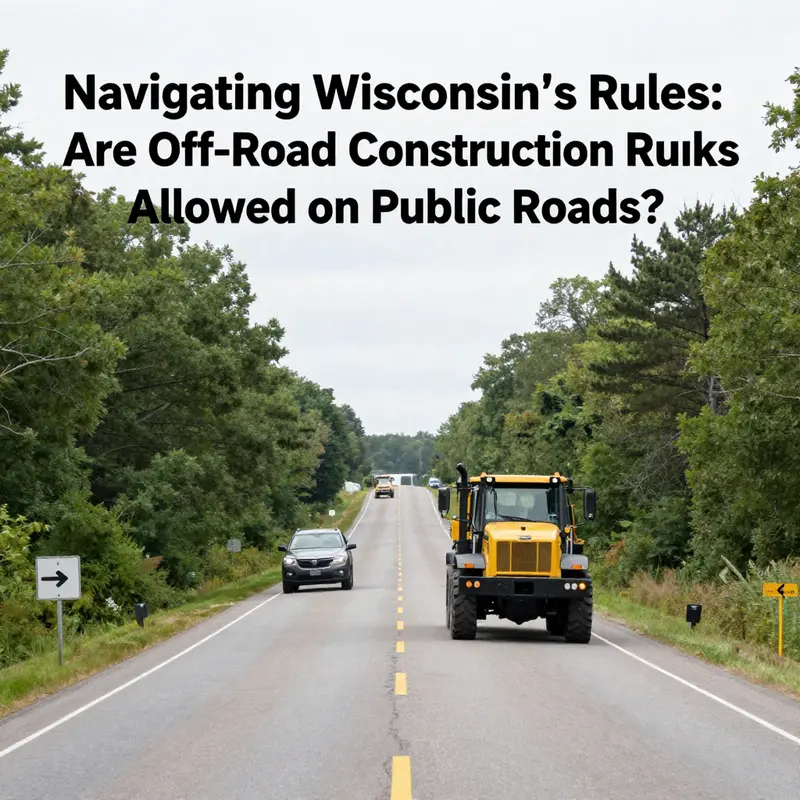
Wisconsin’s road system was built for typical traffic, not heavy, off-road equipment moving on public highways. To protect the road network and ensure public safety, WisDOT maintains standards for any heavy equipment that travels on public streets. Off-road construction trucks are generally not allowed to operate on public roads unless they meet roadworthiness and safety requirements, and many moves require a formal permit and sometimes escort vehicles.
Key requirements include ensuring vehicles are properly registered and equipped with essential safety features such as headlights, brakes, mirrors, and tires suitable for highway use. Many machines used on construction sites lack these road-ready components by design, requiring modifications or exemptions before a road move can occur legally.
Weight and size limits play a central role. Without a permit, standard limits are specific: a single axle is limited to 20,000 pounds, a tandem axle to 34,000 pounds, and the gross vehicle weight limit depends on axle configuration. When a truck or combination exceeds these limits, a WisDOT permit becomes the controlling document and may impose route restrictions, time-of-day windows, and escort requirements.
The permit system serves multiple purposes: it protects infrastructure, reduces traffic disruption, and ensures that heavy moves are coordinated with local authorities and other road users. Escorts help manage lane usage and safety, while route restrictions keep movements away from bridges or segments not designed for such loads.
For project planning, these rules mean operators must plan routes carefully, secure the necessary permits, and align schedules with escort services and road-usage windows. Fleet managers can use planning tools to minimize delays and ensure compliance, ultimately contributing to safer, more predictable construction activity on Wisconsin roads.
Between Mud and Pavement: Navigating Wisconsin’s Legal Boundaries for Off‑Road Construction Trucks on Public Roads
The question of whether off‑road construction trucks can be driven on Wisconsin public roads sits at the intersection of practicality and law. In construction, the urge to move heavy equipment from one site to another is real and immediate. Yet Wisconsin law draws a clear line between vehicles built for off‑road work and those deemed roadworthy for pavement travel. In most cases, off‑road trucks are not permitted on public highways unless they meet stringent road‑fitness requirements or travel under the umbrella of a formal permit. This distinction isn’t mere paperwork; it reflects concerns about safety, road wear, and the shared responsibility of all users who rely on the same network of highways. Understanding the framework helps operators avoid penalties and, more importantly, prevents dangerous situations on busy roadways.
Wisconsin’s regulatory backbone rests on the idea that vehicles operating on state highways must comply with size, weight, lighting, and safety standards. The relevant statutes and administrative rules expect any vehicle that uses public roads to be properly registered and equipped with the features necessary for safe signaling, illumination, visibility, and control. While construction fleets routinely include specialized machines designed for rough terrain and limited speed, those same machines were not originally designed to function as standard road vehicles. When a truck’s dimensions exceed typical road allowances, or when essential road‑legal equipment is missing, the vehicle’s presence on public corridors becomes legally questionable. This is not merely a matter of where the truck is loaded or unloaded; it is about how the vehicle behaves once it is on the asphalt—how it brakes, how it signals its movements, how it traverses curves, and how it interacts with other motorists and pedestrians.
A central hurdle for off‑road trucks is the mismatch between their design goals and road‑use expectations. Heavy off‑road dump trucks, excavators mounted on carrier frames, or articulated haulers are built for durability, high torque at low speed, and maneuverability across uneven terrain. They often carry dimensions and weights that exceed standard highway limits. They may lack, or intermittently meet, the required lighting and signaling configurations—functional headlights, turn signals, taillights, and reflective markings—that a road‑legal vehicle must display in all operating conditions. When these vehicles must traverse public roads, the process is not a matter of “hop in and go.” It becomes a structured administrative sequence designed to ensure safety and to protect the integrity of the road system.
The rule set also recognizes the realities of the work schedule. Sometimes the fastest route to complete a project involves moving equipment between sites through public streets or highways. In those circumstances, operators must acknowledge that movement on public roads requires either that the vehicle itself conforms to road standards or that a permit is obtained to authorize unusual operation. Oversized or overweight loads add another layer of complexity. Even if a truck can physically appear to be driven on a highway, a vehicle carrying an oversized or overweight load typically must secure a special permit from the Wisconsin Department of Transportation (WisDOT). A permit codifies the route, time windows, escort requirements, and any restrictions on traffic, bridges, or roadway segments. Without this permit, the act of moving such equipment on a public road exposes the driver and the company to fines, towing, and liability for damages arising from an accident or road wear. The consequence is not just a legal penalty but a potential risk to public safety that can have lasting repercussions for nearby communities and for the project timeline itself.
The practical upshot is straightforward in principle, nuanced in application: off‑road construction trucks do not automatically acquire a standing authorization to operate on Wisconsin highways. They may be allowed to travel on public roads only if they meet roadworthiness standards that align with statutory requirements or if WisDOT grants a permit that prescribes every detail of the operation. The permit process is not merely a formality; it represents a structured evaluation of how the vehicle, its load, its route, and its timing affect safety, congestion, and structural loads on bridges and pavement. The Permit Office assesses factors such as route vulnerability, shoulder width, sightlines, bridge capacities, and the potential effect on normal traffic flow. Escort vehicles, if required, are not optional decorations but essential elements designed to position, guide, and warn other road users about the oversized or slow‑moving equipment. In short, a permit is not a courtesy; it is a legal instrument that delineates responsibilities and mitigates risk across the operating landscape.
From a safety and wear‑and‑tear perspective, the concerns are legitimate. Roads are designed for a range of vehicle types, speeds, and dynamic interactions that differ markedly from off‑road machines. Heavy equipment with heavy tires and rugged suspensions produces contact patterns, braking distances, and ground pressures that don’t always align with asphalt expectations. When a truck that has not been adapted for road use enters a busy corridor, the risk is twofold: it increases the likelihood of a roadway incident and it accelerates pavement degradation in ways the system was not sized to absorb. These concerns are amplified in weather‑affected conditions, where slick surfaces, reduced visibility, and longer stopping distances intersect with slower moving, high‑center‑of‑gravity vehicles. WisDOT’s regulatory posture reflects a careful balance: ensuring essential construction work progresses while maintaining the safety and efficiency of the broader transportation network.
For operators, the most critical takeaway is clarity about what must be in place before a move onto public roads occurs. The obvious starting point is to consult WisDOT guidelines and the Permit Office, because the absence of a permit is a clear risk path. If a permit is available for a given move, it will spell out the permitted route, maximum dimensions and weights, required times of travel, and whether escort vehicles are mandatory. It will also specify any lighting, signage, or flagging requirements and the duration of the permit’s validity. In some cases, a state or local authority might require additional permissions or coordination with law enforcement for special moves. The overarching principle remains the same: operate with the correct documentation, the requisite safety features, and a plan that accounts for public safety, road integrity, and traffic realities.
From the perspective of day‑to‑day operations, the practical steps start with a precise assessment of the move. What is the truck’s actual weight and its gross vehicle weight rating? What are the exact dimensions—length, width, height—and how do they compare to the highway’s restrictions along the chosen route? Are the headlights, taillights, turn signals, and reflective markings all functioning and appropriately positioned? Are tires road‑going and compliant with highway standards? If not, a retrofit that aligns the truck with road standards may be necessary, but even a well‑equipped, road‑worthy vehicle might still require a permit for the move, given the load and route specifics.
Beyond the vehicle itself, the route merits careful planning. WisDOT’s permit framework obligates operators to consider the entire travel path—from origin to destination and every point in between. The road network isn’t a uniform surface; it comprises urban arterials, rural corridors, bridges, and potential chokepoints that can influence a move’s feasibility. The permit process helps align expectations among project teams, transportation authorities, and the public, ensuring that the impact on traffic flow and nearby communities is anticipated and managed. Even a short, low‑risk move can become contentious if it coincides with peak traffic or hazardous weather conditions. The permit is, in effect, a social contract among the moving operation, the jurisdiction, and the traveling public.
For those seeking a practical anchor in this landscape, the guidance is clear: if you anticipate ever needing to move off‑road equipment on Wisconsin public roads, engage early with the WisDOT Permit Office. Gather all relevant vehicle specifications, loading details, and route information, and prepare to demonstrate that the plan respects safety standards, road dimensions, and traffic realities. The process rewards proactive planning, thorough documentation, and a willingness to adjust schedules or routes to fit regulatory requirements and community considerations. While some operators may face delays, the end result is a safer, smoother operation with clearer accountability for responsibility and liability should anything go wrong.
As with any tightly regulated activity, predictability matters. A move that is properly planned and permitted reduces uncertainty for drivers, engineers, and law enforcement alike. It also helps preserve the integrity of Wisconsin’s roads for future projects. The path from off‑road worksite to jobsite across public pavement is not simply a matter of capability; it is a matter of compliance and coordination that honors both the workers who rely on these machines and the communities that share the road space with them. In this context, the default position remains—off‑road construction trucks are not automatically admissible on public highways. They are admissible only when they meet roadworthiness requirements or are operating under a duly issued permit that specifies the terms of travel. Acknowledging this distinction is not a sign of rigidity but a recognition of a shared interest in safety, efficiency, and responsible stewardship of the state’s transportation infrastructure.
For operators who want to explore the formal route, the best next step is to consult the Wisconsin Department of Transportation’s official resources on vehicle permits. While the specifics can vary with project scope and vehicle configuration, the fundamental premise is consistent: legitimacy comes from compliance, documentation, and timing. By approaching road moves with a clear plan, a willing posture toward safety, and a commitment to regulatory alignment, construction teams can navigate the boundaries between on‑site performance and on‑road legality without compromising the project’s momentum. The result is a practical, safer framework for moving heavy equipment through Wisconsin’s public road network, one that respects both the necessity of construction work and the overarching public interest in safe, predictable road use.
External resource: For more detailed information on permits and compliance, visit WisDOT’s official permits page at https://dot.wisconsin.gov/vehicles/permits.
Final thoughts
The journey of understanding the regulations surrounding off-road construction trucks on Wisconsin roads is as rugged as the trails themselves. From stringent safety standards to necessary permits, each facet of the law shapes the operational reality for enthusiasts and professionals alike. Recognizing these regulations not only ensures compliance but also enhances safety on public roads, preserving the integrity of infrastructure. As the future unfolds, it remains imperative for off-roaders to cultivate knowledge about these laws to navigate not just trails but the legal landscape.