
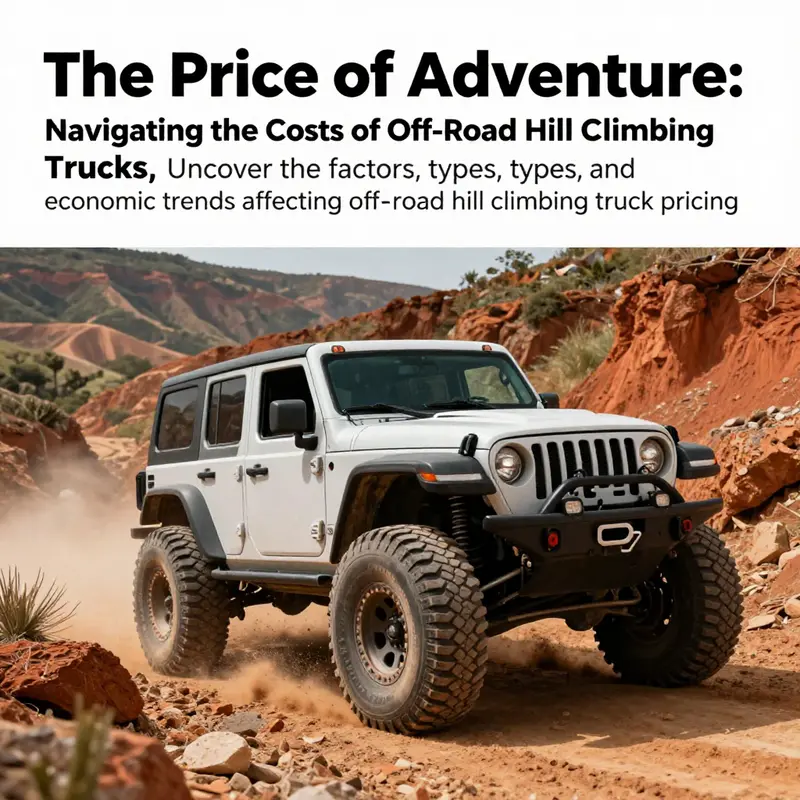
Off-road hill climbing trucks symbolize rugged capabilities, freedom, and adventure. Enthusiasts and racers alike seek these powerful machines to conquer treacherous terrains and climb steep hills. As the off-road community flourishes, understanding the cost of these trucks is vital for informed purchasing decisions. This comprehensive exploration delves into the intricacies that influence the pricing of off-road hill climbing trucks. From understanding the underlying factors affecting costs, to dissecting the various types available, and analyzing key economic factors, we’ll provide the insights you need. Finally, a glance at market trends will help you foresee the future of off-road truck pricing. Buckle up as we embark on this in-depth journey into the world of off-road vehicles.
The Ascent of Price: Unraveling What Drives the Cost of Off-Road Hill-Climbing Trucks

When economists map the price of a tool, they rarely look at a single component. For off-road hill-climbing trucks, the sticker price tells a story of choices made long before the vehicle hits the lift gate. The climb to price is not a straight line but a ridge line shaped by material science, powertrain engineering, and the intended mission. A rigorous user who needs steady performance on ragged, steep grades will weigh durability, torque, and modular capability far differently from a weekend warrior who seeks lightness and speed on rugged tracks. To understand what determines cost, we must walk through the core design decisions that determine value, then consider how those choices translate into price in the real market. The discussion is anchored by broad market observations and does not hinge on any single model, so the themes hold whether the truck is destined for heavy industrial use or for recreational exploration.
Material grade sits at the heart of the cost structure. When a vehicle must endure repeated impacts, abrasive surfaces, and heavy loads, the chassis, suspension, and bodywork are built from materials that offer a high resistance to fatigue and corrosion. High-strength steel alloys and reinforced composites can extend service life in harsh environments such as forest operations, mining access, or disaster zones. Those materials, however, demand more sophisticated production processes and higher raw material costs. They also require more careful fabrication, precise welding, and stringent quality control. The result is a heavier, stiffer platform that resists bending, torsion, and vibration when the terrain tests the vehicle’s limits. The extra durability isn’t just about withstanding a single climb; it’s about maintaining alignment and component integrity after dozens or hundreds of traverses across jagged rock, rutted clay, or dusty, abrasive slopes. In many industrial contexts, durability translates directly into fewer unscheduled repairs and less downtime, a practical form of value that can justify the upfront expense.
But material grade is not a single dial you can twist to tune price. It interacts with how the truck translates raw strength into usable capability. A stronger frame without a compatible suspension system won’t deliver the traction or control operators expect. Conversely, a sophisticated suspension with active damping, adaptive ride height, and electronically controlled differential locks can convert the same chassis into a much more capable climber. The construction details required to harmonize chassis, axles, and suspension contribute to cost through precision manufacturing, specialized components, and the need for robust service networks. For instance, industries that rely on hill-climbing trucks as core equipment—whether for remote extraction, heavy lifting in challenging locations, or emergency response—often demand protective enclosures, reinforced bumpers, and modular attachments. Each added feature elevates the base price, but also expands the truck’s functional envelope. The more the truck must perform under extreme conditions with limited access to maintenance, the more it leans toward premium materials and engineering rigor.
Power and propulsion sit close to material grade in determining price because they define what the truck can actually do on a climb. Hill climbing requires torque delivery at low speeds, sustained reliability, and the ability to manage peak loads when a slope narrows the available traction. A robust diesel or alternatives with ample low-end torque become a focal point of the design. The drivetrain—whether it relies on a heavy-duty manual or a highly engineered automatic transmission—requires components that can absorb shocks and transmit power through adverse traction conditions. Add features such as electronic traction control, selectable four-wheel drive modes, and integrated locking differentials, and the price climbs again. These technologies improve the vehicle’s ability to maintain momentum on steep or irregular surfaces, but they also introduce control systems, sensors, and calibration processes that increase manufacturing costs and, ultimately, the market price.
The interplay between performance capabilities and reliability matters just as much as raw power. A hill-climbing truck without reliable control systems may boast impressive torque, but it will require meticulous tuning and frequent maintenance to stay predictable under load. Modern off-road platforms often integrate adaptive suspension, ground-clearance management, and sensor-based traction strategies that optimize grip in real time. The hardware and software integration needed to deliver this level of performance require specialized engineering teams, higher-quality components, and rigorous testing. Each system adds a layer of cost, but it also provides a safety margin that operators value in high-risk environments. When a truck must perform on uneven terrain for long shifts, the cost of maintaining stable handling and predictable throttle response becomes a business consideration, not merely a technical luxury.
The intended industrial use of the vehicle is a powerful driver of price because it aligns a truck’s design with a specific job. A purpose-built machine that roams a remote forestry site, a mountain quarry, or a disaster zone often carries equipment tailored to those settings. Such configurations typically include winches, reinforced frames, modular cargo beds, and heavy-duty bumpers. It may also encompass special cooling systems to sustain performance in hot climates, armored protection for operator safety in exposed environments, and integrated communications modules to maintain contact with a central operations center. All of these customizations are valuable for mission success, but they add substantial cost because they require specialized materials, additional installation work, and more rigorous quality assurance. Conversely, a truck configured primarily for recreational off-road use tends to emphasize weight reduction, simplicity, and user customization. Fewer high-cost systems mean a lower base price, but also a narrower operational envelope. The market recognizes this distinction: buyers paying for industrial-grade resilience expect durable, serviceable machines with a longer forecasted life under hard use, while recreational buyers may prioritize agility, simplicity, and lower ongoing costs.
As this cost architecture unfolds, the market exhibits a broad spectrum of pricing. A new 4×4 off-road cargo truck with substantial payload capacity and heavy-duty drivetrain components will typically command a price significantly higher than a baseline, non-specialized vehicle. The price band can span a wide range, reflecting the level of equipment, engineering sophistication, and the scale of production. In many markets, buyers will encounter a wide spread—from tens of thousands of dollars for modest configurations intended for light duty, up to six figures or more for purpose-built industrial fleets with advanced protections and modular capabilities. The final price, of course, depends on many variables including the manufacturer, the specific specifications selected, the inclusion of optional features, and the terms of the sale such as financing and after-sales service packages.
Beyond the hardware, costs accumulate in ways that are easy to overlook. Shipping, freight handling, and import duties can significantly alter the landed price for buyers purchasing internationally. Local taxes, registration fees, and compliance with emission standards further shape the total cost of ownership. Even within the same model family, regional variations in labor costs, supply chain dynamics, and availability of skilled technicians can push the price up or down. Sellers frequently emphasize total cost of ownership rather than just the sticker price, highlighting how maintenance, spare parts, and service intervals influence the long-term expense profile. For anyone evaluating a potential purchase, a careful total-cost-of-ownership model often reveals that a higher upfront investment can be offset by lower maintenance bills and longer service intervals, or, in some cases, the opposite if reliability is compromised. This is why conversations about price should always extend beyond the initial sale.
In parallel with these considerations, there is a market for smaller, hobbyist-grade rock crawlers and remote-control variants. These machines, while capable of extreme terrain challenges in controlled settings, operate in a different cost universe. They can range from a few hundred dollars for basic RC models to several thousand for high-performance builds tailored to competitions. These offerings illustrate how the same core concepts—weight distribution, traction, and durability—scale across applications, from the industrial to the recreational. They also serve as a reminder that “off-road capability” is a broad idea with different economic implications depending on the intended use. The contrast underscores why price cannot be fully understood without situating a truck within its ecosystem of use, maintenance infrastructure, and operator requirements.
For readers who want to connect the engineering choices to practical outcomes, there is value in exploring how diesel architecture intersects with economics. A deep dive into diesel mechanics, timing, fuel efficiency, and maintenance planning can illuminate why certain powertrains justify their price premiums, especially when uptime is non-negotiable and repair opportunities are sparse. In particular, a resource that maps out how diesel systems are designed for reliability in demanding environments can provide a framework for analyzing the cost implications of engine choices. Mastering Diesel Mechanics: Your Step-by-Step Path to Success offers a pathway to understand how maintenance planning, parts availability, and technician expertise contribute to total ownership costs. This kind of knowledge helps buyers evaluate whether a higher upfront price translates into meaningful long-term savings or whether a leaner build better aligns with expected usage patterns.
The pricing picture, with its wide bands and nuanced trade-offs, is not simply a reflection of engineering prowess. It is also a function of the context in which the truck will operate. A hill-climbing machine used in remote industrial operations has different value drivers than a purpose-built demonstration or competition vehicle. For the former, reliability, serviceability, and protective features carry more weight, even if they push the price upward. For the latter, where performance bragging rights and modular experimentation are central, the willingness to pay is framed by the desire for customization and the ability to swap components with minimal downtime. The cost calculus, therefore, is a negotiation between technical necessity and strategic use. The buyer’s decision hinges on identifying which attributes translate into real-time value on the job or on the track. That is a fundamental shift from seeking the most powerful engine to seeking the most predictable, maintainable, and adaptable system.
As we consider how to approach pricing in this space, it helps to keep a mental model of how these trucks are used in the field—and how that use-case maps onto price. If the vehicle is expected to operate in harsh environments with limited access to maintenance facilities, then features that reduce risk and simplify servicing become essential and expensive. If the operation is a controlled environment with predictable work cycles, a lighter configuration with fewer specialized systems might deliver the best return on investment. In either case, the conversation about cost moves from a single price tag to a portfolio of costs and benefits—initial, ongoing, and sometimes hidden, in the form of downtime, wear, and the ability to complete tasks within a required window.
From a broader perspective, the cost of an off-road hill-climbing truck embodies a design philosophy: the vehicle is a tool that must fit the job, not just a machine that happens to be capable. That philosophy implies a cost structure where certain capabilities are non-negotiable and others are tradeable, depending on the operator’s constraints and ambitions. When read through this lens, the price becomes a marker of alignment between need and capability. A machine bought to withstand extreme conditions but operated on long, quiet stretches will likely show a different cost trajectory than a machine designed to excel on intense, irregular climbs where every gram of weight and every watt of power counts. A buyer who understands this alignment can negotiate intelligently, weighing the upfront price against the long arc of performance, maintenance, and uptime.
In closing this exploration, the key takeaway is that price emerges from a suite of interlocking decisions. Material grade sets the baseline durability; the powertrain and drive systems translate capability into climb performance; and the intended use shapes which combinations of features deliver reliable value. Market realities—shipping, duties, taxes, and service networks—further color the final number. The best way to approach cost is to clarify the mission: what terrain, what load, what uptime target, and what maintenance bandwidth does the operation require? With that clarity, the price becomes a rational investment, not just a sticker on a spec sheet.
External resources can deepen this framework for readers who want to test the economics against engineering details. For a grounded examination of how material grades and performance considerations intersect with industrial uses, see the external resource on off-road truck material grades, performance, and industrial uses. Understanding Off Road Army Truck: Material Grades, Performance, and Industrial Uses.
The Price of Grit: Deconstructing Costs in Off-Road Hill Climbing Trucks
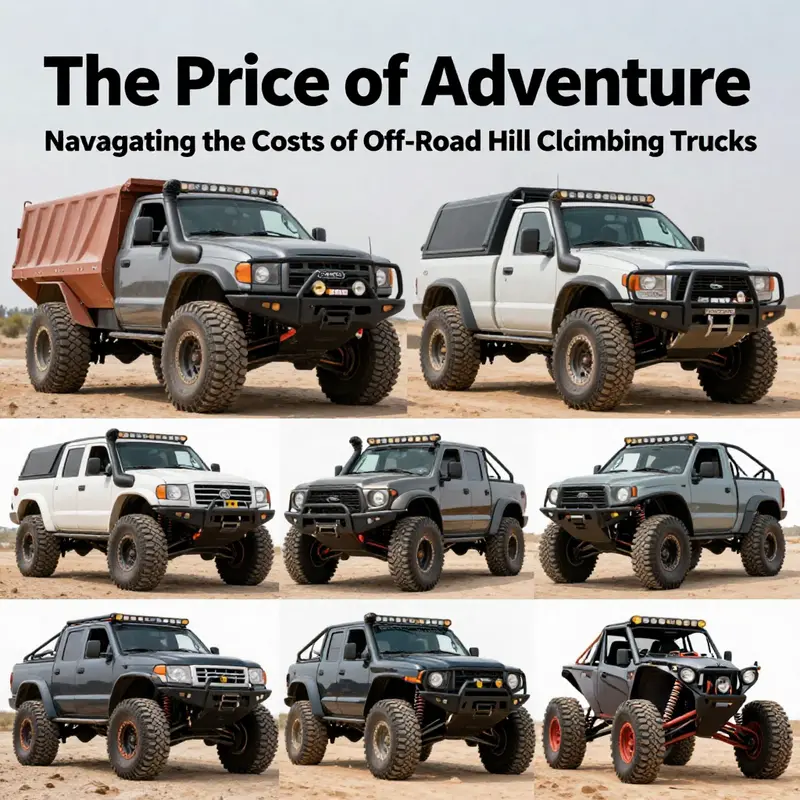
Every off-road hill climbing truck carries with it more than a sticker price. It carries a philosophy of movement through impossible angles, mud, rock, and grade. The cost, in other words, is a story about purpose as much as engineering. In the broad spectrum of these rugged machines, price emerges as the most visible signal of how a vehicle will perform when the world tilts and traction becomes a precious, limited resource. To understand what a hill climbing truck costs, we must first ask what it is built to do. Is it a heavy-duty workhorse designed to haul payloads through remote work sites, a compact crawler built for agricultural access, a purpose-built competition rig, or a scaled-down remote-control model intended for sport and curiosity? Each path commands a different financial trajectory, a different set of constraints, and a different return on investment that is measured not only in currency but in reliability, longevity, and the ability to keep moving when the terrain fights back.
For the industrial and heavy-duty end of the market, a four-wheel-drive off-road cargo truck stands as a practical benchmark. These are the machines that conceptually resemble a bridge between a conventional highway truck and a bulwark against the elements. They are designed to carry significant payloads, negotiate rough routes, and operate in environments where paved roads vanish and bolted steel becomes the language of resilience. In the current marketplace, a new four-wheel-drive off-road cargo truck with a payload reaching roughly 9 metric tons and powered by a mid‑range diesel engine can be priced in a broad range. The list price for such a model often starts in the low tens of thousands, with the common market expectation hovering around mid‑twenties to the low thirty‑thousands for standard configurations. The exact price is a function of the manufacturer, the engine’s power band, transmission type, and the level of refinement in the cabin and chassis. This is the baseline where industrial planners and fleet managers begin to weigh choice, capacity, and economy in balance.
Yet the true cost story doesn’t stop at the sticker. Emissions compliance, such as Euro6, often accompanies the base price, adding a layer of regulatory compliance that can influence both purchase price and ongoing operating expenses. A Euro6-compliant build may command a modest premium, but that premium can be a prudent investment when it translates into better fuel efficiency, lower permitted emissions, and easier entry into regulatory frameworks across different regions. The interplay between power, torque, and fuel economy matters here, because the hills these trucks climb aren’t a matter of sport; they’re a measure of how consistently a machine can move under load, across long shifts, in climates that test engine endurance. In practical terms, buyers aren’t just paying for horsepower; they’re paying for the engineering to sustain performance under heavy load and rough terrain, with the resilience to keep moving after a tire blows out or a rock catches the chassis.
To scale the perspective beyond the large industrial platform, there is a bifurcation in the market that many buyers must navigate. On one side lies the world of multi-purpose crawler vehicles. These are smaller, more versatile machines that can transport goods or personnel across uneven ground with a simpler drivetrain and a more modest payload. The price entry point for these crawlers is dramatically lower than their larger siblings. In bulk, suppliers advertise starter prices in the region of a few thousand dollars—roughly around two to three thousand dollars for bulk purchases of compact crawlers. The per‑unit price drops further as orders scale, turning what might appear as a budget purchase into a fleet-building exercise for a remote site or a maintenance operation. These vehicles are designed for accessibility and practicality. They aren’t built to sprint up the steepest grades, but they can reliably traverse uneven terrain to keep operations moving where standard pickups would stall. For many property maintenance teams, agricultural operations, or small remote worksites, these compact crawlers offer a compelling value proposition: a modest upfront cost coupled with straightforward maintenance and dependable, if modest, performance.
The spectrum, however, broadens dramatically when one steps into the realm of competition rock crawlers. Here the aim shifts from mass transport and worksite reliability to precision, control, and adaptability in extreme obstacle courses. Competition rigs—whether scaled RC models or full-sized builds—test the limits of suspension geometry, grip, and balance as teams push their machines to the edge. The pricing in this segment is highly variable, reflecting the degree of customization, the sophistication of drivetrains, and the degree to which builders optimize weight distribution and chassis stiffness. Entry-level RC rock crawlers often begin in the low hundreds of dollars, with higher-end, more capable models moving into the several hundreds. For full-sized competition vehicles, the price can be significantly higher, driven by bespoke suspensions, high‑end components, and precise control systems. This is where enthusiasts understand the cost as a function of artistry as well as engineering—a reminder that the sport of hill climbing is as much about your ability to choreograph motion through rock and dirt as it is about raw power.
A parallel market operates in a third category that sits between worksite utility and recreation: remote-controlled off-road toy trucks. While these are not capable of transporting goods or spanning real-world distances, they play a critical role in introducing new participants to the physics of hill climbing and off-road dynamics. Prices for these miniature hill-climbers are usually a fraction of their full-sized counterparts, ranging from a modest three dozen dollars to the mid‑hundreds for more sophisticated, higher-performance models. This tier acts as an on-ramp for younger enthusiasts and helps educators and hobbyists build intuition about traction, center of gravity, and torque distribution without the risk and expense of full‑size machines.
Taken together, the market for off-road hill climbing trucks reveals a wide continuum of price points that mirror the diversity of use cases and engineering ambitions. On one end, there are industrial solutions designed to move payloads under extreme conditions, often built to endure harsh climates, rough surfaces, and the physical wear that comes from long hours of operation. On the other, there are crawlers and RC models that celebrate the ingenuity of vehicle dynamics in a controlled environment, where the objective is to optimize grip, articulation, and stability over challenging obstacles rather than to maximize payload or speed. And between these poles lies a spectrum of purpose-built vehicles that straddle utility and recreation, offering manageable capabilities for remote worksites while also satisfying the desire for hands-on, competitive experience.
Understandably, price only tells part of the story. The total cost of ownership for any off-road hill climbing truck depends on a suite of factors that extend beyond the purchase price. Maintenance intervals, tire wear, spindle and axle integrity, drivetrain friction, and fuel or energy consumption all accumulate over the life of the vehicle. A larger, more powerful platform requires more robust maintenance planning, a higher cadence of service, and parts that are often engineered to withstand more rigorous use. In many cases, the total cost of ownership can outpace the initial purchase price when the vehicle spends more time in the shop than on the hill, or when the operator demands a level of reliability that justifies premium components and bespoke upgrades.
Emissions compliance is one ongoing financial element that can impact the total cost. As markets tighten around cleaner operation, meeting or exceeding emissions standards can require upgraded engines, exhaust aftertreatment systems, and more precise fuel management. These systems can raise upfront costs but may translate into lower operating costs through better fuel efficiency, lower tax obligations, and easier compliance with international transport regulations. For fleets that operate across borders or on remote sites with limited infrastructure, the added reliability and regulatory peace of mind can be a decisive factor in the economics of the purchase, even if it means paying a bit more upfront.
Discussions of price cannot ignore the physical scale and the technical complexity of the vehicle. The most capable heavy-duty configurations—those with high ground clearance, reinforced suspension, and the ability to maintain traction across mud, snow, and broken rock—often feature advanced suspension systems designed to absorb shocks and maintain stability. They may incorporate locking differentials, multiple drive connections, and chassis reinforcements that allow for extreme articulation without compromising safety. Each of these design choices contributes to the final price. The more locks, the more complex the hydraulic systems, and the more robust the chassis, the higher the initial cost. These features are not mere luxuries; in the most demanding terrains, they translate into the difference between successful climbs and stalled, immobilized trucks.
Pricing guidance, drawn from supplier catalogs and market listings, reinforces the idea that cost scales with capability. In certain catalog entries, heavy-duty models with multiple drive configurations and modern turbocharged powertrains begin at around the mid‑twenties of thousands of USD. For some premium configurations that emphasize high torque and regulated performance, the price can exceed a modest six-figure threshold, particularly when specialized equipment, reinforced cabs, or mission-specific interfaces are included. It is important to interpret these numbers as reflections of potential capability. Real-world price is a negotiation among payload needs, regulation, environmental considerations, preferred drivetrain options, and the degree of ruggeding desired for the task at hand. The same equation applies to smaller crawlers and RC vehicles, where the baseline price can drop by an order of magnitude, but adjustments for durability, control precision, and component quality still produce meaningful differences in cost.
If you look closely at the cost drivers, one emerges with clarity: size and purpose determine the price ceiling, while engineering discipline and material choice determine the price floor. A lightweight, compact crawler intended for remote sites might cost enough to cover a basic weekly site visit if purchased new, but its annual operating expense could remain modest due to lower fuel consumption, simpler maintenance, and a smaller maintenance footprint. In contrast, a large, four- or six‑wheel-drive workhorse designed for continuous heavy lifting will require a more substantial initial investment, a structured maintenance program, a robust supply chain for spare parts, and a plan to manage wear and tear over many thousands of kilometers and hours of operation. This is not merely about buying a truck; it is about committing to a system that sustains performance over time, especially in environments where a breakdown is not a mere inconvenience but a disruption of critical operations.
The decision framework behind pricing also benefits from an awareness of ancillary costs that often follow the initial sale. Shipping and logistics for remote or international procurement can add a meaningful margin to the price. Import duties, local taxes, and compliance documentation are all factors that sometimes catch buyers by surprise when the objective is to assemble a fleet quickly for a remote site. Financing terms, maintenance contracts, and extended warranties can alter the monthly or annual cost profile in ways that influence lifecycle budgeting. For teams evaluating a heavy-duty platform, it is prudent to run a comprehensive total-cost-of-ownership analysis that includes the price of spares, the cost of specialized tires for rocky or muddy terrain, and the potential need for aftermarket stabilizers or tie-down systems to ensure safe operation during climbs and descents.
In this broader budgeting lens, the conversation naturally leads to how the broader fleet and project management ecosystem interacts with truck pricing. If an operation relies on a diverse mix of vehicles, from compact crawlers to large industrial transports, the economics of fleet management become a tapestry of interconnected decisions. A fleet manager might weigh the upfront sticker price against depreciation curves, maintenance scheduling, and downtime costs. They might also consider the value of modular upgrades—things like enhanced suspension, strengthened chassis, or integrated winches and traction aids—as strategic investments that can lower long-run downtime and improve payload efficiency on the hill. This is where the practical wisdom of fleet optimization comes into play, reminding us that cost is not a single line item but a spectrum of financial commitments that accumulate with every mile climbed and every payload delivered.
For readers who are budgeting with a more experimental or hobbyist intention, the price story remains compelling but fundamentally more approachable. The entry point for hobbyists and RC enthusiasts remains within reason, with models that can be acquired for a few tens or hundreds of dollars. These units offer educational value and hands-on experience with off-road dynamics, and they scale in complexity as the learner’s skill grows. A mid-range RC model with enhanced suspension, more robust motors, and improved control can still cost a few hundred dollars, while top-tier, competition-oriented RC crawlers push into the high hundreds. The emotional price of this tier is measured not in payload capability or regulatory compliance but in the satisfaction of mastering a technical challenge and refining a control strategy that translates to real-world intuition about how traction and gravity interact with tire grip and weight transfer.
Beyond the numerical ladder of prices, there is a deeper, recurring question about value. In any of these segments, the price is a proxy for the confidence that the machine will perform when the terrain becomes hostile. The best answer to “what does it cost?” is not simply “how much money” but “how much reliability, capability, and return on investment does this machine deliver under the conditions it is expected to face?” When the hills demand torque, traction, and balance while carrying weight, the investment in a robust drivetrain, a reinforced chassis, and a thoughtful suspension becomes a strategic decision rather than a one-time purchase. The strongest cases for premium builds tend to be those where the operator cannot afford a breakdown—a scenario common in mining, forestry, and remote infrastructure projects—where uptime is the currency and the cost of downtime far exceeds the upfront price of a well-engineered truck.
As you map out a budget for an off-road hill climbing program, consider how the cost narrative intersects with your organizational realities. If your operation spans cross-border routes with variable fuel prices, you may prioritize engines with clean emissions profiles and better efficiency, even at a higher upfront price. If your hill climbs are more recreational or educational, you might emphasize control precision, ease of maintenance, and accessibility of spare parts, which can steer you toward different configurations that balance cost with experiential value. And if your interest lies in the challenge itself—testing limits, refining technique, and competing—then the cost calculus leans toward customization and performance optimization, often accompanied by a willingness to invest in specialized components that keep the truck competitive season after season. In all cases, it is the alignment between mission, maintenance discipline, and total cost of ownership that ultimately determines whether a given price tag represents prudent stewardship or an overambitious gamble.
For readers who want to connect the pricing discussion to practical procurement considerations, a useful step is to explore how support tools and dispatch planning influence the economics of operating at the edge of capability. The cost of ownership isn’t only a matter of the vehicle’s price tag; it is also about the systems that enable efficient utilization, timely maintenance, and reliable deployment. When teams weigh the initial purchase against ongoing operational costs, they should consider both the capital expenditure and the recurring costs associated with vehicle management. In this light, one practical direction is to examine how fleet tools and software can optimize route planning, maintenance scheduling, and resource allocation. For those curious about the budgeting implications of dispatch software, see this overview: Choosing dispatching software: key tips and pricing. This resource helps illuminate the trade-offs between upfront software expenditure and the long-term value of improved efficiency and reduced downtime. Choosing dispatching software: key tips and pricing
Finally, any serious pricing discussion should acknowledge the data sources that inform these ranges. Market listings and supplier catalogs provide a spectrum of numbers that reflect regional demand, component availability, and the competitive landscape. The external data point from a leading catalog platform illustrates how price bands can appear across heavy, multi-axle configurations, with base entries starting in the tens of thousands and premium configurations pushing beyond the prices most casual buyers would expect. Buyers are encouraged to engage directly with suppliers to secure precise quotations that account for shipping, duties, financing, and any site-specific modifications. Such conversations also reveal the practical realities of delivery to remote sites, the availability of spare parts, and the support network that sustains performance over time. In other words, the price you see on a page is the doorway to a broader conversation about capability, reliability, and long-term value on the hill.
For readers who want a concrete starting point in understanding market variations, remember that the most relevant data often lies in the diversity of the market itself. Heavy-duty work trucks with four-wheel or six-wheel drive typically demand higher investment but deliver the necessary stability and payload support for demanding climbs. Mid-size crawlers offer a balance between capability and cost, while RC models and toy trucks provide a platform to learn core concepts at a fragment of the price. Across all segments, the central truth remains stable: the cost of an off-road hill climbing truck is as much about the mission as it is about the metal—an investment in how a machine can press forward when the hill refuses to yield.
External resource for reference: https://www.alibaba.com/product-detail/Off-Road-Lorry-Truck-999-Price-range_1600743119213.html
Rugged Markets: Unpacking the Economic Engine Behind Off-Road Hill-Climbing Truck Pricing
Pricing an off-road hill-climbing truck sits at the intersection of engineering ambition and market forces. These machines blend heavy-duty chassis rigidity, high-torque diesel propulsion, and specialized suspension with the economic realities of global supply chains. When you look past the raw specs—payload capacity, wheelbase, power output, and drivetrain layout—the price tag reflects a spectrum of decisions about materials, manufacturing complexity, regulatory compliance, and the cost of moving parts from supplier to customer. In practice, the sticker price on a new heavy-duty 4×4 cargo or utility truck with substantial off-road capability often falls within a broad band. Depending on how a manufacturer tunes the spec, adds protective features, and packages the equipment, the price can start in the mid five figures and extend well into the six figures, sometimes surpassing the six-figure threshold for top-tier configurations. These figures are not arbitrary; they crystallize a chain of inputs and decisions that begin long before a vehicle leaves the assembly line and end only when a contract is finalized, financed, and delivered to the final user on rugged terrain or remote industrial sites. The challenge for buyers is to discern which components of price matter most to their use case and which costs can be reliably predicted given current economic conditions.
The broad economic canvas in which these trucks are bought and sold has several persistent motifs. First, the base price of a capable off-road truck mirrors the size of the vehicle and the heft of its drivetrain. A larger machine with greater payload capacity, more aggressive approach and departure angles, and a more robust transfer case and axle assembly tends to command higher prices. Similarly, engines that deliver substantial horsepower and torque, tuned for reliability under harsh conditions, add cost through engineering rigor, durability testing, and long-term efficiency considerations. In practical terms, buyers are often weighing the value of extra articulation, stronger frames, reinforced housings, and longer service life against the upfront price premium. In some markets, buyers also consider how a given configuration will scale when faced with extended duty cycles, extreme climbs, or heavy loads for days at a time. The economic logic is straightforward: customers will pay more if the marginal improvements in capability translate into meaningful reductions in downtime, faster cycle times, or greater safety margins in challenging environments.
A closely related driver of price is the regulatory and regulatory-adjacent costs embedded in the design and build of these machines. Emissions compliance, safety standards, and component durability under challenging conditions all shape the bill of materials and the testing regime. While the specific regulatory targets vary by region, the trend toward tougher standards tends to raise the cost of the engines, exhaust aftertreatment, filtration systems, and chassis reinforcements. Even when a country or region does not dictate an explicit technology stack, customers and national safety expectations push manufacturers to adopt robust performance envelopes. In practice, this translates to more expensive materials, more exhaustive quality assurance processes, and longer development cycles. All of these factors feed into the delivered price, even if the end user never inspects the internal engineering details.
The price also reflects the realities of input costs, which fluctuate with energy markets, commodity prices, and supplier dynamics. Oil prices, in particular, have a cascading influence on the cost structure of off-road trucks. Petroleum-based inputs touch virtually every corner of the vehicle’s ecosystem: tires, lubricants, adhesives, fuel-system components, and even certain forms of plastics used in interior parts and modular panels. When oil prices rise, manufacturers typically face higher raw-material and production costs. These increases are often transmitted to customers through higher quoted prices or adjusted payment terms. Conversely, periods of lower energy prices can ease production costs and potentially widen manufacturers’ margins or enable more aggressive pricing, depending on the competitive landscape and capacity constraints. The sensitivity to energy markets means that buyers who plan for multi-year ownership should track oil price trajectories as part of their purchasing calculus.
Beyond energy costs, macroeconomic conditions shape demand and affordability. Inflation, interest rates, and consumer confidence directly influence whether buyers take on large capital purchases or defer them. In an environment characterized by rising prices and tighter credit, demand for high-end, purpose-built off-road trucks can soften, prompting vendors to refine pricing strategies. They may offer more flexible financing, shorter-term promotions, or bundled maintenance plans to preserve sales volumes without eroding unit margins. In contrast, favorable macro conditions—low inflation, stable interest rates, and solid employment—tend to bolster discretionary spending on specialized equipment. In such climates, manufacturers can maintain premium pricing for high-spec configurations, secure lead times to manage demand, and reduce discounts, all while signaling long-term value through performance guarantees and service networks.
A parallel thread runs through the price dynamic: global trade and currency movements. The modern supply chain for rugged vehicles is transnational. Components sourced in one region, final assembly in another, and delivery to distant markets create a landed-cost calculation that depends on exchange rates, tariffs, and import duties. Tariffs or quotas on certain parts can push overall costs higher, while favorable exchange rates can soften the price of foreign-sourced components. Even in the absence of explicit trade barriers, the cost of shipping, insurance, and logistics remains a meaningful component of the final price. When demand is high and supply chains are tight, these landed costs can compress or widen profit margins in unpredictable ways. Buyers should therefore consider not only the quoted price but also the total landed cost, including freight, duties, local taxes, and any required localization or certification work demanded by the destination market.
In this context, the choice of features becomes a central pricing lever. A base platform with core off-road capabilities may attract a modest premium, but the addition of enhanced suspension, reinforced chassis elements, heavy-duty locking differentials, integrated winches, advanced traction control systems, and corrosion-resistant coatings can significantly elevate the total cost. Each enhancement adds value in rugged environments but also introduces incremental production cost, test requirements, and after-sales service considerations. The economics of scale, supplier competition, and the manufacturer’s own engineering philosophy steer how aggressively these features are bundled and priced. For buyers, the key is to translate feature needs into a clear return on investment: how much extra uptime, safer operation, or faster expedition cycles will the feature enable, and how reliably can those gains be measured across a typical duty cycle?
Another layer of complexity arises from the market orientation of these machines. In industrial or heavy-duty sectors, buyers often negotiate custom configurations tailored to a particular operation. Customization can add months to development and testing, as well as higher per-unit costs due to non-standard components and production line retooling. Yet customization can also prevent costly retrofits, reduce downtime on the job site, and deliver longer period of peak performance in harsh environments. The pricing equation thus becomes a negotiation between the vendor’s capacity to support bespoke builds and the buyer’s tolerance for uncertainty and lead times. In fast-moving markets or regions with acute shortages of qualified labor in the field, shorter lead times may carry a premium, while in more saturated markets, manufacturers may lean into long-tail configurations and optimized standard options that keep costs predictable and margins stable.
The literature on these price dynamics often highlights the role of total cost of ownership. The sticker price is only the most visible tip of a much larger iceberg. Fuel costs, maintenance expenses, parts availability, and depreciation all contribute to the ongoing cost profile of an off-road hill-climbing truck. In rugged service, maintenance plans that minimize unscheduled downtime can prove worth their weight in reliability, even if they add to upfront expenditure. Buyers should examine maintenance intervals, the expected life of key components under heavy use, and the cost of critical replacements in their region. Depreciation depends on how demand for used units evolves and how quickly the market for specialized, high-demand configurations shifts. In some cases, a well-maintained, lightly used vehicle can retain strong resale value, while in others, rapid wear from extreme work can reduce a unit’s value more quickly. The prudent buyer weighs these depreciation implications just as carefully as the initial price tag.
The economic tapestry is not static. Energy-price forecasts, such as those tracked by global statistical agencies and industry analysts, influence strategic pricing decisions and long-range procurement planning. When energy price forecasts point to volatility, manufacturers may build more cushion into pricing to cover potential cost escalations, or offer more flexible contracts that allow price re-openers if input costs move beyond a defined tolerance. Conversely, during stable energy scenarios with predictable input costs, pricing can become tighter and more transparent, which can help buyers plan budgets with greater confidence. This dynamic environment underscores why buyers should engage in thorough supplier conversations, requesting transparent cost breakdowns and real-world data on how input costs have moved in the recent past and how they project forward under different scenarios. Where possible, negotiating terms that link price adjustments to observable indices or commodity prices can reduce the risk of misalignment between supply costs and the buyer’s budget.
For readers who want a practical angle on how pricing decisions extend beyond the vehicle itself, consider the broader ecosystem in which fleets and contractors operate. Pricing decisions for the trucks themselves are often linked to how buyers manage their fleets, dispatching, and maintenance workflows. These decisions do not exist in isolation; they ripple into how a business plans its capital budget, negotiates supplier terms, and designs its maintenance and fuel-management strategies. A useful way to frame this is to think about price as part of an integrated package: the vehicle, the service and maintenance commitments, the financing terms, and the operational tools that help manage a rugged fleet in difficult terrain. For those who want to explore how pricing decisions for one piece of equipment relate to the broader cost structure of fleet operations, a related discussion on dispatching software pricing offers helpful insights into how service, support, and risk mitigation are priced alongside core asset purchases. Discover more about these considerations through resources that analyze pricing strategies for fleet software and services, such as Choosing Dispatching Software: Key Tips on Pricing.
In closing, the pricing of off-road hill-climbing trucks is not solely a matter of the engine’s horsepower or the width of the tires. It is a synthesis of engineering rigor, regulatory compliance costs, input-price volatility, macroeconomic conditions, currency movements, and strategic decisions about features and customization. Buyers who approach price with a holistic view—one that tracks energy market trends, evaluates total cost of ownership, and weighs the value of reliability and uptime—will be better prepared to navigate the price signals that rise and fall with the market. They will also be better positioned to identify opportunities for value creation in pricing negotiations, lead times, and after-sales support that can dramatically influence the long-term cost of ownership. Finally, they should remain cognizant of how broader economic developments, including shifts in global energy markets, can tighten or loosen the belt on both supply and demand. To stay informed, readers can consult external data on oil-price trajectories and forecasts, such as the Global Oil Prices Forecast from Statista, which provides a snapshot of the energy market’s potential directions and helps frame cost expectations in a wider economic context.
External resource: https://www.statista.com/statistics/1270964/global-oil-prices-forecast/
Internal resource: For further insight into how pricing fundamentals can play out in fleet-management decisions and procurement strategies, consider exploring the article linked here: Choosing Dispatching Software: Key Tips on Pricing.
Charting the Cost Curve: Market Trends, Electrification, and the Future of Off-Road Hill-Climbing Trucks
When we speak about the cost of an off‑road hill‑climbing truck, we are really looking at a moving target that reflects not just the sticker price but a broader landscape of ownership. The market for these rugged machines has shifted from a niche, industrial curiosity to a dynamic sector where technological advances, material costs, and policy incentives all interact to shape the total price of ownership. In 2025, the global off‑road truck market carried a substantial footprint, valued at about USD 7.57 billion, and industry analysts projected a brisk compound annual growth rate of roughly 15 percent through the early 2030s. By 2033, the market could surpass USD 24 billion. Those numbers aren’t just abstract statistics; they map the forces that push price trajectories up or down, from the price of raw materials to the rate at which new propulsion and control systems become affordable and reliable under harsh, demanding conditions.
The fundamental demand for these vehicles spans several sectors. Industrial users rely on them to move heavy loads across rough terrain in mines, quarries, and remote construction sites. In these contexts, trucks must traverse uneven ground, mud, rocks, and steep grades while carrying payloads that can run into tens of tons. Recreational users, on the other hand, push the frontier in hill‑climb competitions and extreme terrain expeditions, where performance is defined not just by raw power but by suspension geometry, traction control, and endurance in adverse environments. The price a buyer ultimately pays reflects this spectrum of application. A typical new 4×4 off‑road cargo truck with a payload capacity around 9,170 kilograms (roughly 20,216 pounds) might be equipped with a heavy‑duty diesel powertrain delivering around 210 horsepower and a manual transmission, with a wheelbase in the vicinity of 4,500 millimeters and compliance with stringent emissions standards. Those specifications illustrate a class of vehicle designed for survivability and reliability in industrial settings rather than speed and showroom shine. Yet even within this class, the range of costs is wide, driven by factors that accumulate from the first sketch of the chassis to the last bolt tightened on the assembly line.
Pricing for such trucks is rarely a fixed line. In both new and used markets, the base sticker price can span from roughly fifty thousand dollars to well over a hundred and fifty thousand dollars, depending on who manufactures the chassis, the drivetrain architecture, and the particular blend of capabilities chosen. Add‑ons can sharply tilt the total: advanced suspension systems tailored to brutal terrain, integrated winches, reinforced frames designed to resist fatigue, bespoke cooling packages for hot climates, and heavy‑duty axles built for sustained abuse. Each of these choices compounds capital expenditure and, often, operating expenditure as well, because more capable equipment can reduce downtime and extend service life in punishing environments. Shipping costs, import duties, and local taxes can further alter the price tag, especially for buyers in regions with rising protectionist tariffs or long supply chains. These dynamics mean that two trucks with superficially similar specs can end up with markedly different total costs of ownership once all lifecycle considerations are included.
For hobbyists and smaller enthusiasts, the cost spectrum is more forgiving, yet the same principle applies: performance enclosures, scale of propulsion, and durability all influence price. In the realm of radio‑controlled or small‑scale rock crawlers intended for competition or recreation, prices range from a few hundred dollars to several thousand, offering a window into how performance hardware scales with cost as one moves up the ladder toward full‑size, field‑tested machines. The broader takeaway is that, across the board, the initial price is only the opening line in a longer story. The total cost of ownership includes fuel or energy costs, maintenance, downtime, resale value, and the opportunity cost of capital tied up in a machine that may be deployed only part of the year or in limited geographic areas.
That broader view becomes particularly important when we consider the ongoing transition toward electrification. Electric off‑road trucks are increasingly entering the conversation because they promise lower operating costs, quieter operation, and reduced emissions, which matter both for compliance with stringent environmental regulations and for the practical realities of working in sensitive or restricted sites. The appeal is not merely about a single metric like upfront price; it rests on a suite of performance advantages and long‑term savings. Electric propulsion can deliver strong torque at low speeds, which is highly advantageous on steep climbs and uneven surfaces where traction is the deciding factor. In addition, the regenerative aspects of electric drivetrains can contribute to energy efficiency during starts, stops, and slow maneuvering on grades that would be taxing for traditional diesels.
But electrification comes with its own set of tradeoffs. The upfront cost of large battery packs is substantial, and charging infrastructure for heavy off‑road work is a nontrivial investment. Charging times can affect production schedules, particularly on remote sites where grid capacity is limited or where downtime translates directly into costly delays. Battery efficiency under extreme temperatures, depth of discharge, and cycle life are other levers that shape the long‑term cost profile. Ongoing improvements in energy density, manufacturing scale, and fast‑charging capabilities are steadily reducing these drawbacks, yet the economics of a switch from diesel to electric are never static. The cost calculus now increasingly includes not only the purchase price but also the expected savings from fuel, maintenance, and downtime reductions, against the backdrop of evolving electricity prices and potential subsidies or incentives for clean energy infrastructure.
These factors converge with the global supply chain environment. The price of raw materials such as lithium and cobalt has a direct bearing on battery costs and, by extension, on the price of electric off‑road trucks. Disruptions in mining, refining capacity, or transportation can ripple through to production lines, altering lead times and final pricing. At the same time, governments around the world are adopting more aggressive emissions standards and offering incentives to accelerate the adoption of electric fleets. In prosperous regions, these policy levers can tilt the economics decisively in favor of electrification, especially when coupled with subsidies or tax credits that offset part of the upfront capital cost.
From a strategic perspective, buyers of off‑road hill‑climbing trucks should view price not as a single figure but as a set of interrelated cost components that unfold over time. The initial purchase price is just the first layer. A credible total cost of ownership model should include maintenance and parts costs that reflect the harsh service environment, fuel or electricity costs, uptime and utilization rates, and depreciation. In industrial settings, where reliability directly impacts production throughput, the cost of downtime is a tangible and recurring expense that can dwarf routine maintenance. In high‑demand situations, more capable suspension systems and drivetrains may be worth their premium because they preserve uptime and reduce the likelihood of field failures that require expensive on‑site replacement or long wait times for parts.
The market signals about where costs are headed are nuanced. On one hand, the expanding footprint of off‑road trucks in mining, construction, and remote logistics has driven scale effects that tend to push unit costs down as production volumes rise and supply chains stabilize. On the other hand, demand for higher performance and more resilient hardware keeps pushing some price anchors upward. The balancing act is further complicated by geographic variability. In regions with mature manufacturing ecosystems and strong aftersales networks, customers can realize lower total costs due to easier access to parts, technicians, and replacement components. In market segments driven by bespoke specifications—where buyers demand custom chassis layouts, specialized cooling, or fatigue‑resistant materials—the upfront price climbs in step with the tailored performance envelope.
Electric propulsion adds another layer of financial consideration. Early‑stage electrification projects often carry a premium for the battery system, power electronics, and high‑integrity charging interfaces. Over time, as battery packs gain energy density and cost per kilowatt hour declines, and as manufacturers achieve greater production efficiency, the price gap between electric variants and their diesel counterparts tends to narrow. Yet the decision is not purely a question of upfront payback; it includes the reliability of charging infrastructure in remote sites, the predictability of electricity prices, and the ability to quantify benefits in terms of emissions compliance, workforce safety, and noise reductions—all of which have tangible value to operators with large fleets and sensitive work environments.
To anchor these considerations in a practical sense, imagine a mid‑sized fleet operator evaluating a pair of truck configurations for a rugged worksite. One is a diesel‑powered, 4×4 cargo truck with a robust payload capacity, a manual transmission, and standard off‑road suspension. The other is an electric version with equivalent traction and a similarly capable suspension system, but with a significantly larger energy storage package and an accelerated charging plan. The diesel option may come in at a lower initial price, but it comes with higher fuel costs, more frequent maintenance, and greater heat management demands in hot climates. The electric option offers reduced fuel costs and quieter operation and can avoid certain maintenance events associated with combustion engines. However, it carries higher upfront costs and requires careful assessment of charging availability, cycle life, and thermal management in the site’s climate. The decision becomes a nuanced optimization problem, where the operator weighs the present value of lifetime costs against the strategic value of uptime, safety, and compliance.
Beyond the equipment itself, cost dynamics are shaped by the broader ecosystem of fleet management. Modern operators increasingly rely on digital tools to optimize utilization, maintenance scheduling, and parts logistics. The integration of telematics, remote diagnostics, and predictive maintenance can shave operating expenses and improve uptime. In practice, this means that even if a particular truck line carries a higher sticker price, the long‑term savings from better scheduling, reduced fuel consumption, and fewer in‑field breakdowns can justify the initial premium. For fleets of any size, incorporating the right software and data‑driven processes becomes as important as selecting the base vehicle. The right combination of hardware and software can materially alter the payback horizon and the perceived affordability of a given purchase.
One practical implication for buyers is the relevance of total cost of ownership models that reflect site realities. A plant with stable power supply, strong maintenance support, and predictable weather patterns will experience different TCO dynamics than a remote, resource‑scarce site where logistics costs are higher and downtime penalties are steeper. A comprehensive TCO calculation should include not only fuel and energy costs, but also the cost of capital tied up in the vehicle, insurance, taxes, maintenance parts, and the potential resale value at the end of the asset’s life. Importantly, TCO must account for downtime costs in the most realistic terms possible, because a single unplanned day off the job can eclipses many months of small efficiency gains elsewhere.
In contemplating the future, market analysts highlight several key drivers that will shape costs in the coming years. The first is supply chain stability. As manufacturers scale up production and diversify supplier bases, procurement costs can stabilize, with longer supplier contracts offering price shields against volatility. The second driver is raw material pricing, particularly for lithium and cobalt, which can ripple through to battery prices and, by extension, to the economics of electric off‑road trucks. Third, government regulations on emissions and the related incentives for cleaner fleets will influence the total cost equation in a material way. Regions that actively deploy subsidies or tax incentives for electric equipment and charging infrastructure will see faster payback periods and broader adoption, especially among larger operators facing tighter margins and stricter environmental rules.
The trajectory of technology adoption in off‑road hills and remote work sites is also shaped by the pace of innovation in mechanical systems. Advances in suspension design, traction control, and drivetrain robustness contribute to a lower cost of failure and longer maintenance windows. Durable materials—such as fatigue‑resistant alloys and corrosion‑resistant coatings—improve longevity in harsh environments, reducing replacement costs over time. These improvements not only make the vehicles more capable, but also make them more cost‑effective in the real world. When combined with improvements in energy storage and fast charging, electrified platforms begin to converge toward parity with traditional diesel platforms on a lifecycle basis, even if the upfront cost remains higher for the near term.
For readers seeking a concrete sense of market scale and direction, consider the broader industry analysis that tracks off‑road vehicle segments across multiple applications. The latest assessments point to consistent growth driven by industrial demand, infrastructure investments in developing economies, and a growing emphasis on efficiency and safety. They also highlight the potential for electrified solutions to capture a meaningful share of the market over the next decade, particularly as charging networks extend and battery costs fall. In practical terms, this suggests that buyers who plan for a six to ten‑year asset horizon may find it prudent to include a specter of electrification in their long‑range budgeting, even if they purchase diesel variants today. It is not merely about the color of the exhaust or the quiet of the cabin; it is about the calculus of uptime, efficiency, and resilience under demanding conditions.
The chapter of costs, then, is not a single paragraph but a living dialogue between market size, technology advancement, policy direction, and operator needs. The trend toward electrification, with attendant reductions in per‑hour operating expenses and emissions, is likely to reshape the economics of hill‑climbing trucks in ways that become more pronounced as the technology matures. Yet the path to widespread electrification depends on a constellation of factors—battery economics, charging infrastructure, site logistics, and the availability of skilled maintenance for high‑tech systems. In this sense, the cost narrative is not a simple line but a branching tree where different routes lead to similar destinations: more reliable, more efficient, and more sustainable off‑road capabilities.
As readers weigh their options, it is useful to remember a practical rule of thumb that often holds in this market. The most economical choice is not always the cheapest upfront; rather, it is the option that minimizes total downtime, maintenance spares, and energy expenditure while delivering the required capability. A truck that can keep moving in rough terrain and withstand the rigors of continuous service, even if it costs a bit more at purchase, can deliver a lower overall cost per ton moved and a higher return on investment over the asset’s life. In other words, cost effectiveness in off‑road hill‑climbing isn’t only about the sticker price. It’s about the resilience of the entire system—the truck, the charging or fueling solution, the maintenance ecosystem, and the data‑driven processes that turn raw capability into reliable throughput.
In closing, the cost landscape for off‑road hill‑ climbing trucks is at once complex and predictable in its direction. The market is expanding, technological boundaries are shifting, and the economics of ownership are becoming more favorable for well‑planned electrified or hybrid configurations as scale and innovation converge. Price is still a crucial factor, but it no longer operates in isolation. Buyers who integrate lifecycle thinking—factoring in energy costs, maintenance, downtime, and end‑of‑life value—will be best positioned to navigate the evolving curve. The convergence of stronger demand, smarter engineering, and policy incentives suggests a future where the true cost of ownership becomes a clearer, more stable lens through which to evaluate off‑road hill‑climbing capabilities. For readers who want to anchor these considerations with practical data, a deeper dive into market size and projections from industry research can provide a structured framework to compare options and forecast budgets more accurately. As the sector evolves, the conversation around cost will continue to broaden, embracing not only the price tags on individual machines but also the efficiencies, resilience, and strategic value they unlock on the toughest terrain.
For further context on how fleet management software can influence cost outcomes, consider the broader ecosystem of dispatch and maintenance planning. Effective software tools can enhance asset utilization, reduce idle time, and streamline parts management, which in turn lowers operating expenses and extends vehicle life. A practical path is to explore how digital solutions integrate with the procurement and deployment of off‑road trucks, aligning hardware investments with the organizational capability to manage a dispersed, demanding workload. In many cases, the combination of reliable hardware and robust software is the deciding factor in achieving a favorable cost profile over the asset’s life. dispatch software and fleet management can thus be a meaningful part of the overall cost‑of‑ownership conversation, especially when deployed as part of an integrated fleet strategy.
Looking outward, the macro trend remains clear. The off‑road truck segment is poised for continued growth, with electrification and advanced drivetrain technologies offering a compelling set of benefits for operators who demand both capability and efficiency. Market analyses point to sustained demand across mining, construction, and remote logistics, but the real payoff will come from how well buyers can align vehicle specifications with site realities, manage lifecycle costs, and leverage the right mix of hardware, software, and energy strategies. In the long arc of industrial progress, the cost of getting up that hill is increasingly measured not only by the dollars spent at purchase but by the value created through uptime, productivity, and sustainable operations. For those who plan thoughtfully, the road ahead holds the promise of clearer economics, better performance, and a future where off‑road hill‑climbing trucks represent an efficient, resilient solution to some of the most challenging transport tasks in the world.
External resource for broader market context: For a detailed analysis of market size, application trends, and future projections, see Mordor Intelligence’s Off‑Road Vehicle Market report at https://www.mordorintelligence.com/industry-reports/off-road-vehicle-market.
Final thoughts
In summary, the cost of an off-road hill climbing truck is shaped by a myriad of factors, from its specifications and intended use to the economic environment and market trends. By comprehending these influences, off-road enthusiasts can make confident and informed decisions when purchasing their vehicles. As the off-roading culture continues to grow, staying abreast of these factors will be crucial to securing the right truck at the right price, ensuring an exhilarating yet responsible off-road experience.