
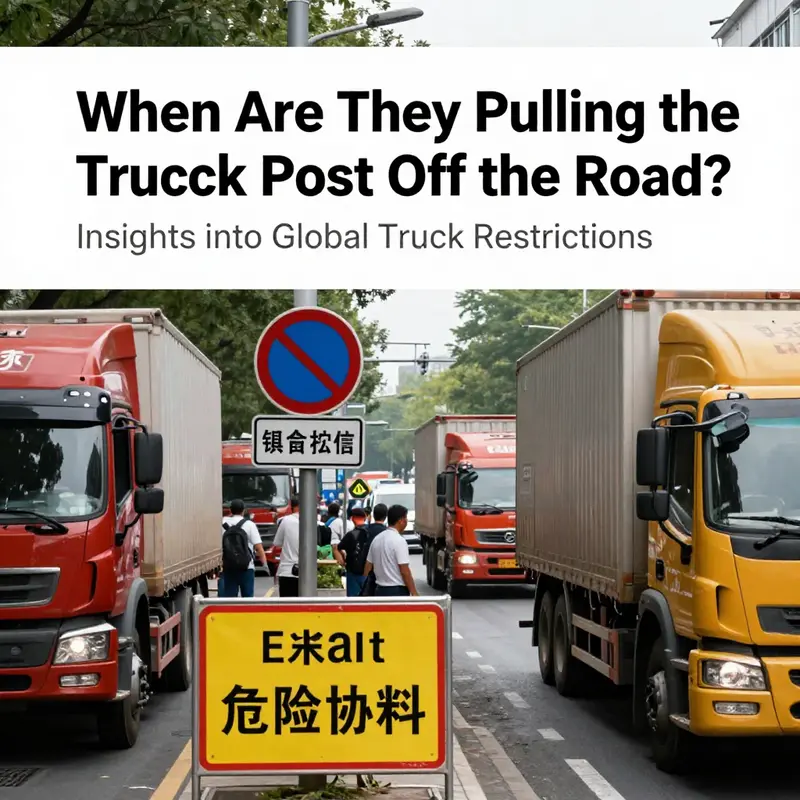
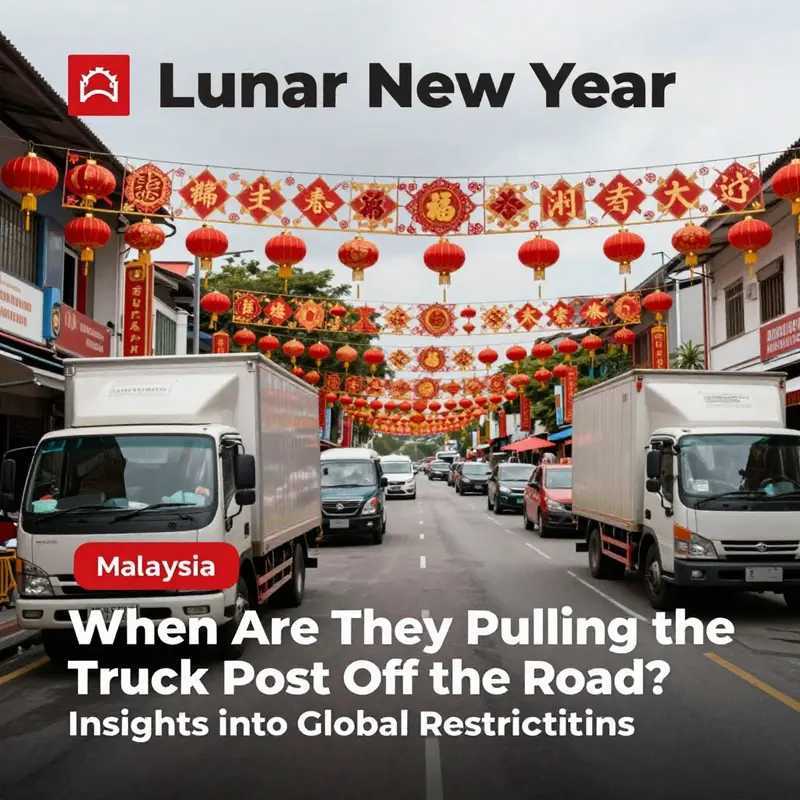
As off-road enthusiasts, rural landowners, and adventurous spirits, knowing when trucks are pulled off the road is crucial for planning your journeys and operations. Regulations regarding truck usage can vary significantly across regions and are often influenced by local safety and cultural considerations. In Beijing, the ban on trucks transporting hazardous materials sheds light on how public safety dictates vehicle management. Similarly, Malaysia’s Lunar New Year restrictions reveal the intersection of cultural events and transportation logistics. Through the upcoming chapters, we will thoroughly explore these different contexts, analyze traffic management measures, and consider the future landscape of truck operations, empowering you to navigate these challenges better.
null
null
null
null
When They Pull the Truck Post Off the Road: Reading the Clockwork of Temporary Restrictions and the Quiet Rules that Shape Heavy Haulage
Roadways are built for movement, but they become stage and conductor when rules tighten and rhythms shift. The question of when a truck is pulled off the road is rarely about a single mandate; it is a composite of time, place, purpose, and risk. In recent research and real-world practice, temporary traffic management measures emerge as the most visible expressions of a broader aim: to preserve life, keep critical operations moving, and balance the needs of all road users during periods when the normal flow would become unstable or unsafe. The clockwork behind these decisions is intricate. It hinges on geographies that see dangers differently, on the specific cargo in transit, on the size and maneuverability of the vehicle, and on a fleet’s ability to respond with agility. The Beijing example is a stark reminder of how targeted bans can be deployed within a city’s administrative boundaries to prevent the transport of hazardous materials from crossing lines that would otherwise seem passable on a map. When a city declares a prohibition that runs from midnight at the start of March to the same hour thirteen days later, it is not a mere pause; it is a calibrated pause designed to minimize exposure to risk during a window when resources and public tolerance for disruption are strained. From March 2 to March 13, 2026, the ban on vehicles carrying dangerous chemicals, particularly those classified as highly toxic, crystallizes the logic of temporality in traffic safety policy. It embodies the principle that some risks, while perhaps rare, carry outsized consequences, and that a city can, for a finite period, compress the risk by removing the most fragile or dangerous elements from its arterial routes. In contrast, Lunar New Year in Malaysia reveals another axis of temporal control. The restrictions on heavy goods vehicles during February 14–15 and February 21–22 in 2026 are not about hazardous cargo but about cultural practice and crowd dynamics. Festivals alter travel patterns in profound ways: people travel for celebrations, supply chains adjust to new schedules, and urban cores experience elevated pedestrian activity and vehicle conflicts. The regulations that accompany these events are as much about preserving safety as they are about preserving the cadence of daily life. Taken together, these examples illuminate how temporary restrictions function as both preventive and predictive tools. They are preventive because they reduce the likelihood of incidents in high-risk moments; they are predictive because they attempt to preserve a minimum level of mobility for essential services and logistics while the city or region reorders its priorities for a compressed period. The chapter that follows weaves these threads into a single narrative about the timing of truck pulls, the instruments used to enforce them, and the real-world consequences for fleets whose routes, schedules, and risk profiles are designed around predictable patterns that are, by design, temporarily interrupted.
Central to understanding when trucks come off the road is the set of temporary traffic management measures that govern roadworks and related operations. Lane closures and narrow lanes are the two most common tools used to manage the physical space that trucks must navigate. Both are designed to reduce conflict points, slow down the overall pace of traffic in a controlled way, and provide a safe buffer for construction activity, incidents, or emergency response. The Chuanling Road case study offers a vivid example of how these measures are codified in standards and applied on the ground. Here, large trucks—defined by the standard GA802-2019 as heavy-duty and medium-duty trucks, along with special operation vehicles and wheeled special machinery—face restrictions between 7:00 and 22:00 daily. The intent is not to punish trucking but to protect workers, nearby residents, and other drivers during hours when traffic volumes swell and visibility can fluctuate. Such precise slicing of the day reflects a philosophy of time as a resource in which the risk profile is highest during peak periods and must be tamed by design rather than forlornly controlled by chance.
Yet exemptions to these restrictions remind us that the system is not a blunt instrument. Essential services, public safety, and emergency response remain unencumbered when lives, property, or critical infrastructure are at stake. Military vehicles, police cars, fire trucks, ambulances, and engineering rescue vehicles performing urgent tasks can move when others cannot. Sanitation, drainage, gardening, and snow removal efforts may also receive exemptions during heavy pollution or adverse weather conditions. The logic here is both practical and moral: a city can delay commerce without sacrificing public safety, but it cannot delay the essential work that keeps a city habitable and defensible in the moment of crisis. The balancing act is delicate. The exemptions acknowledge that the public’s immediate needs persist even as other activities are paused. This is the quiet arithmetic behind every temporary road restriction: it is not only about controlling traffic but about preserving the larger ecosystem of urban function.
One of the most compelling debates within temporary traffic management concerns how to optimize the physical work environment for both safety and efficiency. A body of research, including a March 2024 microsimulation study, has evaluated two prominent strategies: lane closures and narrowed lanes. The context of connected and autonomous vehicles (CAVs) adds a powerful dimension to this evaluation. The findings suggest that lane narrowing, when executed with appropriate guidance and calibrated for the fleet mix, can yield better outcomes for traffic flow and safety than outright lane closures. The presence of CAVs enhances the potential for smoother progression through constricted sections, as these vehicles can adapt more readily to reduced space, maintain stable headways, and adjust to changing lane geometries with less human error. The implications for operators and planners are meaningful. If narrowing lanes can deliver safer and more efficient movement, it follows that the decision to pull trucks off the road during a given window might be less about a binary choice and more about a continuum of configurations. A manager could, in a pinch, exploit the advantages of narrowed lanes to maintain throughput while still protecting workers and minimizing risk. The study also underscores a broader trend in traffic engineering: as automation becomes more prevalent, the rules of engagement on the road shift. System design can harness automation to achieve safer outcomes in constrained spaces, but it requires detailed modeling, robust data streams, and a willingness to revise longstanding practices when evidence suggests a better path forward.
For fleets and dispatchers, these insights translate into practical considerations grounded in planning and risk management. The decision of when to pull a truck post off the road is rarely made in isolation. It is the result of a planning process that weighs cargo characteristics, route alternatives, and the temporal patterns of demand and congestion. It forces a reevaluation of arrival and departure windows, the viability of alternate corridors, and the potential for staggered loading or unloading to spread demand more evenly across time. The regulatory scaffolding—city bans on hazardous materials, cultural event restrictions, and targeted lane configurations—interacts with operational constraints to create a dynamic map of permissible and prohibited windows. In this map, the ability to anticipate restrictions becomes a strategic asset. Fleet managers can build redundancy into schedules by integrating weather, event calendars, and regulatory notices into their dispatch logic. They can also incorporate real-time data streams that reflect the status of roadworks, closures, or lane reductions. The capacity to switch routes quickly, to re-time departures, and to adjust vehicle assignments is no longer a luxury; it is a baseline requirement for resilience in a system where temporary restrictions can be announced with little lead time and enforced with significant penalties for noncompliance.
This is where the practicalities of fleet management and the theory of traffic control converge. A proactive approach to temporary restrictions rests on three pillars: data, flexibility, and communication. Data forms the backbone of visibility—knowing in near real time when a lane is narrowed versus closed, which routes are affected by a material ban, and how long a critical window will last. Flexibility is the operational muscle—the ability to reroute, reschedule, or reassign assets so that the overall service level remains intact despite local disruptions. Communication is the connective tissue—sharing timely information with drivers, warehouse teams, and customers to set expectations and coordinate contingencies. In this context, an internal resource such as dispatch software for fleet management becomes more than a convenience; it becomes a critical facilitator of resilience. By harmonizing route planning, duty cycles, and alert systems, such tools help operators translate the abstract logic of temporary rules into concrete actions on the ground. They enable a fleet to respond not just to a single restriction but to a constellation of evolving constraints, each with its own duration and behavioral effect on traffic.
The broader lesson for anyone guiding trucks through urban and peri-urban landscapes is that temporary restrictions demand a mindset of disciplined adaptability. The Beijing hazardous materials ban, the Malaysia Lunar New Year restrictions, and the Chuanling Road lane configurations collectively illustrate how temporality is designed into policy and practice. The timing of truck movements—whether to pull off the road for a window of safety, to reroute, or to narrow the lane footprint—becomes a question of risk budgeting. It asks: what level of disruption can be tolerated, what alternatives exist, and how do we preserve the velocity of essential supply chains while honoring the rules that keep people safe? In many respects, this is the central tension of modern trucking in cities and regions that strive to grow while safeguarding wellbeing. The choices operators make in response to temporary restrictions ripple outward: delivering on commitments with greater precision, reducing the likelihood of penalties for infringements, and maintaining reliability in the face of uncertainty. The evidence from controlled studies, field implementations, and regulatory experiences converges on a practical conclusion: when managed with the right data, the right tools, and the right level of coordination, narrowed lanes can offer a path to safer, steadier travel for trucks even in the shadow of temporary constraints.
For readers seeking more technical insight into the comparative effectiveness of these measures, the referenced study on lane closures versus narrow lanes for connected and autonomous vehicles in roadworks provides a detailed, data-driven foundation. It helps translate these abstract policy choices into a framework that fleet managers can apply when modeling routes and contingencies. The study demonstrates that the presence of automation alters the calculus, enabling configurations that preserve capacity without compromising safety. It also points to the value of simulation as a decision-support tool, enabling planners and operators to test various configurations before real-world implementation. As the urban landscape continues to evolve—with smarter infrastructure, tighter safety margins, and more sophisticated vehicle technology—the ability to anticipate, simulate, and adapt will determine how smoothly a fleet can navigate temporary restrictions without sacrificing reliability. In practice, this means cultivating a culture of proactive compliance and continuous optimization, where rules are not obstacles but drivers of smarter routing and scheduling. It also means recognizing that the road network is a shared resource whose safety and efficiency depend on the collective discipline of drivers, carriers, regulators, and technology platforms working in concert. For those charting this course, a practical starting point is to integrate plans for temporary measures into the earliest stages of route design and dispatch planning, treating upcoming restrictions as viable variables rather than afterthoughts. This approach creates redundancy and resilience, enabling trucks to resume normal duty cycles as soon as the window closes and the road returns to its standard rhythm.
To close the loop, consider the broader ecosystem in which these rules operate. The public-interest rationale remains clear: temporary restrictions reduce risk, protect essential services, and help maintain orderly urban life during periods of heightened vulnerability. The operational side remains pragmatic: with better data, more flexible tooling, and a culture of proactive compliance, fleets can negotiate the tension between safety and speed without sacrificing reliability. The resulting balance benefits drivers, shippers, municipalities, and communities alike. And in a world where events, regulatory actions, and technological advances continually redraw the permissible contours of trucking, the capacity to adapt can become a competitive advantage rather than a mere compliance burden. For readers who want a practical entry point into improving resilience, exploring software that ties dispatch decisions to real-time road status and regulatory calendars can be a meaningful step. It can help translate the clockwork of restrictions into inbound logistics that stay on track even when the road thins or narrows. dispatch software for fleet management offers a starting place to consider how technology can align with policy and safety imperatives.
External reference: For a rigorous examination of temporary traffic management measures and their effects on roadworks, see the study on lane closures versus narrow lanes for connected and autonomous vehicles in roadworks: https://doi.org/10.1016/j.tranpol.2024.103985
When the Road Goes Quiet: Navigating Regulation Windows, Technology, and the Retirement Moment for Heavy Trucks
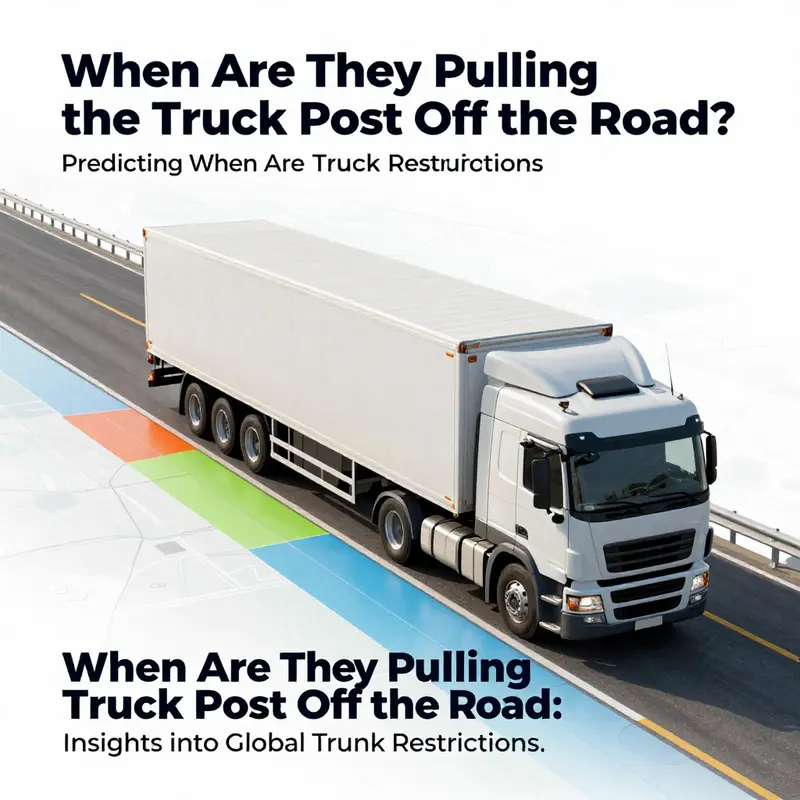
The question of when to pull a truck post off the road is more than a maintenance concern. It is a strategic decision that sits at the intersection of safety, regulation, technology, and the evolving economics of freight. In the modern logistics ecosystem, retirement decisions are rarely triggered by a single failure or a single limit in the life of a vehicle. Instead, they arise from a confluence of factors that change the calculus of asset value in real time. Fleets watch policy calendars as closely as engine blocks, because the moment a rule tightens or a subsidy shifts, the economics of keeping an older truck on the highway can flip from feasible to costly in the space of a few months. The recent landscape, including time-bound regulatory pauses and culturally aligned traffic restrictions in different regions, underscores how temporal and geographic variables can compress the life span of a vehicle in ways that go beyond wear and tear. Yet the same forces that push retirement also create a path to a more efficient future, where new technologies and smarter operations sustain service levels while reducing risk and cost. The chapter that follows takes stock of these dynamics and maps how operators translate them into concrete retirement timing for their fleets.
Emerging regulations now play a decisive role in deciding when a truck loses its place on the road. Stricter emissions standards are a central driver, with anticipated revisions to benchmarking frameworks that could relax certain weight or performance limits for electric and hydrogen-powered trucks. This shift matters even if the upfront price of new propulsion technology remains higher. When a fleet anticipates future standards, it often chooses to retire older models before they become non-compliant rather than trying to retrofit them. The prospect of a 2027 emission deadline, for example, has influenced procurement and replacement strategies well ahead of time. In practice, this means fleets increasingly view a truck’s useful life through the lens of regulatory compliance as much as through mechanics. The consequence is a shortened horizon for some models, especially those that cannot be upgraded to meet evolving standards without prohibitive cost.
Regulatory windows also illuminate the prudence of planning around risk periods rather than reacting in real time to incidents. A vivid illustration comes from specific, time-bound bans and restrictions that restrict the movement of vulnerable cargo during sensitive periods. In a major city like Beijing, there are periods when vehicles carrying dangerous chemicals—especially those classified as highly toxic—are prohibited from traversing the city’s roads within its administrative boundaries. The ban operates from midnight on March 2, 2026, to midnight on March 13, 2026. This is not just a safety pause; it is an explicit calendar event that shapes routing, scheduling, and even the decision to deploy certain vehicles at all. The permit to operate becomes a matter of precise timing, and the absence of an exemption during those days can tilt the economics toward retirement or reallocation of those assets. Similar scheduling discipline appears in other markets. In Malaysia, during the Lunar New Year, heavy goods vehicles face restrictions across two separate windows in 2026: February 14–15 and February 21–22. These examples demonstrate how cultural calendars interact with traffic management, forcing operators to adjust not only routes but also the composition of their itineraries and fleets. The practical implication is clear: within a given year, a truck may be perfectly serviceable, yet there are windows when keeping it active is risky or economically suboptimal. The ability to align asset deployment with those windows— or to avoid them altogether by retiring or reassigning equipment—becomes a core capability for modern fleet management. The regulatory landscape, therefore, pushes retirement decisions deeper into planning horizons and makes the timing a function of both geography and date rather than a simple consequence of mileage.
But regulation is only part of the equation. A fast-evolving technological frontier is equally influential in determining when a truck should leave the road. The rapid adoption of autonomous driving capabilities, advanced telematics, and smarter safety systems is changing the cost-benefit analysis of vehicle longevity. Fleets that lack autonomous or semi-autonomous features, or that fail to integrate with comprehensive telematics platforms, face a widening gap in insurance pricing, eligibility for high-value contracts, and perceived safety. Insurers increasingly price risk around reliability and driver-assistance tech, making older trucks with limited automation comparatively more expensive to insure. Beyond insurance, the business case for retirement strengthens as older platforms fail to connect with modern data ecosystems used by customers and consignees. The ability to track cargo, monitor temperature, verify security, and share live data with smart logistics platforms has become a non-negotiable requirement for many contracts. Trucks that cannot support such capabilities are gradually marginalized, producing a natural but deliberate aging curve: once a vehicle cannot participate in the digital economy of freight, its lower operating costs no longer justify its continued use.
Market dynamics are reinforcing the shift away from aging diesel and gas fleets toward next-generation solutions. The forecasted rise of new energy heavy-duty truck sales to a sizable share of the market by 2026 shifts the calculus of total cost of ownership. Electric and hydrogen-powered trucks promise lower operating costs over their lifetimes, even when initial purchase prices run higher. Fuel costs, maintenance, and emissions-related duties increasingly tilt in favor of newer powertrains that combine efficiency with reliability. In this environment, a truck powered by fossil fuels, while still functional, becomes a financial liability once total ownership costs— including depreciation, maintenance, and the risk of stranded capital—outstrip the economics of a modern alternative. The retirement decision, in short, becomes a timely financial judgement: at what point does the cost of keeping a vehicle on the roster exceed the savings captured by newer technology and better energy efficiency? The answer hinges on the life cycle model a fleet chooses, but the trend is unmistakable. As the segment of new energy heavy-duty trucks grows, the pressure mounts for older units to step aside in favor of propulsion systems that align with the industry’s long-run cost trajectory.
Equally important is the growing need for specialized capabilities that modern freight operations demand. Cargo tracking with end-to-end visibility, precise temperature control for sensitive shipments, and robust security against theft or tampering have moved from nice-to-have features to baseline expectations. The shift toward smarter logistics platforms means that trucks must not only move a load from A to B but also integrate with a web of data streams that optimize routing, scheduling, and performance metrics in real time. Vehicles that cannot support such integration become bottlenecks in the supply chain and are more likely to be retired or repurposed. This is not merely a matter of adding sensors or connectivity. It is about how fleet-level data is used to orchestrate assets, align with customer demands, and unlock efficiency gains that were previously out of reach. In practice, retirement decisions therefore reflect a balance between the residual mechanical life of a truck and its capacity to participate in a data-driven logistics ecosystem.
The practical upshot for fleet operators is a shift in the language of retirement. It is no longer a story solely about engine failure, high mileage, or poor residual value. It is about a strategic blend of regulatory clarity, technology readiness, and market economics that together define the true value horizon of each asset. When a truck can no longer meet regulatory requirements without disproportionate retrofit costs, when it cannot be meaningfully upgraded to participate in advanced telematics and data sharing, or when its total cost of ownership outpaces the economics of modern alternatives, the retirement decision becomes both rational and prudent. Operators who succeed in this new regime do not wait for a breakdown or a price spike to act; they plan retirements on a calendar informed by policy cycles, technology adoption curves, and market forecasts. They optimize the capex-to-operating model by reallocating capital to vehicles and powertrains that promise greater reliability, lower risk, and stronger alignment with customer needs.
The integration of these forces—regulatory timing, technological progress, and market dynamics—creates a more predictable but more selective retirement process. Fleets now manage a portfolio of assets with an eye toward harmonizing compliance, safety, and performance. The best practitioners track not only when a truck will likely require replacement, but when its continued operation would constrain future contracts, limit access to favorable insurance terms, or hinder the seamless exchange of data across the supply chain. This approach requires disciplined capital planning, a clear understanding of lifecycle costs, and a readiness to reallocate assets ahead of changes in policy or demand. Because the decision to pull a truck off the road is now tethered to multiple external rhythms, it benefits from tools that help align asset deployment with policy windows, energy transitions, and the evolving standards of cargo integrity.
As fleets navigate these realities, digital transformation plays a central role. Operational dashboards, predictive maintenance, and route optimization converge to reveal not just when to retire, but how to replace and redeploy most effectively. For teams seeking to optimize retirement timing, the path forward involves more than replacing one asset; it involves reconfiguring the entire fleet in a way that sustains service levels while reducing risk and cost. This means cultivating capabilities around dispatch efficiency, asset utilization, and data-driven decision making. Fleets that invest in these capabilities tend to retire older units earlier in the cycle when the alternative would be costly retrofits or higher risk exposure. Conversely, a well-timed retirement can yield immediate savings through lower insurance costs, reduced maintenance, and better contract eligibility, even before the new asset is fully amortized. In this sense, retirement becomes a strategic lever for competitive positioning rather than a reluctant last resort.
For readers seeking a broader contextual view of how the market is shifting toward modern powertrains and connected fleets, a recent industry analysis offers a comprehensive frame. It places the move toward energy-efficient cabins and powertrains within the larger trajectory of commercial mobility and fleet optimization. External reference: https://www.grandviewresearch.com/industry-analysis/truck-cab-market. Within the broader conversation, organizations should also consider the operational implications of retirement planning for the entire logistics ecosystem. A logical companion to the retirement decision is the deployment of dispatch software and fleet management systems. These tools help synchronize retirement timing with route redesigns, capacity management, and maintenance scheduling. In practice, they translate a strategic choice into actionable steps: reallocate capacity, plan for new powertrains, and weave in the data streams required to keep customers satisfied while reducing exposure to risk and cost. If you are exploring how to modernize the planning around asset retirement, you may also want to examine how advanced dispatch and fleet management platforms can support this transition by providing visibility, automation, and scenario analysis. See the discussion on dispatch software and fleet management for additional context: dispatch software and fleet management. The road ahead for retirement is not a singular event but a continuous recalibration, guided by policy calendars, technical progress, and the evolving value proposition of every asset on the road.
Final thoughts
Understanding when they are pulling the truck post off the road is vital for all stakeholders involved in off-road operations and adventures. From the safety concerns driving Beijing’s restrictions to the celebration-driven regulations in Malaysia, each incident reflects an overarching theme: the balance between public safety, cultural moments, and vehicular access. As we move forward, staying attuned to such regulations will ensure your adventures remain unimpeded and your operations efficient. Ultimately, knowledge is power—especially when planning your next off-road experience or agricultural venture.