
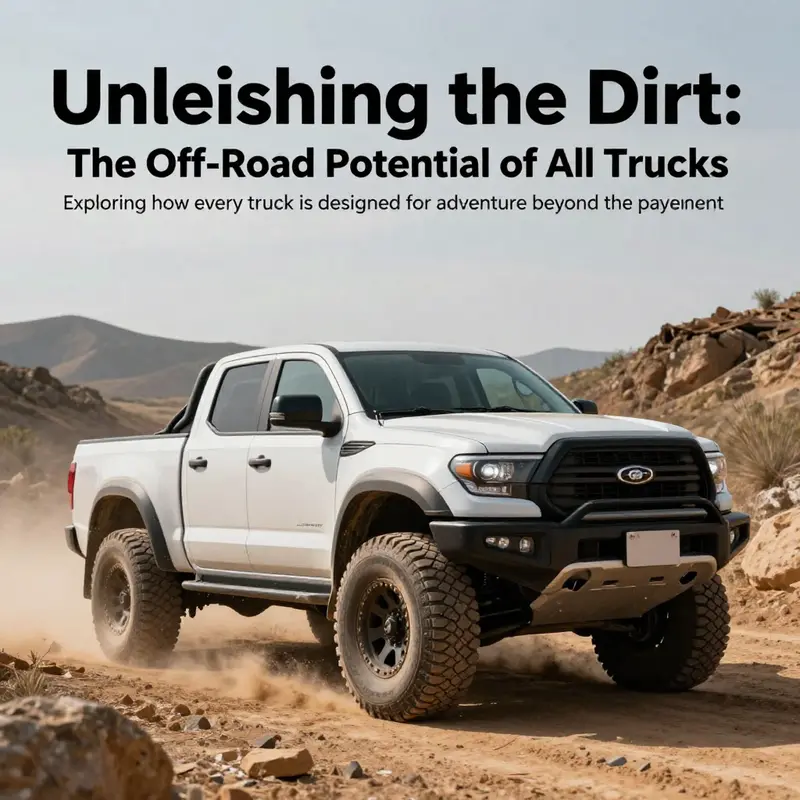
The spirit of adventure calls out to those who seek the thrill of the open road—and beyond. Truck enthusiasts know that the capabilities of their beloved vehicles extend far beyond mere transportation chores. The rugged terrain, muddy tracks, and rocky trails beckon for trucks that can conquer whatever challenge they face. In this exploration, we will uncover the reasons why all trucks are inherently built to go off-road. From the fundamental design philosophies and key features that grant off-road capabilities to the practical necessity of this rugged capability in various industries and the increasing allure of recreational off-roading, each chapter reveals a deeper understanding of why trucks are not just about on-road performance. Prepare to discover how each type of truck, designed with purpose and precision, embodies the very essence of adventure.
Chapter 1: Beyond the Surface of Utility—Why Many Trucks Are Built with Off-Road Purpose in Mind
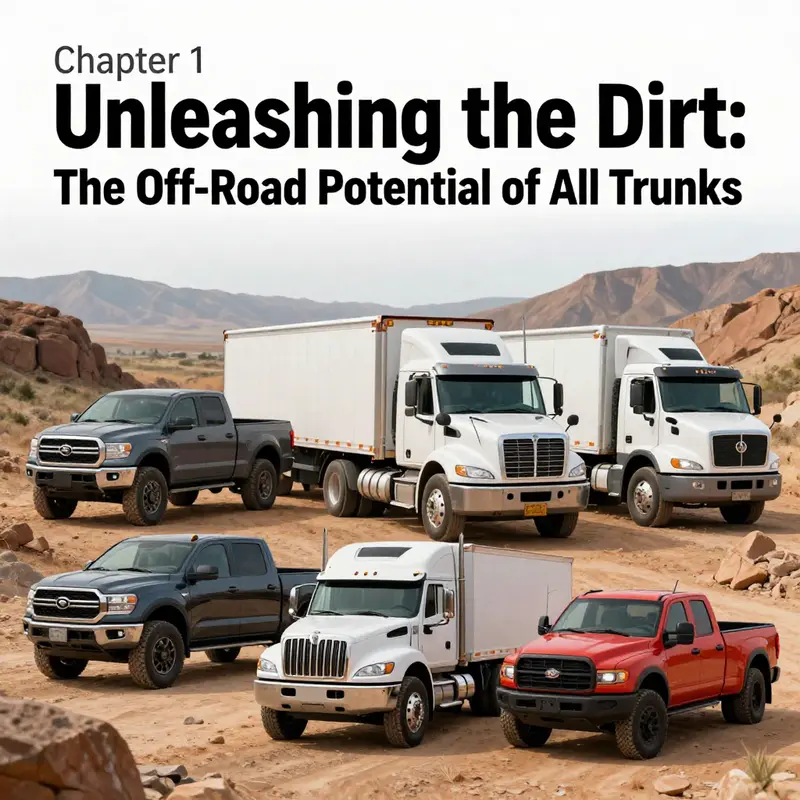
Off-road ability in trucks is often treated as a feature but it is actually a design philosophy. Engineers design for versatility so a vehicle can handle highway efficiency and rough terrain when the situation demands. Ground clearance, tires with rugged tread, and drivetrain options are not decorative; they help maintain momentum when roads end. The goal is to protect cargo and crew while retaining practicality on paved streets.
Different segments of the truck family illustrate this balance: on-road models optimize payload, efficiency, and stability at speed, yet many include off-road enhancements. Dedicated off-road trucks use reinforced frames and aggressive tires to crawl over obstacles. A middle ground exists in midsize and work-oriented trucks that can traverse dirt roads while performing well on pavement. This blend reflects a culture where off-road readiness is expected rather than exceptional.
Beyond hardware, consumer culture and industrial needs push manufacturers toward capability as standard. Accessory ecosystems—winches, skid plates, protective underbody armor—fit early in the design process. The result is a platform that remains comfortable on highways but can switch to rugged operation when necessary. This stance toward work in the real world explains why off-road capability is not a luxury but a strategic property of many trucks.
For readers seeking mechanical context, diesel mechanics or drivetrain principles provide the science behind torque, gearing, cooling, and load handling. Understanding these interactions helps explain how a truck preserves traction and control on variable surfaces. In short, off-road readiness is a measurable, testable aspect of a well-designed vehicle, not a garnish on a showroom model.
Looking ahead, the chapters explore how this spectrum affects payload, maintenance, and the daily realities of fleets and households that rely on trucks as versatile partners in work and life.
Beyond the Paved Path: The Engineering That Makes Some Trucks Off-Road Ready
The notion that all trucks naturally seek the off-road lane is a tempting simplification, but reality is more nuanced. A great many trucks are purpose-built for efficiency, payload, and durability on highways and paved work sites. Others are designed from the ground up to meet the demands of rugged terrain, where the distance between safety and disaster is counted in millimeters and seconds. In this chapter, we stitch together the engineering logic behind why some trucks can leave the smooth surface behind and why the rest stay firmly planted on the road. The answer lies not in a single feature but in a carefully choreographed ensemble of design choices, each tuned to a specific kind of stress, circumstance, and objective. When a vehicle is tasked with crossing mud, sand, rocky trails, or snow, it must do more than simply survive those conditions; it must keep the driver in control, protect critical systems, and extract the vehicle from tough spots without becoming a liability to the crew or the job at hand. This is where off-road capability emerges as a composite strength rather than a lone superpower, and where the line between on-road efficiency and off-road prowess becomes a spectrum rather than a hard boundary.
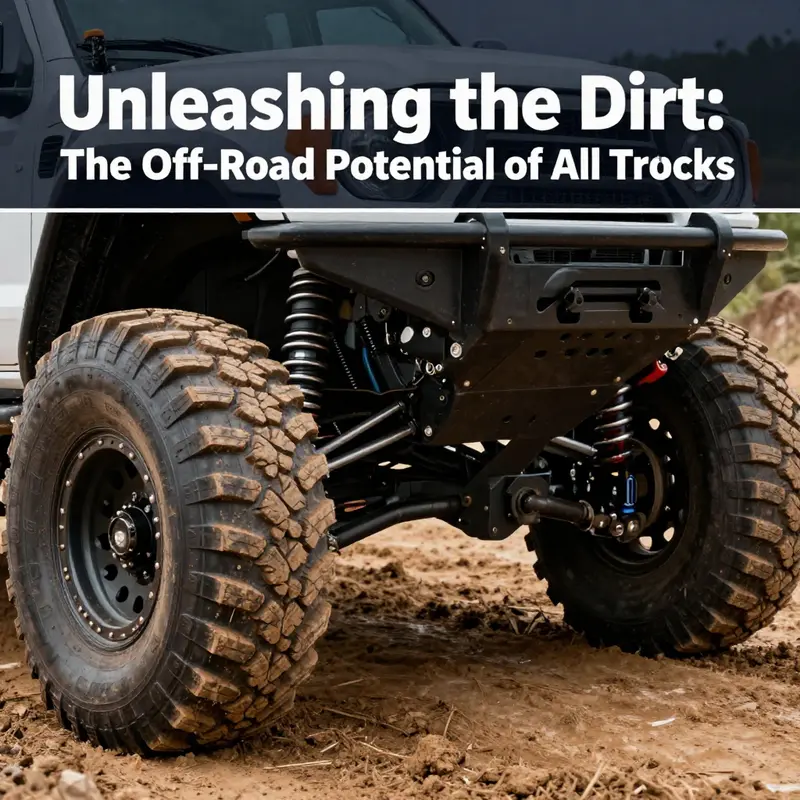
A guiding thread through this landscape is the four-wheel drive concept. Advanced four-wheel drive systems are the backbone of off-road capability because they distribute power to all wheels, maximizing traction on surfaces where grip is scarce or uneven. In the simplest terms, when the wheels share the same demand, the surface dictates the response. In mud, sand, gravel, or sheets of ice, sending power to every wheel helps prevent slippage and allows the driver to maintain momentum where a two-wheel system would simply spin. What elevates real off-road performance beyond basic 4WD is the inclusion of a low-range gearing option. This feature multiplies torque at very low speeds, giving the vehicle a fighting chance to crawl over obstacles, through deep mud, or up steep grades without losing control. The slow, controlled pace is not a luxury but a practical necessity in demanding environments. The low-range mode acts like a carefully chosen lever in a toolkit, enabling the driver to tailor torque delivery to the terrain. The result is a vehicle that can hesitate without hesitation, a critical attribute when your path includes rocks, ruts, or a sudden washout.
But traction is only the first piece of the puzzle. Off-road performance also depends on a suspension system that can absorb shocks while maintaining wheel contact with the ground. Heavy-duty suspensions are designed for significant wheel travel—the ability of each wheel to move up and down to follow the contours of the landscape. In practice this means more than just a smoother ride. It means keeping tires in contact with the ground so that power continues to translate into forward motion rather than lifting the tire off the ground and letting the vehicle slide. The sophistication comes in the balance: suspension components must tolerate repeated impacts, resist bending or breaking under heavy loads, and deliver predictable handling at both crawling speeds and bursts of acceleration. Depending on the model, you will encounter reinforced coil springs, robust leaf springs, or advanced air-suspension options that adjust stiffness on the fly to suit terrain, load, and fuel economy considerations. The common thread is resilience under stress, because rough tracks place unusual demands on the chassis and suspension that road-going trucks rarely encounter.
Tires, often overlooked in casual conversation, are the actual contact patch between machine and terrain. The specialized off-road tire is not simply larger; it is a carefully engineered compound with an aggressive tread that can bite into soft surfaces while shedding mud through self-cleaning channels. Deep, chunky treads provide grip when the ground gives little return, and the sidewalls are typically reinforced to resist punctures from sharp rocks or hidden debris. The tires also influence a vehicle’s stance and clearance. With taller tires and wider footprints, the vehicle can improve ground clearance and approach angles, reducing the risk of underside contact on jagged surfaces. Yet this comes with trade-offs: larger, more aggressive tires can raise rolling resistance, introduce steering effort, and increase road noise on pavement. The careful choice, then, is to pair tires with the vehicle’s mission profile so that the tire’s personality aligns with expected terrain—a decision that separates purpose-built off-road trucks from their urban-focused cousins.
Even the most capable propulsion and suspension system alone cannot endure severe off-road use without a robust frame and protective understructure. A reinforced chassis is a common hallmark of trucks that regularly navigate rough ground. High-strength steel frames and reinforced cross-members resist twisting, bending, and fatigue when payloads are heavy and the terrain unforgiving. This structural backbone supports not only the vehicle’s own weight and loads but also the torque transmitted through the drivetrain during climbs, side-slopes, and towing in rugged conditions. To withstand real-world abuse, these trucks may feature skid plates and reinforced protection for vital components beneath the frame. Skid plates act like armor for the undercarriage, shielding the engine oil pan, transmission, and fuel lines from rocks and ruts that would otherwise cause costly damage. The goal is not simply to survive a rock garden but to preserve maintainability and reliability after a long expedition into the backcountry or a remote job site where service access is limited.
Integral to this architecture is the software and electronics layer that helps drivers manage the complexity of off-road driving. Intelligent driver-assistance technologies have evolved beyond lane-keeping warnings and adaptive cruise control to address real off-road challenges. Traction control systems, stability programs, hill descent controls, and trailer handling aids work in synergy to keep the vehicle’s behavior predictable when traction is scarce or when the payload is dynamic. This is not about replacing driver skill but about extending it. The software can modulate engine torque, brake distribution, and electronic differential behavior in fractions of a second, helping to prevent wheel spin and steering drift that compromise control on slippery slopes or uneven surfaces. For teams operating in regions where a driver may be alone or backed by a small field crew, these assistive features can reduce fatigue, enhance safety, and expand the range of tasks that a truck can undertake without requiring a different vehicle class.
In the broader landscape, a truck’s off-road capability is often described as a package, with each element designed to complement the others. The manufacturer’s choice to equip a vehicle with 4WD and a low-range gearbox, a robust suspension setup, reinforced chassis, and capable tires signals a design intent: this model is meant to face environments where road quality is inconsistent or nonexistent. Conversely, many trucks are optimized for pavement and harvestable efficiency, where weight, aerodynamics, and comfort reign supreme. The distinction is not merely academic. It translates into real-world decision making about when to deploy a particular vehicle, how to plan maintenance in remote locations, and what kind of tires and spare parts belong in the tool kit before a field deployment begins.
The chapters of this discussion would be incomplete without acknowledging the environments that shape these design choices. Work needs—construction, mining, forestry, and specialized industries—often extend far beyond the well-graded arterial roads that carry urban life. In those contexts, the trucks may have to amble through dust bowls, over rocky grades, and along washed-out stretches where a fallback to passenger-car performance is simply not tenable. Emergency response and military operations introduce further constraints, where speed must be balanced against terrain risk, and reliability is not a luxury but a clinical requirement. Even in civilian life, a growing community of outdoor enthusiasts seeks vehicles that combine daily practicality with occasional, purposeful escape into the backcountry. The appeal is clear: a single vehicle that can haul heavy loads on weekdays and explore remote trails on weekends. Yet the reality is that not every truck earns this dual identity. The infrastructure of capability—ground clearance, torque, protection, and control systems—must be engineered, tested, and tuned into a cohesive whole, and that is rarely the default configuration for a vehicle whose primary duty is on paved surfaces.
Within this framework, the discussion often returns to the question of why some trucks “go off road” at all. The answer lies in purpose and adaptation. When a vehicle is designed with the expected tasks in mind—remote job sites, rough access roads, heavy payloads on uneven ground—the engineering becomes a process of safeguarding the core mission: move people and equipment from point A to point B with minimal risk, under variable conditions, and with the option to improvise if the path becomes obstructed. This is why off-road capability is not universal across every truck model. It is a specialization born from a precise understanding of what the vehicle is expected to carry, to where, and under what constraints. Yet the chapter closes with a reminder that capability is a spectrum, and the real value lies in choosing the right tool for the job rather than projecting a universal rule onto a diverse fleet.
For readers seeking a deeper technical grounding on the powertrain and durability considerations that underpin these capabilities, you can explore further resources that illuminate the mechanics at play. A practical entry point is the accessible discussion on diesel powertrains and maintenance pathways, which delves into how durability is preserved under demanding workloads. This context helps bridge the gap between high-level design intent and the maintenance discipline that keeps off-road systems reliable after repeated exposure to rugged terrain. As you map the terrain of your own fleet or personal use, the interplay of traction, suspension, chassis robustness, tire design, and electronics becomes the compass guiding whether a truck is ready to leave the asphalt behind.
In the end, the chapter’s core message is about intention and balance. Off-road capability is not a guaranteed feature of every truck, but a deliberately engineered portfolio of traits that enables genuine performance when the road ends. The challenge for designers is to align this capability with the vehicle’s intended use, the expected load, and the environmental realities of the operator. For operators, the challenge is selecting a vehicle whose character matches the demands of the job and the terrain, while recognizing that some trade-offs are inevitable. A truck may deliver exceptional on-road efficiency, precise steering, and low noise, yet still lack the suspension clearance or the traction engineering needed to navigate a remote mud field. Conversely, a vehicle that shines off-road might compromise ride comfort or fuel economy on paved roads. The art lies in matching the machine to the mission, and in understanding that off-road readiness is not a universal trait but a specialized capability that emerges when the design intent is clear and the components harmonize.
To connect these insights to practical learning and further reading, consider a focused exploration of diesel-driven reliability and maintenance practices, which provides a grounded perspective on how powertrains endure the stresses of off-road work. For a more technical primer on off-road truck campers and the industrial implementation of rugged chassis concepts, the following resource offers an in-depth look at how engineers translate theory into field-ready capabilities: https://www.4x4world.com/off-road-truck-campers-explained-technical-details-and-industrial-implementation. If you want a concise, mechanics-focused companion article that helps you visualize the powertrain’s role in moving weight through tough terrain, you can also consult a dedicated guide on diesel mechanics here: Mastering Diesel Mechanics.
As this chapter threads together the core elements—4WD with low range, robust suspensions, purposeful tires, reinforced frames, and intelligent control systems—the overall picture sharpens: not all trucks roam off-road, but those engineered with these features become capable partners in environments where road quality is a variable. The distinction is practical, not philosophical, reflecting a world in which equipment must match the job and terrain. The next chapter will turn to how manufacturers strike a balance, ensuring off-road specialists remain viable in everyday operations and how fleet managers weigh the costs, maintenance, and lifecycle implications of equipping certain models for rugged duty rather than leaving that task to aftermarket modifications. The terrain awaits, and with it, the decision of whether a truck is simply a means of moving goods or a trusted companion that can survive, and even thrive, where the pavement ends.
Chapter 3: When the Road Ends: Why Off-Road Capability Shapes Truck Use Across Industries
In conversations about trucks, a tempting simplification persists: all trucks go off-road. Yet the reality is subtler. Most trucks are engineered for on-road efficiency and payload economics, with off-road capability surfacing as a calculated response to stubborn terrains, remote worksites, and the safety demands of operating in unpredictable environments. The statement that every truck should be equally versatile off pavement misses the core truth of how trucks are designed, deployed, and managed. The landscape of work—whether it spans quarries, jungled corridors, or desert washouts—demands different answers to the question of mobility. This chapter explores why off-road capability matters so deeply in certain industries and how that necessity translates into design choices, operational practices, and the evolving technologies that keep fleets productive when the surface underfoot shifts from smooth asphalt to mud, rock, and sand.
The essence of off-road capability rests on a simple but critical triad: traction, clearance, and durability. Traction is the most visible element. On loose or uneven surfaces, wheel slip can quickly erase any advantage gained by raw horsepower. Four-wheel drive or all-wheel drive systems, when properly integrated with electronic traction control, enable a vehicle to distribute power where it is most needed. In practical terms, this means the truck can keep moving even when one or more tires encounter sludge, ruts, or a steep incline. It is not just about more grip; it is about intelligent grip—how torque is modulated, how wheels are coordinated, and how the drivetrain preserves momentum without spinning out of control.
Ground clearance follows as the next essential attribute. In rugged terrain, underbody components become potential collision points. Rocks, stumps, and uneven ruts can send a vehicle’s chassis into unintended contact with the world above, risking damage that halts work and endangers crews. A robust suspension system—designed to absorb the shocks of rough roads and rock-strewn paths—reduces fatigue on both vehicle and operator. It also preserves tire contact with the ground, which is the condition most closely tied to traction. High ground clearance, combined with a drivetrain tuned for torque delivery at low speeds, helps a truck glide past obstacles instead of scraping or stalling.
Durability ties the concept together. Off-road work demands reinforced frames, reinforced axles, and components that tolerate higher cyclic stresses. The faster a truck spends its life on uneven ground, the more its tires, suspensions, and hydraulics must endure impact, heat, and vibration. The challenge is to balance weight, rigidity, and endurance without making the vehicle prohibitively heavy or unwieldy on a paved highway. This is where the engineering calculus becomes a matter of context: the job dictates the platform. A fleet that routinely crosses mud and rock will favor a chassis and suspension engineered to survive repeated punishment. A fleet that primarily cruises highways will optimize for fuel efficiency and load stability rather than the extremes of off-road abuse.
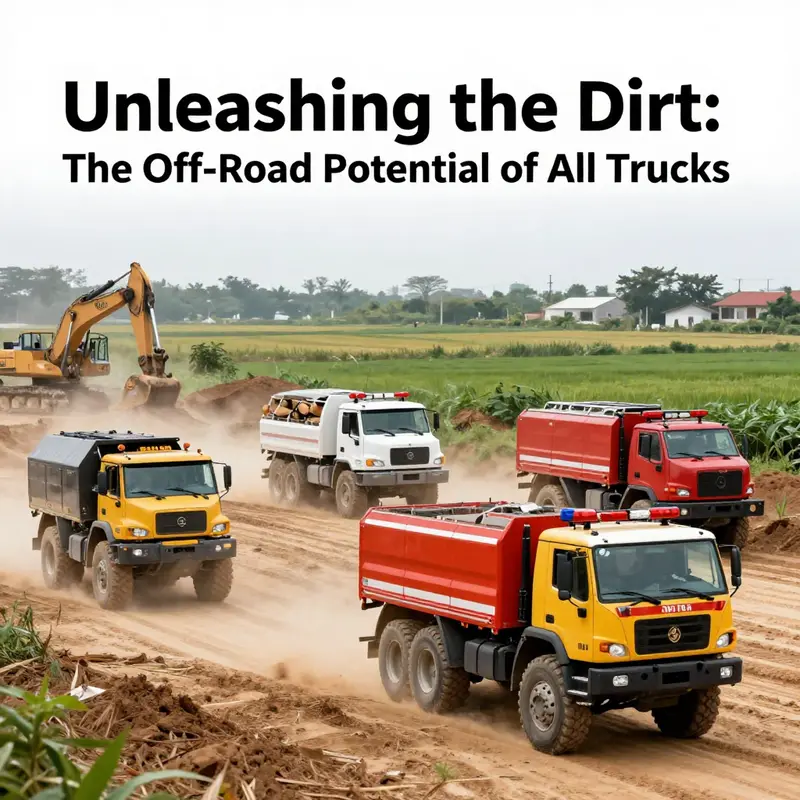
The design choices carry real consequences for operations. In many industries, the terrain itself is the worksite. Sites may lack paved access routes, or they may experience weather that turns dirt lanes into clay-like slicks or muddy ruts. In forested regions, access roads can be narrow and winding, with sudden washouts where a roadbed once lay. In mining or construction, heavy loads must be moved across uneven stockpiles, across temporary bridges, or up rough approaches to loading points. Each scenario tests the vehicle’s ability to maintain traction, clear obstacles, and keep the mission moving. The upshot is not a universal off-road vehicle but a family of vehicles whose capabilities are matched to the environment and to the required cadence of work. When the work demands it, a truck is equipped and operated as an off-road platform; when the work does not, the same chassis could be optimized for on-road throughput and fuel economy.
Industry context clarifies why these capabilities matter. In mining operations, for instance, access roads may be under constant wear from heavy machinery and frequently subject to erosion and weather-induced degradation. An off-road-capable truck can shuttle ore, equipment, and personnel between distant points without waiting for road repair or rerouting through longer, smoother corridors. In forestry or logging, the combination of steep grades, uneven ground, and the need to haul large, bulky loads through challenging terrain makes robust drivetrains and high ground clearance non-negotiable. In construction and large earthmoving projects, the ability to traverse unpaved surfaces and to position large payloads close to the work face reduces turnaround times and minimizes the risk of delays caused by transport bottlenecks. And in agricultural settings, fields, ditches, and irrigation channels often require vehicles that can slip between fields and worksites without becoming mired in mud or rutting fragile soil structure.
Beyond purely industrial contexts, off-road capability also intersects with emergency response, disaster relief, and military applications. Firefighting teams, search and rescue units, and humanitarian missions frequently rely on vehicles that can access remote locations where paved roads simply do not exist or have been compromised. In these circumstances, the value of off-road trucks is not measured in miles per gallon but in the ability to deliver people, water, equipment, and supplies where they are needed most, under conditions that test the limits of conventional transport.
Geographical realities compound these considerations. In parts of the world where infrastructure development lags behind demand, the gap between paved routes and the actual terrain becomes a decisive factor in project viability. Roads may terminate at village outskirts, while the worksite sprawls into remote valleys, hills, or wetlands. The practical impact is straightforward: the heavier the task and the more remote the location, the more essential it becomes to deploy trucks that can operate off-road with confidence. This is not a spectacle of rugged novelty but a systematic response to conditions that shape schedules, budgets, and safety margins. In such contexts, off-road capability is a strategic investment rather than a luxury feature.
Maintenance and operational considerations reinforce why not every truck is an off-road machine. Vehicles designed to tackle rough conditions demand meticulous attention to hydraulic systems, drivetrain cooling, and suspension components. Operators must anticipate the risk of rollovers on steep slopes, the potential for fuel supply interruptions on remote sites, and the consequences of getting stuck in soft ground. These concerns drive procurement choices toward configurations that offer lockable differentials, durable drivetrains, and tires whose tread depth and composition are matched to the typical substrate—be it clay, sand, gravel, or rock. They also shape the training regime, ensuring that crews understand weight transfer during cornering, proper use of low-range gears, and the importance of maintaining a consistent, moderate speed to preserve wheel contact with the surface.
The broader takeaway is that off-road capability in trucks is not a universal trait but a strategic alignment of vehicle design to work, terrain, and safety. In industries where the worksite is physically separated from paved infrastructure, off-road platforms enable continuity, protect schedules, and safeguard operators by providing predictable performance where ordinary highway trucks would stall. Conversely, where paved routes and predictable surfaces prevail, the extra mass, complexity, and fuel use associated with off-road features may be unnecessary overhead. The key for managers and engineers is to distinguish between the environments their fleets will actually encounter and to assign vehicle platforms accordingly. This requires clear criteria for terrain risk, payload requirements, and access needs, informed by field data, operator feedback, and the evolving landscape of drivetrain technologies.
In sum, off-road capability is not a blanket attribute but a tiered capability that meets the demands of rugged environments. It is the difference between fleets that can keep critical work moving in the mud, mud, and more mud, and fleets that must wait for roads to improve or for access to be cleared. The real question is not whether a truck can go off-road, but how well it can perform when the road ends—how it handles grip, clearance, and durability in service of the job at hand, and how the organization supports that capability with maintenance, training, and strategic planning. As industry needs evolve, so too will the configurations that prove most effective on the ground, bridging the gap between highway efficiency and field endurance.
External resource for further reading: https://www.kamaz.com/en/used-trucks
Beyond the Pavement: Why Some Trucks Embrace Off-Road, While Most Stay on the Road
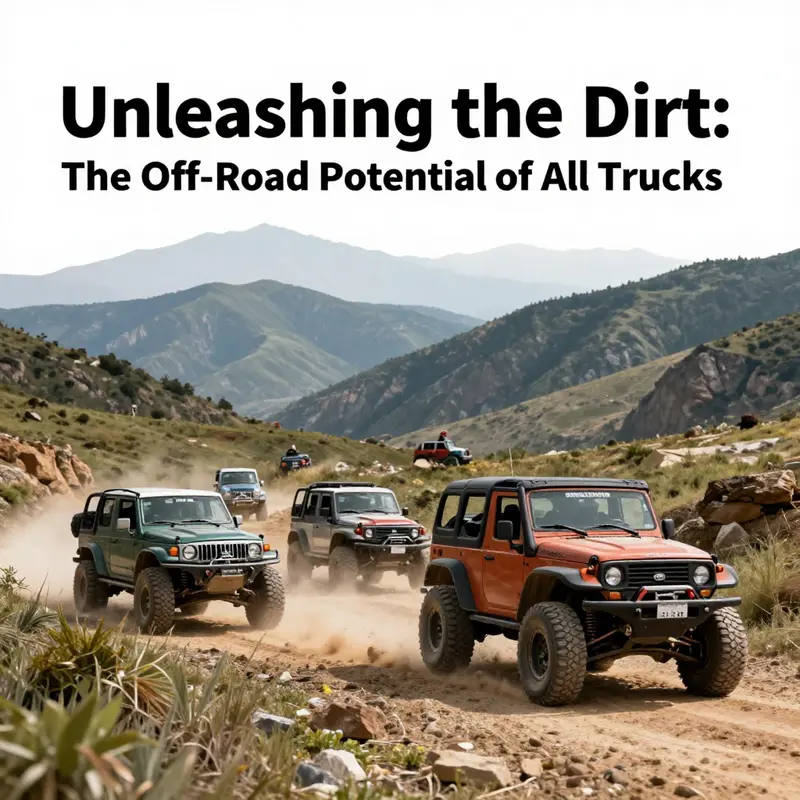
Trucks are often described as off-road capable by marketing, but the reality is more nuanced. In practice, the mix of capability and restraint explains why some trucks venture into rough terrain while others stay on pavement. The engineering layer emphasizes different goals: highway efficiency vs. rugged travel. On-road work trucks optimize payload and fuel economy, with tuned suspensions for comfort and a chassis built for long miles on synthetic surfaces. Off-road models carry higher ground clearance, reinforced drivetrains, and traction systems that can handle sand, mud, or rocky trails. These differences are not just about a single component; they are about integrated packages where tires, suspension, axle articulation, and protection work together. The second layer, practical duty cycles, tells us where off-road capability matters. Remote jobsites, mining, forestry, public safety, and military scenarios demand access where paved roads end, so the added cost and weight of four-wheel drive can be justified. The recreational layer has grown the market further, turning off-road into a form of culture and identity. Enthusiasts seek challenges and new terrains, and manufacturers respond with more capable variants, larger tires, and electronic aids that help drivers manage difficult conditions. Environmental and social considerations also enter the discussion. Off-road activity can impact soils, waterways, and habitats, prompting policies that balance access with conservation. Electric off-road platforms show that quiet and emissions reductions can align with rugged capability, broadening the appeal to more landscapes and users. The responsible path combines skill with machine, emphasizing terrain reading, momentum management, and appropriate system use. Training, preparation, and maintenance underpin reliability when surfaces are unpredictable. In the end, a truck’s off-road readiness is a strategic choice aligned with purpose, environment, and responsibility, rather than a universal trait.
Final thoughts
In the vast landscape of truck capabilities, it becomes abundantly clear that every truck has off-road potential ingrained within its design. Whether driven by work needs or the pursuit of adventure, trucks blend ruggedness with performance to navigate terrains untamed by traditional vehicles. From agricultural demands to recreational escapades, off-road features have transcended niche markets to resonate with broader audiences. The thrilling allure of traversing off-road environments reflects an ever-growing culture of exploration, reminding each truck owner that more than just a vehicle awaits them—an adventurous spirit lies under the hood. Embrace the journey off the beaten path.