
As off-road enthusiasts gear up for adventure, the perpetual debate between trucks and SUVs intensifies. Whether navigating rugged wilderness or conquering treacherous trails, the choice between these two iconic vehicles influences capability, performance, and enjoyment. This exploration delves into key comparisons that redefine off-roading: from fundamental equipment features to mechanical advantages, traction on varied terrains, and enduring durability in design. In every chapter, we’ll dissect the compelling reasons trucks are often crowned the kings of off-road escapades while recognizing the unique characteristics that can make certain SUVs viable contenders. Ready your gear as we embark on this journey together!
Rugged Dominance on the Trail: Trucks at the Forefront of Serious Off-Roading
Off-road driving tests every vehicle against a stubborn standard: ground clearance, torque, and the ability to keep moving when the trail throws its worst at you. In this arena, the observed consensus from research and real-world experience is clear: trucks, especially the heavy-duty varieties, tend to outperform SUVs when the terrain becomes truly demanding. The reasons are structural as much as they are mechanical. A truck is not merely a larger car with more tires; it is a purpose-built tool designed to endure abuse, to carry heavy loads, and to conquer conditions that would stop a standard SUV in its tracks. When you climb onto a rocky slope, ford a muddy wash, or haul gear through a remote job site, the difference is rarely about the ability to accelerate. It is about the vehicle’s fundamental design: a robust frame, a chassis engineered to flex and twist without breaking, and drivetrain choices that prioritize traction and control over comfort alone.
The most visible and frequently cited advantage of trucks is ground clearance. A higher ride height does more than keep the underbody from scraping; it broadens the range of obstacles the vehicle can approach without surrendering line. Rocks, logs, potholes, and uneven terrain all become negotiable if the chassis sits above them with ample clearance. But clearance by itself is not a panacea. A truck’s frame plays a decisive role in transmitting impacts without transferring them directly into the passenger compartment. Body-on-frame construction, which remains a hallmark of many heavy-duty pickups, provides a stiff platform able to withstand twisting forces and the repeated hammering of uneven surfaces. This is not a cosmetic attribute; it translates into durability that matters when you are navigating a remote job site or a backcountry trail where metal fatigue and frame flex are real concerns.
Alongside the chassis, power delivery and drivetrain architecture matter deeply. Trucks routinely pair high-torque engines with four-wheel drive systems that include low-range gearing and, in many cases, locking differentials. Low-range gearing is the off-road philosopher’s stone: it grants controlled, creep-like progress on steep grades and through slick mud where straight-line speed is not merely unnecessary but dangerous. Locking differentials, when engaged, force all wheels to rotate at the same rate, ensuring traction on surfaces that would otherwise send power to a slipping tire. The combination of torque, gearing, and traction control means a truck can pull itself and a load through mud, snow, or wet rock with a steadiness that many SUVs simply cannot sustain as the terrain gets tougher.
Tires and suspension are the quiet, muscular workhorses of off-road capability. Trucks often run larger, more durable tires that preserve traction by maintaining a broad contact patch with the ground. The suspension is engineered to absorb significant shocks while maintaining wheel travel and axle articulation. This translates into better grip as the tires adapt more faithfully to irregular surfaces, rather than skipping across them or losing contact altogether. A truck’s underbody protection—skid plates, reinforced cross members, and robust shielding—further extends its viability in aggressive terrain by defending vital components from rocks and debris that would otherwise end a climb or a trip.
Yet every advantage has a counterweight. The very attributes that empower a truck—its substantial weight, its tall stance, and its high center of gravity—bring trade-offs. In tight, twisty trails, the mass can hinder nimbleness, and the tall profile raises rollover risk on uneven slopes. The same frame that sustains brutal work environments can make a truck feel heavy and less responsive on tight switchbacks or delicate, rock-crawling lines. Fuel economy, too, tends to lag behind lighter, unibody SUVs, and this can be a practical concern on lengthy expeditions or operations that require extended travel between fueling points. The balance then becomes a matter of purpose: if the mission demands the ability to haul heavy loads, to traverse rocky ascents, and to remain resilient under continuous assault from the environment, a truck’s design philosophy delivers an unmatched toolkit. If the mission tilts toward daily driving, long-range comfort, and more modest off-road requirements, there is a compelling argument for SUVs that blend on-road manners with competent off-road capability.
The discussion around SUVs tends to hinge on versatility and comfort as much as capability. SUVs, especially those built on sturdy frames, offer a compelling blend for drivers who seek a vehicle that can handle family duties, daily commutes, and weekend off-road adventures with a single purchase. The unibody construction that characterizes many sport-utility vehicles contributes to a smoother on-road ride and more favorable fuel efficiency. Even when equipped with four-wheel drive systems and protective hardware, SUVs generally emphasize balance rather than brute force. They are engineered to handle the sorts of conditions encountered on a broad spectrum of terrain, from well-groomed dirt roads to light mud and gravel, without demanding the same degree of chassis resilience or powertrain brutality required for extreme off-road racing or mining operations.
The advantage of SUVs shows up most clearly in their daily usability. A well-built SUV maintains a comfortable cabin, predictable handling, and a more approachable steering feel. It typically offers better payload than a standard passenger car while not charging the same premium in maintenance costs as a heavy-duty truck. For many families and outdoor enthusiasts alike, this means practical overland adventures are feasible with a vehicle that doubles as a dependable daily driver. But the caveat remains: the higher level of ruggedness found in full-size trucks means that, for truly demanding off-road tasks, SUVs often reach their limits sooner than a purpose-built pickup does. Their chassis and drivetrain are not designed from the ground up to withstand the twin anchors of extreme abuse and heavy loads. In many off-road environments, that can translate into more frequent modifications, more meticulous maintenance, and a closer eye on component wear.
Electrification adds another layer to the decision matrix. In recent years, electric off-road trucks have emerged as a practical and sometimes superior solution for industrial operations. The appeal lies in instant torque, which helps wrestle through sticky situations without the delay associated with internal-combustion engines. Electric platforms can simplify drivetrain reliability by removing some of the moving parts that are prone to wear in harsh conditions. In mining and remote-work contexts, this translates into longer service intervals between maintenance cycles and a reduced need to configure complex signaling and drive-line adjustments to cope with difficult terrain. At the same time, the traction and energy management systems of electric trucks are tuned to maximize-grip performance under load, which can translate into consistent performance across a wide range of surfaces. The practical implication is a broader toolbox for the operator who must adapt quickly to changing conditions without sacrificing safety or position on the trail. The emphasis, then, is not only raw capability but a different kind of reliability—one built on steady torque, predictable power delivery, and a drivetrain architecture designed for repeated endurance scenarios.
The decision now moves beyond pure capability and toward intent. If the goal is to engage with extremely demanding off-road environments—whether for professional operations in remote terrains, mining sites, or disaster-response scenarios—the combination of higher ground clearance, tougher frames, robust four-wheel-drive configurations, and the capacity to carry heavy payloads gives trucks a distinct edge. The same logic that favors trucks in the backcountry also meets the needs of operators who demand that a vehicle perform under strain day after day. Where the mission is a blend of daily life, occasional serious off-roading, and a preference for interior space and comfort, SUVs present a balanced alternative. They allow more people and gear to travel with a level of convenience that trucks often cannot match if the task requires frequent on-road travel or long daily commutes.
That said, there is more to the story when we broaden the lens beyond personal transport and into industrial possibilities. Electric off-road trucks are not simply a niche curiosity; they are becoming a practical standard in certain industries where durability, reliability, and the ability to operate in isolated environments redefine what is possible. These vehicles demonstrate that the core strengths of trucks—durable frames, powerful torque delivery, and strong low-end torque—are being enhanced by electrification to deliver safer, quieter, and more sustainable operations. In mining, for instance, electric platforms reduce emissions and improve maintenance predictability on long, continuous shifts. In construction and heavy equipment logistics, they offer a predictable power profile and a simplicity of drive that translates into easier operator training and lower total cost of ownership in the long run. But even with these advances, the fundamental truth remains: trucks are designed to endure serious off-road conditions and heavy workloads, while SUVs excel in versatility and comfort, providing a practical middle ground for drivers who tackle moderate trails alongside everyday life.
For readers who want to explore the mechanics more deeply, the literature on diesel powertrains and off-road drive systems offers a grounded primer. Maintenance and capability often hinge on keeping the drivetrain aligned with the terrain it must master. For those who wish to dive into the mechanical specifics and the step-by-step lessons that underpin reliable off-road operation, there is a resource that guides readers through diesel fundamentals and practical repair strategies. It is one thing to know that torque matters; it is another to understand how to preserve it under extreme conditions. mastering diesel mechanics serves as a compact introduction to the discipline that underpins both trucks and their off-road capabilities, highlighting the attention to detail needed to keep a rugged platform performing when the trail is unkind.
In the end, the choice between a truck and an SUV for off-road use boils down to a balance of raw capability, versatility, and the intended use case. For those whose work or passion demands extreme off-road performance, heavy-duty trucks are the more capable toolbox. They offer superior ground clearance, a stronger chassis, robust low-range gearing, and the capacity to carry and haul what is needed when the work is remote and the road is long. For owners who need a more adaptable, comfortable vehicle that can handle everyday duties and still deliver a respectable off-road experience, an SUV remains a compelling option, especially when paired with capable tires, a solid suspension, and a well-chosen four-wheel-drive configuration. The decision is not a binary judgment but a spectrum along which you position your priorities: power and payload on one end, comfort and practicality on the other. And as electrification reshapes the landscape, trucks—both traditional and electric—expand the range of possibilities, offering new ways to approach old trails with increased efficiency and resilience.
External resource: The official overview of off-road trucks from a leading manufacturer provides a framework for understanding the core capabilities designers prioritize in these rugged vehicles. You can explore how engineers structure these platforms to maximize durability, protection, and performance in harsh environments here: https://www.mantruckandbus.com/en/vehicles/off-road-trucks.html
The Mechanical Edge on Real Trails: How Trucks Outperform SUVs When the Going Gets Rough
When you sift through off-road scenarios—from damp forest trails to rock-strewn ascents and muddy bogs—the question isn’t simply about size or comfort. It’s about the mechanics under the hood and how they translate into grip, durability, and predictable control when the terrain refuses to cooperate. In broad terms, the mechanical architecture of trucks lends them a tangible, repeatable advantage over sportier, lighter SUVs when the going turns harsh. That advantage rests not in a single feature but in a concert of design choices that together form a robust platform for sustained off-road performance. To understand why, it helps to start with the backbone of any serious off-road machine: the drivetrain and the chassis, and then move outward to the suspension, tires, and, crucially, how heat and torque are managed under load. In this long view, trucks aren’t just bigger, they are built to endure and to deliver traction where it matters most—and they do so in a way that converts torque into forward motion more reliably than most SUVs can manage in strenuous conditions.
A truck’s drivetrain often begins with a configuration that prioritizes strength and heat management. In many heavy-duty and purpose-built models, the chassis and engine layout favor a longitudinal design with a driveshaft driving a rear differential. This arrangement isn’t a universal rule, but it underpins a logic: a solid, unbroken path for torque to reach the road or trail. The result is a drivetrain that can sustain high torque output over long stretches, with heat generated by heavy use dissipating through a robust cooling system and larger, stronger components. When a trail demands sustained torque to climb a steep grade or to pull through sticky mud, the ability to shed heat and keep the transmission from fading becomes a decisive factor in whether traction remains available or begins to slip. In practice, this means that trucks often deliver predictable, confident acceleration and climbing capability long after a lighter, less rugged platform might start to feel therapeutic as the engine temperature climbs.
From there, four-wheel drive becomes more than a marketing label. On the road it may feel identical to a two-wheel drive, but in the field, 4WD changes the entire geometry of traction. A heavy-duty truck with a properly engineered 4WD system can feed power to the wheels with a deliberate balance, ensuring that when one wheel finds grip it can pull the others toward traction rather than surrender to spin. In many trucks, 4WD is complemented by locking differentials that synchronize wheel rotation, so that when one wheel encounters a slick surface or a rock, the other wheel keeps turning in unison. In practical terms, locking differentials help you conquer deep mud, sand, or a slick slope where two wheels might otherwise spin away and rob you of momentum. This isn’t mere textbook theory; it’s the difference between negotiating a tricky switchback with confidence and having to backtrack, pick a different line, or abandon an attempt altogether.
The chassis and suspension of trucks are designed with a different mandate than many SUVs. A heavy frame and tuned suspension offer more precise control over a wider range of loads and terrains. The suspension geometry is built to absorb bigger jolts while maintaining tire contact with the ground, which translates into traction even when the surface alternates between hard pack, loose gravel, and substantial obstacles. A rugged suspension isn’t just about travel; it’s about tuning for the right spring rate, damping, and anti-roll characteristics so the vehicle stays planted on the obstacle rather than bouncing off it. This firmness also supports payloads that must be hauled, towed, or carried into rough work sites. The upshot is that trucks—especially those designed for heavy-duty or industrial use—offer a more stable and controlled ride over rough terrain, which in turn reduces the likelihood that you’ll lose traction due to a wheel lifting or a chassis folding under an abrupt shock.
Tire size and tread design complete the picture. When ground clearance, approach angles, and the ability to roll over rocks are critical, larger tires with robust sidewalls become a practical necessity. A truck’s tire package is typically built to tolerate rugged service, with deeper tread patterns that grip in mud and a footprint that distributes load more effectively on irregular surfaces. The combination of greater ground clearance, sturdier suspension, and beefier tires yields better capability in situations where smaller vehicles struggle to find traction or to maintain a stable line across uneven ground. It’s not a single magic feature; it’s the synthesis of clearance, chassis rigidity, suspension travel, and tire construction working together to keep the vehicle moving instead of getting hung up on a rock or bogged down in a rut.
A further dimension appears in how modern trucks handle extreme conditions through more advanced drivetrain options. While a base 4WD setup can be enough for many off-road tasks, serious off-road work frequently benefits from systems that offer low-range gearing and, where appropriate, selectable locking differentials. Low-range gearing multiplies torque at the wheels, enabling the vehicle to crawl up a slope or through a thick mud with more finesse and less reliance on wheel speed to maintain momentum. The reliability of those systems becomes a critical concern when the terrain demands slow, controlled, precise engine torque to maintain traction and protect driveline components from shock loads. In practical terms, you’re not asking for speed; you are asking for endurance and control, and a robust drivetrain is built around delivering that combination again and again.
In this matrix of design choices, specialized off-road configurations—such as eight-by-eight arrangements used in tactical contexts—illustrate how far the concept can push reliability and mobility outside paved networks. These configurations emphasize independent operation from a fixed road system, superior traction across a wider set of surfaces, and an ability to carry significant payloads or equipment through environments where standard road-based vehicles would falter. The moral here isn’t that SUVs cannot do work beyond light trails; it is that, when the goal is sustained capability in demanding terrains, the mechanical DNA of trucks tends to align more closely with the needs of the situation. The story of traction, durability, and heat management is, at its core, a story about endurance under load and the confidence that the vehicle will respond predictably when the surface changes beneath it.
Another line of evidence about the durability and reliability of trucks in rough conditions comes from the growing field of electric off-road trucks used in industrial settings. In those applications, engineers emphasize enhanced mechanical properties, durability, and specialized design features that address repeated, high-torque duty cycles. Electrification can deliver high torque at low speeds with controllable, consistent delivery to each wheel, which translates into traction that is easier to modulate on a treacherous surface. The trade-off, of course, is the need to manage battery weight and thermal load across long work shifts and challenging environments. Yet the core principle remains: when the design prioritizes mechanical rigidity, robust heat management, and deliberate torque control, the off-road performance of trucks tends to outshine that of lighter, more car-like platforms on the most unforgiving terrain. This doesn’t negate the value or utility of SUVs in many off-road contexts; it simply makes the case that true ruggedness, sustained traction, and predictable performance across diverse surfaces are more often the domain of trucks.
Of course, there are practical caveats. SUVs can be more maneuverable on narrow trails, more comfortable on long expeditions, and often offer a favorable payload-to-size balance for recreational use. They also tend to handle on-road duties with more refined comfort and efficiency, which makes them practical for daily life plus occasional adventure. The outcome is rarely a simple binary choice; it is a trade-off depending on terrain, mission, and durability requirements. As a rule of thumb for professionals or for those who operate in hostile, remote environments, a purpose-built truck platform with rugged suspension, strong driveline, and appropriate traction aids will deliver greater reliability and momentum when the situation demands significant torque, rock-stplowing confidence, and sustained rough-terrain work. For weekend overlanding or occasional trail exploration, a well-selected SUV can offer a compelling balance of capability, comfort, and accessibility without sacrificing too much in the way of reliability or versatility.
To connect this mechanical perspective with broader ideas about drivetrain philosophy, consider how different training and maintenance practices influence real-world outcomes. A vehicle that sees regular inspection of driveline components, proper lubrication, and timely cooling-system service is less likely to encounter heat-related failures that can strip torque and reduce traction. The robustness of a truck’s construction makes this more feasible; components are easier to access, more forgiving under heavy loads, and designed for longer life under demanding use. In practice, the reinforcement of these systems through quality maintenance translates directly into greater off-road confidence. The learner in any off-road program quickly discovers that the mechanical advantage isn’t a one-time feature; it’s a discipline—regular checks, disciplined handling, and an understanding of how heat, torque, and load interact under the trail’s stress. For those who want a deeper dive into the intricacies of powertrain behavior, a detailed exploration of diesel mechanics provides practical guidance on how torque curves, lubrication regimes, and fuel delivery interplay in heavy-duty systems. Mastering Diesel Mechanics: A Step-by-Step Path offers a structured way to think about these fundamentals. Mastering Diesel Mechanics: A Step-by-Step Path
In the end, the question of whether trucks or SUVs are better off road boils down to what you expect the vehicle to endure and how you intend to use it. If the objective is to tackle demanding terrains, haul substantial loads, or operate in environments where sustained reliability under harsh conditions matters most, the mechanical edge tends to tilt toward trucks. This is not a statement about SUVs’ limitations in every scenario; it is a recognition that, across the spectrum of extreme-off-road applications—from mining and forestry to remote overlanding—truck platforms with sturdy frames, capable 4WD systems, and robust suspensions deliver a more predictable, more controllable, and more durable off-road experience. The argument rests on a disciplined, engineering-grounded assessment of how torque, traction, and heat are managed under load and how that management translates into practical outcomes on the trail. In the field, that translates into fewer excuses and more progress, a crucial difference when a mission hinges on getting through the obstacle rather than turning back.
For readers seeking a broader engineering lens on extreme off-road design, external resources offer deeper dives into how manufacturers optimize chassis, transmissions, and drive configurations for harsh environments. A reference point for engineers and enthusiasts alike is the exploration of off-road truck engineering and its implications for mobility in extreme conditions. As you chart your own path through the terrain, this mechanical perspective provides a compass: trucks win more often in the rough because their architecture supports traction, heat management, and durable operation where the surface refuses to cooperate. The rest—comfort, on-road manners, and occasional trail use—follows the same principle: adapt the tool to the task, and the task becomes fundamentally more manageable.
External reading: MAN Off-Road Trucks: Engineering for Extreme Conditions
Beyond the Wheel: Traction, Terrain, and the Truck-versus-SUV Debate in Real-World Off-Roading
Traction—how a vehicle grips the surface beneath it, negotiates the pitch of a crest, and recovers from a sudden slip—does not exist in a vacuum. It is the outcome of a chain of design decisions that begin at the moment the vehicle rolls off the factory floor and extends into how a driver converts aerodynamics, weight, and torque into forward momentum across rocks, mud, or shifting sands. In off-road contexts, the choice between a truck and an SUV becomes a question of which platform better sustains grip across a spectrum of terrains while carrying load, enduring abuse, and preserving mobility when conditions threaten to strand a crew far from paved roads. The answer is rarely absolute. It is a balance of geometry, engineering, and purpose, where ground clearance, chassis robustness, tire leadership, and drivetrain philosophy converge to define capability.
Trucks bring with them a philosophy of durability that is hard to ignore when the going gets rough. Their higher ground clearance is not simply about clearing rocks; it is about giving a buffer zone between the underbody and the rough surface, a margin that reduces the chances of snagging, bending, or leaking through the chassis. A robust frame, typically more rigid than many SUV architectures, is engineered to resist bending and twisting under load. When a truck carries gear, a heavy payload, or winching equipment, that rugged skeleton becomes a tangible asset. The suspension in such platforms is often tuned to absorb the harsher shocks of heavy-duty use, with air or high-travel systems that ferry a vehicle over irregularities while maintaining wheel contact with the ground. This is not merely about ride comfort; it is about maintaining traction when the surface demands more from each wheel than the others can deliver in isolation.
Powertrains in this class are frequently calibrated to deliver torque at modest engine speeds, which is crucial when negotiating a stubborn hill climb, a slick rock section, or a water-filled rut where momentum can be the difference between progress and bogging down. The ability to choose low-range gearing or a proportional reduction in gearing allows the driver to modulate wheel speed and torque for creeping articulation or controlled wheelspin, depending on the terrain. The tires themselves tend to be larger and more rugged, capable of resisting cuts and punctures while maintaining traction across a broader contact patch. The combination of a stiff frame, confident suspension, and heavy-duty tires creates a package that thrives on the edge of control, where finesse must be matched with raw capability.
But capability is not a one-size-fits-all proposition. For many scenarios—remote work sites, heavy-duty hauling in uneven environments, or long treks through remote wilderness—the truck’s fortress-like approach to terrain is a strategic advantage. These are environments where a vehicle must sustain performance through sustained, demanding abuse. The chassis and drivetrain do not just deliver mobility; they deliver resilience. In such conditions, the ability to press forward with a load or to execute rapid recoveries after a misstep matters as much as raw power. The terrain demands an automobile that can survive repeated impacts, resist fatigue, and maintain traction through the course of a long day or a long project. The result is a vehicle that can translate high torque and substantial suspension travel into controlled progress over features that would arrest lesser machines.
SUVs, by contrast, are often tuned to blend versatility with comfort. They typically offer a lighter footprint and a more refined ride on mixed surfaces, making them attractive for weekend adventurers who want to explore beyond pavement without sacrificing everyday drivability. A capable SUV can feature four-wheel drive, reduced gearing for low-speed control, and respectable ground clearance. Yet the same design choices that improve ride quality and on-road manners can compromise the frame’s willingness to handle the most brutal off-road exploits. In practice, the underbody protection, steering calibration, and suspension travel are often less aggressive than those of full-size trucks, which can limit the approach to larger rocks, the depth of deep mud, and the ability to maintain traction when the wheelbase interacts unfavorably with terrain features. In situations that call for sustained fatigue resistance and the ability to resist underbody impact, SUVs may struggle to sustain the same level of momentum or to recover from a loss of grip with the same margin of safety that a truck can offer.
Where terrain meets traction, geometry becomes as much a decision as horsepower. The breakover angle—the slope from the ground to the undercarriage at the apex of a crest—matters as much as horsepower. A higher center of gravity can magnify the challenge of balance on uneven terrain, and the vehicle’s wheelbase interacts with obstacle size in ways that determine whether a wheel can maintain contact. Trucks, with their longer wheelbases in many configurations, often offer better stability on rough ground when combined with strong axles and leaf or coil springs designed to distribute load more evenly. They can leverage a numerical advantage in ground clearance without paying too steep a penalty in maneuverability at slow speeds. SUVs, with more compact footprints and often lower weight, excel at navigation through tighter trails where abrupt steering inputs and sudden line changes are necessary. Their maneuverability and lighter steering feel can keep momentum in more forgiving tracks and gallery-style backroads but can also invite limits when the trail escalates into a more technical sector.
The reality on the ground rests on a perpetual trade-off between mass, leverage, and grip. In practical terms, a truck’s mass, when managed intelligently with momentum and wheel placement, can be a source of traction on loose soils or in soft mud because weight transfer helps press the driving wheels into the surface. The same weight that grants grip can become a liability on slippery surfaces if transfer induces wheel spin without control. Here, driver input and tire choice become pivotal. A rugged set of tires is not just about size; it is about tread pattern, sidewall stiffness, and the ability to generate bite on surfaces that demand different modes of engagement. A capable four-wheel-drive setup with selectable low-range gearing gives the driver a toolkit, a palette of options for negotiating steep grades, river crossings, or debris-strewn trails. The driver’s ability to modulate throttle, balance weight through body positioning, and utilize recovery gear often matters as much as the vehicle’s intrinsic capability.
SUVs can excel in capitalizing on that same toolkit, but their advantage tends to materialize on routes that require greater finesse and consistent road- manners amid variable terrain. They are often smoother, quieter, and easier to drive when the challenge is moderate and the need for subtle throttle modulation is high. In those scenarios, the SUV’s chassis tends to offer more predictable turn-in, compliant ride quality on uneven surfaces, and a level of comfort that can transform long days in the field into a manageable routine. The trade-off shows up when the surface demands more than a passenger-car ride with a bit of hardware bolted on. In rocks, ruts, or water crossings that push the limits of clearance and protection, the SUV’s undercarriage and suspension can bottom out sooner, risking damage or stalling traction in critical moments. The street-to-trail versatility of SUVs is precisely what makes them the go-to option for many enthusiasts who want to transition from asphalt to trail with minimal equipment changes, yet this same versatility often comes at the cost of maximum off-road endurance on the extreme end of the spectrum.
The discussion cannot ignore the role of electrification and how it reshapes the expectations around traction and terrain. In industrial applications, electric off-road trucks illustrate the value of torque delivery and control at low speeds, the simplicity of electric drivetrains, and the reliability of assistive systems when working in demanding environments. The torque curves available from electric powertrains provide robust instantaneous response, which can help maintain traction without the abrupt throttle inputs that can trigger wheelspin on a conventional internal-combustion setup. The absence of traditional multi-speed gears in some configurations simplifies the driver’s control loop, allowing smooth modulation of traction under load. Moreover, electric powertrains can contribute to weight distribution and packaging advantages that improve center-of-gravity management and protection for sensitive components during off-road operation. This industrial perspective does not replace the core argument for street-legal consumer vehicles, but it does illuminate how the fundamental principles—traction, control, and durability—translate across different vehicle architectures. For readers curious about the frontier of electrified off-road equipment, a practical overview of such machinery can be explored in relation to construction and mining contexts through industry-focused discussions like the Volvo electric construction equipment revolution, which highlights how electrification reshapes durability and performance in challenging environments. Volvo-electric-construction-equipment-revolution
If one thinks beyond the traditional, the core question becomes less about whether trucks are categorically better at every off-road task and more about which platform is better aligned with the mission profile. A truck’s strengths—clearance, a robust frame, high-load capacity, and the ability to sustain momentum through harsh terrain—make it a natural fit for heavy-duty, remote-work, or terrain where the surface remains unpredictable for long stretches. An SUV’s strengths—compact footprint, refined ride, and nimble handling—shine when the objective emphasizes accessibility, comfortable travel over mixed-terrain corridors, and the ability to switch between road and trail with minimal reconfiguration. Both families can be outfitted with protective underbody shields, skids, recovery gear, and tire upgrades, but their core designs predispose them toward different modes of operation. The end result is not a binary verdict but a nuanced assessment: in missions where endurance, payload, and rough terrain are constants, the truck emerges with a clear edge. In journeys where comfort, maneuverability, and rapid access to a wider variety of trails are prized, the SUV often proves to be the more practical companion. The decision, then, is not simply which vehicle is better, but which vehicle is better for the terrain, the task, and the crew at hand.
This perspective invites a broader reflection on the landscapes these machines are built to conquer. Off-road performance is not a single statistic but a constellation of interdependent factors: ground clearance, breakover angle, approach angle, departure angle, suspension travel, tire architecture, gearing strategy, weight distribution, and the driver’s capacity to read the surface and respond with precise control. A tire that offers excellent traction on loose dirt may not perform as well on slick rock; a suspension tuned for comfort on a road may sag under load when a wheel encounters a rock lip. The interplay of these variables means that the most capable machine in a brochure might not translate into the most reliable partner on a given trail. Conversely, a well-prepared vehicle with a thoughtful driver can traverse greater hazards than a more powerful but less adaptable setup. The goal is a coherent alignment of vehicle characteristics with the terrain’s demands and the mission’s constraints. In this light, the off-road debate is less about a universal superiority and more about calibration—matching hardware, driver skill, support equipment, and expectation to the realities of the path ahead.
For readers who want to extend their understanding beyond the basics, consider how a serious off-road program blends mechanical resilience with practical reliability. The safest off-road practice is not simply to maximize one attribute, such as horsepower or clearance, but to optimize a suite of features that work in harmony. It involves studying the trail ahead, selecting appropriate tires, ensuring protection for critical components, and equipping the vehicle with recovery gear that corresponds to the terrain’s risk profile. It also calls for humility and preparation: knowing when to pause, reassess, and switch to recoverable strategies rather than forcing through a barrier that risks more than it yields. In the end, the truth of the matter lies in the balance of capability and context. Trucks carry the weight of heavy-duty ambition and the discipline of rugged engineering, while SUVs bring flexibility and resilience to more modest but diverse adventures. The off-road arena thus rewards a careful pairing of vehicle design with the terrain and a thoughtful, patient operator who understands how to translate theory into traction when it matters most.
As the field advances, the boundaries between these two classes may blur in interesting ways, with new suspensions, protective architectures, and powertrain philosophies that borrow the best traits from each tradition. The dramatic takeaway remains steady: traction depends on more than torque; it depends on the entire system’s capacity to apply that torque to the ground at the right moment. Terrain, too, behaves like a partner in crime, presenting opportunities and obstacles in alternating fashion. The driver’s role is to interpret that language and to align vehicle capability with the path’s demands, whether that path is a remote work corridor or a rugged trail that tests both hardware and nerve. In short, the best off-road choice is not a single answer but an informed judgment, built from understanding the terrain, the mission, and the vehicle’s design philosophy. It is this synthesis, rather than a blunt preference for one platform over another, that will guide enthusiasts and professionals toward the right tool for the job, every time they strap into the cockpit and switch the terrain from a concept to a consequence.
For readers who want to extend their understanding beyond the basics, consider how extreme off-road testing challenges vehicle systems and what that reveals about traction and control; an external resource provides a practical look at how such testing unfolds in practice. External reading on extreme off-road testing
Durability, Design, and the Off-Road Verdict: Trucks vs SUVs
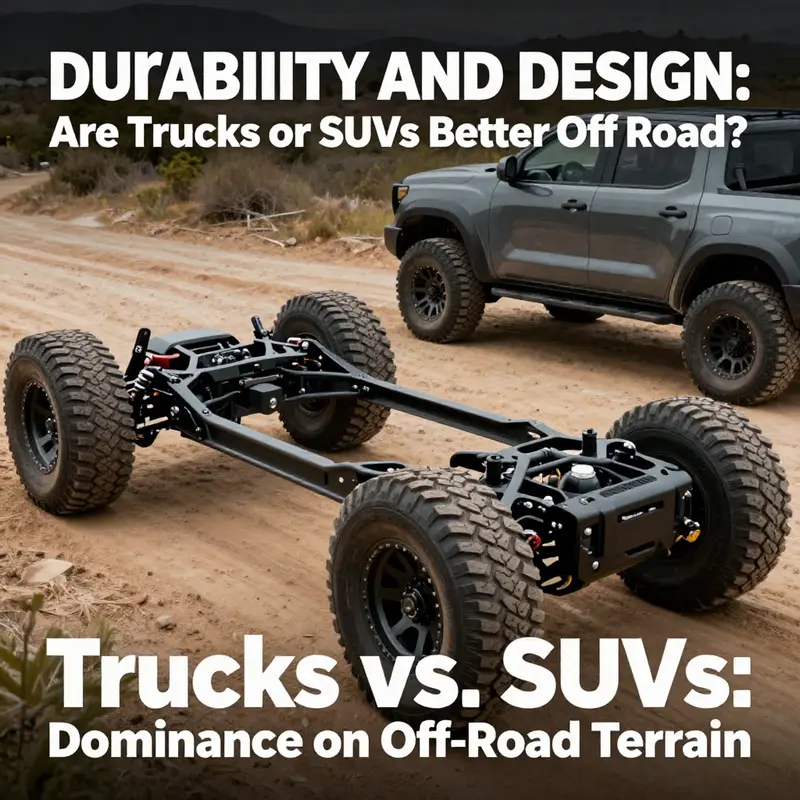
Durability on the edge of the map is not a single feature but a synthesis of design choices, material strength, and how a vehicle behaves under repeated load. On rough ground, a truck’s body-on-frame chassis, robust suspension, higher ground clearance, and rugged underbody protection tend to translate into a platform that can carry, tow, and absorb punishment without losing alignment. By contrast, many modern SUVs lean toward unibody construction, lighter weight, and refined suspension, delivering agility and on road comfort at the expense of brute, all day endurance. The practical takeaway is not a universal rule but a spectrum: trucks excel in sustained abuse and payload endurance, while SUVs excel in maneuverability and day to day versatility that can still perform well off road when the terrain is not punishing.
The off road capability arises from a system of features rather than a single gadget. Four wheel or all wheel drive is common, but the crucial differences live in traction management, low range gearing, locking differentials, and transfer case design. A heavy truck with a strong frame, substantial wheel travel, and protective underbody hardware can press into deep mud, steep grades, and loose rock with a steady cadence. Larger tires and resilient suspensions help maintain traction and reduce the impact of obstacles. SUVs often trade some raw durability for shorter wheelbases, nimble handling, and protective hardware plus electronic aids that enhance control on technical trails. This combination helps them tackle tight switchbacks, rock gardens, and loose descents with confidence, even if they may not sustain continuous assault as long as a purpose built truck.
Real world implications matter most in mining, construction, and remote work where payload, recovery capability, and uptime define success. Payload capacity, towing, and the ability to carry tools across uneven terrain are not abstract numbers but enable practical tasks such as pulling a stuck vehicle, moving equipment, or staging gear across a work site. Electrified off road platforms are expanding the durability frontier by offering near instantaneous torque, predictable heat management, and simpler maintenance in some cases. Yet the old truth remains: a rugged platform, properly configured and maintained, tends to outperform a lightly built one when the road gets rough and the pace demands endurance. The modern answer often blends both worlds: a capable, well protected truck for heavy duty work and a nimble SUV for day to day operations and technical terrain, with electric options enhancing torque delivery and thermal stability where appropriate.
Ultimately there is no single winner. Durability and design live on a continuum shaped by purpose, terrain, and the driver’s priorities for load, speed, and reliability. The best tool for a given job is the one that matches the mission profile: trucks for endurance and utility in extreme conditions, SUVs for agility and all terrain competence, and a growing space where electrified propulsion augments both sides. As manufacturers continue to offer modularity and upgrade paths, a single platform can be tuned to meet different mission profiles, keeping uptime high and the vehicle aligned with the task at hand.
Final thoughts
In the gripping showdown between trucks and SUVs in off-roading, the picture becomes clear. Trucks overwhelmingly dominate in off-road performance due to their higher ground clearance, sturdier frames, and superior traction features, making them ideal for serious adventurers and rugged terrain. While SUVs may offer versatility and comfort for lighter off-road excursions, they simply cannot withstand the harshness that trucks gracefully navigate. Recognizing the core differences can empower off-road enthusiasts to make informed decisions that align with their adventurous spirit. The great outdoors beckons—choose wisely, gear up, and embrace the terrain!