
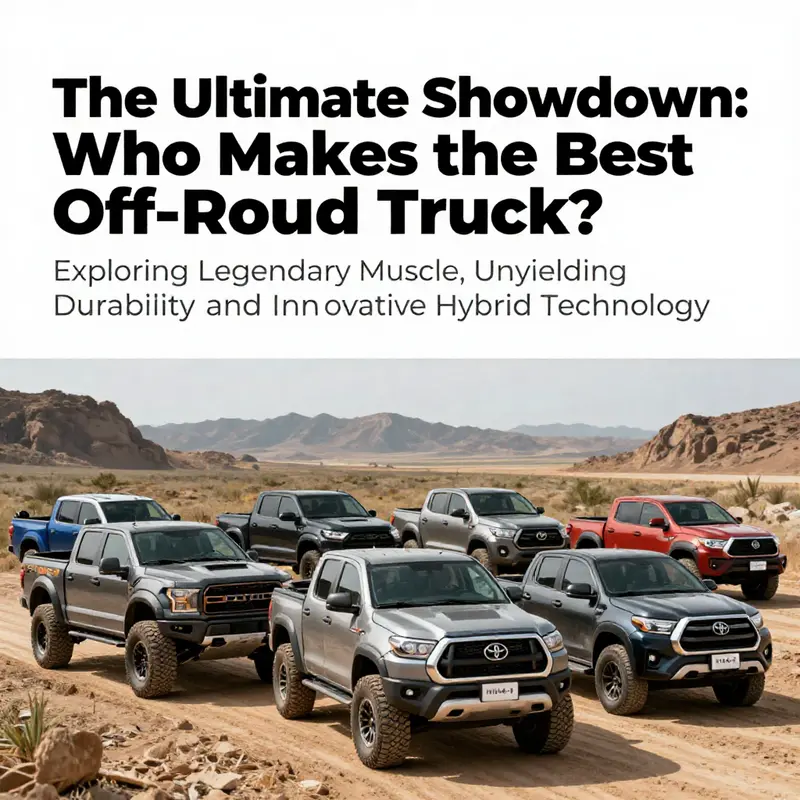
In the rugged realm of off-road pickup trucks, enthusiasts are driven by passion and performance, searching for vehicles that not only conquer uncharted trails but also embody reliability, efficiency, and cutting-edge technology. As new models shuffle into the spotlight, it’s essential to scrutinize the leaders. The Ford F-150 Raptor reigns supreme for pure performance, showcasing heart-pounding horsepower and unparalleled off-road capabilities. The Toyota Hilux stands tall as the go-to choice for those who value durability above all else, ensuring that it can withstand the toughest environments. Meanwhile, the Great Wall Shanhai Pao Hi4-T carves out a niche with its hybrid prowess, presenting a sustainable option without compromising on strength. Each chapter of this exploration will dive deep into what sets these remarkable trucks apart, guiding adventurers, racers, and landowners toward their ultimate off-road companion.
Forged for the Dirt: The Real Benchmark of Off-Road Pickup Power, Endurance, and Hybrid Versatility

In the arena of off-road pickup trucks, performance demands more than horsepower. It requires a synthesis of power, control, and resilience that survives the harshest terrains while still functioning as a practical daily vehicle. As of 2026, the conversations that persist in the field rarely settle on a single champion. Instead, they reveal a trio of archetypes that together define what the best off-road pickup can be: a ferocious powertrain with a championship pedigree, a proven and unwavering workhorse built for the long haul, and a modern hybrid that blends electric efficiency with rugged capability. Each of these paths reflects a different philosophy about how to win on the trail, and each has earned its place in the broader narrative of off-road mobility. The determining factor is less about a brand label and more about whether the machine aligns with the driver’s purpose: speed and desert confidence, or steadfast reliability in remote corners of the world, or a versatile blend that covers both urban commutes and backcountry expeditions with a fraction of the fuel burn. What unites them is a deliberate design philosophy: give the driver the freedom to choose a path through the landscape rather than asking the landscape to adapt to a single, rigid blueprint.
The first pillar of this evolving benchmark is the kind of powertrain that can launch you into the air and still return with a steady hand when gravity reasserts itself. The most celebrated configurations in this category couple a robust V6 with turbocharging to deliver a broad, usable torque band. The result is acceleration that feels almost surgical on open desert floors and the confidence to crest a dune with controlled traction rather than letting the engine surge into a roar and waste momentum. With a modern automatic transmission that shifts smoothly and decisively, the driver experiences linear, predictable response across a wide rpm range. This is not merely about raw numbers but about the relationship between the engine and the throttle, a dynamic that makes blasting down a sandy wash feel both exhilarating and controllable. It is the difference between a ride that is simply fast and a ride that remains composed when the course becomes technical and uninviting. The architecture behind this power is equally telling: long-travel suspension, designed to keep wheels planted as the surface undulates, with a front six-link arrangement and a rear multi-link cradle that preserve tire contact on rocks, ruts, or timbered desert sashes. When the terrain turns abrasive, the damping must respond with precision so speed does not become chaos.
The next essential element is the suspension system and chassis geometry that translate high-speed confidence into measurable, practical advantage. In the best setups, adaptive dampers sit at the intersection of comfort and control, adjusting damping force in real time as the vehicle navigates ruts, washouts, and whoop sections. The result is a ride that feels planted on rough terrain and forgiving on pavement, enabling the driver to carry momentum through sections that would topple a lesser machine. Ground clearance is not just a number scribbled on a brochure; it is the tangible difference between brushing over a rock and dragging a skid plate across the surface. Wide, purpose-built tires provide grip in loose soil, through water crossings, and across slick rock, while a well-chosen rubber compound helps maintain traction without excessive harshness. In this sense, the suspension is the quiet engine of capability, turning raw power into controllable movement and giving the driver a rhythm that translates into speed without sacrificing precision.
Yet capability is most meaningful when it remains usable in everyday life. A true off-road flagship cannot demand compromises that erode daily comfort. It must behave predictably on city streets, conform to parking constraints, and accommodate the needs of a family or crew. That means not only refined ride quality and quiet cabin insulation but also intuitive controls, clear driver aids, and robust yet efficient cooling, especially for the most demanding applications. The integration of advanced aerodynamics, cooling loops, and chassis stiffness contributes to performance by reducing heat buildup and maintaining consistent handling as speeds climb and terrain becomes more punishing. The result is a vehicle that feels at home in a city line as it does on a remote piste. The blend of capability and civility is not accidental; it is the outcome of decades of engineering refinement aimed at delivering a machine that can be both a desert racer and a dependable work partner.
A critical, sometimes overlooked part of this conversation is safety. There is a growing emphasis on how a high-performance off-road platform behaves under the scrutiny of independent tests and real-world scenarios. Buyers increasingly want to know not only how fast a truck can go over dunes but how it protects occupants when things go wrong. This is where data from crash-testing and comparative safety assessments becomes a practical compass. Consider safety data as a counterweight to the thrill of speed: it reminds us that the best machines are those that combine grit with responsible design choices. For a concise, data-backed reference point on safety, readers can explore the documented crash-test results that compare different platforms across common impact scenarios. The point is not to chase safety ratings alone, but to understand how the fundamental architecture contributes to occupant protection in the rugged environments that define off-road work and play. IIHS crash-test results provide a useful context for thinking about how modern trucks balance performance against real-world safety expectations, even as drivers push the vehicle to its limits on rough terrain.
Alongside power and safety lies enduring reliability. The enduring durability narrative centers on a vehicle family that has earned a reputation for weathering aggressive climates, water, mud, and long interstate hauls without demanding constant refuge at the shop. This archetype emphasizes a simple, robust design that keeps critical systems protected and able to operate under varied environmental stresses. In many remote regions, where maintenance opportunities are limited and roadside repairs are not a daily ritual, durability translates directly into mission success. It is the quiet partner that allows a driver to pursue exploration, work, or adventure without the chronic worry of breakages and breakdowns. In this branch of the conversation, the capacity to traverse deep water, handle sustained torque delivery without overheating, and keep components cool under load is as important as peak horsepower. The pulse of this approach is not speed but stamina, the steady, predictable performance that can be trusted when miles stretch into days and weather, terrain, and the clock all demand resilience.
As the dialogue around the best off-road pickup continues to evolve, hybrid and electric propulsion begin to broaden the decision matrix. The modern prototype of the off-road platform embraces electrification not as a novelty but as a practical means to broaden torque availability, improve low-speed control, and reduce emissions on long expeditions. A plug-in hybrid setup can deliver significant torque with electric motors while offering a substantial electric range for quieter, more economical cruising in town or between trailheads. The hybrid’s strength lies in versatility: when the battery is sufficient, you have the urban-friendly efficiency of electric propulsion with the pull of a high-torque, internal-combustion engine for the steep miles and the heavy pulls. When the battery is depleted, the same system can seamlessly supplement the gasoline powertrain, delivering continuous, confident performance to navigate challenging routes or remote backcountry corridors. A three-locker or multiple differential-locking strategy remains a cornerstone of off-road capability in this space, enabling controlled wheel progression on slippery surfaces, steep grades, and rock-strewn passages. High ground clearance, a robust frame, and careful weight distribution further amplify the hybrid’s advantage, ensuring that efficiency does not come at the expense of terrain mastery.
The precise choice among these archetypes is a function of the driver’s itinerary. For the thrill-seeker who imagines themselves carving high-speed lines through sweeping desert flats, a platform with a tuned powertrain and advanced damping that can maintain traction at speed offers undeniable appeal. For the explorer who plans to push into remote regions where fuel is scarce and reliability is priceless, a purpose-built, proven, and durable chassis with a simple, rugged powertrain can be the smarter bet. And for the progressive adventurer who wants both worlds, a modern hybrid with electric range and strong off-road torque can provide the best of both efficiency and capability. It is precisely this spectrum that makes the question of the best off-road pickup less a single verdict and more a conversation about aligning a vehicle’s strengths with a journey’s demands.
In that sense, the field does not crown a universal king but rather celebrates a common DNA shared by all top contenders: precision in the suspension, confidence in the driveline, a chassis that protects occupants under duress, and a design that respects the realities of real-world use. The best choice for one mission is a compromise for another, and the most satisfying path is the one that mirrors the driver’s aspirations and the terrain’s expectations. As the category continues to mature, we can expect further evolution in ride quality, control systems, and hybrid architecture that will push the measurement of “best” from a fixed point toward a dynamic balance that shifts with every trail and every purpose. For readers who want to anchor their understanding in a broader context of safety and performance, the linked safety discussion provides a grounded lens for comparing how these machines behave under stress, while the wider market continues to push toward more intelligent, adaptable, and energy-conscious solutions.
External resource: https://www.caranddriver.com
Durable by Design: The Global Benchmark in Off-Road Durability for Pickups

Durability has long been the quiet engine behind the best off-road pickups. It is the attribute that lets a vehicle survive the kind of punishment most street-oriented trucks avoid almost by instinct. Across the world’s harshest soils and climates, durability translates into uninterrupted capability, predictable handling, and a vehicle that keeps returning from the edge of its endurance with the same resolve it carries into the first miles of a journey. In this light, the durability champion emerges not as a single flashy feature but as a composite of engineering choices, material science, and tested reliability. It is a standard carried by vehicles that have spent decades under relentless use—in desert heat, on rocky trails, through river crossings, and over frost-cracked passes—without surrendering their essential function. The best off-road pickups, when judged by durability alone, are those that demonstrate resilience as a system: chassis, clutches, drivetrains, suspensions, electronics, and body structures all working in harmony under sustained stress.\n\nThe core of any durable off-road pickup begins with its chassis and body construction. Modern iterations lean on high-strength steels and aluminum composites that strike a balance between rigidity and weight. This combination resists fatigue from repeated impacts while maintaining enough flexibility to absorb shocks that would otherwise crack or bend thinner, cheaper materials. The result is a platform that can endure long expeditions where even minor flexing could become a cumulative problem. In the field, this translates to steadier handling on washboard tracks, fewer creaks and groans after a day of rough terrain, and a chassis that doesn’t drift into misalignment after repeated dips and climbs. The body, likewise reinforced, resists denting and deformation when payloads shift under heavy jounce or when a vehicle noses into an obstacle and rebounds.\n\nA critical layer in the durability story is the drivetrain. For off-road work and exploration, the ability to transfer power smoothly from the engine to the wheels without stalling or overheating is non-negotiable. Selectable four-wheel drive with low-range gearing provides the flexibility needed to manage traction at low speeds on slippery rock or steep grades, where momentum is a poor ally and control is the true currency. Locking differentials on higher trims offer the extra grip required when a wheel starts to lose traction in soft sand or on wet shale. These features are not about raw speed; they are about controlled, predictable progress when control is the difference between progress and sitting still. The torque delivered by the powertrain matters as well. In the durability equation, torque figures around the mid-range of a modern diesel or gasoline engine translate into a robust ability to climb grades, crawl over obstacles, and pull a loaded trailer through rough terrain without wanting for more grunt.\n\nSuspension is another pillar of durability. It has to absorb the biggest thumps yet return to a stable baseline for the next obstacle. Reinforced suspensions and heavy-duty axles are the backbone of this resilience. They tolerate repeated high-load cycles and remain aligned after harsh landings or deep ruts. Electronic stability control and traction control systems play a supporting role here, keeping the vehicle steady when the surface condition deteriorates. The combination of robust axles, tuned dampers, and smart electronics ensures that the vehicle does not lose direction or shed control simply because a wheel found a less-than-ideal surface. In practical terms, this means fewer tire damages, less suspension haunting, and more time spent moving forward rather than recuperating from mishaps.\n\nGround clearance is often the most visible sign of off-road capability, yet its significance extends well beyond simply clearing rocks. Adequate clearance reduces the risk of damage to the undercarriage when crossing rough terrain, and it minimizes the chance of thwarted progress by large rocks, ruts, or hidden stumps. The durability narrative thus includes a vehicle’s ability to negotiate obstacles without dramatic suspensions or chassis compromises. Higher ground clearance paired with well-tuned approach and departure angles allows for longer travel over uneven terrain, diminishing the likelihood of getting stuck. These design choices reduce the vulnerability of essential systems to damage and help preserve the vehicle’s core functionality after encountering the kind of terrain that would derail lesser machines.\n\nThe practical reality of durability stretches beyond components into the realm of everyday versatility. A durable pickup isn’t only for pristine desert expeditions; it is built to serve professionals and adventurers alike. This means a payload-tolerant chassis, fuel and equipment efficiency, and a cab that remains livable after an extended off-road stint. The best durability stories include layouts that accommodate heavy-duty tasks while still offering reliable comfort and controls for long days behind the wheel. The aim is a vehicle that can shuttle tools to a remote site, carry gear for extended expeditions, and still perform with the same poise when you return to asphalt. The balance between ruggedness and usability becomes a template for evaluating all-off-road capability: strength that lasts, but practicality that remains accessible for the day-to-day rider or the field crew.\n\nTrim levels are not merely cosmetic; they are part of the durability equation because different roles demand different levels of reinforcement and protective features. On one end of the spectrum, utilitarian configurations emphasize robustness and simplified maintenance, with fewer fragilities to tempt on rough tracks. On the other end, more feature-rich variants provide enhanced protection and more sophisticated electronic aides—systems that help maintain control and integrity across challenging environments without sacrificing the underlying durability. The durability story, then, is not about a single blueprint but about a family of configurations that share a fundamental philosophy: the vehicle must endure long, demanding use without compromising safety, control, or capability.\n\nThe durable pickup’s credibility is reinforced by a proven track record in endurance environments. Real-world testing has long demonstrated that sustained reliability often beats short bursts of high performance. Endurance rallies and cross-continental expeditions expose vehicles to heat, dust, water, and relentless vibration for days on end. It is in these arenas that the durability standard is either validated or rejected. When a vehicle demonstrates steady behavior under such duress, it becomes a benchmark for the segment. The Dakar Rally’s legacy speaks to this idea in a telling way: vehicles that survive the punishing stages, navigate the toughest terrains, and complete grueling legs under fatigue are the ones that redefine what a pickup can endure. It is a narrative of resilience that resonates with operators who depend on these machines day after day and kilometer after kilometer.\n\nIn public discussions about off-road pickup durability, the conversation often circles around some familiar metrics—water fording depth, torque, ground clearance, and the reliability of electronic systems in extreme conditions. A model capable of fording water hundreds of millimeters deep without compromising the engine or electrics immediately signals a design built for immersion and mud. Torque, when paired with a robust drivetrain, provides the power reserve needed to navigate steep trails without pushing the engine into inefficient rev ranges. High ground clearance, together with a well-tuned suspension, gives a vehicle the latitude to tackle rough ruts and rock gardens without bottoming out. And while horsepower can attract attention, durability hinges on how well the entire system behaves when the going gets rough. The best off-road pickups embody this balance, delivering consistent performance through a blend of rugged construction, proven drivetrains, and intelligent control systems that help the driver keep momentum without inviting calamity.\n\nFor readers who want a deeper look at the mechanics behind rugged diesel endurance, consider exploring further resources that detail the practical principles of durability in heavy-duty applications. Mastering diesel mechanics: your step-by-step path to success offers a structured approach to understanding how diesel systems withstand repeated stress, while also illustrating how maintenance practices can extend a vehicle’s life on demanding assignments. This kind of knowledge strengthens the broader narrative about what makes a pickup endure in the field, highlighting the intimate link between engineering choices and real-world outcomes. Additionally, for a broader look at four-wheel-drive capabilities and how they inform durability in off-road contexts, there is a foundational external resource that outlines key 4×4 principles and the way they translate into field resilience. 4×4 guide provides a useful framework to think about how features like low-range gearing, differential locking, and ground clearance contribute to lasting performance even when the surface betrays the driver.\n\nIn this larger conversation about who makes the best off-road pickup, the durability narrative is a constant through-line. A vehicle that can move forward where others falter, that can protect its occupants under extreme conditions, and that can continue to perform after days on washboard roads or through river crossings is, by every measure, the kind of tool that professional operators and adventurers alike would choose again and again. Durability is not a single module to be added on top of a base design; it is an integrated philosophy that shapes every component—from chassis geometry to the thickness of the underbody shield, from the resilience of the powertrain to the intelligence of the stability systems. It is what allows a pickup to be more than a means of transport; it makes it a trusted partner in places where the road ends and necessity begins. The durability story, told across continents and through countless hours of field use, remains the clearest indicator of which trucks truly stand up to the test of real-world off-road life. And in the end, that is the measure by which we compare the contenders: not who goes the fastest on a smooth track, but who endures and still serves when the terrain tests every limit.\n\n
Hybrid Fortitude on the Trails: Reframing Off-Road Pickups Through a Modern Hybrid Strategy
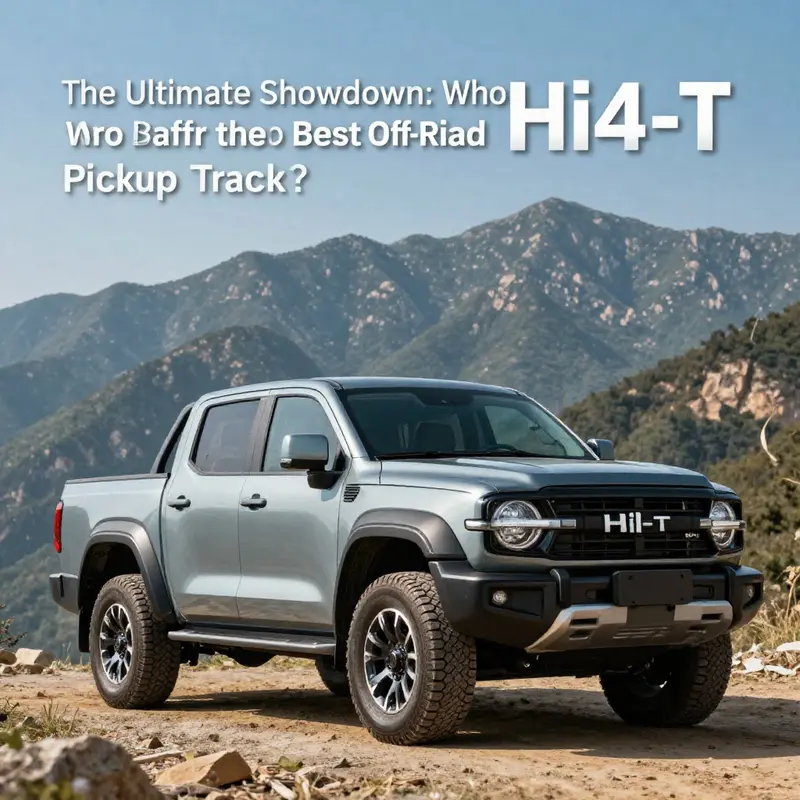
In the rugged world of off-road pickups, capability is measured not merely by raw horsepower or peak torque, but by a balanced spectrum of traction, range, power delivery, and the quiet certainty that comes from engineering that can endure long, demanding sessions in remote places. A new generation of hybrids in this segment demonstrates that sustainable power and rugged reliability are not mutually exclusive. They fuse a refined internal combustion backbone with electric torque, ecosystems of energy management, and a chassis that is tuned for the unpredictable rhythms of dirt, rock, sand, and ice. The result is not simply a greener footprint; it is a broader, more flexible envelope of performance that speaks to the needs of professionals, explorers, and families who chase adventures far from paved roads. In this narrative, a leading example from a major Chinese manufacturer crystallizes the shift: a hybrid off-road pickup that marries long-range capability with sophisticated powertrain engineering, turning what used to be a trade-off into a coherent, usable advantage. While it sits alongside the celebrated, power-focused muscle trucks and the stalwart, durability-driven workhorses, this hybrid candidate signals a different baseline for what the best off-road pickup can be when efficiency, adaptability, and utility are part of the core equation.
What sets this approach apart begins with its propulsion architecture. A 2.0-liter turbocharged engine works in concert with an electric motor, delivering a combined torque that can be felt the moment the throttle is pressed and held. The instant availability of electric assist translates into smooth, controllable traction across slippery grades and uneven surfaces. On steep ascents or precarious ledges, the electric motor’s immediate torque helps the driver modulate grip with finesse, reducing the need for momentum or aggressive wheel spin that can dig a vehicle into trouble. Yet the internal combustion element remains essential for sustained power, high-speed cruising on long backcountry drives, and the ability to replenish energy reserves through efficient cruising and energy recovery. The result is a powertrain that can revitalize the driver’s sense of confidence when the trail tightens, the wind shifts a few degrees, or the ground under the tires demands precise, deliberate steering and throttle management.
Beyond power delivery, the hybrid’s appeal rests on practical, mission-oriented capabilities. The platform embraces a comprehensive energy strategy, including a sizable energy reservoir that supports extended exploration or remote work—an attribute that turns the vehicle into a mobile power station. A notable feature is a robust external power supply, rated at several kilowatts, which makes it feasible to run campers, charge tools, or even supply a temporary power source during outages. This is not merely a convenience; it broadens the vehicle’s use-case envelope. When a campsite is set, the crew can keep equipment charged, lighting steady, and the shelter comfortable without hunting for external generators or extension cords. That kind of versatility matters for long expeditions and rural operations where dependable power is as valuable as traction.
Equally important is the ability to cover significant distances between fill-ups. The hybrid system is engineered to optimize efficiency without sacrificing range, offering a demonstrable, real-world benefit in the form of a long combined range on a single tank and a low, predictable fuel-consumption profile. The numbers may read as technical triumphs on a spec sheet, but in practice they translate to fewer stops, more time on the trail, and less logistical planning for fuel logistics. This is especially meaningful when exploring regions where fuel density is uneven and service networks are sparse. In parallel, the drivetrain and battery management are tuned to ensure that energy is deployed where it matters most—on uneven terrain, in low-traction weather, or across a demanding desert wash—while preserving battery health and efficiency whenever highway miles dominate the journey.
The hybrid’s off-road capability is further reinforced by a drivetrain arrangement that prioritizes traction control and stability. An intelligent all-wheel-drive system adapts to changing conditions, distributing torque to the wheels that can make best use of available grip. On a rocky trail, the system can bias power to the wheels with traction reserves, while on a slick descent it can modulate torque to prevent wheel spin and maintain a controlled, confident pace. Good handling in off-road environments is about predictability as much as raw power, and the emphasis here is on delivering controllable, linear response rather than abrupt torque spikes that can unsettle a driver when traction is marginal. This thoughtful balance—quiet in the cabin, confident on the trail—helps transform a challenging route into a solvable puzzle rather than a source of anxiety.
Utility remains central to the hybrid’s identity. The cargo area is designed with practical, expedition-ready features that acknowledge how owners actually use these vehicles. A three-locker system, combined with a generous number of anchoring points in the cargo bed, supports secure handling of gear—whether it’s recovery equipment, camping supplies, or roof-top gear that must be stowed for overland expeditions. The ability to tether equipment securely means fewer trips back to camp to fetch scattered items and more time to enjoy the work and the wilderness alike. The interior mirrors the outdoorsy purpose with comfort and convenience that matters in long days behind the wheel. Electrically adjustable rear seats with ample recline and a wide rear bench deliver a sense of space that makes a long ride feel less like a slog and more like an extension of home. Privacy glass on the rear windows helps create a peaceful cabin, especially when there are children or elderly travelers on board. In addition, a sophisticated sound-insulation strategy—double rear panels and triple-layer acoustic glass—reduces cabin noise, which matters when the crew wants to enjoy conversation, music, or simply a quiet moment after a long climb.
The safety architecture accompanying this hybrid approach underscores the investment in daily usability as much as off-road performance. A comprehensive suite of driver-assistance features, including automatic emergency braking, lane-keeping assistance, and lane departure warnings, works to reduce the fatigue and risk that can accompany long expeditions or adverse trail conditions. Coupled with a high-strength body structure and multiple airbags, this safety envelope provides a tangible sense of protection. The result is a vehicle that doesn’t just endure demanding terrain; it supports a family or crew traveling through remote environments with a confidence that comes from modern protective systems rather than sheer mass alone.
What emerges from this synthesis is a compelling narrative about how hybrid technology can redefine the value proposition of off-road pickups. The combination of long-range capability, versatile energy management, and reinforced safety creates a platform that is not only capable in difficult terrains but practical for everyday use and family life. The hybrid approach stands as a robust counterpoint to the traditional all-out power route, offering a more balanced equation where efficiency and endurance are not just side benefits but central pillars of capability. And while the allure of raw, unrelenting torque remains strong for some, the hybrid path leans into a broader utility. It allows owners to extend their adventures, to power their temporary setups without hunting for a generator, and to travel farther with fewer interruptions. It also accommodates more diverse travel scenarios, from winter driving on slippery passes to summer trips through arid flats where power management can be the difference between a smooth voyage and a recovery scenario.
In the broader market conversation, the rise of this hybrid archetype pushes other manufacturers to rethink what the best off-road pickup looks like. It invites comparisons not merely on peak performance but on mission versatility, total cost of ownership, and the reliability of power systems under changing climates and terrains. The argument for a hybrid solution becomes a conversation about how to balance enduring strength with efficient energy use, how to provide generous payload and towing capacity without compromising comfort, and how to deliver safety and technology that genuinely improve the user experience rather than merely adding new gadgets. This is not a rejection of the traditional, rugged, pure-performance pickup; it is an invitation to broaden the definition of best by including the daily realities of those who live with their trucks across mountains, deserts, forests, and snow-dusted towns.
For readers plotting a path through this landscape, the hybrid pickup presents a practical framework. It showcases how a balanced drivetrain, a robust energy and power-management system, and a thoughtfully engineered cabin can work together to produce a vehicle that is ready for anything from a weekend off-road to an emergency power solution in a rural community. In that sense, the question of who makes the best off-road pickup becomes less about choosing a single champion and more about choosing the right tool for the mission. A model that harmonizes long-range ability with on-demand torque, that provides a secure and comfortable interior, and that offers practical utilities in the cargo-and-camping domain speaks to a growing segment of buyers who require more than speed and grit. They want a vehicle that can carry gear, power a campsite, haul a trailer, and keep a family safe and comfortable while navigating some of the most demanding environments on the planet. In this light, hybrid technology doesn’t just expand the capability envelope; it elevates the everyday experience of ownership, making the off-road pickup a more inclusive, capable, and dependable partner for exploration and work alike. This is a turning point in how we define the best, as the field acknowledges that the optimum choice is the one that most fully aligns with the driver’s purpose, the terrain they face, and the life they intend to lead on the road less traveled.
For readers seeking further context and technical details on the hybrid approach and its real-world applications in off-road work and exploration, a related examination of charging infrastructure for electric and hybrid trucks offers useful perspectives on how the ecosystem supports these vehicles. electric-fire-truck-charging-infrastructure provides a broader look at how power availability, rapid charging, and energy management are evolving to meet the needs of mission-critical operations and remote adventures. In parallel, official specifications and broader technical disclosures can be explored through the global edition page maintained by the manufacturer, which highlights the interface between hybrid architecture and off-road capability. https://www.gwm.com.cn/shanhaipao-hi4t
Rugged Rivalry: Decoding the Best Off-Road Pickup Truck for Real World Adventures

Choosing the best off road pickup truck is about more than numbers or marketing. It is about how a vehicle behaves when pavement ends, how it carries gear across rough terrain, and how it holds up on long trips. There is no single champion that fits every road and trail. Instead there are archetypes with strengths for different adventures. A flagship power focused model delivers pace and brute resilience for those who chase speed. A globally proven workhorse stands out for durability in mud, water, and remote stretches. A hybrid pioneer blends torque with efficiency for long range trips. When viewed together, these archetypes reveal what makes a great off road pickup for you rather than what a badge promises. The power flagship excels in fast rough terrain but requires careful handling of heat and weight. The workhorse trades speed for reliability and sustained torque in tough conditions and long climbs. The hybrid offers quiet operation and a flexible driving experience with a diesel option or electric assist and common fording ability. In practice the best choice depends on your plans, climate, fuel availability and willingness to maintain a complex powertrain. A true four by four with locking differentials and a well tuned suspension is the foundation, while drive modes and low range help tailor performance to the terrain. Durability remains crucial: robust chassis, ground clearance, protective shields, and reliable electronics. Interiors must be comfortable for long days on the trail. In short, the best off road pickup is the one that fits your journey, not the one that tops a brochure. For those who want more practical depth, many resources compare a broad range of trucks to highlight how these archetypes perform under real conditions.
Final thoughts
Navigating the world of off-road pickup trucks involves discerning performance needs and evaluating reliability amidst diverse conditions. The Ford F-150 Raptor excels as a powerhouse for adrenaline-seekers, while the Toyota Hilux remains an indomitable force for those who require ruthless durability. In an era increasingly focused on sustainability, the Great Wall Shanhai Pao Hi4-T emerges as a trailblazer in hybrid technology, proving that efficiency and strength can coexist. As you consider which truck best fits your off-road aspirations, remember that whether racing through desert landscapes or hauling loads across rugged fields, the ultimate choice transcends mere specifications. It’s about embracing adventure, exploring the unknown, and finding a vehicle that mirrors your spirit.