
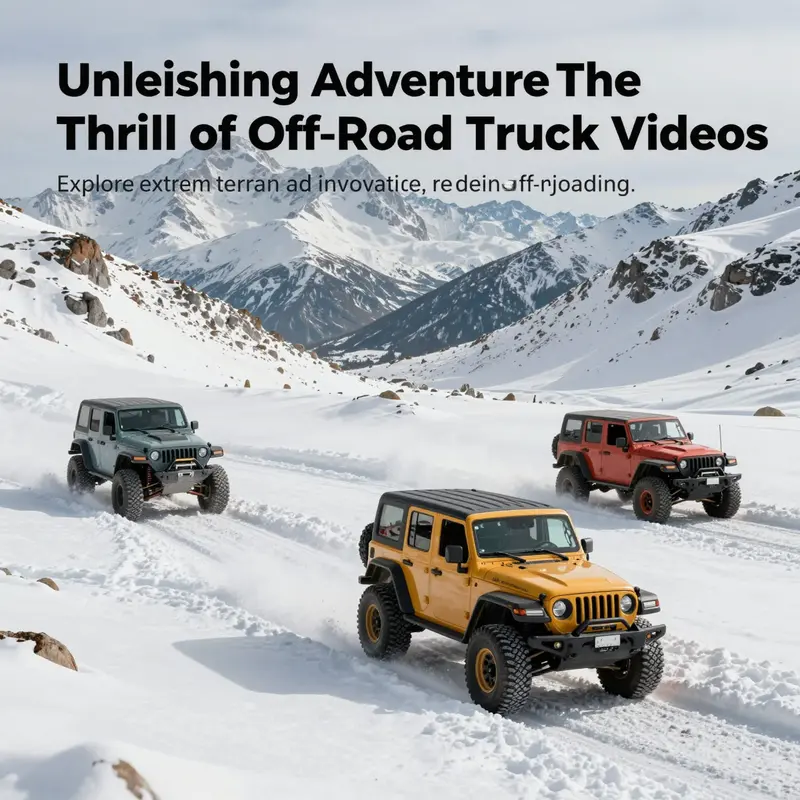
The world of off-road truck videos is a tapestry woven with adrenaline, engineering marvels, and breathtaking scenery. For off-road enthusiasts, racers, rural landowners, and modification shops alike, these videos not only serve as entertainment but also as a testament to the capabilities of rugged vehicles designed to conquer nature’s fiercest trials. In the following chapters, we will delve into the exhilarating essence of these videos, exploring the extreme environments they showcase, the remarkable vehicles featured, and the evolution of this vibrant genre. Together, let’s journey through the heart of off-road culture, dissecting what makes these videos so compelling and impactful.
Beyond the Edge: Immersive Off-Road Truck Videos That Test Machine, Driver, and Terrain
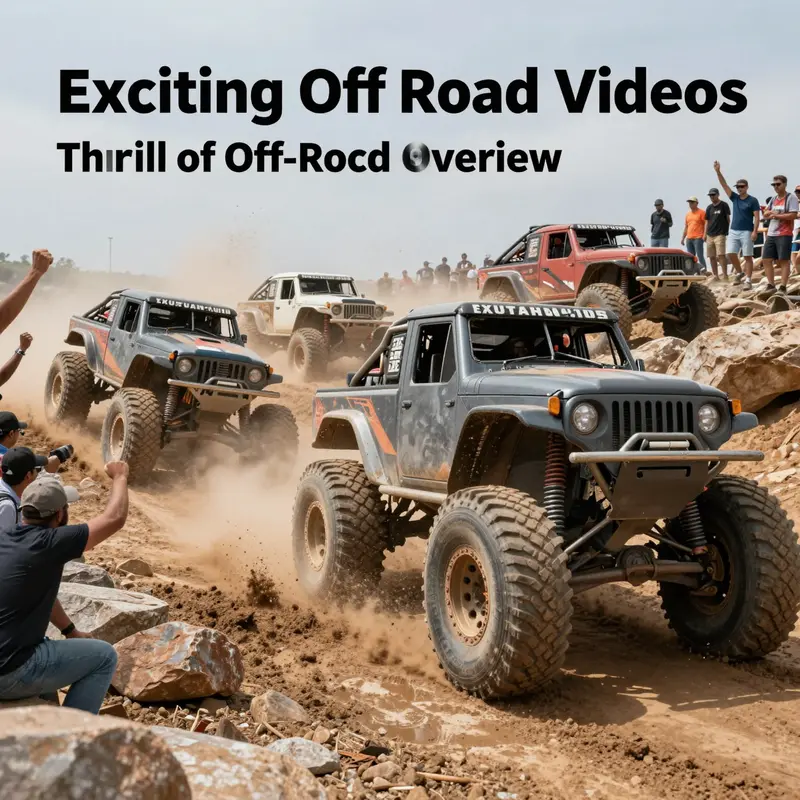
Off-road truck videos unfold as a rare blend of spectacle and technical education. They pull you into a landscape where the line between human skill and machine capability blurs. The camera catches the moment a wheel finds grip on a loose rock, the way suspension cycles through big vertical travel, and the second-longer silence when momentum shifts and the vehicle stabilizes. Viewers don’t just crave speed; they want the tactile sense of weight distribution, the feedback through the steering wheel, and the subtle sounds of clutches engaging or diffs locking. These clips span a spectrum from casual social media clips filmed in remote woods to high-stakes testing on purpose-built courses that push engineering to the edge. They illustrate a common truth: off-road capability is not a single feature but a coordinated ensemble of power delivery, traction systems, articulation, and driver judgment tuned to the demands of a given terrain. In other words, off-road videos are a living ledger of how far vehicle technology has come and how much it still has to learn when the ground turns unpredictable.
Across the catalog of episodes, the terrain sets the pace as much as the engine does. Desert dunes demand a different rhythm from a rocky ascent in a forested hollow. In the former, the emphasis is on throttle management, air intake and tire choice as the machine wrestles with shifting sands and steep faces; in the latter, precise wheel placement and the ability to maintain momentum over irregular surfaces reveal the driver’s calibration and the suspension’s capacity for rapid articulation. A typical clip might show a silver pickup blade through a steep, rocky dirt incline, the camera angle emphasizing the slope, trees framing the scene as dust and leaves swirl in the wake of heavy tires. The driver’s hand remains steady, the line chosen with care, as the vehicle fights to keep front wheels aligned with the crest while the rear axle seeks traction on a looser shoulder. The footage does more than entertain; it communicates a practical language. It demonstrates how modern suspensions use multi-link architectures, what traction control contributes when grip is scarce, and how differentials can be locked to transfer torque in moments when gliding would be impossible.
Beyond the viral clips, the sport side of off-road trucking has grown into a demanding form of motorsport and a design exercise at the edge of regulation. The European scene, with a recent kick-off in Misano, Italy, for a continental championship in early spring, gathered a field of drivers from multiple nations. The competition is a showcase of how teams prepare for a season that spans tarmac and gravel, and how engineers adapt to evolving rules around the rear axle and other critical components. The work happens off the public stage as teams fine-tune suspensions on workshops and testing tracks, carving out milliseconds that translate into better control on bumpy straights or on turns where grip is scarce. The aesthetic of the event—sunlight glinting off metal frames, teams clustered around shock absorbers, and data logs spread across a table—underscores the fusion of sport and precision engineering. These races reveal the discipline behind the spectacle: the rigorous validation of chassis geometry, the balancing of weight bias, and the predictive modeling that helps crews decide when to run stiffer springs versus more travel. What emerges is a narrative that links the thrill of the chase with a disciplined, engineering-first approach to solving real-world challenges.
Meanwhile, the digital frontier mirrors and amplifies what happens on clay, sand, and shale. A leading off-road simulation released early in the year uses advanced physics to reproduce the capricious physics of heavy loads, tire deflection, and the way the ground can swallow a wheel under certain conditions. Players manage oil pressure and suspension height, flip differential locks, and outfit their rigs with all-terrain tires and reinforced armor, then complete missions that range from rescue operations to timed cross-country runs. The sense of immersion comes from first-person cockpit feedback and careful tuning of shake and wind noise to reflect real environments. What this digital mirror makes clear is that the boundary between watching and doing is thinning. People who learn from the videos can experiment safely in the simulation, testing ideas about line selection and throttle inputs before they try them in the real world. The result is a more informed audience, one that appreciates how modern control systems, data streams, and driver input converge to keep a vehicle moving when the condition of the ground would otherwise halt progress.
Taken together, the material suggests a broader meaning for off-road videos than adrenaline or spectacle. They function as a cross-fertilization engine for technology, sport, and media. The audience grows not only through astounding stunts but through insight: how suspensions are tuned for different demand, how traction and weight transfer cooperate to keep the vehicle alive, and how regulatory frameworks shape the equipment used in competition. They serve as a bridge between consumer fascination and professional discipline. For engineers, the videos are a trove of real-world test cases—conditions and responses that orbit around a handful of core questions: How does the machine maintain balance as loads shift? When does a tire lose contact with the ground, and what torque is necessary to recover grip? How does the driver harness momentum without surrendering control? For drivers and teams, they are a reminder that brilliance is not only raw speed but the art of making the right choice at the right moment, translating physics into a reliable line through a treacherous landscape. For fans, they are a window into a community that shares a vocabulary of tire marks, chassis geometry, and route scouting, a culture in which curiosity about how things work sits beside a desire to witness the extraordinary in action.
Those who want a deeper technical dive can explore a detailed guide on diesel mechanics that walks through the maintenance and troubleshooting routines that keep these behemoths ready for punishment and performance alike mastering-diesel-mechanics-your-step-by-step-path-to-success. For readers seeking a broader sense of competitive scale and engineering ambition, the European Truck Racing Championship offers a global stage where these ideas are tested against time and terrain: https://www.europeantruckracing.com
Edge of Terrain: Immersive Off-Road Truck Videos Across Extreme Environments
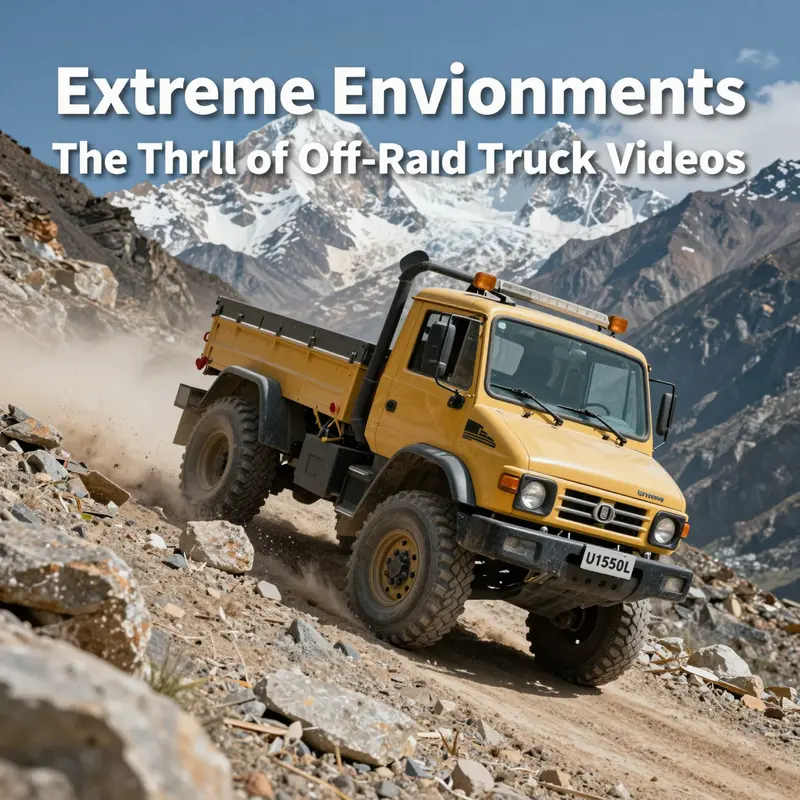
The appeal of off-road truck videos lies in a seamless blend of raw terrain, advanced engineering, and human improvisation. When the camera cuts to a truck digging through thick mud, inching along a swollen river, clawing up a snow-drosted embankment, or threading a rocky switchback, the scene feels like a live reactor of physics in motion. These clips do more than entertain; they capture the dialogue between machine and landscape, a dialogue that unfolds in milliseconds and reveals how design choices translate into control, safety, and resilience. Viewers watch not just for the spectacle but for the education embedded in every tire mark, every degree of articulation, and every measured throttle application. The environments themselves—unforgiving swamps, raging streams, frozen crusts, and jagged outcrops—are not mere backdrops. They are the proving ground that exposes where performance is earned and where it is earned only by tire, traction, and precise driver judgement.
Across the spectrum of extreme terrain, the vehicles shown in these videos embody a philosophy of purpose-built capability. You will notice heavily reinforced frames that tolerate high loads and sudden impacts, oversized all-terrain tires that balance traction with sidewall protection, and suspension systems that articulate with an almost balletic sense of timing. The goal is not to conquer terrain with brute force alone, but to maintain momentum in the face of resistance. In deep mud, for instance, traction becomes a choreography: power is modulated to prevent wheel spin, the chassis shifts weight to find a stable contact patch, and the tires work in concert with compression and rebound to keep the wheel planted. In river crossings, the challenge shifts from wheel grip to water sealing and buoyant weight transfer—elements that reveal how a truck’s chassis and drivetrain are tuned to dampen surge while preserving drive to the wheels.
Snow adds another layer of complexity. Cold underfoot reduces tire pliability, and ice can turn a slope into a glassy ramp. The best clips of snow-covered terrain underscore how drivers anticipate bootleg turns, read pack or crust development, and use gentle throttle modulation to avoid bogging down in crusted snow. The physics are visible: more weight on the drive axle improves bite, but too much weight can overwhelm traction; momentum helps in shallow, firm layers, while a knife-edge balance is required at the drop into a hollow. On rocky trails, articulation becomes a lifeline. The suspension must travel far enough to keep tires on rock ledges while the vehicle remains stable enough to avoid a roll. Differential locks, where engaged, redistribute torque to maximize grip on irregular surfaces, turning a potential stall into a measured ascent. The footage conveys the point that rugged terrain is not a single obstacle but a mosaic of micro-challenges that demand a nuanced, adaptable approach.
The best off-road videos also reveal the driver’s mindset as a crucial component of success. It is not enough to have a machine with impressive specs; the operator’s sense of pace, line choice, and risk assessment matters just as much as the axles and the tires. A patient, deliberate rhythm often wins over a brute-force sprint. When speed is pushed, it is usually in service of momentum rather than vanity, using measured throttle inputs and a precise steering touch to maintain a stable trajectory. This blend of skill and machine tells a broader story about how off-road engineering translates into real-world capability. It highlights how components—suspension travel, locking differentials, traction control algorithms, and drivetrain torque curves—work together in a delicate balance. The clips thus become living case studies, not merely thrilling spectacles, illustrating how engineers expect a vehicle to behave under abrupt changes in surface texture and load.
In the realm of exploration and entertainment, these videos also intersect with a growing interest in how simulation has shaped our understanding of difficult terrain. Without naming specific titles, the genre has long offered a sandbox where terrain physics approximate real-world conditions. Players experience the sensation of negotiating mud, ice, and rock through virtual models that mimic weight transfer and tire deformation. Yet the live-action footage reminds us that real-world physics, driven by real wheels and real drivers, can surprise even seasoned observers. The realities of tire slippage, unexpected traction loss, and the unforgiving nature of a sudden drop or a hidden rock are not always fully predictable on screen. This tension between predicted dynamics and actual outcomes is part of what makes extreme-environment videos compelling: they show the limits of engineering and the ingenuity used to push beyond them.
Beyond the gated confines of cinema-like clips, the same design ethos extends into industrial applications where rugged conditions are the norm rather than the exception. Offshore platforms rely on heavy-duty equipment capable of operating in corrosive seawater, high wind, and constant vibration. In these settings, the core principles are at play: robust frames, sealed and protected drivetrains, and traction-management systems that can function in slippery, uneven, or partially submerged environments. The footage of extreme terrain thus serves as a mirror for professionals who must adapt those principles to their daily work, translating spectator awe into practical understanding of what makes a vehicle worthy of the backcountry or the back deck of a platform. In this sense, the channel of off-road videos becomes a bridge between recreational fascination and real-world application, a loop of learning that travels from the screen to the workshop and back again.
The research material touching on these topics also points toward a compelling current: the experimentation with electrification in harsh environments. A number of teams have pursued fully electric configurations engineered for mountainous or other demanding routes, testing the feasibility of solar-assisted or fully powered systems where traditional fuels may be scarce or impractical. This line of inquiry underscores a future where extreme terrain is not a barrier to sustainable propulsion but an arena that stretches the limits of how electric power can be harnessed. The imagery of an austere, high-altitude expedition powered by sun and battery speaks to a broader trajectory: if endurance and reliability can be demonstrated in the most unforgiving settings, electric technology stands to become a standard feature of rugged exploration rather than a niche specialty. In the videos, you glimpse what this trajectory might look like when the terrain itself becomes a testing ground for propulsion, energy management, and thermal performance under duress.
All of this converges in a single, powerful takeaway: extreme-environment off-road videos are not just a catalog of stunts or a catalog of machines. They are a diagnostic tool for design, a showcase of driver-readiness, and a storytelling device that documents how far engineering has advanced in shaping machines that can survive and thrive where others fail. The clips reveal how weight distribution is managed as the line between traction and slip shifts with every rock, ripple, and ripple of water. They reveal how the choice of tires—along with the pounding rhythm of suspension work and the timing of throttle—transforms potential loss of control into a controlled ascent. And they illuminate an industry-wide impulse toward resilience: a willingness to test, in real-world conditions, the limits of what technology can achieve when confronted by the most extreme and unpredictable environments. The end result is a cinematic archive that teaches as it excites, inviting viewers to imagine what the next generation of rugged, capable machines may endure and how the human skill set supporting those machines will evolve.
A broader look into the evolving landscape of electric-construction equipment shows how the same engineering principles underpin both the backcountry test and the industrial frontier. As a reference point for readers who want to explore related developments, see the evolving conversation around electric construction equipment. electric construction equipment revolution.
For a wider context on how modern, rugged vehicles perform under extreme settings, a useful external resource provides a comparative overview of high-performance trucks in demanding environments. External resource: https://www.highcountrytrucks.com/overview
null

null
Rolling Through Time: The Evolution and Impact of Off-Road Truck Videos

Off-road truck videos began as simple documentation of a truck pushing through mud and rock, a moment of skill captured on a handheld camera. Over time, improvements in camera quality, stabilization, and mounting options let viewers see geometry, traction, and driver decisions with new clarity. The result is a growing craft that teaches as it entertains.
The rise of mobile and short-form platforms shifted pacing toward quick setups, clear obstacles, and compact emotional arcs. Even brief clips can convey risk and technique when paired with precise inputs and a clear line.
This content fosters communities that share field knowledge, recovery tips, and performance data. It also invites industry players to showcase durable solutions under real-world pressures.
Looking ahead, interactive telemetry, virtual reality, and AI-assisted editing promise even more immersive learning while keeping safety and authenticity central.
Final thoughts
As we navigate through the rugged trails of off-road truck videos, we uncover a world where adventure and engineering collide. These videos not only ignite a love for exploration but also inspire innovations in vehicle design and performance. For enthusiasts and adventurers, they provide a thrilling escape into extreme environments, pushing the limits of what’s possible in off-road travel. By embracing these narratives, we celebrate the audacity of adventure and the spirit of community that binds us in our quest for the ultimate ride.