
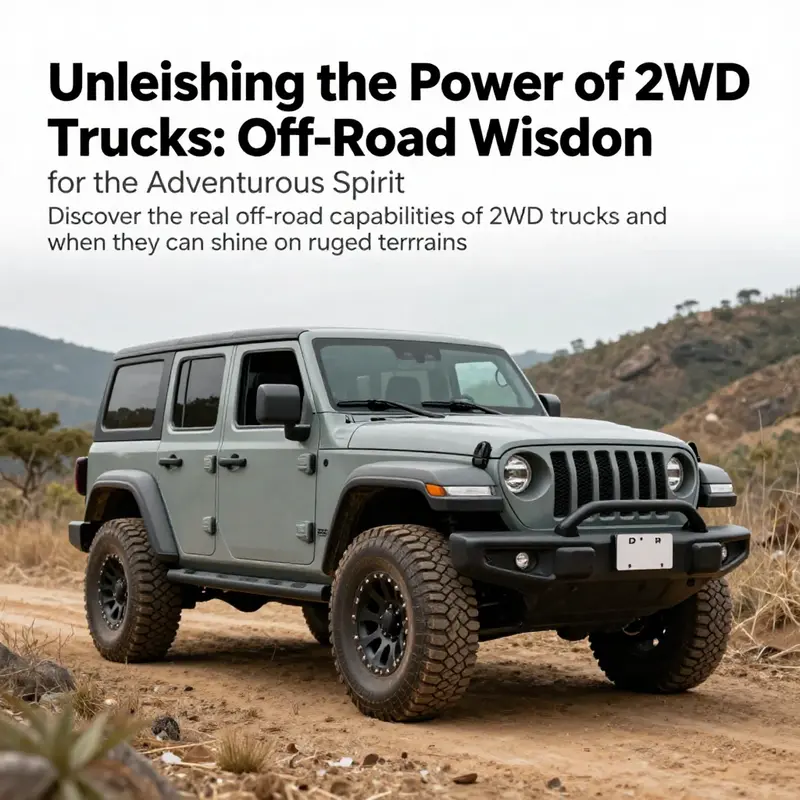
When it comes to venturing off the beaten path, enthusiasts often debate the merits of two-wheel drive (2WD) trucks versus their four-wheel drive (4WD) counterparts. While 4WD systems are known for their superior traction and control, 2WD trucks also have a place in the off-roading world—albeit under specific conditions. This article unravels the intricacies of utilizing 2WD trucks for off-road adventures. From understanding their limitations to evaluating their performance in mild terrains, we delve into their key features and practical considerations for adventurers, racers, and landowners alike. By the end, you’ll have a clearer picture of whether a 2WD truck can embark with you on your next rugged exploration.
Two Wheels on the Edge: The Real Limits of 2WD Trucks Off Road
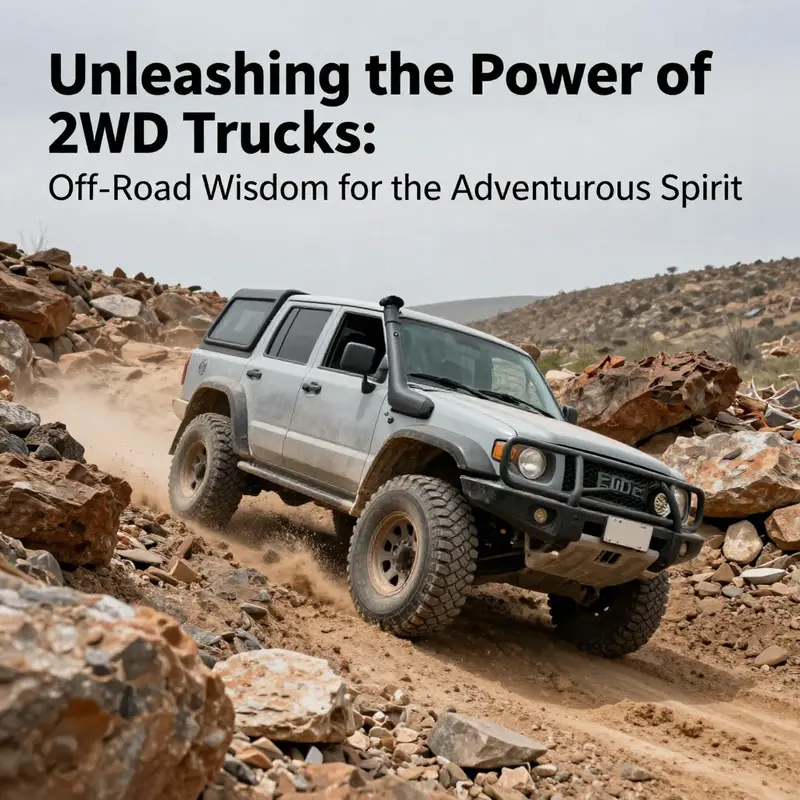
Two-wheel-drive trucks can be straightforward and economical on everyday pavement, yet when the terrain tilts toward mud, rock, sand, or steep grades, the absence of power being sent to all four wheels becomes a defining constraint. The essence of off-road capability is not simply engine strength or ground clearance; it is the consistent, controllable traction that keeps momentum and position through unpredictable surfaces. With 2WD, power arrives at only two wheels, and on slick or uneven ground those two wheels can spin independently of the others. The result is not just slow progress, but a sudden loss of control that can turn a hill climb into a stalled standstill or a slippery descent into a precarious slide. This core limitation scales with the severity of the terrain. On a mild dirt track, with the right tires and a careful throttle, a 2WD truck can maneuver competently. On a true off-road challenge, however, the same truck will quickly reveal its vulnerabilities, exposing drivers to a widening gap between intent and outcome.
Traction is the first and most visible gap. In 2WD setups, only two wheels receive drive torque. If those wheels lose contact with the ground, if the surface shifts beneath them, or if there is uneven ground contact, the drive wheels can spin without pulling the vehicle forward. This is especially problematic when the surface is loose—mud, loose sand, or soft snow—where the tires must grip the substrate as much as push the weight of the truck. In such conditions, momentum can become a liability; once you lose grip, the engine keeps spinning, the tires dig in, and the truck digs itself deeper into the terrain. Unlike 4WD systems, there is no automatic distribution of torque to the wheels with the best grip. Without a mechanism to lock the power to more favorable contact points, the 2WD truck can quickly trade forward momentum for a stuck moment, and every additional moment can feel like a drag toward a more stubborn predicament.
The lack of advanced off-road features compounds the problem. Modern off-road trucks in 4WD configurations often include locking differentials that force opposing wheels to rotate at the same speed, crawl control to maintain progress at low speeds, and robust skid plates to protect undercarriage components. These elements work together to maintain momentum, stability, and protection when the going gets rough. In a 2WD truck, those features are missing or limited by design. The differential that distributes torque between axles in a 4WD setup has no counterpart here to coordinate the front and rear wheels simultaneously. Skid plates, a critical line of defense against rocks and debris, are not a universal feature with the same intent and coverage as in 4WD builds. And without a dedicated transfer case, there is no simple mechanism to reconfigure the power path for improved traction on unpredictable surfaces. The result is a truck that can ride high and clear on a straight stretch of dirt but falters the moment the line between grip and slip is tested by an irregular rock, a buried obstacle, or a sideways slope.
For drivers who expect to navigate farmland, rough construction zones, or remote rural routes, these limitations do more than slow progress; they redefine risk. A 2WD truck can accommodate mixed terrain when the mix is predictable and the obstacles are light. A farmer crossing a field after rain or a contractor meeting an unpaved access road before dawn may find that a 2WD chassis, paired with sturdy tires and careful pace, handles the day’s routine tasks. Yet the moment the surface grows slicker or steeper, the honest assessment becomes clear: 2WD is a compromise, not a universal solution. The terrain becomes a gatekeeper that filters what is feasible and safe, and the more extreme the environment, the more that gate closes.
Even the physical design parameters of a 2WD truck contribute to this dynamic. Ground clearance helps to avoid scraping over obstacles, but it does little to improve traction once the vehicle begins to slide. A stiff or soft suspension can influence wheel contact with uneven ground, yet without a deliberate torque management system, those suspensions can only react to terrain rather than anticipate it with balanced drive. Strong tires and higher sidewall compliance can improve grip, yet tires that excel on gravel may offer limited traction in mud or snow when only two wheels are delivering power. The broader message remains consistent: traction—not power or ground clearance alone—defines off-road capability in a 2WD configuration.
This is not to say 2WD has zero off-road value. There are contexts in which a two-wheel drive can perform well, and in those contexts the vehicle remains practical and economical. A 2WD truck with a generous wheelbase, high ground clearance, and tires chosen for the task can traverse light trails, rocky lanes, and uneven farm paths with a measured approach. The key words are approach and terrain: choose routes that maximize tire contact with the ground, avoid deep ruts or mud pits, and maintain a steady, controlled pace rather than a forced crawl or abrupt throttle. In these limited circumstances, the 2WD architecture becomes a predictable tool for a specific task, not a general all-terrain solution.
Beyond the basics of traction and design, the economics of ownership shape decisions as well. A 2WD truck is typically less expensive to purchase and maintain, and it can deliver solid fuel efficiency on paved roads. For fleets focused on urban deliveries, or for individuals who rarely leave the asphalt, those advantages can outweigh the off-road constraints. The calculus shifts, however, the moment the job requires consistent off-road reliability. In those moments, the incremental cost of a 4WD or AWD system, with its accessory benefits such as locking differentials, improved cruise control of torque, and better protection of underbody components, becomes a sensible long-term investment. The practical reality is that 2WD remains an option for the occasional off-road excursion, provided the terrain is kind and the risk is managed with careful planning and proper equipment. For regular, serious off-road work, the margin favors a more capable drivetrain.
A broader field view helps frame this choice as a matter of intended use rather than a single specification. The modern off-road landscape is increasingly capable, with electric or traditional powertrains designed to deliver traction across demanding surfaces. Even as 2WD can be aligned with careful planning, the universal takeaway is simple: 2WD can handle rough roads with restraint, but it cannot reliably emulate the all-weather, all-terrain performance that 4WD or AWD platforms are engineered to deliver. In practice, farmers and contractors who routinely face mixed terrain, or weekend explorers who routinely push beyond easy trails, confront a decision with lasting implications for safety, efficiency, and readiness. The choice between 2WD and 4WD is thus less about a single feature and more about a commitment to a driving philosophy—one that weighs the cost of a potentially immobilizing moment against the value of steady, predictable traction.
For those who still want to optimize a 2WD setup within its limits, a few practical strategies can help. Upgrading to all-terrain or mud-terrain tires with a stiff sidewall can improve grip and resistance to punctures in rough ground. Upgrading suspension components to improve wheel contact and ground clearance can reduce the chance of bottoming out on rocky paths. Adding underbody protection helps shield vital components from damage when the route is longer and rougher than expected. Weight distribution, too, can influence traction in certain conditions; in some 2WD configurations, a slight forward weight shift can improve grip on the driven axle, but this should be approached with caution to avoid reducing steering control or increasing the risk of rolling if the vehicle slides sideways. Even with these enhancements, the fundamental limitation remains; the two-wheel drive system lacks the inherent capacity to adapt torque across all contact points when surfaces vary dramatically under load. This is why the overall assessment of 2WD off-road capability points toward selective use: great for easy terrain with a cautious driver, less reliable for anything approaching rugged, variable, or unpredictable ground.
In the broader arc of off-road experience, the comparison to four-wheel drive and newer off-road technologies is instructive. The multi-wheel, multi-axle systems that modern engineers design emphasize traction continuity, controlled torque, and planetary gearing arrangements that maximize grip on a range of surfaces. Where 2WD provides simplicity and efficiency, 4WD provides redundancy and resilience. The landscape of off-road work—whether in agricultural fields, rural delivery routes, or mountain pass treks—tends to reward that resilience. The conclusion colleges around a simple principle: for demanding terrain and variable conditions, a drivetrain that can balance torque to all wheels is not a luxury but a fundamental safety and performance feature. The 2WD truck remains a capable daily driver and a selective off-road tool, but its position in the toolkit is clearly defined by the surface and the risk one is prepared to shoulder. For readers planning continuous or recurring off-road adventures, the evidence across terrain types consistently supports this prioritization: 4WD or AWD delivers greater control, confidence, and capability when the going grows unpredictable.
External reference for deeper technical context about how 4WD designs influence off-road performance is available here: https://www.offroadunlimited.com/2025-truck-off-road-performance
Two-Wheel Footing on Gentle Ground: Assessing the Real-World Viability of 2WD Trucks in Mild Off-Road Terrain
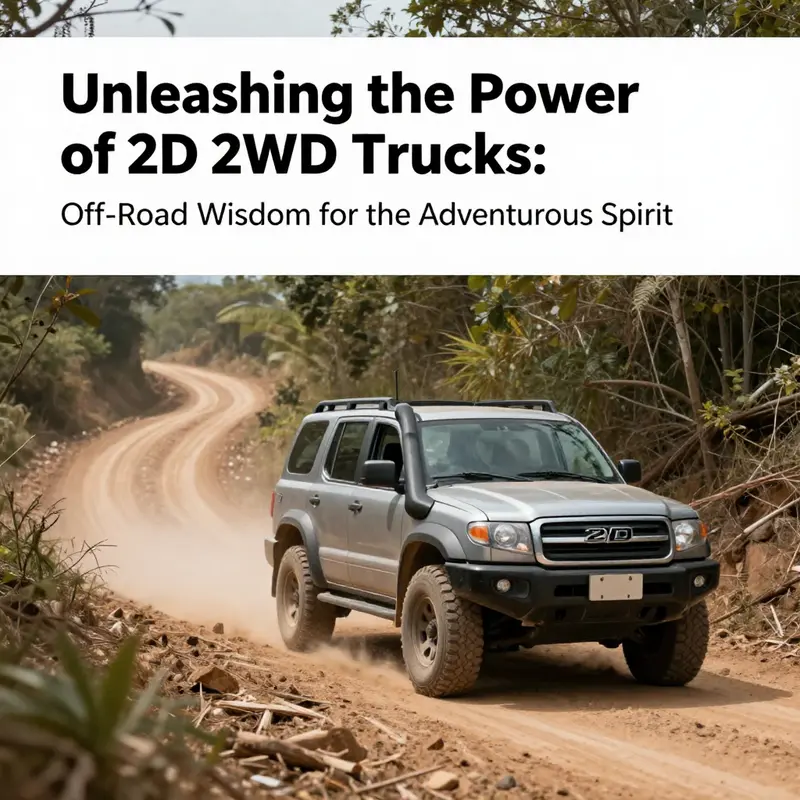
When a chapter about off-road capability narrows to mild terrain, the question shifts from whether a vehicle can cross a rugged obstacle to how reliably it can cope with slightly uneven ground, loose patches, or damp spots while keeping cost and efficiency in check. For many operators, a two-wheel-drive truck represents a sensible compromise: lower upfront cost, simpler maintenance, and better fuel economy on flat or well-kept surfaces. Yet off-road performance is not a single dial you can turn up or down; it is the sum of design choices, tire selection, suspension behavior, and how a driver interacts with the terrain. On mild trails, a 2WD truck can still deliver solid results if the work is predictable, the route is known, and the conditions are stable. The challenge is recognizing what mild terrain really means in the field—where grip can fade with a patch of mud, where a shallow rut can steal momentum, and where a heavy load can push a vehicle past the point where two wheels can keep traction. In that context, the 2WD equation becomes a blend of engineering, habit, and planning rather than pure capability alone.
Design economics and how they translate to performance sit at the heart of this discussion. Two-wheel-drive systems trim the drivetrain, reduce weight, and shave maintenance costs. The result is a vehicle that is attractive for fleets chasing lower operating expenses and higher utilization. In steady, flat environments—paved yards, concrete lots, or firm gravel—2WD can shine where the absence of front or rear differential torque noise is hardly noticeable and where the efficiency gains accumulate across a long shift. The same efficiency edge, however, is vulnerable to the variable grip that mild terrain can still throw at a truck. The moment a surface loses bite, the two-wheel setup must rely on the remaining driven axle to pull the truck forward. If that traction is compromised by moisture, loose rock, or soft soil, momentum can wane quickly and the vehicle can begin to spin a tire or slide toward the soft edge. Even then, a well-sorted 2WD platform—with robust tires, good ground clearance, and sensible gearing—will navigate many tasks that never demand the bite of a four-wheel system, though with clear caveats about risk and pace.
In practical terms, the applications of 2WD in mild terrain tend to cluster around controlled environments. Light industrial operations on paved or compacted gravel surfaces, on-site material handling, and routine yard transfers fall into this category. The restricted surface variability in these settings plays to 2WD’s strengths: fewer moving parts to monitor, lower failure points, and a drivetrain that can be serviced with familiar schedules. A fleet operating in this space often notes fewer surprises during routine maintenance and a lower total cost of ownership per mile, provided the loads remain within predictable ranges and the routes stay within well-traveled corridors. The caveat is that the simplicity of 2WD should not be confused with indifference to terrain. Even mild off-road tasks can present edge cases where grip is marginal, and where the driver’s skill—throttle modulation, wheel position, and speed management—becomes a decisive factor. The interplay of these factors means 2WD is not universally best, but it can be adequately reliable when the job and the surface align.
A meaningful comparison with four-wheel-drive models becomes essential here, not as a binary verdict but as a spectrum of capability tailored to the task. The core difference is torque delivery. A 4WD system can distribute power to all four wheels, so when one wheel hits a slick patch or a rock, the others help anchor the truck and maintain forward momentum. In mild terrains, this translates to steadier acceleration on uneven grades, reduced wheel spin, and a lower risk of getting stuck. Conversely, the 2WD setup concentrates traction on two wheels, which can be an advantage on hard surfaces where drag is a concern and efficiency is paramount. But when a route features damp clay, wet leaves, or a shallow rut, the two driven wheels can reach the point of diminishing returns faster, particularly under heavier loads or when the Jeep-jostle of a truck’s suspension compresses and articulates across obstacles. The decision is seldom black or white: many fleets default to 2WD for routine tasks and bring 4WD into service only when a particular route or season signals a higher risk of traction loss. This middle-ground approach recognizes that the terrain, load profile, and driver capability co-create the off-road outcome, rather than drivetrain architecture alone.
To illuminate the real-world texture of these choices, testing and field data offer valuable guidance. In strictly controlled, flat environments, 2WD configurations frequently deliver the best fuel economy and lower maintenance costs because the torque path is shorter and the drivetrain bears less rotational mass. Industry analyses have suggested that, in such settings, 2WD fleets can realize up to roughly a 15 percent improvement in fuel efficiency and operating costs versus more complex drivetrains. That advantage, however, evaporates as soon as the surface begins to slip or as a grade steepens. Even a light incline or firmer dampness can magnify the performance gap between a 2WD system and a properly equipped 4WD setup. Real-world data collected from operators shows that the effectiveness of 2WD hinges on a cluster of linked variables: tire tread and pressure, weight distribution within the load, the angle of approach on grade changes, and, critically, the driver’s technique. A driver who understands how to modulate throttle use, anticipate traction loss, and pick lines that minimize wheel spin can extract surprising capability from a 2WD platform in mild terrain. But when conditions shift toward moisture-laden ground or when a heavy payload pushes the rear wheels into softer substrates, the advantage of distributing torque to all four wheels becomes evident. In that moment, the absence of a front or rear differential drive is not merely a performance limitation; it is a safety and momentum concern that can influence a task’s duration and risk profile.
These considerations align with a practical, risk-aware philosophy for fleet operations. The smart strategy is to assess the exact mix of terrain and task in advance and to calibrate the vehicle choice to that mix. If most duties occur on hard-packed surfaces with occasional light off-road sections, a well-maintained 2WD truck with appropriate tires can deliver dependable service with lower total cost. If jobs routinely push into damp, soft, or uneven ground, or if a heavy load must be hauled up a slope with uncertain grip, the safer bet is a 4WD platform that can sustain momentum without stalling. Even then, it is worth recognizing that 2WD is not inherently inferior; it is simply tailored to a narrower operational envelope. The best outcomes arise when fleet managers document the terrain profiles, align maintenance schedules with the expected duty cycles, and foster driver skills that maximize traction and steady progress on the surfaces encountered.
In planning such a balance, managers who invest in people for fleet management success tend to see better outcomes across the board, including safer off-road operations and more efficient resource use. For a deeper perspective on this people-centered approach, see Invest in People: Key to Fleet Management Success. The human element—training, communication, and proactive maintenance planning—often determines whether a 2WD setup remains a cost-effective solution or becomes a liability in the field.
For readers seeking a broader frame of reference beyond the chapter’s focus, industry trends and analysis from respected sources provide the wider context. As one line of evidence, the Material Handling Industry (MHI) has documented how terrain and surface quality can shape the practical performance of truck fleets, underscoring that the relative advantages of 2WD versus 4WD depend heavily on environmental conditions, task complexity, and operational discipline. For broader context, see the external resource: MHI Industry Trends.
When 2WD Trucks Can Handle the Trail: Features That Make Light Off-Roading Possible
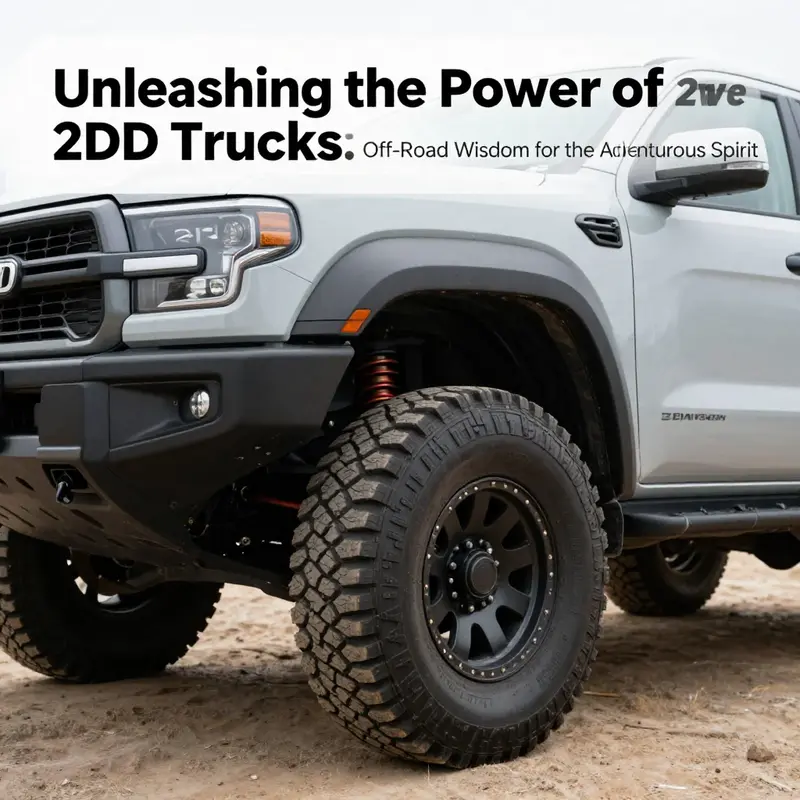
Understanding the practical strengths and limits of two-wheel-drive trucks is essential when planning light off-road use. A 2WD truck is not inherently designed for the extremes of rock crawling, deep mud, or steep, slippery inclines. Yet many owners find these trucks surprisingly capable on modest dirt roads, farm tracks, and packed gravel paths when the right combination of features and driving approach is in place. This chapter walks a careful line between capability and constraint, describing the mechanical traits and real-world adjustments that let a 2WD truck perform reliably off the beaten path.
At the heart of a 2WD truck’s usefulness off-road is its simpler drivetrain. With power delivered to only two wheels—usually the rear—the truck omits transfer cases, front differentials, and extra driveshafts. That simplicity reduces weight and mechanical complexity. A lighter vehicle loses less momentum when climbing gentle slopes or negotiating washboard tracks. Less complexity also means fewer components that can fail away from service, which improves reliability for occasional off-road tasks.
Those same design choices feed two practical advantages: fuel efficiency and lower ownership costs. Reduced mass and fewer moving parts lower fuel consumption and reduce wear. For someone who uses a truck mostly on paved roads but sometimes needs to reach a field, job site, or remote parking area, better economy and cheaper maintenance matter. This cost-benefit trade-off is why many choose a 2WD model for mixed-use work, knowing that moderate off-road access is often enough for their needs.
Traction remains the defining constraint. On loose, wet, or uneven ground, only two driven wheels must do all the work. This limits a 2WD truck’s ability to regain momentum if a wheel slips or loses contact with the surface. However, traction can be improved without changing the drivetrain. Choosing the right tires is the most effective step. All-terrain or light off-road tires with deeper treads and stronger sidewalls increase grip on dirt, gravel, and compacted mud. Alongside tires, attention to tire pressure helps: slightly lower pressure enlarges the contact patch and smooths ride over rough ground. Small adjustments make a measurable difference when traction is marginal.
Ground clearance and suspension geometry also determine how well a 2WD truck moves across uneven terrain. A taller ride height prevents the chassis from scraping over rocks and ruts, while a robust suspension absorbs impacts and preserves traction by keeping tires in contact with the ground. Many 2WD trucks offer higher suspension options or aftermarket upgrades that raise clearance and improve wheel travel. These changes help avoid getting stuck by reducing the chance of underbody hang-ups and by allowing the vehicle to roll over obstacles rather than plow into them.
Weight distribution influences off-road behavior, too. With a rear-wheel-drive layout, loaded cargo in the bed increases rear-wheel traction. For practical purposes, carrying a modest amount of weight above the rear axle can improve grip on loose climbs. Conversely, an empty bed on soft ground reduces traction and increases the chance of spinning the driven wheels. Thoughtful packing—placing heavier gear over the axle and avoiding top-heavy loads—helps a 2WD truck remain composed off-road.
Gearing and torque characteristics matter where steady, low-speed power is required. Lower axle ratios and transmission setups that emphasize torque at low RPM help maintain momentum across soft surfaces. A 2WD truck that can deliver smooth, controllable power without abrupt boosts or surges gives the driver better ability to modulate throttle input and prevent wheel spin. A skilled approach to throttle control and momentum often compensates for what the drivetrain lacks.
Braking and stability control systems have improved, and even many 2WD trucks now include features that assist in traction management. Electronic traction control and stability systems can detect slip and reduce engine power or apply brakes to specific wheels, improving control on mixed surfaces. These systems are not substitutes for the mechanical advantage of four driven wheels, but they help manage the power that is available and prevent losses that would otherwise strand a vehicle.
Practical driving techniques expand the envelope of a 2WD truck. Maintaining momentum through soft patches and choosing lines that keep weight over driven wheels reduce the risk of getting bogged. Avoiding extreme angles and tight turns prevents situations where only one wheel bears propulsion responsibility. When faced with mud or sand, lowering tire pressure, using steady throttle, and keeping momentum are key. If the vehicle does become stuck, basic recovery gear such as traction boards, a shovel, and a tow strap are invaluable. Learning how to use these tools safely is as important as having them.
Some owners consider limited modifications to increase capability while keeping costs reasonable. Tire upgrades, modest suspension lifts, and better shock absorbers are common. Adding weight over the drive axle for occasional loads, or swapping to locking differentials where available, changes the vehicle’s off-road behavior. Each modification comes with trade-offs in handling, fuel economy, and warranty concerns. Modifications should be chosen carefully with the intended terrain and frequency of off-road use in mind.
Safety plays a central role in deciding whether a 2WD truck is appropriate for a given route. On steep, wet, or loose slopes, the inability to send power to all four wheels increases the risk of slide-offs and loss of control. For frequent exposure to those conditions, a four-wheel-drive or all-wheel-drive vehicle is the safer option. For occasional travel on well-packed dirt roads, access tracks, and fields, a 2WD truck that is well-equipped and well-driven can be both economical and reliable.
Maintenance and preparedness are part of the package. Regular inspection of tires, brakes, and suspension keeps the truck ready for venture beyond pavement. Because 2WD trucks have fewer drivetrain parts, routine maintenance is straightforward and less costly. For owners who want a deeper understanding of upkeep and troubleshooting, resources on diesel and mechanical maintenance provide practical guidance and skills. One helpful internal resource is the comprehensive guide to maintaining heavy-duty engines and drivetrains, found in the Mastering Diesel Mechanics series.
Ultimately, a 2WD truck is a compromise: it favors efficiency, cost, and road comfort over ultimate off-road capability. When matched to the right tasks—farm access, light service roads, and gentle trails—its features make it a sensible choice. The key is to accept the limits, select the appropriate tires and suspension setup, practice effective driving techniques, and prepare for recovery. With those elements in place, a two-wheel-drive truck becomes a reliable, economical tool for modest off-road work and access. For further technical reading on features and applications of vehicles in rugged settings, see this detailed guide from Forklift Power: https://www.forkliftpower.com/2wd-rough-terrain-forklift-guide-key-features-applications-and-performance-insights/.
Two Wheels vs Four: How Drive Layout Shapes Off‑Road Capability
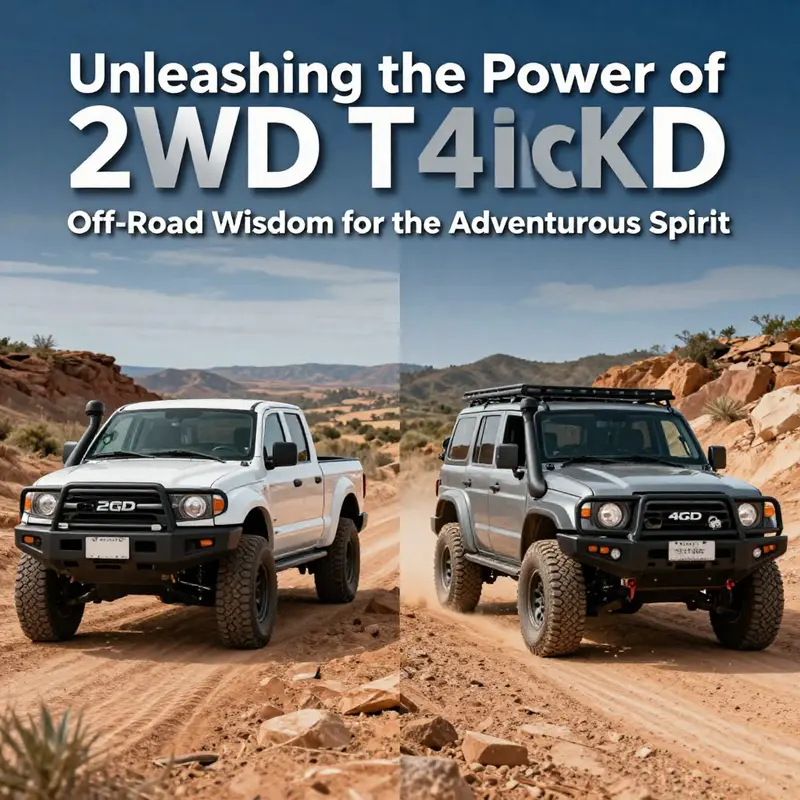
When evaluating whether a two‑wheel drive truck can handle off‑road adventures, the debate often narrows to a single truth: distribution of power matters. Two‑wheel drive sends engine torque to only two wheels—typically the rear on trucks—while four‑wheel drive sends torque to all four wheels. That difference rewrites the rules for traction, momentum, and how a vehicle reacts when the path ahead turns muddy, sandy, rutted, or steep.
Think of off‑road ground as a puzzle of changing grip. On a smooth dirt road with firm surface and shallow ruts, a two‑wheel drive truck can move confidently. The driven pair provides enough traction to start, stop, and keep steady momentum. But the moment grip becomes inconsistent—when one drive wheel spins in sticky mud or a pair of tires lift off the ground on a rock ledge—the limits of two‑wheel drive show. With power sent only to two wheels, the engine’s effort can be wasted when those wheels lose traction. A four‑wheel drive system, by contrast, can route torque to the wheels that still bite into the surface, maintaining forward motion when traction is fragmented.
This is not simply about raw pulling power. Evenness of traction affects control. When all four corners share torque, the truck resists yaw and understeer better over irregular terrain. During steep climbs and descents, distributing power across four wheels reduces the chance of a sudden slip that can lead to loss of control or a roll. The net effect is safer handling and a lower likelihood of getting stranded during serious off‑road excursions.
At the same time, four‑wheel drive systems carry practical trade‑offs. They add mechanical complexity. Extra components—transfer cases, additional shafts, and more differentials—mean extra weight. That weight affects fuel economy and robs agility on normal roads. Complexity also raises the cost of purchase and repair, and increases the number of systems that need periodic attention. Modern designs mitigate some penalties by using part‑time or on‑demand engagement. These systems operate in two‑wheel mode during easy driving and engage four‑wheel drive as needed, which helps efficiency without sacrificing capability when conditions worsen.
For people who use a truck for mixed duties—daily commuting, hauling light loads, and only occasional trail drives—a well‑equipped two‑wheel drive can be an economical and sensible choice. The right tires, increased ground clearance, and a robust suspension transform many two‑wheel trucks from strictly on‑road haulers into competent machines on mild trails. A lift and a set of all‑terrain tires improve approach and departure angles, reduce underbody strikes, and expand the truck’s usable terrain. But these modifications do not change the fundamental torque distribution. They make getting stuck less likely on benign surfaces but cannot replicate the consistent bite and redundancy that four‑wheel drive provides in truly slippery or technical terrain.
Beyond hardware, driver technique plays a large role. A skilled driver in a two‑wheel truck can avoid trouble by maintaining momentum, choosing lines that keep driven wheels on firm ground, and using gentle throttle inputs that limit wheel spin. Lowering tire pressures to increase contact patch can help in sand or loose gravel. Still, such techniques have limits. Losing momentum on a steep, sandy climb or sinking into deep mud is a moment where mechanical advantage matters most. In those situations, only a four‑wheel drive system provides the redundancy needed to pull through multiple low‑traction contact patches.
Weight distribution and payload also influence off‑road behavior. A heavily loaded rear bed can improve traction for rear‑driven two‑wheel trucks by increasing downward force on the driven axle. However, added weight raises the truck’s center of gravity and can worsen handling on steep or side‑hilling terrain. Conversely, a light front end can cause steering wheels to lose grip on loose descents. Four‑wheel drive blunts these sensitivities by giving traction options at both axles, reducing reliance on perfect weight balance.
Maintenance and reliability are practical considerations often overlooked in capability debates. Two‑wheel systems are simpler and therefore cheaper to maintain. Fewer moving parts mean fewer failure points on long trips far from service. For an owner who values simplicity and who plans only occasional off‑pavement outings, the simplicity of two‑wheel drive can be an asset. For regular off‑road use, the extra maintenance of four‑wheel drive is a reasonable trade for the increased reliability in harsh conditions.
When deciding which layout suits you, think about the environments you’ll face and how often you’ll go there. If your routes include wet fields, muddy forest tracks, deep sand, or steep alpine approaches, four‑wheel drive should be nonnegotiable. If your adventures are limited to graded dirt roads, compacted trails, and occasional rocky stretches, a two‑wheel truck with targeted upgrades may be perfectly adequate. For people who hover between those categories, on‑demand four‑wheel systems offer a middle ground—efficiency on the highway, and four‑wheel traction when the trail demands it.
Preparation narrows the gap between two‑wheel and four‑wheel capability. Recovery gear—straps, a snatch block, a high‑rated tow hook, and a compact shovel—can save a day that would otherwise end in a tow. Tire choice is impactful: aggressive all‑terrain or mud‑terrain tires increase bite and help both layouts. Suspension with enough travel and protective skid plates buy you confidence and longevity. And for those who travel remote backcountry, a basic knowledge of vehicle recovery and winch use is essential, regardless of drive layout.
There is also a safety mindset to adopt. With two‑wheel drive, avoid attempting features you cannot comfortably back out of. Thin ice, deep mud, and steep, loose approaches are not just capability tests—they are risk multipliers. Four‑wheel drive expands your envelope, but it does not make you invincible. Both setups require conservative planning: accurate assessment of conditions, a clear turnaround strategy, and limits on what you will attempt solo.
In short, four‑wheel drive delivers clear, measurable advantages where traction is compromised or terrain is technical. Two‑wheel drive can be surprisingly capable on mild trails and offers savings in weight, cost, and complexity. The right choice depends on the mix of terrain, frequency of off‑road use, and appetite for maintenance and upgrades. For serious, frequent off‑road work, four‑wheel drive is the safer, more capable option. For occasional adventures and light trails, a thoughtfully prepared two‑wheel truck will get you where you want to go—if you respect its limits and prepare accordingly (for mechanical insights, consider mastering diesel mechanics to keep your truck ready: mastering diesel mechanics).
For a clear, authoritative take on how four‑wheel drive can mean the difference between moving forward and being stranded in slippery or rough conditions, consult this external analysis: https://www.caranddriver.com/features/a39560871/four-wheel-drive-vs-two-wheel-drive/
Prepared and Practical: How to Make a 2WD Truck Work Off-Road
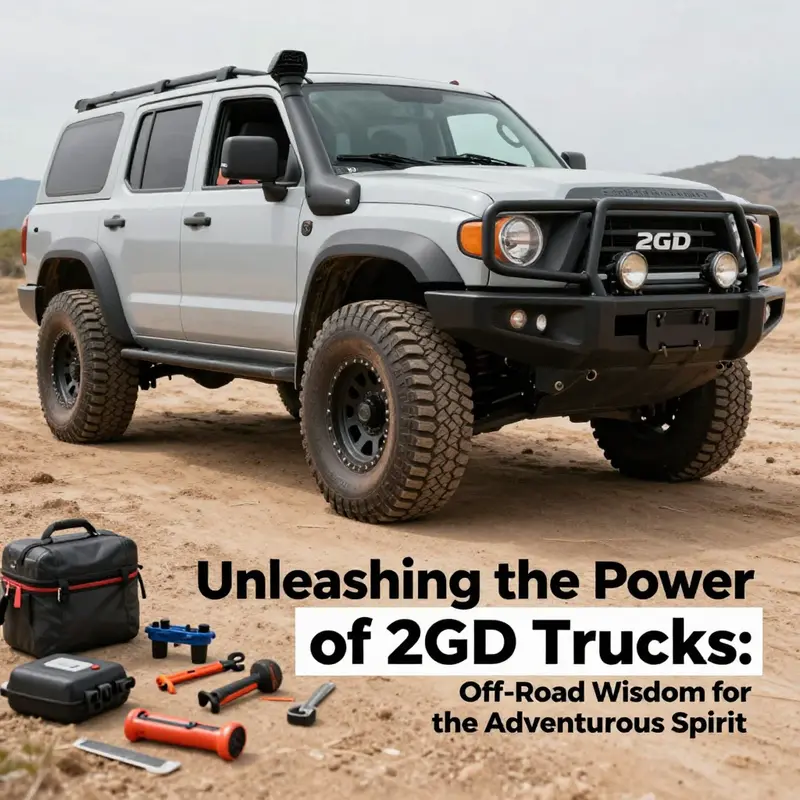
Using a two-wheel-drive truck off-road requires a realistic approach that balances preparation, technique, and selective upgrades. A 2WD truck lacks driven wheels at both ends, but it can still traverse many unimproved roads and mild trails when the driver understands limitations and plans accordingly. The key is to reduce risk, protect vulnerable parts, and use smart driving habits that maximize traction and momentum without overtaxing the vehicle.
Tire choice is the single most impactful upgrade for off-road use. Stock highway tires are designed for silence and ride comfort on pavement. Off pavement, their shallow tread and soft compounds shed traction and cut easily on rocks. Switching to a tire with an aggressive tread pattern, stronger sidewalls, and higher load ratings makes a dramatic difference. Such tires bite into loose surfaces, resist punctures, and reduce slippage. Equally important is adjusting tire pressure on the trail. Lowering pressure on sand or loose dirt increases the contact patch and improves flotation. On rocky ground, slightly higher pressure helps protect the bead and avoid pinch flats. Carry a reliable pressure gauge and a portable inflator to restore pressure before returning to pavement.
Ground clearance and underbody protection are the next priority. A 2WD truck can be lifted or equipped with stiffer springs to increase clearance, but even modest gains matter more when paired with skid plates. Rocks, stumps, and ledges threaten the oil pan, fuel tank, transfer case (if present), and frame rails. Factory protection is often minimal. Adding metal skid plates to shield the oil pan, transmission, and fuel system prevents costly damage and builds confidence when choosing a line. Focus on durable materials and secure mounting points. Bumpers with integrated brush guards protect sheet metal and permit safer recovery hitch points. Remember that modifications change weight distribution and approach angles. Keep them balanced to avoid creating new vulnerabilities.
Driving technique is where skill compensates for hardware limitations. On soft surfaces, maintain steady momentum rather than short, aggressive bursts of throttle. Sudden acceleration in a 2WD setup quickly leads to wheel spin and loss of forward progress. When climbing, select a consistent throttle and keep the steering wheel steady. Use lower gears to control speed without overworking the brakes. On descents, engine braking is preferable to heavy riding of the brakes. Avoid sharp steering inputs that unload a wheel and reduce traction.
Weight management influences traction more than most drivers expect. Too little weight over the driven axle reduces grip; too much weight at the rear can lift the front wheels and hamper steering, especially in rear-wheel-drive trucks. Distribute gear so the driven axle carries sufficient load. For front-wheel-drive platforms, this means keeping cargo forward. For rear-wheel-drive trucks, a modest load in the bed can improve traction during climbs or on soft surfaces. Use secure tie-downs and avoid free-swinging items that can shift and suddenly alter balance.
Recovery gear transforms a potentially long delay into a manageable task. Traction boards, a sturdy tow strap, a rated shackle, a folding shovel, and a high-lift jack can be invaluable when a 2WD truck gets bogged down. Traction boards give the driven wheels something to bite into without needing another vehicle. A recovery point mounted to the frame is safer than bumper attachments. If gravity or deep mud are likely, travel with a partner vehicle for towing. Carrying a winch is possible on a 2WD truck, but it adds weight and complexity, and it requires secure anchor points and safe operating knowledge.
Suspension choices and maintenance determine how well the truck copes with repeated off-road stress. Upgrading to a slightly firmer spring rate reduces bottoming on ruts and maintains better tire contact. Stronger shock absorbers reduce wheel hop and improve control over rough terrain. Regularly inspect suspension bushings, mounts, and fasteners. Off-road use accelerates wear, and a single failed bushing can change alignment and cause premature tire damage. Routine lubrication of suspension joints and replacing worn parts before a trip are cost-effective steps that prevent breakdowns.
Engine, drivetrain, and cooling system health are critical. A 2WD truck may be less strained than a fully loaded 4WD in some conditions, but slower speeds and constant throttle on soft surfaces increase engine load. Keep filters clean and fluids topped. Overheating and low fluid levels are common causes of failure when a truck operates off-road for extended periods. Periodic inspection of axles and differential vents prevents pressure buildup and contamination. For diesel-powered trucks, a basic grasp of fueling and engine maintenance helps troubleshoot problems away from the shop; for drivers who want to deepen that knowledge, resources like “Mastering Diesel Mechanics: your step-by-step path to success” offer practical guidance on upkeep and repairs.
Situational awareness and planning reduce exposure to hazardous conditions. Check weather and trail reports before leaving. Wet conditions dramatically change traction levels and increase the likelihood of getting stuck. Scout unfamiliar trails at walking speed to pick a safe line. Avoid deep ruts and soft shoulders that can trap a truck. Know the limits of the vehicle and the driver; a cautious turnaround is preferable to a risky crossing. Pair conservative decision-making with observational skills: listen for strains from the engine, watch for smoke or fluid leaks, and stop to inspect any odd sounds.
On-trail etiquette and safety practices matter. Stay on designated routes to protect fragile terrain and avoid getting into areas where rescue is difficult. Let someone know your route and expected return time. Carry basic first-aid supplies and enough water for unexpected delays. When traveling with others, agree on recovery signals and procedures to keep everyone safe during a pull or winch operation.
Finally, accept that a 2WD truck has inherent limits. Sand dunes, deep mud, and steep, slippery inclines remain environments where full-time 4WD or AWD systems perform far better. That said, with the right tires, underbody protection, sensible suspension upgrades, careful weight distribution, recovery gear, and practiced driving technique, a 2WD truck can handle many light to moderate off-road tasks reliably. The goal is not to turn a 2WD into a 4WD but to make thoughtful choices that expand safe capability without inviting reckless use. For practical tips on making 2WD vehicles more capable and lessons from experienced enthusiasts, see this detailed discussion: https://www.team-bhp.com/forum/technical-questions/107895-how-make-2wd-more-capable-offroad-conditions.html
Final thoughts
In conclusion, while 2WD trucks are often seen as the less capable variant in off-road discussions, they can indeed hold their own in certain conditions. Their performance shines in mild terrain, from dirt roads to easy trails, especially when equipped with the right features and maintained correctly. Understanding the limitations is vital, and for off-road racing fans and adventurers, it is essential to approach each terrain with realism about what a 2WD can handle. If you’re tapping into the thrill of off-roading, either for rural work or recreational exploits, knowing when and how to deploy your 2WD truck ensures you can maximize its potential while mitigating risks. Respect the terrain, respect your vehicle, and your off-road journey can still deliver unforgettable experiences.