
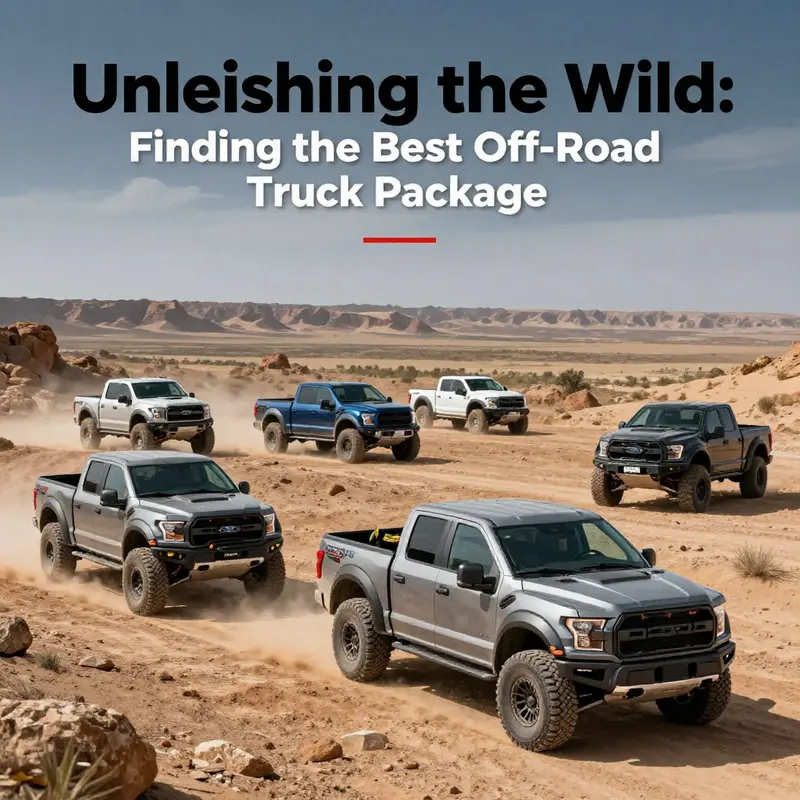
For off-road enthusiasts and adventurers, the choice of truck can define the journey. In the quest for the best off-road package, several contenders emerge, each with its unique strengths. The Ford F-150 Raptor, a behemoth in off-road capability, sets a measure for performance and design. However, the competition is fierce with vehicles like the Jeep Wrangler Rubicon, Toyota Land Cruiser, and GMC Sierra 1500 ZR2 vying for supremacy. Each chapter of this guide dives deeper into the world of off-road trucks, evaluating what truly makes a package exceptional—from engineering marvels to consumer preferences—guiding you through the decision-making process tailored for rugged terrains and unyielding landscapes.
Tracking the Benchmark: What Defines the Best Off-Road Package in Modern Pickups
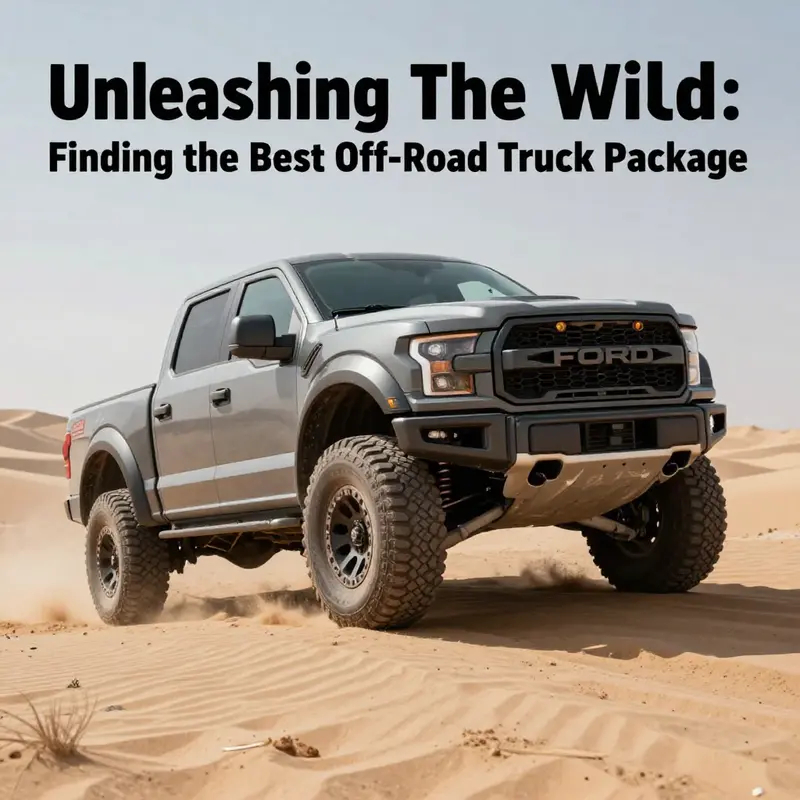
When readers ask which pickup sets the standard for off-road prowess, this chapter traces the elements that define the best factory-backed package. It isn’t about a single model so much as a design philosophy: robust suspension, ground clearance, tire strategy, and a responsive powertrain working in concert to maintain momentum on rough terrain. A top-tier package relies on real-time damping that adapts to ruts and rocks, preserving wheel contact and minimizing pitch while keeping the driver in control. Ground clearance and tire architecture are intertwined, with generous height, protective guards, and larger, capable tires that bite into sand and gravel without sacrificing durability. Power must be broad and usable, offering torque across a wide rev range and smooth throttle response to prevent wheel spin in demanding sections. Four-wheel drive becomes terrain-aware, with a transfer case and differentials coordinating to keep the vehicle moving rather than stuck. Finally, the ethos: a cohesive system designed for extreme conditions that remains practical for daily driving, acknowledging trade-offs but delivering reliability and confidence on the trail. The benchmark is not a single model but a standard by which others are measured. For readers seeking deeper numbers, official specifications provide detail on chassis, suspension, power, and traction management and help illustrate how the package achieves its balance of capability and usability.
Beyond Trail-Ready: Unpacking the Best Off-Road Package in Today’s Pickup Lineup

When a reader asks which truck has the best off-road package, the answer isn’t a single line item on a spec sheet. It’s a holistic judgment about how a vehicle blends purpose-built capability, durable engineering, and real-world confidence into one cohesive drive system. In the modern pickup market, the contenders that claim dominance in the off-road realm—whether through tuned suspensions, high-traction drivetrains, or chassis geometry engineered for desert speeds—must persuade with more than raw horsepower or aggressive styling. They must prove they can stay calm and controlled when nature throws a rough road, sand, mud, and rock at the tires, while still delivering a package that remains usable, repairable, and fun to drive on everyday commutes. Across this landscape, one truck consistently emerges as the benchmark for off-road specialization, and a few close competitors illustrate the breadth of what “best” can mean in practice. The Ford F-150 Raptor, as the most explicit product of off-road design intent, has built its reputation by leaning into purpose rather than mere rugged appearance. The Raptor isn’t just a pickup with bigger tires and a louder exhaust; it’s a vehicle whose entire chassis, suspension, and powertrain philosophy is oriented toward conquering extreme terrain with speed. Its “slightly exaggerated” styling is more than a visual cue. It signals a design discipline that accepts higher hurdles—the kind you encounter in wide desert corridors, whoops, and long sand flats—as the baseline condition for daily use. The Raptor embodies a concept that is almost counterintuitive: the best off-road package often requires a truck to behave like a dedicated off-roader even when you’re not in the middle of a rock crawl. The suspension is a critical artery of that discipline. Ford’s collaboration with performance specialists results in an independently tuned setup designed to survive the rigors of high-speed desert driving. The shocks, which have carried the Raptor across dunes with a composure most trucks reserve for smooth highways, are the kind of component that can become a decisive difference when a washboard road opens up ahead at speed. In the Raptor R, the upgrade to Fox 3.1 shocks translates that design philosophy into even deeper travel and more precise damping. It’s not just more stiffness or a bigger spring rate; it’s a calibrated system that translates rough terrain into manageable motions, so the driver can keep the line, the pace, and the momentum. This is why the powertrain pairing matters as much as the suspension tuning. A 720-horsepower V8 engine—an emblem of such performance—makes it possible to crest a hill at speed, to punch through a whoop section with control rather than brute strength alone, and to keep pushing toward the next obstacle rather than pausing to recalibrate. High-speed desert driving is a skill as much as a capability, and the F-150 Raptor’s combination of power, torque, and throttle response makes it feasible to negotiate large, open stretches with a sense of confidence that few rivals can match. The spread of capability is reinforced by traction-conscious design choices. The wide fenders are not a cosmetic flourish; they accommodate larger, more capable tires and help manage rubbing under hard compression during aggressive articulation. The four-wheel-drive system is engineered to deliver traction when you need it most, with a balance between downhill stability, climb performance, and the ability to recover once you’re stuck in a tricky situation. This bandwidth of capability is what elevates the Raptor beyond the realm of “high-end all-terrain” into “all-terrain, all the time.” Yet the landscape of off-road packages is broad and nuanced. If the Ford is the most explicit statement of off-road engineering, other brands offer compelling alternatives that emphasize different strengths. The Jeep Wrangler Rubicon, for example, is a vehicle whose off-road chops are tied to a philosophy of modularity, approach and departure angle optimization, and mechanical simplicity that can outperform more technologically dense rivals on certain terrains. Its reputation in the rock-crawling and extreme-trail communities rests on a chassis nearly purpose-built for entry-level reliability and field serviceability, with ground-clearance and lockable differentials that can be engaged with a level of predictability that brings a smile to drivers who relish technical trails. The Toyota Land Cruiser LC300, renowned for reliability and long-haul capability, offers formidable off-road hardware with a focus on durability and a user experience built around maintaining traction across a wide range of conditions. In many settings, the LC300 embodies the idea that off-road competence is a marathon, not a sprint; it’s about weathering long expeditions with a calm demeanor, rather than tearing through a single obstacle course at breakneck speed. The GMC Sierra 1500 ZR2 adds a more modern, technology-forward approach to off-road performance. Its chassis engineering and the involvement of advanced damping systems deliver controlled travel and tuned compression that give a driver confidence in a broad spectrum of surfaces, from rocky grades to damp, slippery earth. Each of these machines demonstrates that the best off-road package can be defined through different design priorities: desert-speed superlatives, rock-ready low-speed capability, durability for long cross-country treks, or a balanced, tech-enhanced platform. What makes the Ford Raptor stand out, in the context of a chapter that aims to decide which truck holds the crown, is not simply the headline horsepower or the flash of its styling, but the integrative approach that aligns the engine, the suspension, the chassis tuning, and the traction system into a single narrative of capability. It speaks to the idea that off-road performance is systemic. You don’t win on one lever—power alone can lamp your tires without a grip on the ground; you don’t win with a fancy suspension if the demands of desert travel collapse the frame under load. The best package is not a series of independent features but a carefully engineered ecosystem, tuned to meet the specific demands of extreme terrain while still remaining dependable, serviceable, and enjoyable in everyday use. This is where the broader market’s values intersect with the realities of off-road driving: the ability to maintain traction when terrain forces you to adjust speed and approach angle; the capacity to keep momentum through uneven surfaces; the predictability of how the vehicle will respond to steering input, throttle nuance, and brake modulation when the road surface is doing something very different from what it was designed to do on pavement. The CFORCE 1000 MV, though not a pickup, provides a revealing counterpoint in the way it frames the off-road package as a complete system. This ATV stands out within its class for a precise, well-rounded approach to off-road challenges. Its 963cc V2 engine delivers a robust 84 horsepower, with strong low-end torque that helps it pull through mud, ruts, and forest trails without needing to spin the engine into a high rev range. The suspension is a standout feature, fully adjustable in compression and rebound damping at both ends—front at 7.3 inches and rear at 9.3 inches. That level of adjustability is a tool for the rider to fine-tune the ride for different terrains, from forest trails to deep mud, and it mirrors the mindset behind a truck’s off-road success: the ability to adapt to the environment so the vehicle remains planted and controlled rather than overwhelmed. The design also reflects a practical recovery-oriented philosophy. High-mounted radiators and intake ports are positioned to resist mud ingestion, an issue that can derail even the best off-road mission if cooling becomes compromised. Heavy-duty front and rear tow hooks, plus a high-positioned winch, emphasize recoverability—an essential trait when you’re pushing through remote terrain and know that a back-up plan will be needed sooner or later. The 30-inch CST Wild Fang tires illustrate a tire philosophy that favors versatile traction—capable in mud without sacrificing performance on harder, rockier surfaces. The ATV’s success in carving out a niche as a “unicorn” in the market—an off-road platform that doesn’t force a compromise between mud and trail performance—offers a salient reminder that a successful off-road package isn’t only about strapping on bigger tires or selecting a higher-performance engine. It’s about anticipating the terrain, enabling the vehicle to maintain traction, and enabling recovery if things go awry. In a way, this ATV example becomes a tactile demonstration of the design logic that brands apply to their trucks, even if the two markets do not always intersect in the same product category. It underscores the broader pattern that the best off-road packages share when measured against the real-world demands of off-road driving. They integrate power delivery with tuning that respects wheel contact with the ground, and they maintain system integrity under load, heat, and varying grip conditions. They also recognize that a vehicle’s off-road capability is not an isolated feature but a collection of supporting elements: a drivetrain designed for torque at the wheels, a suspension that can absorb impact while preserving control, a chassis that remains rigid enough to handle aggressive use yet flexible enough to articulate, and a cooling strategy that keeps the engine—or the powertrain—cool under sustained, high-load operation. Beyond the technicalities, the best off-road package is also about the kind of driving experience it yields. The driver should feel empowered to choose speed, line, and throttle with a sense of certainty about how the machine will respond. That is the heart of a capable off-road platform: a driver’s trust built through predictable behavior, not merely through impressive numbers on a spec sheet. The discussion of different models, from the desert strip-cruising capabilities of a flagship pickup to the rugged, all-terrain adaptability of a purpose-built ATV, converges on a common principle. The project of building an off-road package that can handle everything from sand-swept washes to rocky ledges is not about chasing one perfect feature. It’s about harmonizing multiple systems so that the vehicle can perform in expressive, dependable ways across a broad range of environments. For readers who crave practical guidance on evaluating a truck’s off-road package, the approach should focus on how the powertrain interacts with the suspension, how the traction system behaves under varied grip, and how the vehicle’s geometry—approach, breakover, and departure angles—affects its ability to negotiate obstacles. It also helps to consider maintainability and serviceability, because off-road adventures can place unusual demands on components, and a package that cannot be serviced in the field or at a nearby shop can quickly become a liability rather than an asset. In this context, the best off-road package is not an absolute, but a convergent outcome—one that aligns a vehicle’s core capabilities with the terrain it is likely to encounter, while staying true to the practical realities of ownership. The Ford F-150 Raptor’s standing as a leader in this space is thus not only about its on-paper speed or its desert-optimized suspension; it’s about the sum of its parts working together in harmony under pressure. When a driver reliably experiences controlled behavior at 70 mph through a desert expanse, when a climb or descent is navigated without fear of frantic wheel spin or chassis squatting out of alignment, that driver understands what “best off-road package” truly implies. The chapter in the broader story—the one that follows this exploration of the F-150 Raptor and its rivals—will delve into how buyers translate these competing philosophies into real-world choices, including maintenance considerations, resale value, and the nuances of choosing between advantage in one terrain class versus another. For those who want to deepen their mechanical understanding while considering what makes a true off-road system work, there is a practical path worth following. It centers on becoming fluent in the language of the drive train, suspension, and steering—an education that can be pursued through resources on diesel mechanics and automotive fundamentals. Mastering diesel mechanics: a step-by-step path to success is a resource worth exploring for enthusiasts who want to understand how torque, cooling, and fuel delivery influence a truck’s off-road performance over long expeditions. The link to this guide is included here as a practical invitation to broaden the reader’s technical literacy without losing sight of the bigger picture: the best off-road package is the one that makes a driver feel both capable and confident, no matter what the trail throws at them. Mastering diesel mechanics: a step-by-step path to success. The strategic takeaway is that the strongest packages are those that empower the driver to pilot the vehicle with clarity, while the vehicle’s systems absorb the abuse and keep working. In the chapters that follow, readers will see how the evaluative framework developed here translates into purchasing decisions, test-drive experiences, and long-term ownership considerations. The goal is not just to name a winner, but to illuminate the underlying design principles that determine why a given off-road package feels exceptional in real life. The road to that understanding winds through high-speed desert sections, rock gardens, forest trails, and the subtle, sometimes invisible, work of engineers who design for reliability and performance under pressure. The best off-road package, ultimately, is the one that lets a driver read terrain with confidence, make precise mechanical choices in real time, and return home with the sense that the vehicle and the trail have spoken the same language all along.
Engineering at the Edge of Terrain: How Off-Road Packages Turn Rough Ground into Traction
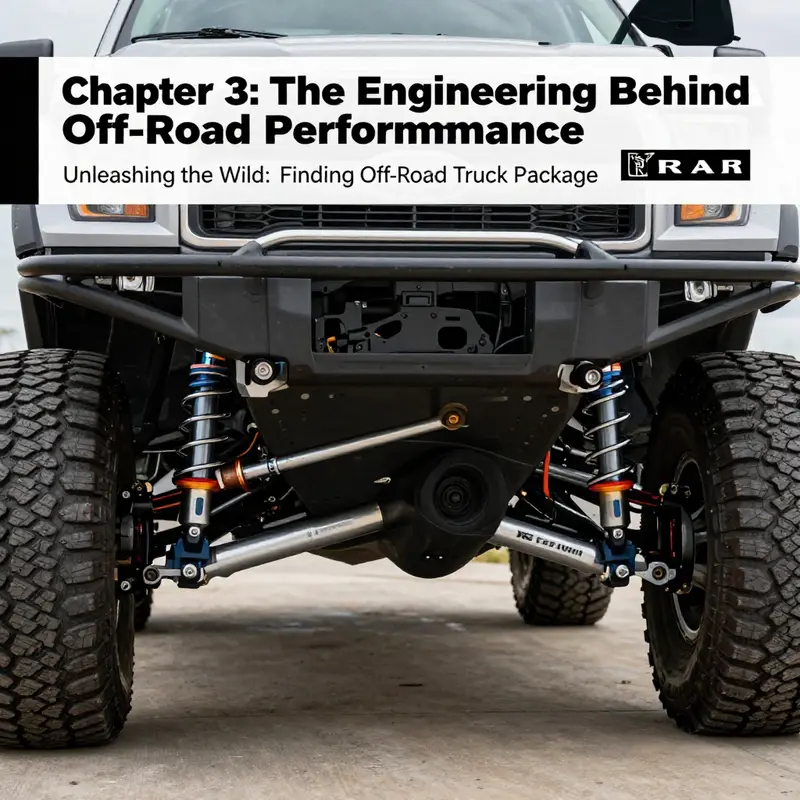
The engineering behind off-road performance is a disciplined conversation between curvature, grip, and power, conducted at the points where machine meets earth. It is not a single feature or a flashy upgrade that defines capability; it is the seamless integration of tires, driveline, suspension, chassis geometry, and propulsion that turns uncertain ground into predictable momentum. The tire, as the stubbornly honest interface between vehicle and terrain, anchors the discussion. Modern off-road tires are not merely wide or rugged; they are intricately engineered to bite into soft surfaces like mud, sand, or snow while offering self-cleaning behavior that prevents a shallow, exhausting stall of traction. Deep, widely spaced tread blocks are paired with reinforced sidewalls that resist puncture and provide lateral stability when the surface becomes irregular, such as a rocky rut or a shoulder of gravel that would otherwise threaten a wheel that slips sideways. In this sense, the tire becomes a measured balance of grip and endurance, tuned to maintain a link to the ground even as the surface refuses to stay still.
But traction is only the first act. The next is the thrust that moves the machine through resistance. Off-road motion confronts a spectrum of obstructions: rocks, roots, uneven grades, and the micro-dynamics of the soil itself. The running gear must deliver enough force to overcome these impediments, while also negotiating internal power losses from the drivetrain, the weight of the vehicle, and the friction that arises when a wheel climbs over a ridge or carves a line through a soft patch. The engineering principle that governs this is both straightforward and deeply nuanced: the thrust a vehicle can develop is ultimately bounded by two things—the power available from the engine-transmission pairing and the shear strength of the terrain-soil interface. In other words, you can have enormous horsepower and clever gearing, but if the ground underneath cannot transmit that force without shear failure, traction becomes a lottery rather than a guarantee. This tension—between engine output, drivetrain efficiency, and terrain response—drives the design choices that make an off-road package genuinely capable, not just capable of looking the part on a brochure.
A robust off-road system therefore requires a drivetrain that can deliver sustained drawbar pull without overwhelming the tires or the chassis. The four-wheel-drive architecture is not simply a marketing badge; it is an engineered solution to distribute torque in a way that preserves traction across a variety of obstacles. The goal is to prevent wheel spin where the surface cannot supply enough shear resistance and to maintain forward progress when a wheel encounters a slick patch or a sudden drop in grade. The dispersion of torque to the front and rear axles must be managed with finesse, so that the vehicle can climb, descend, or negotiate a side slope without excessive steering correction or torque steer. This requires a drivetrain that responds not just to pedal input, but to the dynamic reality of the ground underfoot, a feedback loop that informs how much grip is actually available and how much power the system can safely deliver.
Suspension plays a parallel role, translating a vehicle’s power into controlled motion over the terrain. A high-performance off-road package is built on suspension geometry that maximizes wheel travel while preserving tire contact with the ground. This means more than simply soaking up big bumps; it means shaping the motion so that a wheel can drop into a rut and re-engage the surface without rebounding into a hard, destabilizing jolt. The most effective suspensions in serious off-road contexts are tuned to balance stiffness and compliance. They absorb irregularities with controlled damping while maintaining enough stiffness to prevent excessive body roll, which would rob steering precision on uneven tracks. The interplay between spring rates, damping curves, and the vehicle’s mass distribution is delicate, and it manifests in the vehicle’s ability to traverse a desert wash, a jagged woodland trail, or a rocky hillside without losing composure.
A modern engineering toolkit adds another layer to this narrative: digital simulation and virtual testing. The most forward-looking teams scan real-world off-road tracks—whether mountainous routes or forested byways—using high-precision sensors. They transplant those scans into digital twins, creating virtual tracks that mimic the true harshness and unpredictability of the terrain. Engineers then subject suspension kinematics, chassis dynamics, and drivetrain response to countless iterations, refining tuning parameters before a single prototype rolls off the line. This data-driven approach not only accelerates development but also reduces risk by exposing the system’s limits in a controlled environment. In practical terms, it means that the final product delivers predictable performance in the most challenging conditions, translating laboratory insight into real-world assurance.
Alongside these core elements, the surface interface remains a focal point of consideration. The ground interaction is governed by friction, lap after lap of trial-and-error checks that blend material science with empirical observation. In forestry or other demanding applications, the need for stability on varying soil textures—soft forest floor, hard-packed trails, or moisture-slick clay—requires a well-rounded package. The design space is not just the obvious suspects like tire compound or differential behavior; it extends to weight distribution, center of gravity, and the ability to maintain steering integrity while negotiating an obstacle. The best packages approach this as an ecosystem: tires designed for grip and self-cleaning, a drivetrain calibrated for traction and heat management, a suspension tuned for wheel control and body balance, and a chassis that can tolerate the abuse of severe terrain without sacrificing control or safety.
The literature that informs this integration is clear about the physics at play. A peer-reviewed overview emphasizes that the thrust developed by a vehicle’s running gear is not simply a matter of horsepower. It is the product of engine torque, transmission efficiency, drivetrain losses, and the soil’s resistance to shear. That interaction is dynamic; as surface conditions change, the effective grip shifts, the required drawbar pull adjusts, and the driver’s ability to modulate power through bends and grades becomes a key differentiator. The insights from that work reinforce a practical truth: the most effective off-road packages do not rely on one or two star features. They hinge on a harmonized system where each element supports the others, constrained by the realities of terrain and the physics of motion.
This holistic view also illuminates how engineering practice has adapted across different industries that rely on rugged mobility. In forestry contexts, for instance, small-capacity trucks prioritize maneuverability and low ground pressure to protect environmentally sensitive corridors while still negotiating tight, winding routes. Medium-capacity machines balance payload with off-road capability for mixed-terrain work, whereas large-capacity configurations emphasize payload efficiency and sustained performance on established rough tracks. These case studies, while rooted in specific operational needs, underscore a universal theme: off-road excellence is a matter of proportional restraint and intelligent trade-offs, not simply raw power or aggressive styling.
The shift toward virtual ride technology signals a broader evolution. Engineers now test the dynamic relationship between front- and rear-wheel inputs, chassis flex, and tire contact patch under simulated terrains that replicate real-world uncertainty. This practice reveals how small tweaks in damper rates or spring stiffness cascade into measurable differences in stability, traction, and ride quality. The result is a product that behaves more predictably at pace, a necessity when the terrain itself is the largest variable. In this sense, off-road packages become less about a collection of discrete parts and more about a disciplined architecture: a system designed to negotiate the moving target that is natural ground.
For readers seeking a point of practical orientation within the broader discussion, consider the underlying material that makes possible the engineering feats described above. The tire is the anchor; the engine and transmission are the engine room; the suspension is the body’s nervous system; the chassis provides the spine through which energy travels. When these elements are correctly balanced, the vehicle can maintain traction through a broad spectrum of ground conditions, maintain steering authority with minimal driver input, and deliver controlled, confident progress where other machines hesitate or stall. The engineering story, then, is one of thoughtful limits—how to extend grip and stability in the face of unpredictable terrain, how to manage heat, how to preserve mechanical integrity under load, and how to return the driver to the line with a sense of trust that the vehicle will respond as expected. It is a narrative in which performance is earned through precision, not rhetoric.
In sum, the engineering behind off-road performance is a convergence of tire science, powertrain capability, drivetrain control, and suspension finesse, all harmonized through modern simulation and a disciplined design philosophy. The argument is not simply that a particular model is the best, but that the best off-road package embodies an integrated approach that respects terrain physics and embraces data-driven iteration. The result is a truck that can translate high-desert torque into controlled motion, rough forest trails into confident progress, and every challenge on the path into a measurable, repeatable performance. For designers and drivers alike, this is the enduring truth of off-road capability: traction is earned, not given; and the most capable packages are those that choreograph the entire system to work in concert with the ground beneath them.
Mastering Diesel Mechanics: Your Step-by-Step Path to Success. This internal reference emphasizes how powertrain reliability and maintenance underpin sustained off-road performance, reminding readers that the best off-road packages are built to endure as much as they are built to excite. External validation and ongoing learning, as seen in peer-reviewed studies and practical manuals, anchor this discipline in measurable outcomes. For those seeking a rigorous, science-informed perspective, the chapter’s conclusions align with the broader research on traction, thrust, and terrain interaction offered by established sources. External reference: https://www.sciencedirect.com/science/article/pii/S002074622400185X
null
null
Final thoughts
Ultimately, while the Ford F-150 Raptor might lead the pack with its unparalleled performance and design, the landscape of off-road trucks continues to evolve with formidable contenders that each bring their unique flair and engineering prowess. Whether you’re an off-road racing enthusiast, a landowner in need of a workhorse, or a weekend adventurer chasing trails, understanding the nuances of each vehicle will empower you to make the best choice for your off-road endeavors. Don’t settle for just any truck; choose a vehicle that will rise to the challenges of the wild and complement your adventurous spirit.