

For those with a thirst for adventure and a knack for adventure, choosing the right truck can mean the difference between the thrill of exploration and the frustration of being ill-equipped. The ultimate street-legal off-road truck is not just a vehicle; it’s a gateway to endless possibilities and uncharted territories. Among the contenders, the Jeep Wrangler Rubicon effortlessly stands out for its perfect balance of formidable off-road capability, legal compliance for street use, iconic design, and a vibrant community that supports its owners. In this exploration, we dive deep into the unmatched off-road prowess of the Wrangler Rubicon, understand its legal and practical benefits, appreciate its rugged and timeless design, and acknowledge the passionate owner community that makes this truck a beloved icon in off-roading culture.
Beyond Trail and Tarmac: The Unmatched Off-Road Capability of the Street-Legal Benchmark Truck
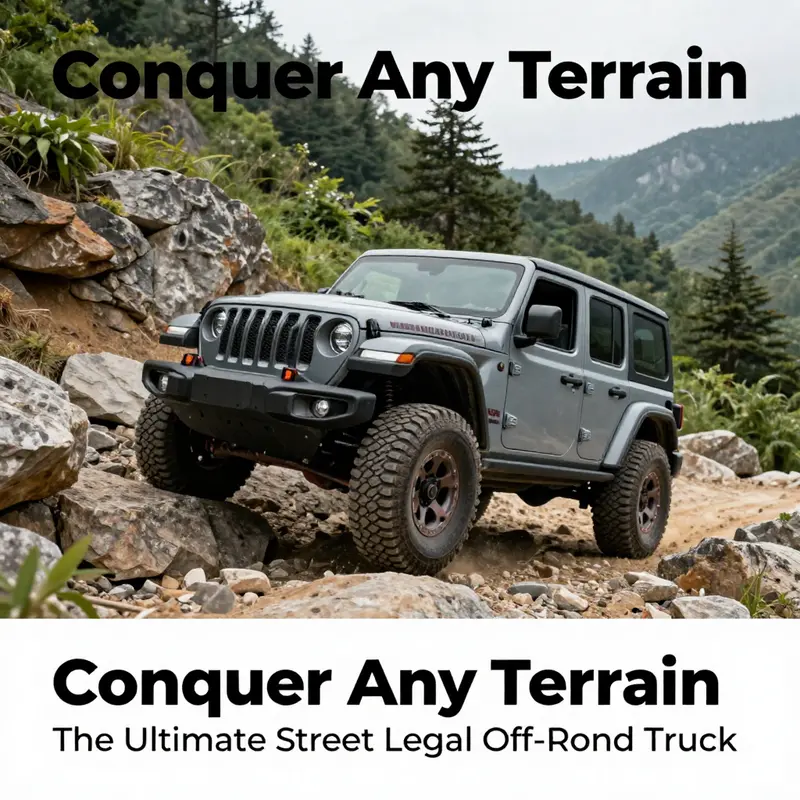
When the road ends and the trail begins, the real measure of a street-legal off-road truck is not simply raw power or a fancy feature list. It is the quiet, unwavering ability to blend rock-scrambling grit with everyday practicality. The standard by which such a vehicle is judged rests on a delicate equilibrium: rock-crawling capability that can be trusted in extremis, and a daily usability that doesn’t demand a second vehicle for grocery runs or school drop-offs. In this space, the landscape of the best options is defined less by a single, unbeatable miracle and more by a consistent, repeatable philosophy. That philosophy places off-road hardware at the core, but always binds it to the road-legal realities of emissions, safety, and reliability. The result is a machine that can truly be driven to work, then driven to the backcountry without needing a permit, a chase vehicle, or a change of clothes for the drive home. It is in that duality that the concept of unmatched capability finds its home.
At the heart of this class is hardware engineered to tackle obstacles that would stall ordinary pickups. A genuine off-road setup emphasizes front and rear traction management, often in the form of locking differentials that can be engaged to force power to the wheels with the most grip. A low-range transfer mechanism multiplies torque at crawl speeds, turning a steep, slippery rock face into a manageable incline. Heavy-duty axles provide the strength to endure harsh uneven surfaces, while a purpose-built suspension focuses on articulation, control, and ground feel rather than simply smoothing the ride over paved streets. When these elements work in concert, the truck’s chassis becomes a flexible tool rather than a rigid brute; it negotiates craggy terrain with poise and returns to the road with predictability that news headlines rarely capture on a trail day. Add to this a thoughtful layer of underbody protection—skid plates that shield vital components from gouges and punctures—and the vehicle begins to feel like a purpose-built expedition platform that still respects the road’s rules.
The conversation about what makes such a vehicle truly “unmatched” cannot ignore the street-legal requirement, which is more than a checkbox on a spec sheet. Street legality means the chassis, engine, and electronics are tuned to meet the same safety and emission standards that govern ordinary daily drivers. It means seat belts, airbags, lights, and emissions controls are not afterthoughts but integral parts of the design. It also means the vehicle must behave predictably in traffic, with reasonable braking, stable steering under a wide range of speeds, and a cabin that protects occupants from road noise and the elements. The balance is delicate: we want rugged capability without creating a borderless vehicle that feels specialized or unsafe on public roads. The best examples in this space demonstrate that it is possible to build a platform capable of full-throttle desert crossings and, on Monday, a quiet commute with predictable fuel economy and comfortable seating.
From a design perspective, the silhouette and geometry of a true off-road street-legal truck contribute as much as the mechanical details. A high approach angle helps the vehicle meet steep, angular obstacles without the front bumper or undercarriage meeting the ground first. A stout breakover angle minimizes the point where the vehicle’s belly drags over a rock garden. A suitable departure angle then allows a confident exit from a downward slope without sliding the rear end into terrain that would snag. These angles are not cosmetic; they determine where the truck can go without becoming stuck and how easily it can recover when it slips. The same logic informs the interior’s rugged usability: durable, weather-resistant materials, straightforward controls, and layouts that keep essential items within easy reach when the tires are perched on uneven ground. The goal is a cabin that feels sturdy rather than flashy, a place where buttons are intuitively located, switches are tactile, and climate control can fight cold air or summer heat even when the vehicle is perched at an odd angle. In everyday life, that practicality translates into fewer trips to the shop and more confidence behind the wheel.
Another pillar of this story is reliability and the community that grows around a vehicle with true off-road mettle. When a platform is used as a foundation for exploration, it tends to attract a dedicated following. This community generates a wealth of practical knowledge: real-world maintenance tips, after-market modifications, and a shared understanding of how to optimize setup for different terrains and climates. The advantage here is not merely practical advice; it is a form of collective reassurance. If a driver decides to chase a long-distance overland route or to push a vehicle through a demanding desert crossing, there are countless enthusiasts who have faced similar challenges and documented the outcomes. The social side of ownership—the sense that a vehicle is part of a broader, supportive ecosystem—adds intangible value to the raw capability, turning a difficult adventure into a more predictable, safer pursuit.
Yet the reality of unmatched off-road capability is not without trade-offs. The very traits that enable crawling over boulders tend to carry costs in other domains. There can be compromises in on-road ride quality and noise isolation, as the chassis and suspension prioritize articulation over comfort in high-speed highway conditions. The same rugged chassis and protection that guard vital components in rocks may add unsprung weight, affecting handling and braking that drivers notice most on pavement. Drivetrain complexity, with its multiple modes and electronic aids, can demand higher maintenance and careful oversight. And because the hardware is designed to endure rough service, those responsible for repairs need to develop a specialized skill set or a trusted network of technicians. All of these factors inform the decision-making process for anyone considering a serious off-road-capable, street-legal truck. They remind us that the ideal choice is not a mythical behemoth that conquers both mud and commute in equal measure; it is a thoughtfully engineered platform that minimizes the friction between trail prowess and daily practicality.
For a buyer, the path to the best option in this category begins with clarity about intended use. If weekend forays into backcountry trails are a monthly ritual, while weekdays are spent in traffic and parking lots, the priority shifts toward a balanced stack of capabilities and comforts. In such cases, the vehicle should offer confident low-speed control on uneven surfaces, reliable braking when the tires are compromised by loose rock or mud, and durable protection for critical components without rendering the cabin a fortress of isolation from the outside world. The best choice should also provide a reasonable warranty and parts availability, because even rugged platforms benefit from the assurance of serviceability and timely maintenance. The ownership experience grows richer when a broad aftermarket ecosystem exists, offering tires, suspension tuners, protection gear, and other enhancements that tailor the vehicle to specific climates and terrains. This ecosystem is more than a convenience; it is a safety net that helps owners extend their adventures with confidence and fewer interruptions.
In practice, evaluating these vehicles involves a blend of technical literacy and real-world testing. A prospective buyer should scrutinize the drivetrain’s flexibility and reliability under varied conditions. They should also assess the effectiveness of traction management systems, how predictably the vehicle responds when switching from asphalt to loose terrain, and whether the underbody protection remains accessible for routine maintenance without requiring excessive disassembly. Inside the cabin, ergonomic controls, clear instrumentation, and all-weather durability of materials become indicators of long-term satisfaction. The best option emerges not from a single standout feature but from the quality of the aggregate experience: the smoothness of the on-road ride, the ease of routine checks, the confidence inspired by the vehicle’s approach to obstacles, and the reassurance of a robust support network should adventure turn into a problem on the trail.
The chapter you’ve followed thus far has laid out a framework for understanding why a street-legal off-road truck that truly stands apart must satisfy a constellation of criteria. It is not enough to claim that a vehicle can tackle rocks; it must also prove it can carry a family to school, haul gear to a campsite, and still return home with its tires clean enough to pass a routine inspection. It is not enough to claim that a vehicle is engineered for mud; it must remain predictable and controllable when the mud has given way to gravel, and the highway pace has not yet ended. The strongest candidates in this category are those that internalize the paradox of the street-legal off-road pursuit: excellence on rough terrain, without surrendering the niceties of everyday life.
As the discussion continues, it will become clearer that there is no single name that exclusively defines this space. Instead, the conversation should center on the match between a truck’s hardware, its road-legal integrity, and the owner’s personal mission. The most compelling platforms—built to endure, to perform, and to adapt—serve as a reminder that the benchmark for capability is not a fantasy but a real-world balance achieved through careful engineering, reliable engineering, and a culture of discovery. In the broader arc of the article, this chapter establishes a touchstone for what makes a truck in this class remarkable: the ability to pair extreme capability with responsible, everyday usability, a pairing that invites every future test, every new trail, and every mile on pavement to feel like a natural extension of the same journey.
For deeper technical context, refer to the official guide: https://www.jeep.com/vehicles/wrangler/.
Lawful and Capable: Navigating Compliance and Everyday Practicality in the Best Street-Legal Off-Road Truck
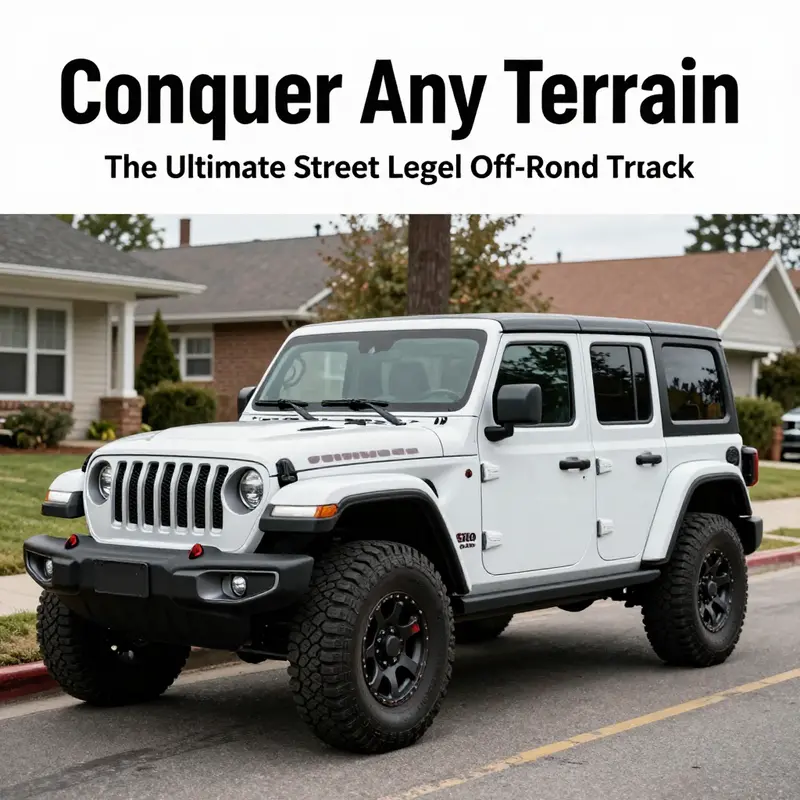
The question of which vehicle earns the distinction of the best street-legal off-road truck cannot be settled with a single feature chart or a performance metric alone. It requires a long, careful look at how well a machine balances two broad, often competing demands: the ability to roam rugged terrain and the obligation to be safely, legally operable on public roads every day. The best choice, in other words, is less a trophy for dirt and more a compromise that remains faithful to the road. A vehicle that truly earns this label must blend extreme off-road capability with road-going practicality, all while adhering to safety and emissions standards. In today’s market, that balance is achievable because the baseline platform many buyers rely on—an iconic, rugged utility vehicle with 4×4 prowess—has evolved from a pure off-road specialist into a surprisingly competent street companion. It is not merely about power or posture; it is about how the machine translates that capability into controlled, repeatable, and lawful performance across a wide spectrum of conditions. When you stand back and ask what the category prioritizes, the answer becomes a narrative of engineering discipline that does not abandon comfort, fuel efficiency, or everyday usability in pursuit of adventure alone. The best street-legal off-road truck, in this sense, is less a singular star and more a durable, adaptable blueprint for mixed-terrain living.
From the start, legal compliance sets hard boundaries. Vehicles intended for public roads must meet federal safety standards that cover restraint systems, occupant protection, crashworthiness, lighting, and electronic stability. They must also satisfy emissions regulations designed to curb pollutants and protect air quality. These requirements do not exist to dampen off-road ambitions; they exist to ensure that a vehicle can responsibly share the pavement with millions of drivers. Consequently, a true off-road capable truck that remains street-legal will include the same baseline safety gear as any other family sedan or pickup: seat belts for all passengers, airbags where appropriate, lights that perform in all weather, and an emissions control system tuned to meet the relevant standards. The result is a vehicle that can tackle mud and boulders while still stopping in time at a red light, which is a crucial test of the “best” criterion for buyers who need daily drivability as much as weekend grit.
Yet compliance is only part of the story. Practicality—the everyday usefulness that makes a vehicle worth owning beyond the thrill of conquering a trail—is what often distinguishes the good from the great. The archetypal rugged platform that has earned widespread respect through the years is renowned for its ability to approach and conquer rough obstacles due to its generous approach and departure angles, stout underbody protection, and a suspension tuned to manage the slings and arrows of rough terrain without turning every highway bend into a jarring reminder of the ride quality that off-road prowess usually sacrifices. The best choice recognizes that a street-legal machine must also deliver predictable, composed behavior on tarmac. It should ride with a degree of refinement that makes daily commuting feasible, fuel economy that won’t alienate a budget-conscious owner, and a cabin that accommodates gear, passengers, and the occasional cargo run with a minimum of fuss. The juxtaposition of capability and civility is the core of practicality in this niche. A vehicle that can ignore a rough track for a few miles while still comfortable enough to take a family on a weekend escape earns a premium in the eyes of buyers who refuse to surrender the road for the trail entirely.
The growing role of electric propulsion in this space further reshapes both compliance and practicality. Electric drivetrains bring immediate torque, smooth power delivery, and the potential for reduced emissions, which aligns well with regulatory trends and city driving realities. A road-legal off-road truck that relies on electric power can deliver the kind of controllable traction that makes tricky rock-crawling approachable through advanced traction control, torque vectoring, and regenerative braking. At the same time, the shift to electrification introduces new considerations—weight distribution, battery packaging, thermal management, charging infrastructure, and in some cases, stricter noise and vibration controls. The modern interpretation of the best street-legal off-road truck, therefore, is often an electric or near-electric platform that follows the same route: pass the safety and emissions tests, prove off-road capability, and deliver everyday practicality. The discussion around this evolution has already moved beyond niche magazine fantasies toward real-world possibilities, including high-performance, road-legal platforms that deliver more than two minutes of adrenaline before returning to the grocery store.
A notable takeaway from the current landscape is the emergence of a road-legal US hypertruck that has reportedly surpassed 1000 horsepower. Described in a reputable automotive publication, this machine marks a milestone in the fusion of extreme off-road capability and full compliance with road-safety and emissions regulations. It demonstrates how advanced engineering can balance corner-crushing torque and arterial-high-speed performance with the regulatory framework that governs on-road use. The important caveat—one that every buyer should consider—is that performance at such a scale comes with tradeoffs. Weight climbs with big powertrains and battery packs, which affects braking distances, tire wear, and energy consumption. Packaging constraints may limit interior space or payload capacity, and charging needs become a meaningful part of the ownership experience. Even so, the fact that a road-legal hypertruck exists in the same conversation as more conventional off-road-capable trucks expands the horizon of what “best” can mean in practice. It pushes the bar higher for engineering, safety compliance, and everyday usability, reminding buyers that legality does not necessarily erase ambition; it channels it into tangible, road-appropriate form.
Legal compliance is underscored by a framework of safety testing and verification that helps translate off-road bravado into confidence on public roads. Independent evaluation programs continue to influence design direction, particularly as people demand more sophisticated driver aids, stronger crash protection, and more resilient braking performance in rough terrain. The intersection of on-road safety testing and off-road durability has become a critical decision point for buyers who weigh the risk-reward calculus of extreme capability versus everyday reliability. When a vehicle is built to withstand the rigors of dirt roads while also meeting the same crash-test standards as a mainstream family vehicle, it earns a credibility stamp that translates into broader acceptance by insurance providers, regulators, and the buying public. In practice, that means the best street-legal platform is one that can, with consistent performance, be trusted to perform well in a city or suburb as much as it can on a remote trail. It is the practical, not merely aspirational, demonstration of engineering discipline.
To ground these considerations in real-world applicability, it helps to reference the safety and performance benchmarks that guide today’s market. Independent safety evaluations, such as IIHS crash test results, illustrate how even extreme, purpose-built designs must pass rigorous on-road protection standards to remain eligible for public operation. This reality anchors the conversation in something tangible: the human factor of safety. A vehicle that delivers rugged capability yet fails to protect the occupants in a crash cannot be deemed the best, regardless of how readily it climbs a rock staircase. Conversely, a platform that advances both traction and restraint performance—while still providing a forgiving, handle-with-care ride—demonstrates that the bar for practical street use has risen. For readers who want a closer look at how crash-test results influence vehicle design and consumer trust, see the discussion surrounding IIHS testing linked here: IIHS crash test results. This link serves as a reminder that safety engineering is not an afterthought but a defining requirement in the modern equation of capability and legality.
The practical upside of this integrated approach is clear. A well-rounded street-legal off-road truck can handle a muddy trail, a city commute, and a weekend repair job without forcing the owner to compromise one need for another. The interior environment matters just as much as the drivetrain, which means climate control, sound insulation, durable seat materials, and intuitive controls all deserve emphasis. Weatherproofing and rugged reliability are not purely aesthetic choices; they enable owners to keep moving through rain, snow, or dust, with minimal downtime. A practical truck will also offer flexible cargo configurations, a bed or cargo area that accommodates gear, and towing or payload capacities that support work-related tasks or weekend adventures. These attributes become the intangible dividends of a design that respects the road while embracing the off-road soul. The result is a vehicle that remains a capable workhorse and a dependable daily driver, a combination that many buyers prioritize more than raw peak performance.
Another axis of practicality is the vehicle’s ecosystem. A truly usable off-road truck benefits from a robust service network, straightforward maintenance schedules, and predictable parts availability. This reality translates into lower total cost of ownership and greater confidence for owners who rely on their truck in more than a single scenario. The best platform, therefore, is not merely defined by what it can do on a rocky hillside but also by how easily a driver can maintain it, customize it, and repair it in the field or at a local shop. That ecosystem includes aftermarket support, which remains strong for platforms with enduring legacies and large user communities. Even in a market that increasingly favors electric powertrains, the balance between aftermarket options and factory-backed support plays a decisive role in long-term satisfaction. The more established the support network, the easier it is to broaden capability increments—protecting the investment and enabling the owner to tailor the truck to evolving needs without losing street legitimacy.
In this framework, the choice of the best street-legal off-road truck is less about chasing the newest hyper-performance package and more about finding a platform that proves its worth through consistent, real-world execution. It must perform on trails with confidence, handle road surfaces with composure, and remain predictable in the kind of weather, traffic, and daily routines most owners experience. The vehicle should refuse to behave like a stripped-down race machine and instead feel like a dependable partner for the varied life of an off-road enthusiast who also spends time in the city or suburbs. This is where the conversation naturally settles on a vehicle design philosophy that prioritizes durable construction, practical ergonomics, and a safe, legally compliant driving experience as the foundation for true capability. The best platform, then, becomes a thoughtful blend of ruggedness and restraint, a machine that respects the rules of the road while honoring the explorer’s spirit. It is this synthesis—compliance fused with practicality—that invites a broader audience to consider off-road capability not as a weekend escape but as a lifestyle choice that can live on asphalt as easily as it can on gravel.
Of course, the landscape continues to evolve. As technology advances and regulatory environments adapt to new powertrains and materials, the boundary between off-road mastery and street legitimacy will keep shifting. Buyers should remain attentive to how new architectures address safety, emissions, and durability, while also evaluating whether the vehicle’s everyday ergonomics, comfort, and reliability align with their personal routines. The best street-legal off-road truck, in this sense, is a living product—not a static idea—that grows with the owner’s needs and the road ahead. For readers curious about the latest frontier in high-performance, road-legal off-road engineering, the recent report on a hypertruck reaching 1000 horsepower provides a provocative glimpse into what the future might hold, while still anchoring expectations in the necessity of road-legal compliance and practical everyday use. External resource: https://www.autocar.co.uk/article/first-us-hypertruck-reaches-1000bhp
The Silhouette of the Street-Legal Off-Road Icon
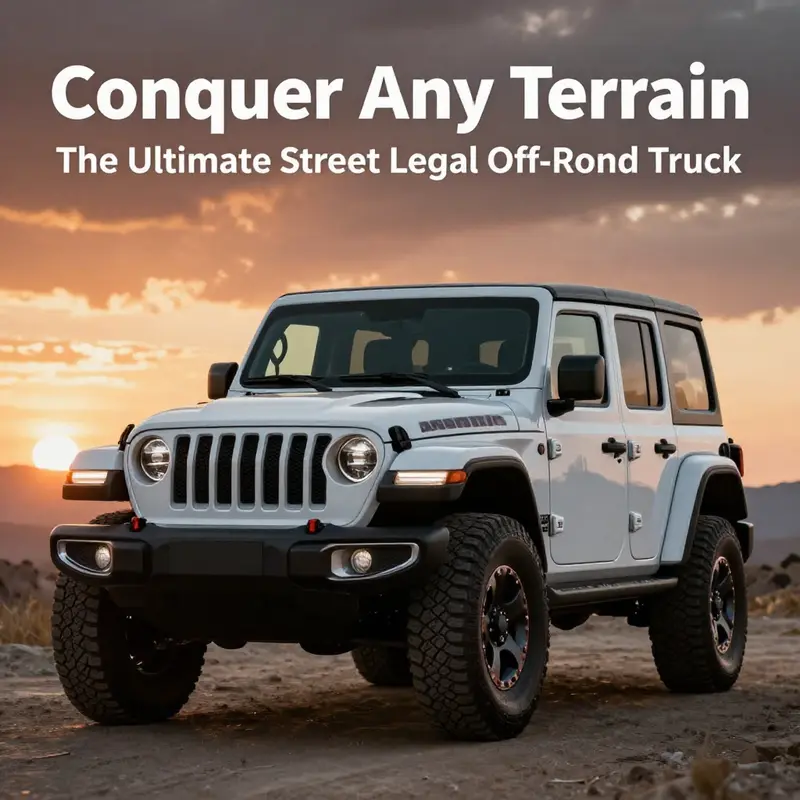
Across the spectrum of vehicles built to tackle rough terrains, one design language endures: a simple, uncompromising geometry that tethers rugged capability to everyday practicality. This silhouette—boxy by necessity, solid by consequence—has staying power not just on trails but in daily life, where comfort, reliability, and road legality matter as much as wheel travel and ground clearance. The chapter that follows moves through the idea of an off-road truck as a design object, not merely a machine, tracing how a certain archetype came to symbolize the intersection of adventure and street legitimacy. It is a narrative of form meeting function, of heritage shaping modern engineering, and of a vehicle that has become a benchmark because it refuses to surrender either role—off-road aggressor or daily-driver companion—to the other.\n\nFrom a distance, the vehicle reads as an order of angular lines and protected surfaces. The distinctive boxy profile, a hallmark of enduring off-road design, communicates resilience before a tire even touches the road. Its front fascia is dominated by a grille that isn’t merely decorative; it aligns with the vehicle’s purpose by providing a generous approach, an attribute that translates to confident rock crawling and respectful obstacle negotiation. The bumper is rugged but not punitive, designed to absorb impacts and to guide contact away from critical components during steep ascents and uneven transitions. In the same breath, the silhouette speaks of practicality. The fender flares, pronounced yet purposeful, accommodate larger tires and higher suspension travel, while maintaining a stance that preserves stability at highway speeds. The visual language signals a vehicle ready for mud, sand, rock, and snow, and it signals it with coherence rather than bravado.\n\nThe functional elegance of this design rests on a simple premise: capability should be earned, not manufactured through theatrical styling. The design integrates core off-road necessities—locking differentials, skid plates, and a low-range transfer mechanism—without forcing the user to trade comfort or legality for terrain conquest. These elements aren’t ornamental; they are tactile guarantees that the vehicle can meet the demands of a diverse driving portfolio. When traversing rugged trails or similarly challenging routes, drivers benefit from features that couple strength with predictability. Because the design emphasizes modular protection and a logical distribution of mass, the vehicle maintains composure on gnarly rocks and in slippery descents, and it remains tractable on high-speed gravel roads. The result is a machine that communicates confidence through proportion and texture as much as through performance figures.\n\nThere is something almost architectural about the interior philosophy, too. The cabin is utilitarian, not austere. Its logic is straightforward, echoing the same practical virtues that define the exterior. A driver’s cockpit arranged for tactile feedback—where controls are deliberately placed and resistant to the harsh realities of trail work—speaks to a long lineage of explorers who learned to trust a vehicle’s physical cues. The transmission tunnel may look busy at first glance, with dual levers for the transfer case and the transmission, but the arrangement is a deliberate response to real-world needs. It enables quick adaptation to changing terrain, whether one is easing down from a rocky ledge or negotiating a tight switchback in loose dirt. Even the handbrake, substantial and deliberately positioned, becomes a tool for maintaining control on slippery grades, a reminder that the best off-road trucks balance brute capability with intuitive operation.\n\nIf design tells a story about intent, it is reinforced by heritage that refuses to dissipate over time. The archetype in question traces its lineage to a trail long recognized as a proving ground for serious off-roaders, a place where a truck’s soul is tested by boulders, ruts, and the fearsome silence of high-altitude canyons. The legacy is not only about durability; it is about confidence earned through repeated exposure to demanding terrain. Over the decades, that story has persisted because the vehicle’s form has remained adaptable rather than static. The boxy geometry that defines its personality is not a relic; it is a functional choice that preserves approach and breakover angles, enabling drivers to approach obstacles with a level of assurance that is hard to achieve with more curvaceous designs. In this light, the silhouette is more than a visual signature; it is an equipment manifesto, a guarantee that the truck is ready for adventure as soon as the doors close and the engine settles into its work.\n\nThe practical reality of street legality sits at the core of this conversation. A design that performs off-road well must also perform on the street without requiring special permits or credentials. The vehicle that embodies this balance demonstrates compliance with safety and emissions standards, while still offering the capability to navigate rough terrain. It is a rare synthesis: a vehicle that can cruise a city boulevard with the same ease it handles a rocky mountain pass. That seamless transition is not a fortunate accident. It is a product of thoughtful engineering, where powertrains, chassis tuning, and suspension geometry are tuned to deliver predictable behavior, whether one is accelerating onto a highway on-ramp or creeping up a shale-strewn slope.\n\nThe interior experience matters for daily life as much as for trail life. A cabin designed for practicality tends to reward long drives with comfortable seating, accessible storage, and straightforward controls. The ergonomics of the vehicle—the height of the seating position, the reach to the gauges, the ability to see over the hood when backing out of a tight trail—play a significant role in the vehicle’s overall usefulness. In many ways, the interior becomes a second stage of the design story: it translates the ruggedness of the exterior into a space where everyday chores—groceries, school runs, late-night returns from a camping trip—are performed with a sense of purpose rather than compromise. The lighting, the materials, and the dash layout all speak to an intention: that the vehicle is a tool for both exploration and daily life, not a distraction from either.\n\nMarket appeal follows from this thoughtful synthesis. A design that resonates with a broad audience tends to become more than a product; it becomes a cultural touchstone. The archetype in question has sustained interest across generations, attracting both longtime enthusiasts and younger buyers drawn to the romance of adventure and the tangible payoff of rugged capability. Even as the automotive landscape shifts toward electrification and new propulsion paradigms, the demand for a vehicle that blends character, reliability, and real-world utility remains persistent. In this sense, the silhouette is not just a shape; it is a promise that a vehicle can be both a form of self-expression and a practical instrument for navigating the world’s diverse terrains.\n\nCultural significance, finally, emerges from how a vehicle is used and discussed within communities that prize off-road exploration. The design becomes a shared language—an invitation to outfit a machine with protective plating, to select tires that strike a balance between traction and road noise, to mount recovery gear that is both accessible and discreet. For students of mobility and regional automotive culture, the ongoing popularity of this archetype is more than a preference. It is evidence of a broader appetite for vehicles that refuse to be one-note. The best street-legal off-road truck, in this sense, is the one that can tell a consistent story: a story about capability, about legality, and about a life that is as comfortable on a tar road as it is on a trail that never truly ends.\n\nThe design narrative here does not reside in a vacuum. It sits at the intersection of engineering discipline and user imagination. The truck that most clearly embodies this philosophy does not require a user to choose between worlds; it invites them to navigate both, with the expectation that their vehicle will respond with the same honesty on Monday’s commute as it does on Saturday’s descent into a canyon. Keeping this balance intact demands a design that is as thoughtful in the workshop as it is in the showroom: tested under the most unforgiving conditions, refined through years of feedback from a diverse community, and continuously adapted to drivers whose needs evolve with every new trail discovered. The result is a vehicle that is not merely admired for its rugged charm but appreciated for its reliability, its practicality, and its enduring ability to bridge two seemingly disparate realities—the high-desert road and the rough, ungraded track.\n\nFor readers seeking a deeper dive into the mechanical craftsmanship behind off-road performance, consider exploring a practical guide on diesel-powered maintenance and its relevance to heavy, adventure-ready trucks: mastering diesel mechanics: your step-by-step path to success. This resource highlights how robust mechanical fundamentals underpin the trust drivers place in these machines, especially when the terrain tests their endurance and the clock demands reliability.\n\nAs the chapter closes, the image that lingers is not simply the vehicle’s rugged exterior but the total package: a design that respects the rules of the road while honoring the call of unpaved horizons. The silhouette remains instantly recognizable, yet infinitely adaptable. It signals to owners and engineers alike that a vehicle can be both a steadfast workhorse and a faithful companion to exploration. In this sense, the best street-legal off-road truck is less about chasing peak specifications than about preserving a cohesive identity—one that marries terrain-taming prowess with everyday practicality and a sense of adventure that refuses to fade with the setting sun.\n\nExternal resource: https://www.motortrend.com/cars/jeep/wrangler-rubicon/
The Living Network Behind the Best Street-Legal Off-Road Truck: Community, Support, and a Trail-Ready Platform
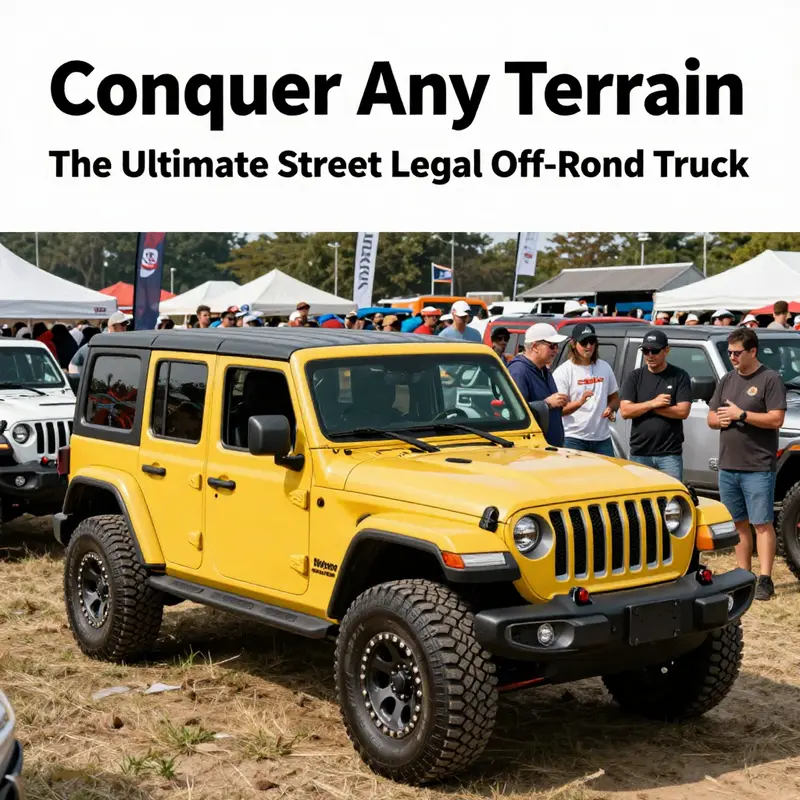
Off-road capability only comes alive when paired with a strong supportive ecosystem. A trail-ready, street-legal truck is as much about its owner community, official service networks, and accessible knowledge as it is about gears and gauges. This chapter explores how forums, dealers, and certified technicians collaborate to keep the vehicle compliant, reliable, and ready for daily driving and rugged adventures. The result is not just a machine, but a durable platform backed by shared expertise, transparent maintenance practices, and a culture of safety and responsibility.
Final thoughts
The world of off-roading and adventure driving is vast and exhilarating, and at its forefront stands the Jeep Wrangler Rubicon. Its unmatched off-road capability ensures that no terrain is too challenging, while its legal compliance makes it a practical choice for everyday driving. The iconic design captures the essence of ruggedness, appealing to those who value both aesthetics and functionality. Complemented by a passionate community, the Wrangler Rubicon not only serves as a reliable vehicle but also fosters connections among off-road enthusiasts. For anyone seeking the best street-legal off-road truck, the Jeep Wrangler Rubicon remains a benchmark of excellence, adventure, and community.