
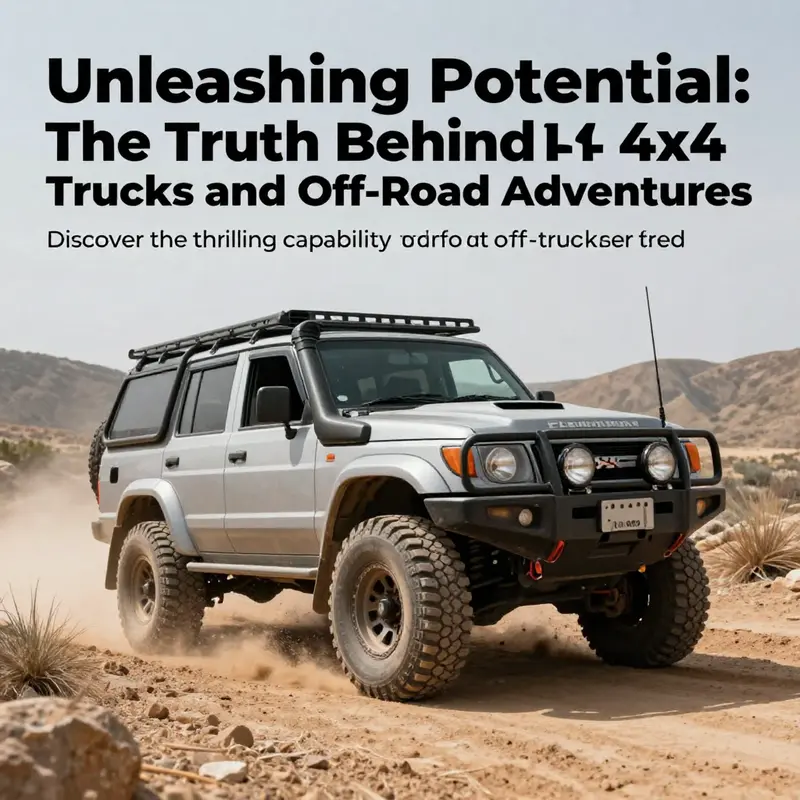
For off-road enthusiasts, 4×4 trucks embody the spirit of adventure and resilience. These rugged vehicles are engineered to tackle the most challenging terrains—transforming mud, sand, and rock into mere obstacles. As we delve into the performance features that make these trucks unparalleled, we will explore the inherent challenges they encounter, drive into the realm of technological innovations enhancing their capabilities, and reflect on their economic significance in various sectors. Each chapter will unveil the multifaceted essence of 4×4 trucks, ensuring an enlightened understanding of their role in off-road endeavors.
Traction Without Compromise: The Off-Road Prowess of 4×4 Trucks
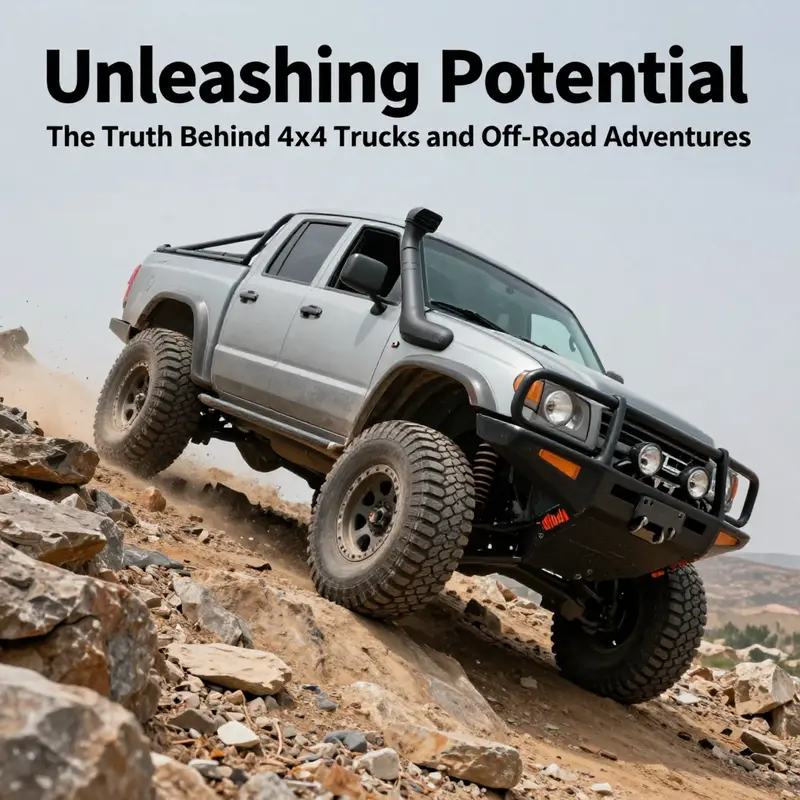
A four-wheel-drive truck designed for off-road work carries more than a rugged silhouette and big tires. It embodies a philosophy of control that begins with traction and extends through suspension, steering, and torque delivery. On surfaces that mute the effectiveness of a standard two-wheel-drive vehicle—mud that clings to treads, sand that sifts away grip, rock gardens that demand precise weight transfer, or ice that mirrors a glassy sheet—the 4×4 chassis becomes a set of tuned responses to terrain. The core advantage is straightforward in theory and immediate in practice: power is distributed to all four corners, so no single wheel can lose contact with the ground without the others compensating. That simple premise underwrites a performance envelope broad enough to span mountains, beaches, snowfields, and rain-slicked streets alike, while still permitting efficient operation on paved roads when conditions allow. Yet the story is not simply about capability on rough surfaces; it is about the synergy of systems that together produce a reliable, predictable, and handleable machine in the hands of a skilled driver.
The most visible component in this equation is the four-wheel-drive system itself. In its essence, 4WD is a mechanism that shifts torque away from wheels that are slipping and toward wheels with solid grip. When a tire starts to spin on mud or loose sand, the drive system can channel power toward other wheels that are digging into the substrate. The result is momentum maintained, momentum regained, and momentum kept where it counts: forward motion. This is especially crucial when traversing upward inclines or negotiating obstacles that would stall a vehicle with only two driven axles. The improvement in traction translates directly into the ability to climb, descend, and maneuver with confidence where a standard vehicle would hesitate or stop.
To complement the 4WD system, most off-road-ready trucks employ a heavy-duty suspension alongside bigger, more rugged tires. The suspension is not merely a spring and damper package; it is the vehicle’s nervous system when negotiating a jagged trail. Long-travel suspensions absorb the impact of rocks, ruts, and abrupt surface changes, preserving ride quality and keeping the wheels in contact with the ground. This continuous contact is essential for maintaining traction because when a wheel leaves the ground, its ability to contribute to propulsion and steering is reduced. High ground clearance follows as a parallel priority, allowing the undercarriage to pass over obstacles rather than scraping through them. In practical terms, this means fewer punctures or bent components and more confidence to push through terrains that would threaten a lesser machine.
Tire construction also plays a decisive role. Aggressive tread patterns, robust sidewalls, and pressure-management capabilities are standard features in off-road designs. The tires are not just about bite; they are about durable contact patches that can resist punctures and resist chunking when faced with sharp rocks or hard-packed surfaces that would tear through a lighter tire. The result is a combination of grip, durability, and stability that helps a driver maintain steering feel and braking control across a wide spectrum of surfaces.
Beyond the hardware, the driver’s interface with the machine matters almost as much as the components themselves. A robust 4×4 chassis often includes drive mode options that allow the operator to tailor traction behavior to conditions. Many trucks provide a choice between two-wheel drive and four-wheel drive, letting a driver optimize for fuel efficiency on smooth pavement and switch to 4WD when the going gets rough. The ability to select different drive modes is not only a matter of performance but of protection: 4WD engagement in dry, paved conditions can lead to drivetrain binding and excessive wear, so modern designs typically require deliberate action from the operator to enable the system in appropriate contexts. Some platforms also incorporate electronic or automatic 4WD systems that monitor wheel slip and engage the appropriate drive to the wheels that have traction, reducing driver workload and improving responsiveness when surfaces change suddenly.
Engine power, while not the sole determinant of off-road prowess, remains a critical enabler of momentum and hill-climbing ability. A torque-rich powertrain, paired with a displacement that favors high-torque delivery, helps the vehicle push through resistance without requiring the driver to relentlessly hammer the accelerator. In practical terms, a 4×4 off-road truck benefits from engines that deliver substantial torque at low to mid-range RPM, allowing the wheels to push through sticky mud or climb steep grades with controlled, manageable acceleration rather than abrupt bursts that can break traction. In many configurations, power outputs in the range of roughly 125 kilowatts and engine displacements around six liters provide the kind of grunt necessary for confident off-road performance. The modern balance—adequate torque, efficient throttle response, and robust torque curves—lets drivers modulate their approach to obstacles rather than forcing the truck to overcome rough terrain with brute force alone.
The chassis and drive components cooperate with the vehicle’s geometry to create a predictable sense of control. Locking differentials, for instance, lock the torque distribution to all wheels, ensuring that both sides of a axle receive equal power when grip is limited. When one wheel sits on a slick patch while another sits on a firmer patch, the differential’s lock prevents the slip from robbing propulsion. The practical effect is a more forgiving negotiation of rutted tracks, wet clay, and loose scree. But the use of locking differentials, like all other drivetrain features, must be managed with discipline: engaging a lock on dry pavement or at high speed can cause drivetrain binding, tire scrubbing, and excessive wear. The responsible driver becomes not merely a passenger of power but a conductor guiding when and how to deploy that power.
The terrain portfolio for a 4×4 off-road truck is telling. These machines are designed to handle mountains where switchbacks test climbing ability, beaches where the surface can shift under weight and tide, and snow or ice where traction becomes a constantly evolving challenge. They must also conquer rugged, muddy roads where the ground can change from one meter to the next, or from wheel to wheel, as ruts appear and collapse under the weight. The truck’s geometry—its center of gravity, wheelbase, and approach and departure angles—becomes a map for where it can go. A long wheelbase can contribute to stability on descent, while a compact radius and ground clearance improve the vehicle’s ability to clear obstacles without sudden toe-in or rubs against the undercarriage. The best off-road designs achieve a balance: enough stability to inspire confidence at speed, yet enough flex to absorb the irregularities of the terrain.
Another dimension that often goes underappreciated is the driver’s relationship with the vehicle’s weight distribution and throttle control. Off-road travel depends on smooth input rather than aggressive bursts. The driver modulates throttle to avoid wheel spin and stands ready to use steering inputs to coax the chassis into a favorable line through a rocky corridor or a sandy trough. This interplay, in which the vehicle’s mechanical systems respond to the driver’s intention, is the essence of off-road capability. It is a dynamic that ties together the 4WD layout, the suspension, the tires, the locking differential, and the powertrain into a cohesive whole. In many fleets that rely on 4×4 trucks for remote-site access, this harmony is not just about mobility—it is about reliability, safety, and the ability to complete critical tasks when time and terrain cooperate against the mission.
The off-road ecosystem also includes the way a truck behaves when it is not actively climbing or crossing obstacles. In many environments, a truck’s ability to handle slow, deliberate movements is just as important as raw acceleration. Handling low-speed crawler tasks, such as precise placement of materials on rugged ground, requires a predictable throttle response, a well-tuned brake system, and a chassis that settles quickly after a bump. In such settings, a four-wheel-drive system can be more a facilitator of stability than a brute force engine. The ability to keep momentum through a soft bog or a compacted mud patch can prevent a stall that might stall a job or strand a crew on site. These subtleties are what convert a vehicle from a simple means of transport into a trusted partner in remote operations.
The chapter on off-road capability would be incomplete without acknowledging the role of training and decision-making in fleets that rely on rugged mobility. A truck may be designed to be resilient, but it gains its full usefulness only when operators are trained to read terrain, choose appropriate drive modes, and manage weight transfer across incline and decline. In practical terms, this means knowing when to engage four-wheel drive for a climb, when to switch to low-range gearing for a steep descent, and how to use the vehicle’s geometry to minimize the risk of getting stuck. It also means recognizing the difference between a surface that requires careful throttle modulation and one that invites a steady, confident push. In fleet management discussions, the human element matters just as much as the hardware. Invest in people who understand the terrain, the machine, and the mission, and you amplify every bit of capability a 4×4 truck can offer. invest in people key to fleet management success
From a broader perspective, the story of off-road trucks sits at the intersection of utility, technology, and safety. In industrial applications, such trucks are designed to withstand harsh conditions while delivering payloads and performing material handling in remote or rugged environments. Their lifting heights and fork lengths, while more associated with other classes of equipment, illustrate the underlying principle: durability and reach can be tuned to special-purpose tasks without sacrificing the vehicle’s core capabilities. The underlying takeaway is that a 4×4 off-road truck can be a cornerstone of operations that require reliable access to difficult terrain, whether for construction, mining, or disaster response. The same principles that let a truck navigate a rocky slope or a sandy wash also enable it to perform critical tasks on remote sites where ordinary vehicles would falter.
Despite the abundance of described capabilities, it is important to acknowledge the context in which these machines operate. Four-wheel drive is not a panacea; it is a tool that must be applied with discernment. The weight, ride dynamics, and mechanical complexity of a 4×4 system create both benefits and trade-offs. For example, on dry pavement, the advantages of 4WD recede and the risk of drivetrain strain increases if the system is engaged unnecessarily. The prudent operator respects this boundary, reserving four-wheel drive for when traction is compromised or terrain demands extra grip. In the same vein, maintenance cannot be neglected. The robust components—suspension, axles, driveline, and tires—depend on routine inspection and timely service to retain their performance under demanding conditions. The value of a well-maintained off-road truck is not simply measured in the miles it can cover but in the certainty it affords crews who rely on it to reach remote locations and complete essential tasks.
In doing justice to the off-road capability of four-wheel-drive trucks, one must also consider the evolving landscape of simulation and training. For drivers who want to internalize the physics of weight transfer, traction, and suspension dynamics without risking equipment on rough terrain, high-fidelity simulations offer a valuable proxy. A realistic virtual environment can reproduce weight distribution, torque, and suspension behavior, enabling drivers to practice line selection and throttle control before venturing into real-world trails. While such simulations cannot replace live-field experience, they can shorten the learning curve and help operators approach challenging environments with greater competence and confidence. The net effect is a more capable operator who can extract the remote-locomotion potential of a 4×4 off-road truck while preserving safety and minimizing wear on equipment and terrain.
The narrative of off-road 4×4 trucks thus converges on a simple refrain: traction, protection, and control are the pillars of capability. Add to those pillars a properly seasoned operator, and the machine becomes more than its parts; it becomes a tool that expands the radius of where work can happen. This is not about brute force alone but about a harmonized system in which transmission, axles, suspension, tires, and driver judgment work in concert. It is this harmony that allows a 4×4 truck to perform where ordinary vehicles cannot, and it is why off-road capability remains a defining feature of modern fleet strategies, remote-site access plans, and field operations that must navigate the unpredictable.
External source and further reading: https://www.alibaba.com/product-detail/4X4-Off-Road-Rough-All-Terrain-Forklift-Truck_1600727738538.html
Grip, Grit, and Ground: Navigating the Real-World Trials of 4×4 Off-Roading

A 4×4 truck is more than a badge of capability; it is a system designed to coax grip from the most uneven ground, to translate human judgment into controlled motion, and to endure the punishing realities of remote landscapes. Yet the off-road world does not yield to bravado. It tests your line choice, your throttle discipline, and your respect for the vehicle’s limits. When you pull away from the pavement and enter a trail shaped by rain, wind, and time, you are stepping into a dynamic conversation among tires, suspension, drivetrain, and courage. The terrain speaks in mud, rock, and shadow; the driver must listen, adjust, and respond with precision. What follows is a synthesis of the kinds of challenges a capable 4×4 will meet off road, how those challenges reveal themselves in real conditions, and how both machine and mind must harmonize to keep moving forward.
In the broadest sense, the first and most immediate adversary is mud and the deep ruts it forms. Mud embodies a volatile mix of suction, shear, and inconsistent grip. A wheel that sinks into a soft path can spin with little forward progress, while an adjacent wheel might ride higher and grab, leaving the vehicle perched and vulnerable to a side slip. The physics behind this are straightforward and unforgiving: as a wheel attempts to push against a soft surface, it loses the progressive traction needed to propel the truck. The 4×4 system helps by distributing torque more evenly than a two-wheel-drive setup, and locking differentials can ensure that all wheels share the load. But even with such technology, the outcome hinges on driver input. Gentle, progressive throttle is the antidote to a spinning tire; abrupt surges tend to bury a vehicle deeper or throw it into a side pull that exhausts steering effort. Steering input must be thoughtful as well. In sticky ground, turning too sharply can cause a wheel to scrub or to climb out of the rut only to drop back into a worse track, while too little steering makes the line rigid and unresponsive. The driver learns to pick a path that minimizes steep angles and maximizes the chance that each wheel sits on firmer ground, even if that firmer ground is not perfectly flat.
The second major theater of off-road challenge sits higher in the air: rocky and steep terrain. Here the landscape tests the truck’s articulation, approach and departure angles, and the ability to sustain traction while negotiating obstacles such as boulders or a ledge. The suspension must absorb heavy impacts while the powertrain maintains a delicate balance between momentum and restraint. Excessive speed can force the undercarriage to strike or wheel away from the ground when a rock is encountered; too little speed invites a loss of momentum and a stall in the middle of a climb. A driver who understands the terrain’s rhythm—reading the line, selecting a path with a smooth ascent, and anticipating where the wheels will contact rock or soil—will often keep the truck’s weight over the contact patches rather than letting it surge away from the obstacle. When a truck begins to lose traction on a steep, uneven ascent, the instinct to briefly ease off the throttle, then reapply power with controlled throttle modulation, can be the difference between a clean climb and a stubborn stall. In such moments, the qualifying factor is not only the truck’s power but the system’s ability to deliver it where it’s needed. Locking differentials helps here by equalizing torque across axles and ensuring that slipping wheels do not undermine progress. Yet even with differential locks engaged, the driver must avoid excessive steering or abrupt braking that could unsettle the chassis. A steady, deliberate approach, with continuous but moderate power, preserves traction through the rocky mosaic and prevents the vehicle from tipping its balance.
Environmental factors complicate matters far beyond the terrain itself. Dense forests, thick brush, and narrow trails introduce the human element—reduced visibility, uncertain footing, and the danger of unseen obstacles just beyond the bend. Visibility becomes a puzzle of line-of-sight and pace. The driver must trade speed for opportunity, choosing to pause and reassess when the understory conceals the trail ahead or when a bend hides a hidden rock or root. Weather compounds the risk: a path that is firm and dusty in one moment can become a slick, binding surface after a rainstorm or a dusting of new snow. Rain reduces traction on dirt and rock alike, while snow can mask ruts, rills, or fallen branches that would otherwise guide careful wheel placement. The environmental dynamic also tests the driver’s judgment about risk and reward—whether to press forward on a snow-covered grade where traction is uncertain, or to backtrack and select another route that preserves momentum without courting a rock-failure scenario. In forests and on winding trails, the challenge is not simply to stay upright but to do so while conserving momentum and keeping the vehicle’s center of gravity within safe limits.
A fourth category concerns the vehicle itself. No truck is perfect for every terrain, and the constraints of ground clearance, tire design, suspension travel, and weight distribution can become limiting factors in real-world conditions. Ground clearance matters: when a fresh obstacle looms—a rock ledge, a tree root, or a fallen trunk—the distance between the undercarriage and the surface sets a hard boundary on what is traverseable without contact. If clearance is insufficient, the risk intensifies of scraping the oil pan, exhaust, or other sensitive components. The tire is the other critical constraint: tread depth, tire width, and sidewall stiffness determine how well a wheel can bite into uneven ground, grip on a slick surface, and resist puncture from sharp-edged rocks. A tire that is too narrow may sink into soft soil or rut, while a tire that is too stiff may ride over obstacles with little grip. Weight distribution matters as well. A truck carrying heavy loads in the back or overhanging payload into the bed can shift the center of gravity, making cornering at lower speeds on a slope more precarious. The drivetrain and chassis carry their own constraints: even with a robust four-wheel-drive system and locking differentials, the torque split must be managed to avoid twisting the drivetrain or overheating axles under sustained climbs. Components such as springs, shock absorbers, and linkages are designed to absorb impact and maintain wheel contact; when these parts are worn or undersized for a given load, the vehicle reacts less predictably to the terrain. In other words, capability has a ceiling defined by the finite endurance of the hardware and by how well the operator knows when to deploy that hardware. The most capable trucks can do extraordinary things, but they demand respect for their limits and a careful, preemptive approach that anticipates what lies ahead rather than reacting when it is too late.
The interplay among mud, rock, weather, and vehicle specifics creates a dynamic that rewards patience, preparation, and adaptive decision making. Drivers who excel in off-road contexts are rarely reckless; they are curious and methodical. They study the line before committing to it, they consider how each wheel will contact the ground, and they recognize that the best route is often the one that keeps momentum flowing with the least resistance rather than the most audacious obstacle negotiated in a single move. Preparation begins long before the vehicle is pointed toward the trail. It includes a thoughtful equipment checklist—stable tires with appropriate tread, correct tire pressures for the terrain, a sturdy recovery kit, and a clear sense of weight distribution for the given load. It also includes a mental map of the route: a plan that identifies potential hazards, alternating lines, and safe turnaround points if the terrain proves impassable. Even with the most capable truck, a prudent decision may be to turn back rather than risk a deeper dive into a terrain that exceeds the driver’s comfort or the vehicle’s margin of error. This is not capitulation but a responsible practice that preserves both equipment and the person operating it.
The research landscape around off-road driving emphasizes that the challenges described here are not mere theoretical concerns. They are validated by the lived experiences of drivers who have learned to respect the limits of the machine and to adapt their technique to the conditions at hand. The literature on off-road driving emphasizes the essential need for throttle modulation, careful steering input, and prudent line selection in mud; it highlights how a rocky ascent requires smooth power delivery and optimal weight distribution to keep the wheels in contact with the surface. It also notes how environmental factors—visibility, weather, and vegetative encroachment—mandate a slow, deliberate pace and a readiness to alter plans mid-course. Finally, it acknowledges that vehicle-specific limitations—contact patch, ground clearance, drivetrain architecture—shape what is possible and what remains out of reach on a given day. Taken together, these insights paint a clear picture: 4×4 capability is a product of both engineering and experience, a synergy between the vehicle’s hardware and the driver’s judgment.
In practice, this means that the off-road experience is not simply about having the right gear or the right trail map. It is about cultivating a sensibility for risk, a habit of inspection, and a disciplined approach to pursuit and retreat. A successful outing is rarely a triumph of force. It is usually a quiet sequence of micro-decisions—when to creep, when to roll back, where to aim a wheel, how to adjust the throttle, and when to pause to reassess the next move. The driver’s relationship with the terrain becomes an ongoing negotiation. The truck offers grip and torque, but the driver provides purpose, cadence, and restraint. The result is a performance that looks effortless when executed well but rests on a complex choreography of factors that must be understood and practiced. This is the essence of off-road mastery: not a single daring move, but a disciplined pattern of perception, planning, and proportional action that aligns the vehicle’s capabilities with the terrain’s demands.
For readers who envision real-world practice over glossy demonstrations, the takeaway is clear. Off-road success begins with a realistic assessment of the terrain, a plan that respects the environment and the vehicle’s limits, and a willingness to adjust or abandon a line if risk outweighs reward. It requires staying attuned to the subtle cues—the way the ground sounds under a tire, the feel of the steering wheel as traction shifts, the way a suspension compresses as the wheel meets a rock. It also requires ongoing maintenance and preparation: keeping tires in good condition, ensuring that locking mechanisms, steering components, and the suspension are up to the task, and understanding the thermal and mechanical stresses that come with sustained underbody contact and high articulation. In the end, the 4×4’s off-road competence is not only about how far you can go but how well you can read the landscape, manage your resources, and choose the safer, smarter path when the next obstacle appears on the horizon.
External resource for further reading on confronting and overcoming off-road challenges: https://www.offroad-enthusiast.com/offroad-challenges-and-how-to-overcome-them
Trailcraft Transformed: Tech Frontiers Elevating 4×4 Off-Road Trucks

Over the years, the simple formula of four wheels pulling a vehicle through rugged terrain has evolved into a sophisticated, adaptive system. A modern 4×4 off-road truck is defined not just by grip or tire tread but by a suite of deeply integrated subsystems that sense, decide, and respond to changing ground conditions. The result is a platform that feels almost alive in how it requests less effort from the driver while delivering reliable traction, stability, and safety across mud, sand, snow, rock, and uneven surfaces.
Power distribution begins with electronically controlled locking differentials and adaptive traction control, which allocate torque across axles and to individual wheels in real time to maintain momentum when grip is variable. These systems reduce wheel slip without overcooking throttle inputs, letting the vehicle carry speed through mixed terrain where a single wheel might bite while another spins.
Suspension technology has progressed alongside these controls, with air suspension enabling on-the-fly ground clearance adjustments. The ability to raise the ride height for approach angles and obstacles, then lower it for stability on hard-packed trails changes the vehicle geometry without sacrificing tire contact. Independent rear suspension helps keep tires in contact over irregularities, smoothing the ride and preserving traction as the terrain shifts beneath the chassis.
The cockpit has become a dense, actionable data hub. Terrain monitoring systems fuse data from sensors, cameras, and mapping inputs to present wheel slip, suspension travel, and predicted grip in intuitive formats. In advanced configurations, software can suggest gear selections, throttle modulation, or height adjustments to optimize contact patches. Some implementations even use AI to pre-configure vehicle settings before a trial run, reducing cognitive load and enabling drivers to focus on line choice and energy management rather than subsystem tuning.
Material and powertrain choices reinforce these capabilities. Lighter alloys and high-strength steels improve weight distribution and handling, while hybrid or electric powertrains deliver instant torque and cleaner operation. The resulting efficiency supports longer missions and lower emissions, with quieter operation that helps preserve sensitive environments and reduce fatigue for crews on extended deployments.
Maintenance and support remain essential. Remote diagnostics, 24-hour service networks, and predictive maintenance data allow issues to be spotted before they become failures, keeping fleets productive in remote settings such as mining corridors, disaster-response routes, and remote construction sites. Operators gain confidence knowing help is available around the clock, enabling them to push machines toward the edge of capability with greater reliability.
Taken together, these trends redefine what a 4×4 off-road truck can do. The integrated control stack, dynamic suspension, and data-driven cockpit turn challenging terrain into a repeatable, navigable task. The focus shifts from pure hardware bravado to predictable, scalable capability that supports a wide range of missions, from critical infrastructure support to remote exploration. External references can illustrate how electrification, automation, and smart diagnostics are expanding the frontier across heavy machinery. External resource such as the illustration of electrified construction equipment demonstrates how the same engineering principles apply across platforms. Volvo electric construction equipment revolution offers a broader lens on how these ideas scale, reinforcing the narrative that the tech frontier in off-road trucks is part of a larger movement toward smarter, more capable, and more resilient heavy machines.
Traction, Trade, and Territory: The Economic Ripple of 4×4 Trucks in Off-Road Realms

When a four-wheel-drive truck meets a landscape that refuses to be tamed by ordinary vehicles, a particular kind of economic logic takes hold. The machine is not merely a means of transport; it is a portable worksite, a logistics node, and a hedge against the unpredictable rhythms of remote geography. In off-road contexts, traction is more than grip on mud or sand. It is a multiplier of productivity, a shield against downtime, and a driver of regional resilience. The four-wheel-drive system, the high ground clearance, and the rugged chassis work in concert to convert difficult terrain into a predictable corridor for operation. In practical terms, that means operations can begin earlier in the day, continue later after sunset, and move with a steadiness that minimizes the costly pauses that plague remote work. In turn, local economies become less susceptible to the caprices of weather and terrain, and the same vehicles that push ore from a mine or timber from a forest also push data, parts, and expertise through the supply chain with greater reliability.
The economics of off-road work hinge on uptime as a scarce resource. In many remote sectors, a single delayed trip can cascade into wait times for critical inputs, scheduling conflicts for crews, or missed contractual windows. A capable 4×4 truck reduces that risk by defeating one of the most stubborn adversaries in rugged environments: inaccessibility. A vehicle that can climb steep, muddy grades, cross rocky stretches, or traverse washboard trails without getting hung up is a vehicle that keeps the broader operation moving. In these settings, the cost of a single breakdown is magnified not by the price of a spare part alone but by the opportunity costs that accumulate while a site sits idle. The investment in robust suspension, durable tires, and reliable drivetrains pays for itself as a steady cadence of trips returns to the workflow, translating into predictable throughput and the ability to honor delivery deadlines, maintenance cycles, and project timeliness.
Across the fields of mining, construction, agriculture, forestry, emergency services, and remote logistics, 4×4 trucks perform a kind of labor conversion. They take the energy produced at the plant, the materials harvested from forests, the soil treated for crops, and the fuel, water, and personnel that drive every operation, and convert it into usable output on sites that would otherwise be cut off. In mining, for example, supply lines wind through rugged access roads and stalled approaches that would strand teams and delay ore flow. A 4×4 platform can shuttle blasting mats, crew gear, and ore samples with a cadence that aligns with blasting schedules and processing shifts. In construction and civil works, the ability to haul heavy tools and equipment up uneven grades reduces the need for multiple trips and consolidates tasks that would otherwise require special escorted convoys. For agriculture and forestry, the vehicles traverse muddy fields, uneven logging lanes, and forest roads to move feed, seed, seedlings, and cut timber to central points with reduced risk of equipment damage and soil compaction that would otherwise erode future productivity.
The safety and efficiency dividends extend beyond the site perimeter. Remote logistics—the practice of moving essentials to and from dispersed locations—depends on dependable access. When roads degrade after rainstorms or seasonal washouts, a 4×4 truck can perform critical re-routings that prevent breakdowns in the broader supply chain. That reliability translates into lower insurance costs for fleets operating in remote zones, because risk exposure to stranded cargo and unplanned detours diminishes. It also strengthens labor retention. Teams placed in isolated areas value dependable transportation that minimizes personal risk, reduces fatigue from long detours, and shortens the time needed to reach remote job sites. In an industry landscape that increasingly links safety performance with efficiency metrics, the economic argument for robust off-road capability becomes more compelling: reliability lowers total cost of operation and raises the probability of on-time project delivery.
The ripple effects of reliable off-road transport extend into the earnings statements of firms that mobilize around remote work. Fleet utilization metrics improve when 4×4 trucks consistently reach their destinations on schedule. The same vehicles can be repurposed more quickly between tasks, lowering idle-time costs and enabling crews to meet tight production windows without renting additional support vehicles. In sectors like emergency response and disaster management, the payoff is even more pronounced. Off-road capability enables faster reach to affected communities, faster deployment of relief supplies, and quicker restoration of essential services. The resulting economic stability—fewer days lost to inaccessibility, quicker restoration of power lines, roads, and communications—helps local economies rebound more rapidly after disruptions. This is the kind of systemic resilience that firms and communities alike monitor, quantify, and invest in, because the returns materialize not just as quarterly gains but as longer-term capacity to operate in diverse geographies.
To understand these dynamics more concretely, it helps to picture the roles different vehicles play on the ground and the way they complement one another. A capable 4×4 truck often becomes the frontline tool for field operations, moving crew, equipment, and basic consumables between a central base and scattered work cells. It supports the core process by ensuring that personnel can access their work areas when roads are compromised or terrain is unforgiving. From a supply chain perspective, these trucks reduce the need for redundant transportation assets on remote sites, allowing a fleet to rotate assets without sacrificing coverage. In this way, the 4×4 is not only a conveyance but a strategic asset that stabilizes the entire operating model. The ability to traverse challenging terrain without excessive wear and tear on the vehicle translates into lower maintenance costs per kilometer traveled, longer asset life, and more predictable budgeting for capital depreciation and maintenance reserves. The cumulative effect is a favorable shift in the total cost of ownership, a metric many operators track closely as they scale up activities in remote areas.
Beyond the hard numbers, the economic impact of 4×4 off-road capability weaves into workforce development and regional opportunity. Sites that must operate in challenging geographies create demand for skilled maintenance technicians, drivers trained in off-road risk management, and logistical planners who can optimize routes around natural obstacles. The need for local repair, parts supply, and service networks generates employment, stimulates small-business growth, and anchors economic activity in areas that would otherwise rely on highly centralized operations. In rural regions, the presence of robust logistics infrastructure linked to rugged transport capability can attract ancillary businesses—tooling suppliers, fuel depots, and telematics services—that diversify local economies and provide steady employment. The investment in a fleet designed for off-road work thus becomes a layered catalyst, sustaining jobs, nurturing supplier ecosystems, and enabling communities to support larger-scale, capital-intensive projects.
A broader industrial ecosystem also responds to the demand for capable off-road transport. Engineering and manufacturing supply chains adapt to produce components that enhance reliability in harsh environments: heavy-duty suspensions that cushion rough terrain, higher ground clearance to clear obstacles without scraping, locking differentials that maximize grip, and tires engineered for mixed terrain. These innovations circulate through the market, raising the performance baseline for other vehicle classes and even spurring maintenance innovations that extend service intervals and reduce downtime. In practice, this means more robust manufacturing practices, better-aftermarket support, and improved logistics software that coordinates operations around the realities of off-road work. The net effect is a more productive, better-connected economy that can mobilize resources quickly in response to demand for remote work and emergency response capabilities. The economic gains are not merely the sum of individual vehicle purchases; they are the multiplication of improved uptime, reduced downtime risk, and the resilience of supply chains across remote geographies.
This picture of economic impact is reinforced by the way off-road capability broadens the geographic footprint of activities. When rugged transport unlocks access to mineral resources, agricultural zones, or forest products, operations can expand into areas that were previously deemed uneconomical due to accessibility constraints. The decision to explore or develop in these regions becomes more viable, often accompanied by investments in roads, bridges, and supporting services that further embed economic activity into the regional fabric. The cumulative effect is a more balanced regional development pattern, where wealth generation is less concentrated in easily accessible hubs and more distributed across landscapes that reward resilience and strategic planning. The 4×4 truck thus assumes a role not just as a vehicle but as a strategic asset that unlocks value across multiple layers of the economy, from field productivity to regional investment. In this sense, the question “can a 4×4 truck go off-road?” expands into a broader inquiry about how mobility under challenging conditions enables growth, manages risk, and sustains livelihoods in places where terrain shapes opportunity as much as policy or market demand.
As industries evolve, partnerships and knowledge-sharing become increasingly important. When operators adopt a holistic view of off-road mobility, they begin to integrate vehicle capability with maintenance regimes, telematics, and workforce training. This integration supports continuous improvement in efficiency and safety and helps organizations anticipate the needs of a changing terrain—whether it is thawing permafrost, seasonal mud, or a dry, rocky expanse. In practice, this means more than choosing a vehicle; it means designing a maintenance schedule that minimizes unplanned downtime, selecting routes that optimize fuel efficiency, and equipping crews with the skills to respond quickly when terrain challenges arise. The result is a more agile operation, one that can adjust to seasonal shifts, supply chain disruptions, and the unpredictable tempo of remote work. In this sense, the economic argument for robust off-road capability becomes a narrative about adaptability as much as throughput.
To connect these ideas with practical pathways, consider how companies and communities can leverage off-road capability as a lever for broader development goals. Investments in fleets designed for rugged terrain should be paired with robust training programs, parts and service networks, and data-driven route planning. When fleets operate with high uptime and predictable costs, they create room in budgets for essential complementary investments—roads maintenance, digital connectivity, and local workforce development—that strengthen the local economy over the long term. This integrated approach helps ensure that the benefits of 4×4 off-road capability are not confined to productivity metrics alone but extend to social and economic resilience that communities can rely on during periods of disruption or change. The story of these vehicles, then, is not a tale of isolated machines but a chapter in the broader narrative of how mobility in challenging terrain can underpin sustainable growth, equitable opportunity, and durable prosperity for regions that have long faced the test of rugged landscapes.
For readers who want to explore this dimension of mobility in action, a practical pathway is to examine how organizations connect off-road capability with community and workforce development. One way is to look at industry collaborations and corporate social responsibility initiatives that align logistics efficiency with local impact—an approach that demonstrates how the same assets used to maintain production lines and service delivery can also empower communities through jobs, training, and improved access to essential services. These partnerships illustrate how the economics of off-road transport do not exist in a vacuum; they weave into social outcomes, infrastructure improvements, and the resilience stories that communities tell when prosperity is measured not only by profits but by the steadiness with which people can access opportunity, even when the terrain is unforgiving. In this sense, the economic impact of 4×4 trucks in off-road applications becomes a story about practical genius meeting social purpose, where traction on the ground translates into traction for sustainable growth across landscapes.
To read more about how enterprises are integrating off-road mobility with broader operational and community goals, see the linked discussion on trucks that are shaping change in diverse environments. Trucks for Change: Supporting Habitat for Humanity. This example illustrates how mobility and reliability support not only day-to-day productivity but also the capacity to extend help where it matters most, tying together commercial performance with stakeholder value and social impact. In this way, the chapter closes on a forward-looking note: as markets evolve and terrain remains a constant, the 4×4 truck stands as a practical instrument for turning challenging geographies into engines of opportunity.
For a technical perspective on maintaining and sustaining performance in harsh environments, researchers and operators may also consult established technical resources that describe the kind of heavy-duty design principles that underpin reliability in off-road work. These resources provide a framework to understand how suspension, clearance, drivetrain geometry, and chassis durability coalesce to deliver consistent operation in demanding settings. External references that summarize best practices in maintenance and performance under rugged conditions can offer valuable context for managers planning fleet upgrades or expanding operations into new terrain. https://www.isuzuparts.com/
External resource: https://www.isuzuparts.com/
Final thoughts
The journey through understanding 4×4 trucks reveals not only their formidable capabilities but also the rugged charm that beckons adventurers. Balancing raw power with technological sophistication, these trucks are designed to conquer any landscape. Though challenges persist, the innovations continually emerging signal a bright future for off-road enthusiasts. Whether on the trail or on a construction site, the economic significance of 4×4 trucks enhances their allure, confirming their status as the ultimate vessels for adventure. As you embrace the off-road lifestyle, remember: the right truck is not just a machine; it’s a ticket to freedom.