
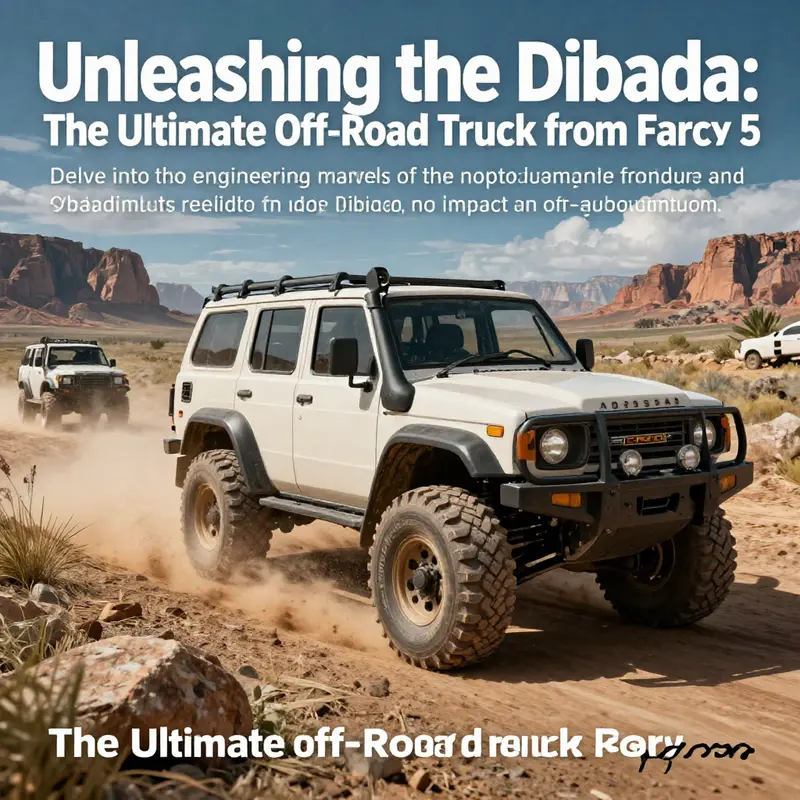
In the thrilling landscape of Far Cry 5, the Dibada stands out as a symbol of off-road innovation. This fictional vehicle, crafted by Ubisoft, captures the imagination of off-road enthusiasts and gamers alike. Engineered for combat and exploration, the Dibada is a must-know element for anyone passionate about rugged adventures. From its design roots to its gameplay advantages, each chapter explores the multiple facets that define this off-road beast. We will peel back layers on the Dibada’s development, dive into its features, compare it with real-world machines, investigate its role in gameplay, and assess how it has been received by a vibrant community. Get ready as we navigate through the exciting world of the Dibada.
Behind the Wheel in Hope County: The Dibada and the Fabric of Far Cry 5
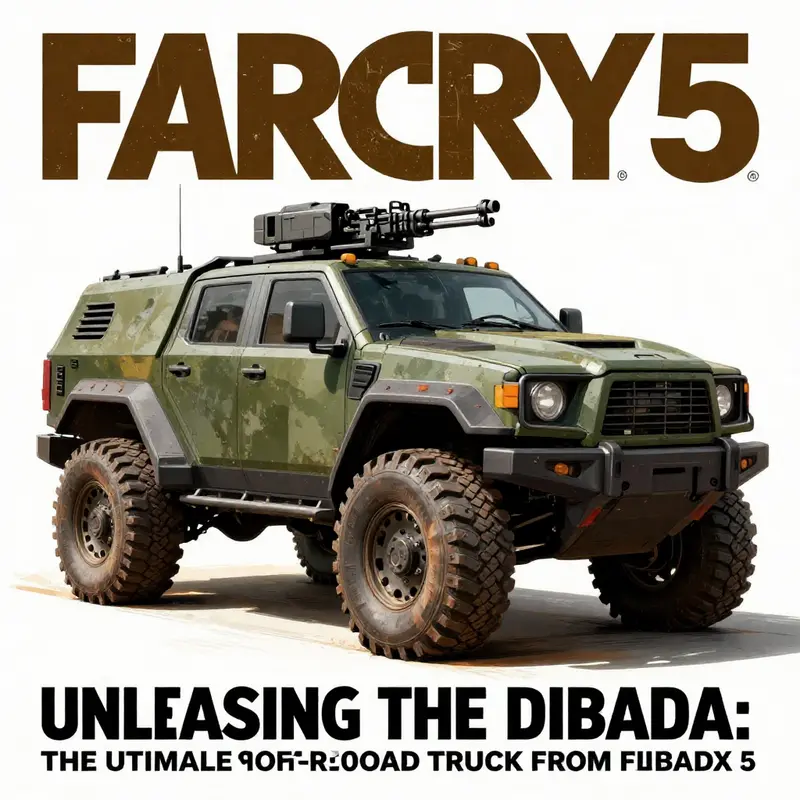
In Hope County, the off road truck known as the Dibada emerges as more than a transport device. It is a narrative instrument designed to translate rough terrain into tactical possibility, a machine that can carry a squad across treacherous slopes and pivot quickly into a defensive posture when danger closes in. Its presence signals a world where means of mobility are as much a part of the story as the characters who inhabit it. The Dibada is not a direct clone of a real vehicle but a stylized amalgam crafted to feel believable within Far Cry 5 s Montana inspired landscape, balancing immediacy of use with a hint of frontier resilience.
The development heartbeat behind the vehicle comes from Ubisoft Montreal, the studio charged with shaping the game s environments, weapons, and mobility into a cohesive whole. Concept discussions center on a silhouette that communicates mass and capability without overpowering the game s pace. Early explorations emphasize a rugged pickup lineage with practical armor and a mounting system that could plausibly support a weapon platform, yet never drift into caricature. The result is a vehicle that reads as familiar and capable, a tool suited to both long hauls across ridgelines and the unexpected snarl of a firefight in Hope County s tighter spaces.
From sketch to screen, the Dibada progresses through a careful design language grounded in utilitarian American vehicle culture. The team seeks a balance between high ground clearance, reinforced front ends, and a restrained but present mass that communicates protection without sacrificing maneuverability. The color keys, surface treatments, and weathered textures tell a story of use—mud and rust as a natural part of the world—so players perceive the machine as a lived in tool rather than a showroom exhibit. The intention is clear: the vehicle should feel capable enough to tread a ranch road and robust enough to be a mobile bunker when a confrontation erupts.
The engineering rationale behind the Dibada centers on weaponized practicality. Its mounting system and possible gun port are designed to respond to on screen action without interrupting the vehicle s momentum. Weight distribution, suspension travel, and drive geometry are tuned to deliver a sense of control in uneven terrain, so players experience a deliberate rhythm between acceleration, climb, and descent. Animators choreograph driving sequences, hill climbs, and the dynamic moments when the Dibada must weather cover fire while maintaining forward motion. The vehicle thus becomes a stage for emergent gameplay rather than a passive backdrop.
Beyond the nuts and bolts, the Dibada s design is tied to Hope County s storytelling tempo. It supports the game s broader ecology of vehicles, each with a distinct physics profile and tactical role. The Dibada acts as a mobile line of defense and a platform for cinematic action, enabling players to convert a chase into a kinetic, vehicle forward engagement. This is not mere spectacle; it is a calibrated choice that shapes how players approach threats, navigate terrain, and leverage the world s hazards to their advantage.
In short, the Dibada embodies a disciplined approach to in game vehicle design. It fuses form and function through a production pipeline that honors narrative intent while respecting real time rendering constraints. The result is a believable, lived in machine that invites exploration, supports emergent strategy, and strengthens the atmospheric texture of Far Cry 5 s Hope County. For readers curious about how game designers translate mechanical concepts into playable systems, the Dibada offers a compact reminder: start with a core capability, build a silhouette that reads at a glance, and interpolate performance with the world s logic so that every turn of the wheel feels earned. As a vehicle within Far Cry 5, it stands as a testament to how a well designed machine can extend storytelling and empower players to shape their journey across the map.
Under the Hood of Hope County: The Dibada in Far Cry 5

When players first encounter the Dibada in Hope County, the vehicle reads as a rugged mobile fortress rather than a simple transport. It signals power and durability over polish, inviting players to test control and timing in a world designed for bold moves. Its silhouette and armor suggest a blending of utilitarian truck culture with battlefield practicality, a tool built to absorb punishment, ram obstacles, and reshape the terrain of a chase or ambush. The Dibada is a fictional creation shaped by Ubisoft s design discipline, a product of collaboration between concept artists modelers and engineers who craft a cohesive in world presence instead of copying a real world model. Its in game performance emphasizes weight and steadiness rather than nimble speed, ensuring it dominates crowded chokepoints while leaving room for tactical improvisation.
The vehicle draws on Western truck iconography but filters it through Far Cry 5 s rugged combat aesthetic. The mounted machine gun and ram functionality are not mere decoration; they encode a philosophy of space management and kinetic disruption. In players hands the Dibada becomes a platform for creative engagement: it can shield allies, punch through patrol lines, and carve a path through terrain that forces a change in approach rather than a single shot or sprint. The design team treats the Dibada as a living instrument of the game s systems, carefully balanced to feel credible yet extraordinary in service of the open world s tone.
From a production standpoint, the creator s mind behind the Dibada is a chorus rather than a single name: designers concept artists animators and technical artists contribute threads to a shared fabric. The result is a vehicle that feels coherent with Hope County s physics and narrative, a recognizable toolkit for exploration and mayhem. In this sense the Dibada embodies Far Cry 5 s attitude toward vehicles a deliberate blend of real world cues and fictional invention that can support both storytelling and dynamic combat. For players seeking performance insight Far Cry 5 offers an in game benchmark and a range of settings to tune visuals without sacrificing the sense of scale and impact that define the Dibada s role. Ultimately the vehicle invites exploration of how design can turn a car into a narrative instrument a stage for dramatic moments and a statement about the world in which it exists.
Dibada and the Maker Myth: Unraveling Far Cry 5’s Off-Road Icon and Its Real-World Echoes

When players pause to look at the line of rugged vehicles in Far Cry 5, they encounter something more than a set of metal and tires. They meet a crafted identity. Among these machines, the off-road truck that dominates rough county roads—an imposing, armored, and weapon-ready behemoth—serves a purpose that far transcends strict realism. It exists to heighten drama, to empower players with a sense of sovereignty as they push through Hope County’s backcountry, and to symbolize a world where danger lurks behind every ridge and every fence line. In the game’s universe, this truck is not linked to a real-world manufacturer in the sense a showroom product would be. It is a fictional creation, designed and placed by Ubisoft’s in-house design teams to feel tangible, credible, and instantly iconic within the Far Cry milieu. The vehicle’s name, its silhouette, and its combat-ready posture work together to convey a particular narrative: in this landscape, power is a combination of capability, attitude, and a willingness to press through obstacles that would stop a lesser machine. The Dibada, as it is often referenced in the broader conversations around Far Cry 5’s vehicle lineup, embodies that synthesis. It is designed to look like a heavy-duty American workhorse—the kind that would handle long dirt roads, steep grades, and adverse weather—yet it also carries the swagger of a battlefield asset, a stylized answer to the game’s lawless frontier. This juxtaposition is not accident. It’s a deliberate choice that reflects how the game uses vehicles to tell stories about the land, its dangers, and the kind of resolve required to survive them. The result is a machine that feels authentic enough to trigger a sense of recognition, while remaining unmistakably fictional enough to avoid any real-world branding that might burden its character with constraints or expectations that have no place in a fantasy open world.
From the outset, the Dibada is pitched as more than transportation. It is a mobile narrative beat. Its armor plating, its robust chassis, and its mounted machine gun are not merely for show; they are visual cues that signal the truck’s role in the game’s world-building. The appearance invites players to project their own stories of survival, confrontation, and endurance onto a vehicle that seems capable of handling the worst the landscape can throw at it. And because the game’s environment rewards bold action, the vehicle’s exaggerated performance becomes part of the player’s perceived toolkit: it can punch through rough terrain, scale uneven ground, and deploy a sense of superiority in the moment—an effect that fuels immersion.
Yet the Dibada’s design also reveals where the game’s logic diverges from real-world engineering. In Far Cry 5, the truck’s capabilities are tuned to maximize gameplay satisfaction rather than to meet the exacting standards of a production line or a safety audit. The engineers who translate real physics into a playable sandbox must blur the edges where reality would otherwise constrain gameplay. The result is a vehicle that feels substantial and convincing but remains a product of storytelling. Its performance envelope is intentionally broader than what would be practical in the real world, allowing players to experience cinematic resilience: a vehicle that can haul through mud without stalling, absorb impacts that would crumple a real truck, and operate with a weapon system that exists to amplify tension and pacing rather than to reflect any real-world armament program. In that sense, the Dibada is less a mechanically faithful replica and more a cinematic instrument, a tool designed to advance the player’s sense of agency and to heighten the emotional stakes of each encounter with lawmen, cultists, or wildlife that stand in the way of freedom.
The Dibada’s lineage, in the minds of players and critics alike, often invites a comparison with real-world inspirations embedded in popular culture rather than with a single, identifiable factory. The design language borrows from a family of rugged, utilitarian machines—vehicles built to endure, to transport, and to operate in environments where comfort gives way to function. In this sense, the Dibada borrows a cultural shorthand: it reads as a tribute to the archetypal American workhorse, reimagined through the game’s lens of drama and danger. It fuses a muscular silhouette with tactical cues—tenets of a world where the line between civilian and combat support equipment can blur in the heat of conflict. The result is a vehicle that feels grounded enough to be plausible within the series’ lore, yet fantastical enough to signal that players are venturing through a landscape that has been stylized for storytelling rather than a documentary on engineering accuracy.
The broader context of Far Cry 5’s vehicle ecology helps illuminate why Ubisoft chooses to foreground a vehicle like the Dibada. In many open-world adventures, traversal is not a mere function; it is an invitation to explore, to push through challenging terrain, and to engage with the world’s hazards on a personal tempo. The game rewards exploration with spectacle—dramatic vistas, dramatic escapes, and dramatic confrontations. A weaponized, armored truck can serve as a mobile stage for those moments, providing not just transport but also a sense of imminent threat and heroic possibility. When players encounter an off-road truck in the wilds of Hope County, they are encountering a deliberate design choice: the world’s rough edges demand a vehicle that can meet them head-on, and the Dibada answers with presence, capability, and a character that feels both familiar and fantastical.
This tension between believability and fantasy is precisely what makes the Dibada emblematic of how fiction constructs its own automotive myths. In the real world, engineers are bound by physics, safety, reliability, and production realities. Off-road gas-powered RC trucks from the hobby world, by comparison, exist in a space that prizes hands-on engineering, tactile feedback, and iterative testing. They are engineered for durability, realistic handling, and practical run times, with four-wheel drive systems, independent suspensions, and materials chosen to survive the inevitable rollovers and rough landings of off-road trials. The contrast is stark and illuminating: Far Cry 5’s vehicle ecosystem aims to excite imagination and narrative momentum, while real-world RC trucks aim to refine how real enthusiasts experience control, speed, and terrain. The narrative intent and the engineering intent diverge, yet both worlds celebrate the same core human impulse—a desire to master rough terrain through machines that embody power and control.
Realistic or not, the Dibada belongs to a lineage of game-design craft that uses oversized, stylized machines to shape the player’s sense of place. It is not merely about how fast a truck can accelerate or how steep a hill it can scale; it is about how the vehicle contributes to the story’s texture. The vehicle becomes a character in its own right, with a mood, a silhouette, and a set of possibilities that extend beyond its on-screen performance. Players come to understand Hope County not just through its people and its landscapes, but through the way its vehicles move through the terrain and through the way those vehicles carry the weight of the game’s moral choices. In that sense, the Dibada is a crafted artifact, a tool that serves storytelling as much as it serves the thrill of the chase.
To connect this reflection to a broader sense of engineering and play, consider how real-world off-road machines are appreciated in the hobbyist world. Real gas-powered RC trucks, such as those popular in dedicated communities, are built with an eye toward durability and refined handling. They are tuned to respond to rough terrain with predictable, controllable behavior, and their components—from four-wheel-drive configurations to suspension kinematics—are designed to deliver a credible, repeatable driving experience. The hobby emphasizes a close feedback loop between operator input, mechanical response, and terrain interaction. While the Dibada borrows the aura of that rugged reliability, it remains firmly within a fantasy pipeline that prioritizes narrative impact over engineering fidelity. The contrast, rather than diminishing either side, deepens the appreciation for what each medium accomplishes: Far Cry 5 uses vehicles to frame conflict and exploration in a stylized landscape, while real-world off-road machines demonstrate how people translate technical constraints into tangible, reliable performance.
For readers who want a more grounded sense of engine fundamentals that underlie the kinds of propulsion and power management discussed in both worlds, a hands-on primer can offer a bridge between fiction and reality. Mastering Diesel Mechanics: A Step-by-Step Path to Success provides a concise, accessible tour of how diesel engines operate under load, how fuel delivery and cooling interact during demanding off-road tasks, and how maintenance practices sustain performance in tough environments. While the Dibada does not mirror a specific real-world design, the scholarship and discipline behind real engines illuminate why the game’s designers lean into the impression of power—without being hemmed in by the constraints that would impede storytelling.
In the end, the question of who makes the off-road truck in Far Cry 5 resolves into a broader understanding of how media crafts its myths. Ubisoft’s internal teams shape a vehicle that feels plausible, that carries the tone of a frontier where danger and opportunity intersect, and that serves as a playground prop for moments of high drama. The world of Far Cry 5 invites players to inhabit roles and make choices, and the Dibada—a fictional craft forged for this particular universe—stands as a testament to how game design uses machines not only to move characters, but to move narrative energy through space and time. Real-world off-road engineering, by contrast, grounds itself in a different discipline: the continuous pursuit of reliability, efficiency, and performance under real constraints. Both approaches celebrate the same core joy—mastery of terrain through machine and mind—and the dialogue between them helps us see why the off-road is such a compelling space, whether in a vivid game world or on a rugged trail.
External resource: https://www.traxxas.com/
Who Builds the Dibada? Tracing the Makers Behind Far Cry 5’s Off‑Road Armored Truck

Hope County is a landscape carved from risk and resilience, a setting where the ground itself tests a vehicle’s limits and the people who drive it. In such a world, the off‑road truck family occupies a distinct perch: not merely a mode of transport, but a nimble weapon of mobility, a mobile fortress that can slice through rough terrain and harsher encounters with equal poise. The question of who makes this kind of machine in Far Cry 5 lands at once in the realm of in‑game lore and the practical craft of game design. On the surface, players may simply hop into a rugged, armored truck and let the engine do the talking. Yet behind that ready-to-roll silhouette lies a more intricate story about creators, constraints, and the way a fictional universe curates its tools for survival and spectacle. The vehicle in question carries a name that surfaces in some discussions about the game, a name that hints at something autonomous and deliberate: a machine built not by a single toiler in a factory, but by a constellation of designers, artists, and engineers who shape an experience as much as a chassis. In Far Cry 5, the off‑road truck is presented as a purpose‑built instrument, a stylized yet believable mash‑up of combat readiness and off‑road stamina. Its engine, suspension, and mounting hardware are pitched to the player as a blend of power, durability, and utility. The look of the truck speaks to a world where violence and resourcefulness converge: heavy upholstery, reinforced panels, a weathered exterior that tells stories of rivers crossed, mud flung, and roads conquered. It is easy to imagine a real‑world supply chain delivering something like this to a player whose aim is to traverse a landscape that resists easy conquest. Yet the most important truth about the Dibada—a term that’s used in some circles to refer to the vehicle within Far Cry’s ecosystem—is that it remains a fictional creation. The game’s designers did not tie the truck to a real automobile manufacturer. Instead, they crafted an in‑world vehicle—an original amalgam of design cues, mechanical logic, and gameplay balance that feels tangible, even when it exists purely within a digital frontier. The Dibada, then, stands as a testament to how a game crafts its own makers, not in the sense of who pounds the metal in a foundry, but who imagines, tests, and ultimately births a vehicle that players will fight, drive, and rally behind in the course of exploration and conflict.
To understand the “who” behind a vehicle like this, we need to look at the creative ecosystem that surrounds Far Cry 5’s vehicle design. First come the concept artists who sketch the initial shapes—the way a truck’s line, its silhouette against the stamp of a mountainscape, or the heft of its arms and armor communicates a certain sturdiness and menace. Then enter the vehicle art directors and 3D modelers who translate a flat concept into a form that can exist in an open world. Their work must account for more than just aesthetics; it has to be plausible within the game’s physics, compatible with terrain, and balanced for gameplay. The vehicle’s engine note, torque curve, and suspension travel are tuned to feel satisfying to the player while ensuring that the truck remains operable across Hope County’s varied topography. The armor plating, the mounting hardware for the machine gun, and the placement of windows and viewports all feed into a sense of character. In other words, the Dibada’s design is the product of a multidisciplinary team that fuses artistic intuition with mechanical sensibility and player psychology. While players never meet these designers in a lobby or on a loading screen, their fingerprints appear in the rhythm of the vehicle’s movement, its response to rough terrain, and the way it communicates brutality without becoming a caricature of violence.
Within the game’s lore, the truck’s creation also aligns with a broader ethos of Hope County’s infrastructure and militia culture. The landscape invites improvisation: vehicles are often repurposed, strengthened, and weaponized in response to the exigencies of occupation and resistance. The Dibada embodies this reality; its heavy build, reinforced bodywork, and a mounted armament system suggest a vehicle that has been adapted for frontline use. The design language echoes a familiar truth about military and utility vehicles in the real world: the most effective machines often derive their character from a practical synthesis of utility and combat capability rather than from a single, pristine blueprint. In Far Cry 5’s universe, this synthesis is not merely cosmetic. It shapes how players approach objectives, how they traverse the map, and how they choose to engage or avoid hostiles. The truck’s presence signals a particular philosophy: in a world where danger lurks in every bend, mobility is as critical as firepower, and the best tool is one that can endure, adapt, and respond quickly to changing terrain and threats.
The Dibada’s harvesting of real‑world cues—without ever belonging to a real‑world brand—serves a crucial narrative function. The designers drew from recognizable genres: the rugged American pickup, the armored personnel carrier, the utilitarian work truck. The fictional vehicle sits at an intersection where admiration for raw mechanical might meets the deliberate restraint of a game designer’s balancing act. The result is an artifact that feels authentic within Far Cry 5’s world while remaining unmistakably fictional. The decision not to anchor the truck to a real manufacturer preserves a sense of world-building integrity. It allows the game to define its own limits, risk, and capability. In a landscape where the line between reality and fiction is blurred by attention to detail, keeping the Dibada as an original creation allows Ubisoft to tailor its performance to the narrative needs of Hope County. This approach yields a vehicle that can be both iconic and cautious, a symbol of power that does not overwhelm the game’s broader dynamism.
The gameplay implications of this design choice are worth noting. The truck’s engine and suspension enable it to climb rocky grades and ford shallow streams with a degree of assurance that a standard road cruiser could not muster. Its armor provides a measure of protection against pilot‑level threats and smaller arms fire, while its mounted machine gun adds a siege capability that can influence combat pacing during pursuits or when securing an outpost. The vehicle’s balance is deliberate: it must feel substantial and imposing while still remaining maneuverable enough to navigate tight forest trails and switchbacks that define Hope County’s geography. This balance is not accidental; it is the outcome of playtesting, feedback, and iteration. The Dibada must support a wide spectrum of player strategies—from heavy assault and vehicle‑based ambushes to more cautious, reconnaissance‑leaning approaches that rely on mobility over brute force. The team’s intent is to create a vehicle that invites players to experiment, to toggle between offense and transport, and to use the open world’s terrain as a tactical ally rather than a barrier.
The absence of a real manufacturer does more than preserve fictional sovereignty; it also frees the designers to iterate without external constraints. If the Dibada had a real‑world badge, it would invite comparisons, expectations, and licensing considerations that could limit creative expression. By keeping the truck as an in‑world construct, Ubisoft can lean into a stylized yet credible portrayal of a vehicle that belongs to a world where improvisation, scarcity, and militias shape every car’s destiny. This freedom is essential for a title like Far Cry 5, where the aim is to fuse exploration with a sense of danger and unpredictability. The makers—the designers, artists, and engineers—are communicating a story through metal and electronics as much as through dialogue and mission design. The Dibada is thus less about a single origin and more about a shared intent: to craft a vehicle that feels earned through the world it inhabits, a tool that players will believe in as they traverse a landscape that demands resilience.
In sum, the question of who makes the off‑road truck in Far Cry 5 points not to a factory floor but to a collaborative artistic discipline. The Dibada is the product of Ubisoft’s internal vehicle design lineage, conceived to be both believable within Hope County’s rough geography and tailored to the game’s play loop. It is a vehicle designed to be used, to be feared and relied upon in equal measure, and to carry the weight of the world’s anxieties as players steer through its winding, rain‑slicked roads. It represents a deliberate choice: to anchor a fantastical open world in a vehicle that feels useful, durable, and emblematic of the game’s broader themes—the tension between liberty and control, the drama of improvisation, and the craft of making immersive, interactive tools that invite players to write their own stories with metal, mud, and momentum. The Dibada, by design, remains a fictional construct whose strength lies in its function and personality rather than in any corporate provenance. That is the core of the makers’ craft: a collaborative, improvisational process that yields a machine both credible and compelling, a creature of the road that invites players to test its limits while charting their own path through the wilds of Far Cry 5.
Beyond the Myth: Fan Reception, Community Insights, and the Dibada in Far Cry 5
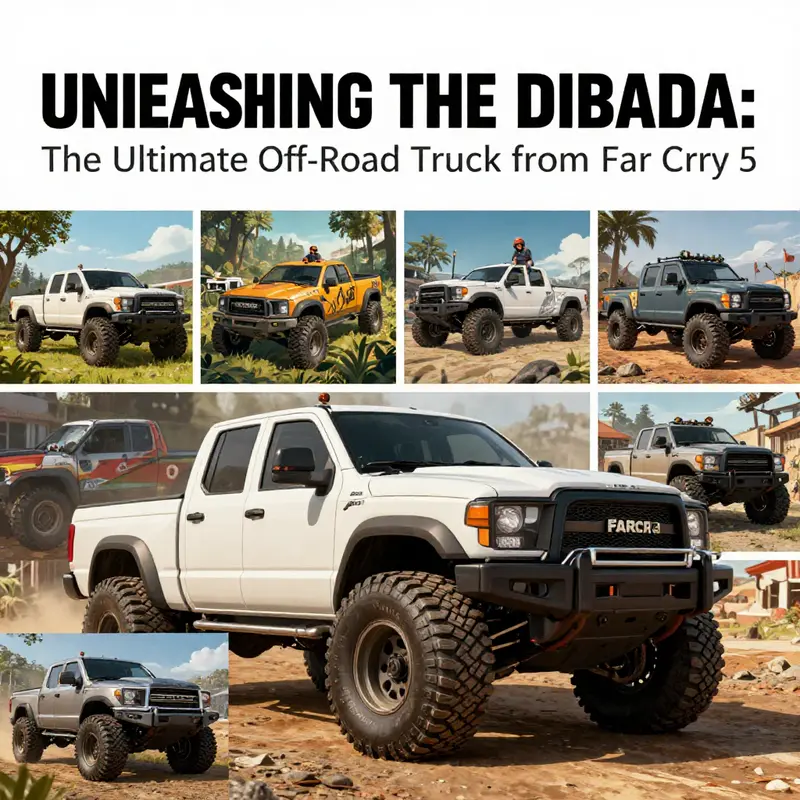
In Hope County, players roam ridgelines and dirt trails, chasing resistance, exploration, and the feeling of shaping a world with their choices. A recurring question in fan discussions asks: who makes the off-road truck in Far Cry 5? The vibe of the query invites a single producer, but the actual conversation among players reveals something broader: a shared process of meaning-making that thrives on rumor, design intuition, and community lore. There is no official vehicle named the Dibada in the base game, and no canonical single manufacturer behind the off-road truck. Dibada persists mainly as a fan-made concept that circulates in memes and modding circles, not in Ubisoft documentation. This distinction matters because it shows how a living community can keep a world vibrant even when official materials stay silent.
What matters in practice is the design language rather than a pedigree. Far Cry 5 leans into rugged utility and plausible real-world archetypes—vehicles that feel credible for survival and action in Hope County—without anchoring to a specific brand. The result is a flexible canon that invites players to project backstory while staying anchored in gameplay: performance, versatility, and the mood of the landscape matter more than a precise manufacturer label. When people imagine a backstory for the truck, they are engaging in a healthy form of world-building that mirrors how fans interact with other open worlds.
The community, meanwhile, keeps the dialogue alive through fan content, mods, and art. A single post or image can crystallize a widely shared idea, and repetition can make something feel ‘canonical’ even if official sources are quiet. The Dibada-tag is a symptom of that dynamic—a symbol of how players interpret form and function, not a sanctioned historical record. For verification of canonical facts, the safest route is to consult official publisher materials and FAQs. For Far Cry 5, the official stance is best understood by reviewing Ubisoft’s communications, including the game FAQ.
In sum, the question of who makes the off-road truck has no single answer in the published canon; the answer belongs to the community’s collaborative sensemaking. The Dibada endures because it captures a tension between official information and fan imagination, demonstrating how authorship in a living game world is collective, ongoing, and dynamic. Trust primary, official sources for canonical details, and celebrate the creativity that emerges when lore and fan imagination mingle.
Final thoughts
The Dibada is not just a vehicle in Far Cry 5; it embodies the spirit of adventure, resilience, and creativity that captivates both gamers and off-road enthusiasts. Its design and capabilities resonate with real-world inspirations, offering players the thrill of exploration amidst danger. As we explored the intricate details of the Dibada—from its inception to its gameplay prowess and community reception—it becomes evident that this truck is a celebration of all things rugged. It invites players to engage with the environment in innovative ways while bridging the gap between gaming and real-life off-road culture. The Dibada has carved out its niche, uniting fans in their appreciation for this formidable machine.