
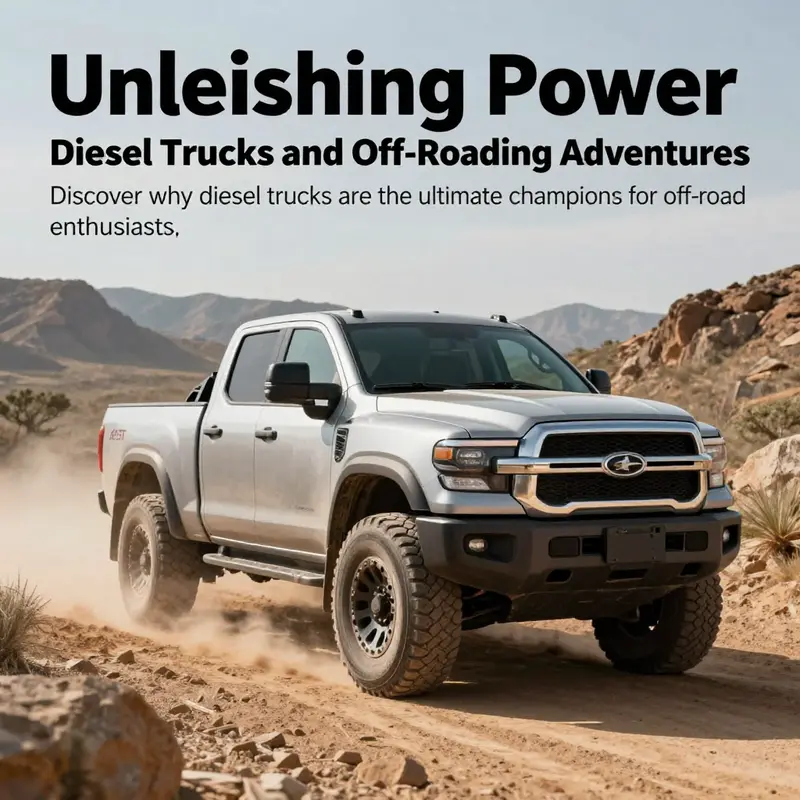
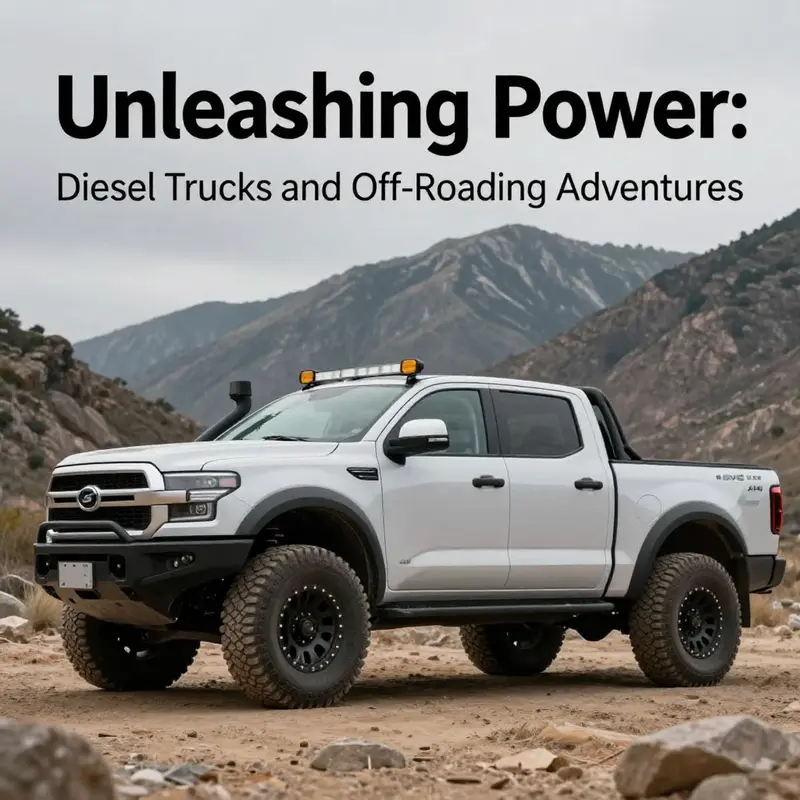
For those who live for adventure, nothing compares to conquering rugged terrains and untamed landscapes. The quest for the ideal off-road vehicle often leads adventurers to a pivotal question: are diesel trucks the right choice for off-roading? Combining exceptional torque, unmatched durability, and specialized features, diesel trucks stand as the titans of the off-road community. This article delves into four key aspects: understanding the inherent advantages of diesel trucks for off-roading, exploring their durability and power, analyzing the importance of traction and torque, and evaluating the features that ensure off-roading success. By the end, you will appreciate why diesel trucks are an undeniable force in the wild.
null
null
Durability, Torque, and Trailcraft: How Diesel Trucks Endure and Conquer Off-Road Challenge
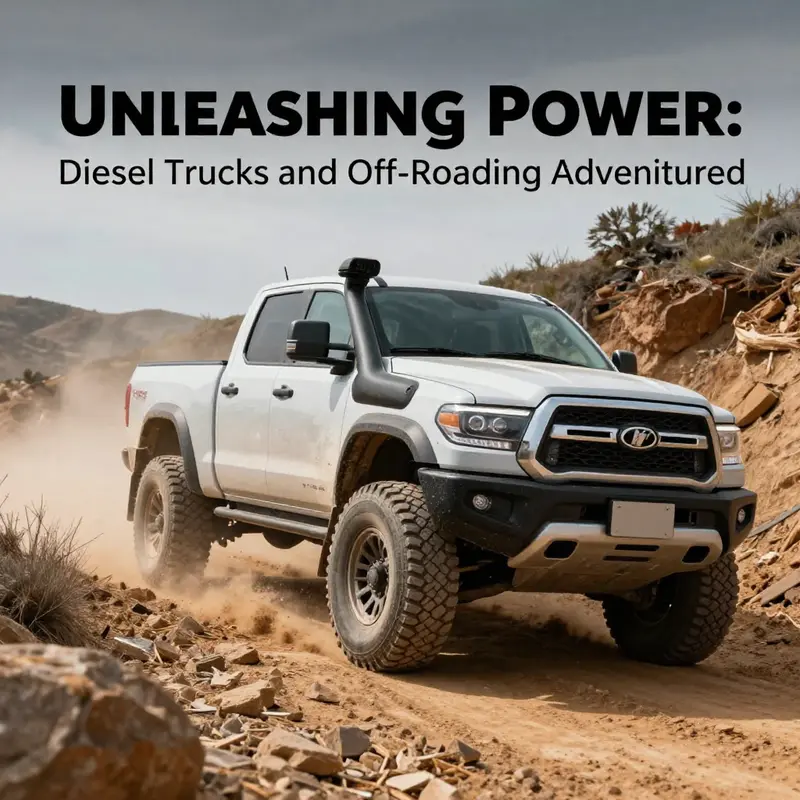
The pull of off-road exploration is a test of resilience as much as a test of bravery. When the trail steepens, when mud thickens, and when rocks rise like teeth from the earth, it is the diesel’s combination of durability and torque that keeps a descent or climb from turning into a struggle or a stall. Diesel engines, by design, deliver substantial low-end torque and a power delivery that arrives with intent and steadiness. This is not just about raw horsepower on a dyno; it is about the way torque is metered to the wheels at crawl speeds, allowing a driver to approach a stubborn obstacle with precision rather than urgency. In off-road practice, the capability to move a vehicle smoothly through rough terrain at low RPM reduces the likelihood of wheel spin, driveshaft strain, and drivetrain fatigue. The result is a vehicle that can maintain momentum through a sequence of obstacles with controlled throttle, a trait that translates into fewer recoveries, less risk, and a greater sense of command behind the wheel.
Durability follows close behind torque in the off-road diesel equation. Diesel engines operate under higher compression and with robust internal components, and this heavy-duty ethos extends well beyond the engine block. A vehicle engineered for off-road use typically couples this muscular powertrain with a chassis designed to resist flex and fatigue under abuse, a suspension system built to endure repeated impacts, and a drivetrain that can survive the harsh realities of uneven surfaces and demanding loads. The typical off-road diesel platform balances a rugged frame with reinforced axles, protective skid plates, and a suspension that can cope with both rock-crawling and long muddy pulls. In the real world, this translates into longer intervals between major repairs when a truck is driven through rough country—intervals that matter when a week’s outdoor itinerary includes backcountry byways where a breakdown would be a project with a high stakes, not just an inconvenience.
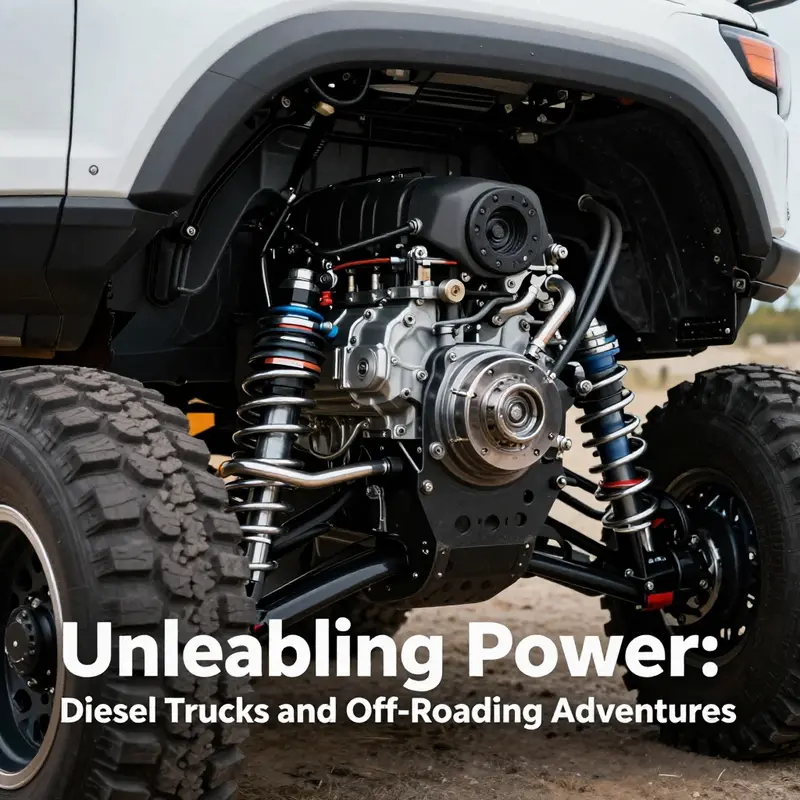
One of the most critical components in this durability equation is the suspension system. Off-road geometry tests every part of a truck: the chassis, the springs, the dampers, and the connection points that must flex and rebound without failing. A reinforced setup—whether it uses heavy-duty leaf springs or modern, long-travel coil configurations—gives the tires a better chance to stay in contact with uneven terrain and maintain traction. Without that traction, even the most capable engine can spin wheels and shed momentum. The goal is consistent, predictable grip, and that is where the suspension earns its keep, especially in conditions that demand slow, deliberate progress rather than fast, high-RPM torque bursts.
Differentials, too, play a pivotal role in turning torque into movement when the surface turns hostile. Locking or electronically controlled locking differentials make it possible to transfer power to the wheel that has traction and to limit power to the wheel that does not. In rock gardens or slick ledges, locking the differentials can prevent a single spinning wheel from stealing momentum and leaving the vehicle stranded. A well-designed off-road diesel system often includes advanced traction aids—low-range gearing for crawling, electronic stability controls tuned for uneven surfaces, and multi-mode transfer cases—that work together to keep power where it is most effective: at the ground where it is needed most.
Beyond the engine and drivetrain, ground clearance and approach angles are not vanity metrics; they are practical necessities for protecting a vehicle in rugged environments. A leading diesel off-road package typically features ten inches or more of ground clearance, along with carefully tuned approach, breakover, and departure angles. These numbers matter because they determine whether a vehicle can crest a ledge, clear a rock outcropping, or roll through a rutted rut without scraping the undercarriage. The geometry matters because it dictates the difference between a clean line through a tricky pass and a miscalculated contact with the terrain that can bend headers, driveline components, or exhaust systems. In the field, it is not unusual for a well-configured diesel pickup or SUV to reach terrain that would challenge a less robust setup, simply because the chassis and bodywork have been optimized for the kind of abuse off-road travelers routinely face.
The load-bearing capability of off-road-ready diesels is another essential facet. When adventurers pack for expeditions—roads less traveled, camp gear, spare parts, recovery gear—the ability to tote payload and tow heavy trailers becomes a practical asset. A diesel’s high torque curve gives it a steadier pull when moving a load up or down a slope or when stabilizing a trailer across uneven ground. The combination of torque and payload capacity means you can bring along more gear, more water, more fuel, and more equipment for rope rigs, winch lines, and recovery kits, all without forcing the engine into a high-rev tug of war. This is not merely about carrying capacity in a showroom spec; it is about enabling longer, more self-reliant trips where the terrain itself dictates tempo rather than the powertrain’s willingness to rev.
From a reliability perspective, the diesel platform’s resilience becomes most evident in the long arc of an adventure weekend to the near ridgeline of a distant wilderness. The wear and tear that accumulates from repeated climbs, mud-driven sludge, and cold-start cycles can be manageable when the vehicle’s heart and bones are built for it. Diesel engines are known for durability and their ability to operate in demanding heat or cold with routine maintenance and careful service intervals. This reliability is especially valuable when a trip includes challenging segments—water crossings, rocky grades, and steep, uneven grades—that can otherwise tax a gasoline-powered setup. The combination of long service intervals and a drivetrain designed to resist impact fatigue can translate into a more confident ownership experience for off-road enthusiasts who keep to remote trails.
One of the enduring virtues of diesel power in off-road contexts is the simplicity of the torque delivery. Low-end torque is not a modern luxury but a pragmatic feature. It allows a driver to modulate throttle with fine control and to maintain momentum as the terrain changes underfoot. A ride that begins to bog down when the slope increases or the mud thickens can often be saved by a measured application of throttle and a careful line choice, rather than a shift into a higher gear or an aggressive rev. In practice, this means a diesel-equipped platform can maintain a crawl pace that preserves traction and reduces the risk of wheel spin, which in turn reduces the likelihood of getting stuck or requiring a recovery operation in a precarious spot. The driver’s ability to anticipate the engine’s response and to blend throttle with braking becomes a crucial skill that is reinforced by the engine’s torque profile.
Versatility remains a defining trait of diesel platforms in the off-road world. For those who want a vehicle that performs well on-road but shines off-road, diesel architectures are often paired with sophisticated 4×4 systems and adaptive traction controls. This pairing creates a balanced experience where daily driving remains comfortable and familiar, yet the vehicle can switch seamlessly into a more capable off-road mode when the trail demands it. The essence of this versatility is the ability to ignore the compromise between highway manners and trail manners by offering both in one package. In practice, the diesel powertrain becomes the anchor that keeps the vehicle predictable while the 4×4 system adjusts to the challenge at hand, maintaining the momentum required to crawl over a ledge as confidently as it cruises a highway stretch.
A final reflection on durability and power emphasizes the human factor in off-roading. The best diesel platforms for extreme terrain are not just about components and numbers; they are about how well the system can be serviced, how approachable the maintenance is, and how straightforward it is to diagnose issues in the backcountry. Enhanced durability should align with serviceability. When a vehicle’s fuel system, cooling circuit, or exhaust aftertreatment demands attention, having a design that favors modularity and ease of access matters as much as raw capability. A wise approach blends rugged engineering with practical ease of maintenance, because the journey itself—where two days become four, and an unknown path becomes a story you tell around a campfire—depends on the confidence that you can keep going rather than wandering in search of a repair shop.
For readers curious about practical, hands-on knowledge that complements the durability discussion, a focused resource on diesel mechanics offers a clear path to proficiency. It presents a step-by-step approach to understanding the inner workings of diesel engines, a helpful companion for anyone who wants to extend the life of a rugged platform and keep it performing at peak when the going gets rough. You can explore that guide through this linked resource: mastering diesel mechanics. The intent is not to replace professional service but to empower enthusiasts with fundamentals that support safer, more effective field maintenance and preventive care.
Placed alongside the broader buying and spec considerations, durability and power shape a diesel’s off-road identity. They determine not only how the vehicle handles a particular obstacle but how it endures the cumulative stress of travel over many miles of rough terrain. In that sense, diesel power is not simply about raw numbers, but about a driver’s ability to translate torque into controlled, sustained performance across a landscape that rewards patience, preparation, and resilience. It is this orientation toward endurance that makes diesel platforms compelling choices for off-road adventures where reliability and the confidence to press forward are as valuable as speed or flash in the moment victory.
The decision, of course, is not universal. There are trade-offs—cost, complexity of emissions systems, and sometimes lamentable fuel economy in certain conditions—but the argument for durability and torque remains persuasive for those whose trips demand a vehicle that can absorb abuse, haul heavy loads, and keep moving when a more fragile setup would falter. When a trail calls for steady cadence, predictable grip, and a ride that asks for consistent torque rather than a sprint, diesel power becomes less a choice among many and more a system that aligns with the rhythm of rugged exploration. In that sense, durability and power are not just the attributes of a drivetrain; they are the philosophy that guides the off-road journey and the pride of those who choose to traverse the world with engines that are built to endure.
Torque, Traction, and Terrain: Why Diesel Tractors Dominate Off-Road Adventures
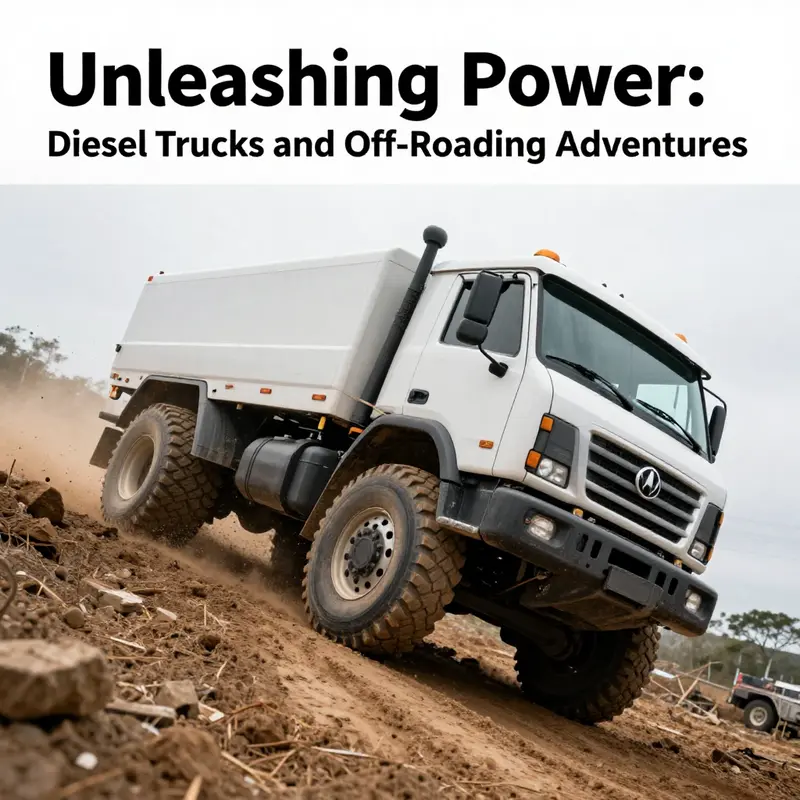
On rugged terrain, the decisive factors are traction and torque—the forces that keep a tractor moving when the going gets tough. In off-road field work, diesel-powered tractors provide a distinctive blend of robust low-end torque and ballast-driven stability that makes them reliable where other machines struggle. This isn’t about sprinting to a finish line; it’s about slow, deliberate progress with power you can modulate at the ground level. The diesel torque curve is rich at low revs, letting the tractor push through soft ground, crawl past stumps, or climb a sloped bank without needing revs that flare and wheel spin. The result is a controlled, predictable movement that feels almost tireless when machines with weaker torque are forced to stall or slip.
Traction begins with the tires. Agro or flotation tires, depending on the work, offer grip and flotation that suit soil conditions. The choice of tire pattern, tread depth, and air pressure affects how the tread bites into soil, clay, or loose dirt. But tire choice alone isn’t enough. The tractor’s differential and driveline strategy—whether it is a limited-slip or locked differential, a four-wheel-drive system with selectable engagement—determines how power is distributed to each wheel. Locking or near-locking differentials keep drive where it’s needed most, reducing the chance that a single spinning wheel robs momentum. In the rough, that kind of control can decide between crossing a furrow or getting stuck in a rut.
Ground clearance, approach, and departure geometry matter too, though in a different sense than starched out SUVs. A tractor’s ground clearance gives room to clear roots and stones, while the operator can adjust ballast and weight distribution to keep tires in contact with the ground where possible. High ballast on the rear hitch improves rear wheel grip and helps the front wheels maintain steering leverage on uneven terrain. The geometry of any implement-hitch setup shifts mass and grip in ways that affect traction under load.
A robust suspension is less about comfort than contact. Many agricultural machines rely on rigid or semi-rigid frames with springs that keep axles under load while absorbing bumps. The net effect is consistent tire contact across uneven soil and minor drops, which translates to smoother application of power and less wheel spin. In slow, controlled work, the combination of heavy torque and reliable grip produces a machine that can keep moving through muddy, rocky, or rutted fields without constant throttle hunting.
Drivetrain design reinforces this behavior. Diesel tractors typically emphasize torque-rich operation with gearing that favors low-speed pull rather than high-speed sprint. Four-wheel-drive systems, selectable or permanently engaged, allow the operator to keep power on the ground where traction exists, while differentials provide the ability to keep moving when one wheel encounters slick clay or a sudden drop. The immobility of a tractor is minimized by the predictable, linear response of a diesel engine tuned to deliver steady torque as load increases.
Beyond the field, this torque-traction synergy underpins the reliability required in heavy-duty tasks: towing heavy implements, pulling a stuck vehicle, or gradually extracting road equipment from soft shoulders. The economics are simple: with a diesel engine that holds a strong, usable torque band at low RPM and a drivetrain engineered for grip, the tractor can operate at low speed with high confidence and fewer gear changes, reducing operator fatigue and risk.
Final note: in off-road work a diesel tractor made for grip and durability can outperform lighter machines in the long run. That is why the design emphasis remains on mechanical reliability, traction control through tire choice and drivelines, and a torque delivery that remains calm under load. For operators, the result is not a flash of speed but a steady hand on the controls and the assurance to press ahead when the terrain tests you.
null
null
Final thoughts
In conclusion, diesel trucks represent the perfect blend of power, durability, and specialized design, making them the logical choice for off-road enthusiasts. Their ability to deliver exceptional torque at low RPMs ensures that even the toughest terrains become conquerable. As we traversed through the benefits—ranging from unparalleled durability to essential off-roading features—it is clear that diesel trucks reign supreme in extreme adventures. For any adventurer looking to take their pursuit of off-roading to the next level, these trucks offer the Brawn and brains needed to tackle any environment.