
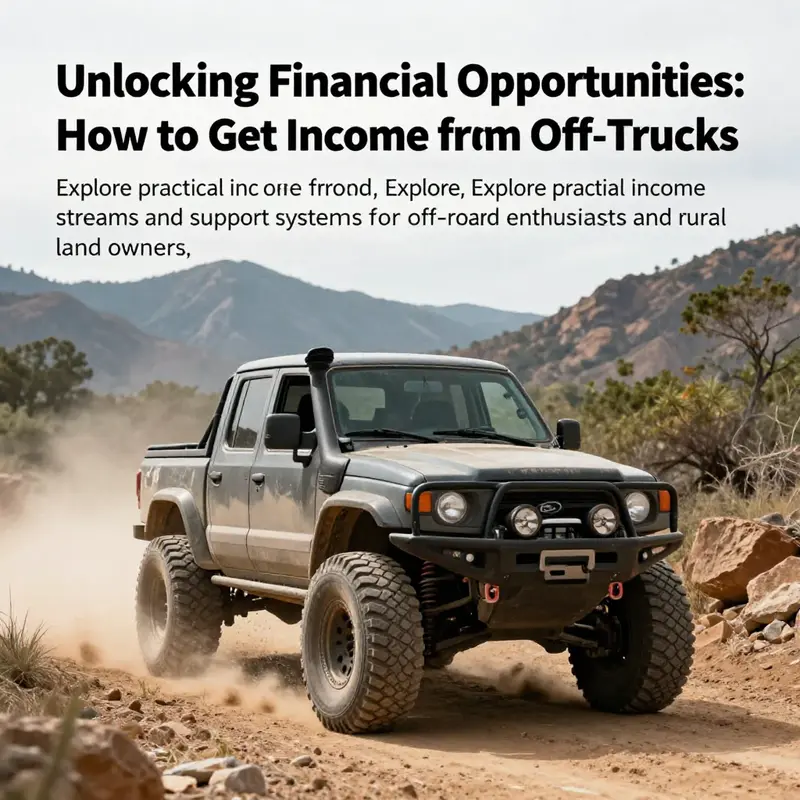
For the rugged adventurers and off-road enthusiasts, the thrill of traversing uncharted territory goes beyond mere passion. It can also open doors to valuable income opportunities. This article delves deep into viable strategies to monetize off-road trucks, from rental services to guided tours, ensuring you make the most of your adventurous spirit. Furthermore, we’ll uncover assistance programs designed to lighten the financial load associated with vehicle ownership. Finally, we’ll share essential tips to avoid the often deceiving allure of ‘free money’ scams related to off-roading. Get ready to uncover a treasure trove of possibilities that marry your off-road lifestyle with financial gain.
Turning Off-Road Power into Real Profit: Vehicle-Related Income Opportunities with Off-Road Trucks

The idea of pulling in free money specifically from off-road trucks doesn’t hold up under scrutiny. There is no legitimate loophole or windfall that treats a rugged vehicle as a money faucet. Yet the reality is more practical and much more actionable: off-road trucks, with their raw capability and adaptability, can become steady sources of income when you build a careful plan around legitimate opportunities. The chapter you’re reading is not about empty promises or flashy shortcuts. It is a map to real economic value that fits into the rhythm of a life, family, and business. When people ask how to get free money on trucks off road, the honest answer is that you don’t get free money. You create value that others are willing to pay for, and your truck becomes a tool in a larger system of services, logistics, and employment. You turn a passion for rugged terrain into a portfolio of income streams, each with its own scope, risk, and reward. The core idea is simple: leverage the truck’s strength, versatility, and reliability to meet needs that people and organizations have in the real world, in a lawful and sustainable way.
Across landscapes and industries, off-road trucks are prized for their durability and their ability to operate where ordinary vehicles cannot. That combination opens a practical cascade of income opportunities that feel natural rather than forced. You can start small with a service-based side hustle that uses your truck’s bed, cargo space, and towing capacity. You can scale into formal contracts with construction or mining sites that demand reliable transport in challenging terrain. You can even develop niche offerings that blend adventure with enterprise, like guided overland experiences or specialized hauling for remote projects. The throughline is clear: profitability emerges from consistent demand, careful pricing, and dependable execution. The money is earned bit by bit—through repeat customers, referrals, and a reputation for safety and efficiency—rather than handed to you by some magical mechanism.
One of the most straightforward pathways to income is to treat the truck as a service platform rather than a one-off asset. A pickup or a heavy-duty off-road rig can become a moving and hauling solution for people who need help with tasks that require more space or power than a typical sedan or SUV offers. Moving small apartments, transporting bulky materials, or delivering equipment to a remote site are all tasks that fit naturally with a capable truck. In many communities, homeowners and small businesses need help with occasional heavy lifting, loading and unloading, or transporting bulk items from supplier to job site. Rather than owning a fleet, you can start by offering a reliable, on-demand moving or hauling service in your local market. The value proposition is built on punctuality, clear communication, proper securing of loads, and a transparent pricing structure. When a client experiences a smooth, efficient operation, they are more likely to become a repeat customer and to recommend your service to others. As your reputation grows, repeat bookings compound and you gain leverage in scheduling and pricing, turning what began as a side gig into a dependable income stream.
That same logic translates into yard care and landscaping tasks where your truck’s capacity becomes a practical asset. Yard debris, mulch, soil, gravel, or landscape timbers require transport heavy enough to justify a dedicated vehicle, yet flexible enough to fit variable work sites. For customers managing large properties or commercial landscaping projects, the ability to haul materials efficiently saves both time and labor costs. You can pair hauling with a modest set of related services such as delivery of mulch, soil, or stone, and even assist with light equipment transport. The key is to understand the needs of your local market, price value rather than time spent, and keep a tight control on load securement, fuel efficiency, and vehicle wear. In practice, this means carrying a basic toolkit for securing loads, protective blankets for fragile items, and a simple inventory of commonly requested materials. With a steady stream of local clients, a truck-based yard-care offering can become a reliable add-on to a broader service business, contributing to a diversified income that aligns with the seasonal ebb and flow of outdoor work.
A more specialized path emerges when you lean into the transport of equipment and materials to remote or challenging sites. Off-road trucks excel precisely where standard vehicles stumble: rough trails, steep grades, uneven terrain, or beaches and river crossings where access is limited. In industries such as mining, construction, forestry, or emergency services in rural areas, there are contracts and recurring work that rely on the unique capabilities of off-road fleets. Enter the world of transport contracts for equipment and supplies to remote locations. This is not about casual gigs; it’s about establishing relationships with firms that operate in unforgiving terrains and require a reliable partner who understands the practical realities of field work. Building these relationships starts with a clear demonstration of capability: secure load practices, compliance with safety standards, a plan for dealing with weather and terrain, and a track record of on-time deliveries. In this space, you are competing less with other individuals than with the efficiency and reliability of your operation. A well-run vehicle and crew translate directly into higher-margin work, predictable schedules, and ultimately more predictable income.
The growing demand for off-road vehicles within industrial settings creates additional, more formal opportunities. Large-scale projects in mining, construction, and forestry often require vehicles capable of moving heavy loads between site stages, transporting surveying gear, or supporting logistical tasks that standard trucks cannot perform. In such contexts, advanced features—four-wheel drive capabilities, locking differentials, and robust suspension systems—are not just enhancements; they’re prerequisites. If your truck is equipped to handle extreme terrains and you have the right insurance and safety protocols in place, there are chances to secure transport contracts that provide steady rounds of work. Keeping up with the evolving requirements of these industries means ongoing investment in maintenance and readiness. It also means cultivating a professional presentation: clear bids, documented certifications, and a reputation for reliability. The payoff is a market where your vehicle is not a novelty but a critical tool, and where contracts can be scaled through longer terms or repeat engagements. To navigate this space well, you need to pair practical know-how with a disciplined approach to cost control, scheduling, and customer communication. In short, the off-road truck becomes a backbone asset within a broader supply chain rather than a one-off asset for personal use.
As the world shifts toward sustainability, new revenue streams emerge for environmentally conscious fleets. Electric and hybrid off-road models are becoming more common, and with them come incentives and cost benefits that can alter the economics of running a small fleet. Governments and utilities frequently offer incentives for fleets that reduce emissions, and some programs subsidize the upfront cost of cleaner vehicles or provide tax advantages for maintenance and fuel savings. In the long run, sustainable vehicles often operate at lower per-mile costs thanks to reduced fuel consumption and fewer maintenance surprises tied to older engines. The challenge is to translate these advantages into a defensible business case: you need to model the total cost of ownership, factor in depreciation, performance in the specific terrain where you operate, and the reliability of charging or fueling infrastructure in remote locations. When you can quantify the savings and align them with a customer base that prioritizes green practices or corporate responsibility, your operation gains credibility and competitive differentiation. You may find that public agencies, environmental programs, or private firms with sustainability goals are especially receptive to partnering with a small off-road fleet that can deliver on both reliability and environmental performance. This is not about gimmicks; it is about aligning technology, policy incentives, and practical operations to carve out a more durable and scalable income path.
Entrepreneurship also has a place here, especially if you want to shape a niche that blends exploration, adventure, and professional service. Guided overlanding tours, for example, can harness your truck’s rugged capabilities to offer curated experiences for enthusiasts seeking remote, scenic, or technically challenging routes. These ventures require more than a powerful vehicle; they demand safety discipline, route planning, customer communication, and a careful balance between risk and reward. You’ll want to establish standard itineraries, safety briefings, and emergency plans, as well as a clear pricing structure that includes permits, insurance considerations, and equipment provisions. The model scales when you build partnerships with lodging providers, local guides, or conservation groups who value responsible tourism. Trail maintenance is another angle: offering maintenance or restoration services for popular off-road trails can create recurring business. Land managers and clubs often need contractors who understand the demands of heavy equipment on fragile ecosystems. A truck with the right gear can haul trail-maintenance materials, deliver equipment to sites, and transport staff across rough paths. These ventures are not quick fixes; they require a business mindset, customer acquisition, and the ability to delivery consistent service on schedule.
Leasing or rental arrangements offer a related but distinct path to income. Some owners find value in renting high-demand capacities to adventurers, researchers, or professionals for short-term projects. Leasing can be particularly attractive when you have a well-maintained truck, a predictable maintenance routine, and a clear understanding of insurance requirements. The leasing model shifts some risk away from your day-to-day operations and can stabilize cash flow, especially if you can secure longer-term leases or seasonal demand. It’s a way to monetize underutilized capacity without needing to operate full-time in a service business. Of course, leasing comes with its own set of obligations: you’ll need robust maintenance records, transparent terms, and a plan for how to handle incidents on site. A well-designed leasing arrangement can provide a predictable revenue stream while preserving the asset for other endeavors during off-peak periods.
Technology and innovation are not distant concepts in this arena; they are practical tools that can expand revenue opportunities. The trend toward smarter logistics—where onboard sensors, route optimization, and data-driven scheduling help you run more efficiently—offers potential new lines of income. If your truck is already equipped with the capacity to support advanced planning and data collection, you can offer services around remote monitoring, equipment transport analytics, or even provide logistics support for small projects that require precise coordination in challenging terrain. The promise is not fantasy. It rests on the convergence of capability, data, and reliability. A truck that can navigate a remote site with a well-planned route and a transparent record of performance becomes a valuable partner to clients who must meet tight timelines in demanding environments.
All these opportunities depend on a foundation of responsible operation. The income story is strongest when you couple business development with disciplined maintenance, safety, and compliance. The truck is not a cashier; it is a tool that must be kept in peak condition. The more you invest in preventive maintenance, load-securement training, and safe driving practices, the more you protect your margins. The most successful operators treat maintenance not as a cost, but as a strategic investment that preserves uptime and reduces the risk of expensive downtime. The path toward profitability is therefore twofold: actively seek demand through diversified service offerings, and actively manage the asset to ensure reliability and safety on every job. When you combine these elements, the off-road truck becomes a platform for income that scales with your effort and your market’s needs. The money you earn grows not from a single stroke of luck but from the steady, repeatable work that clients value and will pay for year after year.
To support practical actions, it helps to see maintenance and efficiency as part of the business plan. A solid maintenance routine—regular inspections, timely part replacement, and a simple but effective readiness checklist—enables you to bid confidently on projects with clear delivery timelines. It also reduces the risk of costly downtime that erodes margins. A well-maintained truck performs more predictably, which is essential when you’re juggling multiple clients or contracts that depend on reliable on-time delivery. The more you live in that operational discipline, the more capable you become at turning opportunities into revenue rather than chasing after them with uncertain results. And as you grow, don’t forget to build professional systems around your work. Simple invoicing, clear terms, and transparent communication turn a one-off job into a relationship. In this way, your off-road truck can evolve from a dependable workhorse into the central hub of a broader, sustainable income strategy.
For readers who want to deepen practical skills that support revenue growth, one resource worth exploring centers on the mechanical foundation of the vehicle. A strong grasp of diesel or gas engine systems, transmission, cooling, and problem-solving keeps your operations lean and minimizes non-billable downtime. A practical path is to study core maintenance concepts and hands-on procedures, focusing on the engine, drivetrain, and safety-oriented systems. This kind of knowledge is not glamorous, but it pays off in resilience and control over your price-to-value proposition. For those who prefer a guided route, there are accessible steps you can follow to build competence, troubleshoot common issues, and maintain peak performance in remote settings. In the long run, the ability to diagnose and handle routine maintenance yourself translates into lower operating costs, faster job completion, and greater confidence from clients who rely on you to keep their projects moving forward under challenging conditions. The combination of diversified services, disciplined maintenance, and strategic investment in skills creates a powerful, resilient model for turning off-road power into consistent profit. The truck is not a magical fund; it is a practical instrument in a carefully managed business ecosystem.
As you consider these pathways, a straightforward reminder anchors your decision-making: there is no legitimate, guaranteed “free money” tied to off-road trucks. The value comes from purposefully chosen activities, professional conduct, and ongoing investment in equipment and skills. If you pursue service-based opportunities, seek industrial contracts, explore guided experiences, or contract for remote haulage, you will find real income that can be scaled over time. The key is to align your capabilities with market demand, price for value, and maintain a disciplined approach to risk and investment. Throughout, the truck remains your primary asset, a vehicle that empowers you to respond to real needs in ways that are practical, lawful, and financially sustainable. And if you ever feel tempted by a flashy promise of “free money” tied to off-road trucks, come back to the core principle: value is created through reliable service, responsible operations, and a clear, honest understanding of what customers need and are willing to pay for. In that frame, off-road power translates into meaningful, measurable profit.
For readers who want to connect practical mechanics with revenue opportunities, consider viewing the related maintenance and performance-focused resources that emphasize reliable operation in tough environments. A well-serviced engine, robust drivetrain, and secure load management are not just technical details; they are the backbone of your professional credibility and your financial resilience. In this light, even a modest side hustle or a handful of contracts can become a robust enterprise when supported by sound engineering, careful planning, and a customer-first mindset. The path from aspiration to income is rarely glamorous, but it is reliably repeatable when you treat the truck as part of a disciplined business engine. Through steady effort, careful budgeting, and a willingness to adapt to changing market needs, your off-road truck can become a durable source of income that grows over time rather than a source of sudden luck. This is how real money is earned in the off-road world: through consistency, reliability, and value delivered in every mile.
In closing, while there is no legitimate way to extract free money from off-road trucks, there is a clear, practical framework for turning your vehicle into a reliable income source. Start with service-based offerings that leverage your truck’s capacity. Expand into industrial contracts that demand capability in difficult terrain. Consider entrepreneurial ventures that blend adventure with professional service. Embrace electric or hybrid models where incentives and long-term efficiencies can bolster profitability. Build a disciplined maintenance routine and continuously sharpen your mechanical and operational skills. And always prioritize safety, compliance, and ethical practice. When you follow this path, your off-road truck stops being a mere asset and becomes a dependable engine of revenue that aligns with your goals and your community’s needs.
Internal link: For practical maintenance skills that support revenue growth, explore the detailed guide on diesel mechanics here: Mastering Diesel Mechanics.
External reference: For a broader academic and technical context on off-road vehicles and their design considerations, see the overview at https://www.sciencedirect.com/topics/engineering/off-road-vehicle.
Funding Trails: Government and Nonprofit Pathways for Off-Road Trucks and the Green Transition
Across the rugged geographies where off-road trucks haul land, ore, or construction payloads, finance and policy are quietly reshaping the way these machines move the world. The common image of a free windfall or a miracle grant loosening money from the sky is rarely accurate in practice, especially for owners and operators of heavy equipment that runs in harsh environments and under demanding schedules. Yet a coherent web of government programs, public financing, and nonprofit support does exist—designed not as a handout but as a targeted, strategic investment. This chapter unpacks how those programs work, who can access them, and how to align business strategy with the broader push toward cleaner, more efficient off-road operations. In doing so, it becomes clear that there is no simple shortcut to “free money,” but there are genuine avenues to reduce upfront costs, soften risk, and accelerate the transition to zero-emission and low-emission equipment that can deliver long-term savings and environmental benefits.
The most compelling stories in this space come from places where policy makers recognize the dual value of reducing emissions and sustaining local economies. In California, the Clean Off-Road Equipment Project is not just a line item in a budget; it is a deliberate approach to help small businesses and public agencies purchase zero-emission non-road mobile machinery (NRMM) such as electric forklifts and cargo loaders. The project allocates substantial funds to bridge the gap between existing fleets and cleaner alternatives, acknowledging that the capital barrier is often the primary hurdle for adoption. The same logic informs broader public policy: to decouple heavy industry from pollution footprints without constraining growth. Alongside these grants, California has launched a Zero-Emission Truck Loan Pilot aimed at financing the acquisition of zero-emission medium- and heavy-duty trucks. The combination of grants and loan guarantees creates a one-two approach that lowers both the upfront and the ongoing operating costs of cleaner fleets, while spreading the financial risk across agencies, lenders, and the communities that rely on these services. The emphasis on equity—ensuring that small enterprises and underserved communities can participate in the clean technology transition—reflects a broader social contract: green growth must be inclusive if it is to endure.
The United Kingdom has pursued a parallel path with a more aggressive subsidy framework. A dedicated pool of £318 million is directed to the shift toward zero-emission commercial vehicles, including heavy-duty trucks and off-road equipment. The policy design is straightforward and ambitious: provide subsidies that can cover a meaningful portion of the purchase price, with the potential to unlock market uptake that would be improbable if fleets had to shoulder the full cost alone. The result, at least in the initial years of implementation, is a measurable shift in market dynamics. Fleet operators begin to include zero-emission options in their procurement plans, and manufacturers respond by expanding capability and refining technology to meet real-world demand. The magnitude of the UK subsidy, coupled with clear procurement criteria and a track record of demonstrated carbon reductions, helps translate policy into practical decisions on the ground. Market analysts report that by the first three quarters of 2025, electric heavy trucks had achieved a notable, although still modest, share of the overall segment—an early indicator that policy can catalyze change when aligned with industry needs and credible deployment expectations.
What shines through in both cases is not just the size of the checks but the design of the programs. The most successful funds pair capital assistance with technical and logistical support. This is critical for off-road operations, where a fleet’s success depends not only on the purchase price but on maintenance capabilities, charging or fueling strategies, and the compatibility of new equipment with existing operations. In practice, applicants frequently find that blending grants with low-interest loans, or pairing subsidies with technical service packages, yields a far greater return than relying on a single instrument. Early-stage pilots, too, matter. They provide the data necessary to refine subsidy formulas, gauge impact on emissions, and demonstrate to policymakers that the investments produce tangible benefits—fewer emissions, improved energy efficiency, and more resilient local economies.
The global momentum around decarbonizing non-road machinery further reinforces the idea that transformation is both necessary and feasible. Countries like Germany, France, and Canada have introduced pilot programs and emission targets for non-road machinery, drawing on road-vehicle regulations as a blueprint for governance, accountability, and standardization. The appeal of this approach is clear: if rules can create predictable markets for electric or low-emission trucks on public roads, why not extend similar expectations to the off-road sectors that power mining, construction, and heavy logistics? The policy architecture in these places tends to emphasize three pillars: a reliable funding stream, an accessible application process, and a transparent measurement framework that tracks progress toward clean-equipment adoption and job-creation goals. When combined, these elements help reduce uncertainty for contractors and small businesses that must plan multi-year fleet refreshes in an environment where price, volatility, and regulatory expectations matter just as much as motor performance.
It is important to anchor this discussion in the practical realities of how to pursue assistance. First, eligibility is rarely limited to large fleets or well-capitalized firms. Most programs explicitly include small businesses and public agencies, with particular attention paid to underserved communities or regions where access to financing and technical resources is uneven. This emphasis on equity does more than level the playing field; it expands the potential market for cleaner equipment by making it financially feasible for operators who might otherwise delay upgrades. The process typically unfolds in stages: an initial feasibility assessment, a formal application, sometimes a letter of intent, and finally the disbursement of funds or the procurement of subsidized loans. Each step requires documentation—business licenses, fleet rosters, operating profiles, and, increasingly, environmental impact projections. The more rigorous the data pack, the smoother the review, and the quicker operators can move from planning to procurement and deployment.
Yet the path to funding is not a straight line. Applicants must balance financial feasibility with program rules and timing. Many programs operate on annual or multi-year cycles, with discrete windows for proposals and separate timelines for grant disbursements and loan approvals. This cadence means planning is essential: fleet managers should align procurement schedules with funding cycles, ensuring that the timing of an upgrade can coincide with an open grant window or a loan program’s drawdown period. In addition, the due diligence expected by funders—risk assessments, maintenance plans, and projected return on investment—can be as rigorous as private financing. In practice, the best applicants present a coherent narrative that connects fleet renewal with operational efficiency, emissions outcomes, and community benefits. The strongest proposals articulate not just how much money is needed, but how it will be used, what milestones will be achieved, and how success will be measured.
For operators who work in remote or hazardous environments, the implications of these funding streams extend beyond the balance sheet. Access to capital for cleaner equipment can unlock resilience in hedging against fuel price volatility, supply chain disruption, and downtime caused by maintenance failures associated with older machinery. The policy lens sees this resilience as a public good: fewer emissions, lower fuel waste, and safer work environments that translate into steadier local economies and healthier communities. In that sense, government and nonprofit programs are not merely subsidies; they are strategic investments in the capacity of frontline operators to maintain productivity while reducing environmental impact. This is especially meaningful for small contractors and community-based fleets that might previously have faced higher barriers to entry—factors that can determine whether a project remains economically viable and whether a region can attract or sustain new kinds of green jobs.
Nonprofit organizations play a complementary role in this ecosystem. They frequently provide targeted assistance that addresses gaps left by government programs. In some cases, nonprofits help with vehicle repair grants for individuals who rely on transportation for employment, offering a bridge to continued work when a fleet upgrade is not yet possible. They also support workforce development and training programs that prepare technicians and operators for the maintenance and operation of zero-emission equipment. Emergency roadside assistance and other safety-net services, while not grants per se, can reduce the risk and anxiety associated with upgrading to new technologies. For families and small businesses alike, this network of support can be the difference between a stalled upgrade and a successful transition. Even modest support in the form of access to repair services or subsidized transit benefits can meaningfully reduce the total cost of ownership and improve job reliability for workers who would otherwise be tethered to older, higher-emission machines.
When we think about the practical steps a fleet owner should take, the path often begins with discovery and planning. Start by surveying the local and national landscape of programs that target off-road equipment and heavy-duty machinery. This involves mapping grant opportunities, loan programs, and pilot projects that align with your fleet’s size and its operating profile. It also means identifying nonprofit resources that can help with specialized aspects of the transition, such as maintenance planning, workforce training, and community engagement around green initiatives. A deliberate approach to discovery helps avoid the trap of applying to multiple programs without a coherent strategy, which can lead to fragmented funding and stalled projects.
Once a potential funding stream is identified, the next step is to assemble the right team. This typically includes finance or procurement leadership, operations managers, and a sustainability or compliance officer who can articulate emissions goals and show how the upgrade supports regulatory or corporate social responsibility targets. The team should work closely with the fleet vendor ecosystem to ensure that the equipment under consideration can meet the operational demands of the job site, from thermal management and durability in extreme conditions to maintenance access and spare-parts logistics. It is here that the policy framework begins to intersect with practical engineering realities: the incentives may favor certain technologies or configurations, but the success of a project will ultimately depend on a fleet’s ability to operate in a cost-effective manner in the field.
An essential element that often determines program success is evidence. Funders want to see that the investment will yield verifiable results. Operators should consider building a simple but robust framework for tracking energy use, maintenance costs, and uptime improvements. In addition to emissions reductions, this data can demonstrate improvements in reliability and total cost of ownership. The most compelling proposals tie financial metrics to environmental outcomes, showing how subsidy funds or loan support move the needle on both sides of the equation. In practice, this means forecasting scenarios for different configurations, including the potential for modular upgrades, retrofitting components where feasible, and staged deployments that allow operations to continue with minimal disruption.
As a practical aside, the availability of internal resources on fire-assessment and infrastructure planning, especially in more complex deployments, can be crucial. For fleet operators considering electrification or hybrid configurations for off-road use, the need for robust charging or fueling infrastructure is non-negotiable. The internal logistics of installing charging stations, or ensuring a reliable supply of alternative fuels in rugged sites, may seem like ancillary concerns but are central to the viability of any funding-supported transition. For those exploring the electrical dimension of the shift, a useful companion reference is the discussion around electric infrastructure for off-road fleets, including charging strategies and integration with existing site utilities. See the resource on Electric Fire Truck Charging Infrastructure for a practical example of how infrastructure planning informs fleet decisions. electric-fire-truck-charging-infrastructure
In the broader sense, the lessons from California and the United Kingdom illuminate a common thread: successful subsidy programs are not only about writing checks. They are about creating a pathway that reduces friction, aligns incentives, and provides a reliable signal that the market will continue to move toward cleaner technologies. This yields mental models that operators can apply regardless of geographic location. If a program emphasizes equity, ensure the application process is accessible and transparent. If a loan pilot exists, prepare a credible repayment plan and a robust maintenance schedule. If a grant is available, translate the environmental impact into measurable metrics that demonstrate local and regional benefits. The end-to-end experience—identifying funding, completing applications, deploying the equipment, and reporting outcomes—becomes a cycle of continuous improvement, with each iteration making the next one easier and more impactful.
Nonprofit support adds texture to this picture by filling in the gaps that government programs cannot practically address at scale. For example, organizations may provide targeted vehicle repair assistance for low-income individuals who rely on transportation to maintain employment, thereby enabling them to participate in economic activity while their families benefit from cleaner mobility. They may also fund workshops that train operators and technicians in the specific maintenance requirements of zero-emission equipment, ensuring that upgrades do not become bottlenecks due to a shortage of skilled labor. Public transportation subsidies and mobility benefits can complement a fleet transition by offering alternatives to personal vehicle use, reducing overall demand on the grid and easing the burden on communities that must balance mobility with affordability. While these nonprofit and public supports operate on different scales and with different purposes, together they create a more robust ecosystem that sustains the transition over time.
It is also worth noting the global knowledge exchange that underpins these programs. Pilot initiatives funded by governments often incorporate best practices from other regions, including performance benchmarks, reporting templates, and lessons learned about the operational realities of zero-emission off-road machinery. This cross-pollination accelerates learning and helps prevent avoidable missteps when a region embarks on its own electrification or gas-to-electric upgrade. It also creates a more predictable, scalable market. When fleet operators can anticipate stability in subsidies and loan terms, they are more inclined to commit to multi-year fleet modernization plans that deliver meaningful environmental and economic returns. In this sense, government and nonprofit efforts function as a form of public infrastructure—an investment that supports productive activity, reduces risk, and builds a foundation for sustained improvement.
For those who are evaluating whether to pursue these programs, the decision criteria often come down to timing, alignment, and feasibility. Timing concerns whether the funding window fits the operator’s procurement schedule and realistic deployment date. Alignment means the project must harmonize with the operator’s environmental goals, maintenance capabilities, and workforce development plans. Feasibility includes the practical aspects of site readiness, grid capacity for charging needs, and the availability of service networks for maintenance and repairs. The more clearly a proposal articulates these elements, the more compelling it becomes to reviewers who must weigh competing requests against limited funds. In practice, this translates to a disciplined approach to forecasting, a transparent line of sight from investment to outcomes, and a credible plan for sustaining results after the initial funding period ends.
The broader takeaway is that while there is no effortless “free money” for off-road trucks, the landscape of government and nonprofit assistance offers a viable and increasingly effective route to reduce the total cost of ownership and accelerate environmental gains. The combination of grants, subsidized loans, pilot programs, and nonprofit services creates a multi-layered support system. Operators who approach this system with a clear strategy, a data-driven plan, and a willingness to engage with a network of public and charitable actors can unlock benefits that extend beyond a single upgrade. They can realize faster project timelines, improved reliability, and a cleaner footprint for their operations—benefits that resonate with employees, local communities, and the broader public interest. In the end, the chapter of funding trails is less about chasing a windfall and more about building a legitimate pathway toward durable change.
For readers seeking a concrete starting point, begin by surveying the funding landscape in your region and identifying at least one government program and one nonprofit resource that align with your fleet’s needs. Gather your fleet roster, maintenance histories, and a clear plan for how a transition will be implemented. Document anticipated environmental benefits and operational improvements. When you prepare your application or your inquiry, present a coherent narrative that connects the dots—from problem to solution, from cost to benefit, from policy to practice. The journey may require persistence and collaboration, but the payoff can be substantial: reduced emissions, lower operating costs, and a fleet that is better prepared to meet the demands of a changing energy and policy landscape. And as you chart this course, keep in mind the real-world logistics of infrastructure readiness, maintenance capability, and workforce training. A well-conceived plan that accounts for these elements stands the best chance of turning policy and philanthropy into practical, lasting gains for your off-road operation.
External resources can provide a critical accelerant in this process. For policymakers and practitioners alike, the California Clean Off-Road Equipment Project page offers a detailed glimpse into how a state can structure incentives to drive adoption while maintaining focus on equity and economic opportunity. This example, while specific to one jurisdiction, encapsulates many of the design principles that successful programs share: clear eligibility, accessible application pathways, transparent measurement, and a balanced mix of grants and loans. To learn more about these ongoing efforts and to explore related funding opportunities, you can consult the broader coverage of green business and policy initiatives at the following external resource: https://www.californiagreenbusiness.org/clean-off-road-equipment-project
If you want a practical, on-ramp example of infrastructure considerations that often accompany these programs, see the internal resource on Electric Fire Truck Charging Infrastructure for a sense of how charging and grid considerations can influence fleet decisions. This is a useful companion to the policy discussions, illustrating how the operational side of electrification—sites, charging capacity, and uptime—must be integrated with funding strategies to ensure that the financial support translates into real-world improvements. electric-fire-truck-charging-infrastructure.
Steering Clear of Scams: A Realistic Guide to Legally Supporting Off‑Road Truck Ventures Without Free Money
When you start talking about off‑road trucks and money, a peculiar magnetism pulls at the imagination. The idea of a windfall that appears without work, without risk, without the hard miles of business building, can be seductive. In the world of vehicles—especially something as tactile and adventurous as an off‑road rig—the lure of instant cash can whisper from every corner of the internet. But the reality is clearer and more reliable: there is no legitimate, sustainable source of “free money” tied to off‑road trucks. The promises you’ll encounter range from eye‑catching to outright dangerous, and they can derail plans, drain resources, or put you at legal or safety risk. What follows is not a cheat sheet for quick riches. It is a coherent, practical guide to navigating the terrain with your wits intact, so you can either monetize your vehicle responsibly or secure the transportation you need without stepping into scams that masquerade as opportunity.
The first principle to embed is cautious skepticism. A quest for free money often starts with a blank slate that scammers rush to fill. They flood forums, social feeds, and crypto‑adjacent communities with flashy banners, claims of instant rewards, and the gloss of legitimacy. The cognitive trap is simple: if something sounds too good to be true, it probably is. The second principle is practicality. If your goal is to extract real value from an off‑road truck, there are well‑defined, lawful avenues that respect both the vehicle and the people who might use it. Those avenues do not involve magic keys, secret codes, or sudden windfalls. They involve work, planning, and legitimate channels that preserve trust, safety, and long‑term stability. This chapter stitches together those avenues into a single, flowing narrative, so you can see how each piece fits with the others and with the broader topic of sustaining off‑road truck efforts.
A core, legitimate path to generating income from an off‑road truck is to monetize the vehicle itself when it is not in active use. The concept rests on the simple logic of supply and demand: if a vehicle sits idle, it loses value and utility. If it is available, well‑screened buyers or renters gain value from it, and the owner gains income, but only if risk, insurance, and maintenance are properly managed. In practice, this means establishing a clear, documented rental or lending process that protects the truck and its owner. Without naming brands, the framework is familiar to anyone who has considered asset sharing: time windows when the truck is available, a transparent rental rate that covers depreciation and usage, and a contract that specifies responsibilities for damage, refueling, insurance, and dispute resolution. The goal is a predictable stream, not a lottery ticket. A cautious approach starts with a clean vehicle history, current maintenance logs, and an appraisal of insurance coverage that can handle rental activity. It also means calculating the true cost of ownership during idle periods—the tires that slowly weather, the battery that may discharge, the routine service that must not be skipped—and then pricing accordingly so the venture remains profitable rather than speculative.
Beyond rentals, there is room to offer experiences that align with the skill and terrain that off‑road trucks embody. If you are confident in off‑road driving, you can craft guided tours or adventure experiences in areas where local regulations permit. Such offerings should be anchored in safety, environmental responsibility, and customer education. They require careful planning: permits or land use considerations, liability waivers, safety briefings, chosen routes that minimize risk to the landscape and participants, and a plan for emergency contingencies. The value proposition here is experiential rather than transactional: a guided route through rugged scenery, a learning session about recovery techniques, tire pressure management, and the etiquette of responsible off‑roading. The emphasis is on enriching experiences that respect the environment and the community while providing fair compensation for the time and expertise you bring. Again, success hinges on professionalism, not luck; every tour or experience should be backed by a written outline, safety protocols, and a clear booking and refund policy that protects all stakeholders.
A further channel is the broader labor market that can accommodate vehicle capabilities. In some contexts, an off‑road truck is more than a showpiece; it can be a practical asset for specialized transport, events, or logistics tasks that require rugged capability. This is not a shortcut to wealth; it is a path that demands compliance with local regulations, proper licensing, and insurance that reflects the actual use of the vehicle. It may also involve partnering with established teams or operators who can provide scalable work while you maintain control of how and when your truck is used. The overarching principle remains consistency: align any paid driving or hauling tasks with safety standards, legal requirements, and transparent agreements. When you structure this clearly, your off‑road truck becomes a versatile tool rather than a speculative lure.
As you consider these income opportunities, it is essential to acknowledge the legitimate programs that can help reduce costs or support transportation access. Government and nonprofit resources do not grant free money in a magical sense; they recognize the role that reliable transport plays in employment, schooling, and medical care. Roadside assistance from an insurer or a recognized auto club is one example of a real cost‑saving service that can soften the blow of vehicle trouble. It is not free money, but it is a practical benefit that protects your asset and your finances when you need it most. In addition, some organizations offer grants or repair assistance targeted at people facing barriers to transportation. These grants are not a windfall; they are means‑tested, conditionally awarded, and often carefully restricted to specific needs or regions. They can help with essential repairs, essential travel costs, or programmatic support designed to keep people in the workforce or in school. If you qualify, these resources can make a meaningful difference, but they come with eligibility criteria and application processes that require honesty, documentation, and timely follow‑through. Public transit subsidies, when available, should be viewed as a strategic option to reduce single‑occupancy car use and the related expenses. The key here is to approach each program with a diligent, methodical plan: gather documents, confirm timelines, and maintain a clear record of communications. The aim is not to replace income with a windfall but to reduce friction and keep mobility affordable while you pursue legitimate revenue streams from your truck.
This is also where the danger of scams becomes most acute. The same impulse that promises a fast reward can manifest as a barrage of traps designed to harvest personal information or money. You may encounter offers that claim you can receive hundreds or thousands of dollars by merely clicking a link, sharing a private code, or completing an ultra‑short survey. Some of these scams masquerade as giveaways or lottery winnings tied to your vehicle, while others pose as charity drives or government programs that require you to hand over banking details. Impersonation is another common tactic: a fraudster may pretend to be a government official, a vehicle manufacturer, or a recognizable public figure to manufacture urgency and fear. The tactics can also involve social engineering that preys on eagerness or anxiety—urgency to act now, a fear of missing out, or a pressure to use a payment method that bypasses normal safeguards. In short, the landscape is cluttered with noise, and the most persuasive messages often rely on credible‑sounding language, a professional appearance, or a veneer of legitimacy to lower your guard.
To protect yourself, cultivate a set of guardrails that you apply consistently. First, never click on suspicious links or scan unknown QR codes, especially from unfamiliar accounts or strangers on social media. Links can direct you to fake websites designed to harvest login credentials or payment details. Second, do not use payment methods or devices that belong to someone else, especially if you do not have explicit permission from the owner to authorize a transaction. This is especially important if someone claims the process is for “verification” or “account unlocking.” Third, be wary of offers that insist on rapid action or require a payment upfront. Scammers love to create a sense of urgency. Fourth, always verify through trusted channels. If a claim comes from a third party, cross‑check with recognized organizations, official government portals, or local community services using contact methods you can independently locate. Fifth, safeguard your personal information. Do not reveal sensitive data such as social security numbers, bank details, or access credentials to unknown parties. Even seemingly innocuous data can be misused when combined with other information. Finally, involve a trusted adult or a professional advisor when you are unsure. A second pair of eyes can often spot inconsistencies that your enthusiasm might miss.
A practical, experience‑based way to anchor these guardrails in everyday decisions is to adopt a simple decision framework. Before engaging with any offer, ask yourself three questions: Is this from a clearly recognized, legitimate source? Does the offer require upfront payment or sharing of sensitive data? Can I verify the claim through a trusted, independent channel? If the answer to any of these questions is no, you pause and reassess. If the answer is yes, you still proceed with caution—keep records, seek corroboration, and avoid committing until you have read and understood all terms and conditions. This checklist does not guarantee perfection, but it creates a disciplined approach that reduces risk and preserves the integrity of your off‑road truck project.
It is also worth considering the broader ecosystem around off‑road trucks. Communities of enthusiasts, mechanics, tour operators, and small businesses can offer mentorship, legitimate collaboration opportunities, and shared resources that increase resilience. Networking in a careful, reputable way helps you calibrate expectations and avoid the quick‑money traps that sprout in online spaces. The idea is not to fear the internet, but to use it as a resource while anchoring decisions in verifiable information, solid contracts, and transparent financial practices. As you pursue legitimate revenue streams, you also build a support network that can respond to challenges—whether a sudden repair need, a regulatory question, or a shift in local demand for off‑road experiences.
An important nuance is the role of ethics and sustainability. The appeal of quick money can easily overshadow commitments to the landscape you drive through and the people who share the space with you. Responsible operators plan routes that minimize environmental impact, follow land access rules, and demonstrate respect for local communities. They insure vehicles adequately, maintain paperwork, and honor commitments to customers and partners. In practice, this means investing in good tires, periodic maintenance, and safety gear; it means training yourself and any guides or assistants in recovery practices and hazard recognition; it means building a repertoire of vetted, safety‑minded partners who can help you scale gradually and responsibly. When you prioritize reliability, safety, and accountability, your off‑road truck becomes less a lure for scams and more a legitimate vehicle for earning income, supporting your adventures, and contributing to the communities you visit.
In closing the practical loop, remember that the real opportunities around off‑road trucks come from disciplined, legitimate channels. Renting or sharing your vehicle when it is idle, offering professional guided experiences, and engaging in authorized, safety‑mounded work can yield meaningful income or cost relief. Government and nonprofit programs exist to support transportation in a targeted, accountable way; they are not free money, but they can reduce the financial friction that often shadows adventurous projects. The danger of scams lurks wherever there is a promise of effortless gain, especially in spaces where people are excited by vehicles and the thrill of exploration. Recognize scams for what they are, trust verified channels, and build a structure around your vehicle that emphasizes safety, legality, and long‑term value. If you want a concrete example of a community‑driven approach to trucks that emphasizes legitimate work and social impact, you can explore the concept of Trucks for Change—an initiative focused on community‑supported vehicle projects and charitable use of trucks. trucks-for-change-supporting-habitat-for-humanity.
For readers seeking additional guardrails on online safety and fraud prevention, a broader external resource offers practical guidance on recognizing and protecting against scams that target younger audiences and vulnerable users. This resource emphasizes careful skepticism, the importance of parental guidance in online interactions, and steps to report suspicious activity. While not truck‑specific, the principles translate well to any sphere where the lure of “free money” appears alongside perceived opportunity. External resource: https://www.southplus.cn/article/123456
Final thoughts
Navigating the world of off-road trucks isn’t just about the thrill of adventure; it can also be a pathway to financial gain. By leveraging your truck for income through rentals and services, you can harness its potential beyond leisure. Moreover, understanding the available government and nonprofit assistance can provide crucial support for maintaining your vehicle’s performance. But remain vigilant against scams that prey on the hopeful. Embrace these opportunities with confidence, and let your off-roading journey be both exhilarating and rewarding.