
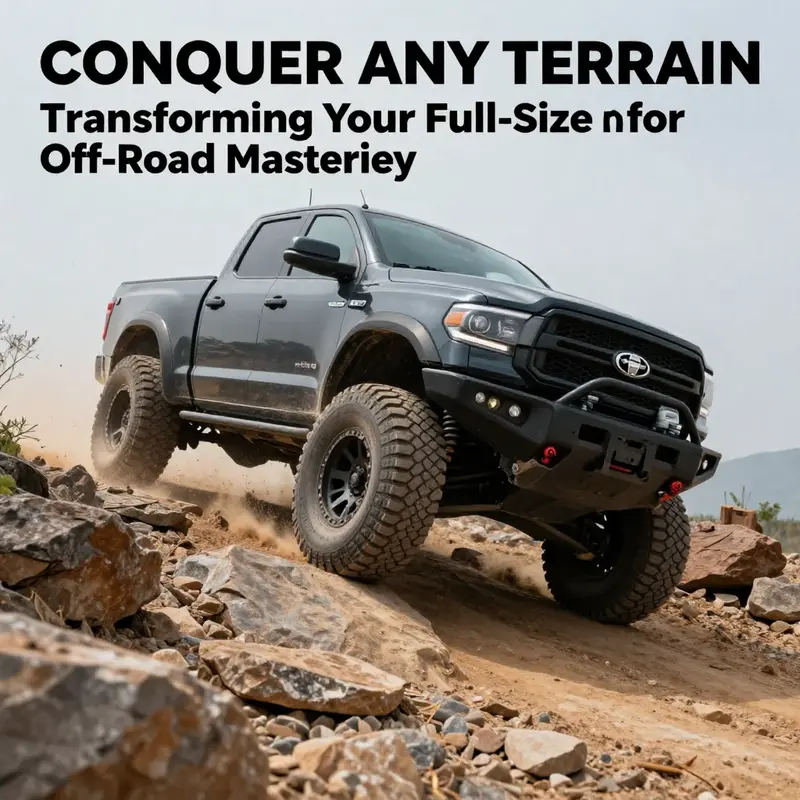
The call of the wild beckons, and there’s no mightier ally on uncharted trails than a full-size truck. However, unleashing its true off-road capabilities requires a strategic approach. Off-road enthusiasts and adventurers understand that enhancing their vehicle isn’t just about looks; it’s about performance, safety, and confidence on rugged terrains. This comprehensive guide will delve deep into elevating your truck’s off-road game. In Chapter 1, we’ll explore how to upgrade the suspension for smooth navigation over bumpy landscapes. Chapter 2 provides a vital insight into tire selection, ensuring grip and durability on all surfaces. Chapter 3 focuses on enhancing the drivetrain to conquer challenging terrains. Chapter 4 addresses crucial modifications for improving ground clearance and angles, vital for challenging obstacles. Lastly, Chapter 5 shares essential off-road accessories every truck owner should keep handy. Together, these chapters form a roadmap to transforming your full-size truck into an off-road powerhouse.
Beyond the Lift: Crafting a Suspension-Driven Edge for Full-Size Trucks Off Road
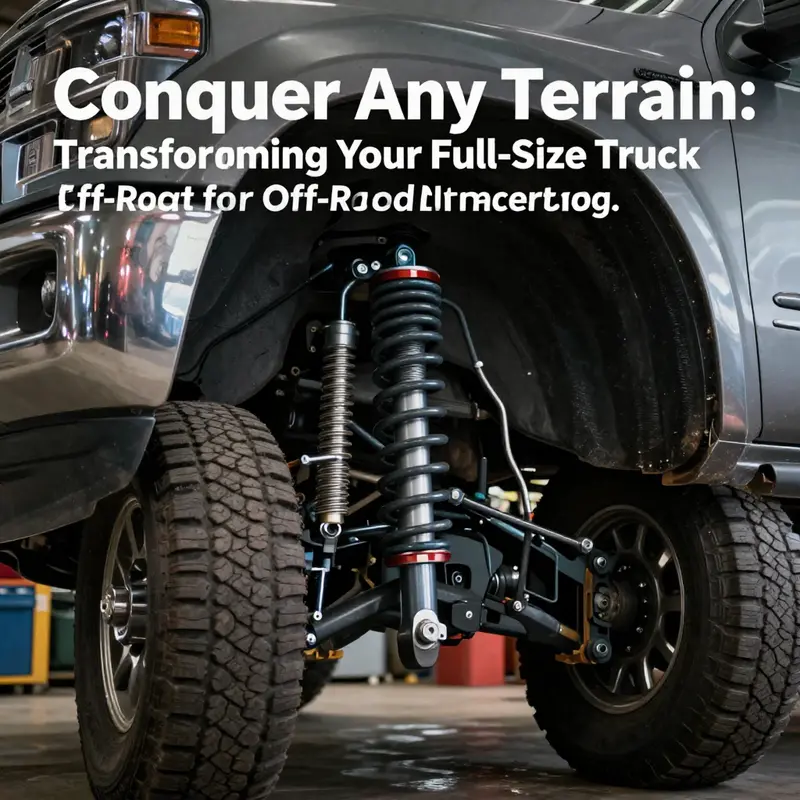
Every serious off-road mission begins with the suspension. For a full-size pickup, the suspension is not merely a cushion between the wheels and the frame; it is the honest interface that turns traction into momentum, shock absorption into confidence, and clearance into capability. When you set out to make a truck better off road, you don’t just add height. You rebalance geometry, control, and feedback so the tires stay in contact with the ground while obstacles like rocks, ruts, and whoops demand less compromise from the driver. The goal is to increase ground clearance and wheel travel without turning the truck into a traffic-space sculpture that stumbles at highway speeds. In practice, the work centers on four pillars: lift and ride height, damping and control, chassis integrity, and geometric harmony.
Lift and ride height sit at the surface of the change, but they are not the whole story. A proper lift achieves ground clearance, yet it also shifts the angle of approach, departure, and breakover. If you choose a suspension lift, you are picking not only extra inches but a new set of geometry relations among control arms, driveshafts, steering linkage, and the axle. The simplest options include shackle reversals, spacer kits, or add-a-leaf configurations that can raise the front and rear by a modest margin. These approaches are attractive for their lower cost and minimal intrusion into drive-line angles, but they can introduce new alignment challenges if you do not address the mounting points and leaf spring behavior. For more dramatic changes, full lift kits that replace or lengthen springs or struts deliver greater lift, typically in the range of two to four inches. When you push into that territory, you cannot overlook the consequences. The longer leverage alters track width, axle articulation, and the need to rework control arms and possibly the driveshaft angle, to suppress vibration at speed and protect universal joints. And for those who crave the ultimate in adaptability, air suspension systems offer a dynamic platform. They let you raise the chassis for rough trails and lower it for highway stability, but they demand careful air management, line routing, and a dependable compressor system to avoid sag and drop when the terrain tightens.
But height is not the master; it is a lever. The dampers that live with the upgraded springs are the governing governors of how the truck will actually ride and perform in real life. High-performance dampers are essential when travel increases, because they tame the spring’s oscillations and keep the tire in contact with the ground through rough terrain. In the off-road world, dampers with larger internal hydraulics, remote reservoirs for heat management, and the ability to tune damping across a range are highly desirable. When you are crawling through a rock garden or bounding over whoops, the ability to adjust damping to soften the impact without sacrificing control can keep tires from bouncing off the ground. Flexible damping is not about a comfortable street ride alone; it is about predictable steering, precise throttle response, and consistent braking in the dirt. Note that improper damping can produce choppy rears and unpredictable body roll, especially on lifted trucks on uneven terrain. The right combination of spring rate and damping force yields a chassis that remains planted, keeps the wheels spinning on the terrain rather than just spinning in air, and allows the driver to pace the line with confidence.
Alongside the new height and dampers, the truck’s undercarriage and frame crave reinforcement. A lifted vehicle endures greater stress through the frame, the crossmembers, and the suspension links, particularly when heavy tires and stiff springs amplify the load during side-hill climbs or rock ledges. Strengthening measures may include additional bracing, stronger sway bars to reduce roll, and protective skid plates that deflect rocks from critical components such as the oil pan and the transaxle area. The aim is not to stiffen the ride into a brick; it is to stabilize the geometry so every component can do its job without bending under load. When you integrate these modifications, you must check for frame-to-body clearances, ensure that skid plates do not contact tires or suspension parts, and verify that drivetrain angles remain within a safe envelope to avoid binding or accelerated wear.
Geometry is the quiet engine behind all the visible changes. Lifting the body alters the interplay of caster, camber, and toe, and it can also widen the wheel track if you opt for certain kits. The result can be stronger on rough surfaces yet unpredictable on pavement if the tires and alignment go out of spec. Slope, twist, and articulation angles become part of a new normal; hence, getting a precise alignment after any lift is non-negotiable. An aligned setup keeps steering predictable and tire contact optimal across the range of operating conditions. It is easy to underestimate how small shifts in camber or toe can degrade grip on loose dirt or mud. A well-balanced geometry helps the tires maintain contact on the climb and avoids scrub that costs traction on the way down. It also curbs the tendency for one wheel to grab more than the other in slick conditions, which would otherwise lead to wheelspin or a sudden arcing drift when the truck is commanded to change line.
Practical reality reminds us that suspension upgrades do not happen in a vacuum. They must be integrated with the truck’s overall engineering, and they should be installed by someone with competence in vehicle dynamics and safety. Suspension work is not a casual, “swap-in-a-day” modification; it requires careful measurement, alignment planning, and a willingness to address potential warranty and regulatory impacts. A professional installation ensures the lift height, shock valving, and linkage geometry are compatible with the truck’s chassis and powertrain. While the temptation to mix and match components from disparate sources is strong, the best results come from a system designed to work together, with attention to ground clearance, axle geometry, steering feedback, and the risk of binding at full articulation.
This is also where the driver’s experience matters. The most successful off-road drivers treat suspension as an active partner in the line selection and throttle management rather than a passive accessory. They learn to read the terrain, choosing smoother lines when possible and using engine braking to control descent rather than braking hard. A careful approach reduces abrupt loads on the suspension and minimizes the chance of axle binding. The on-road manners of the vehicle should remain acceptable, though not identical to a stock highway cruiser. The driver’s skill must bridge the gap between the extra height and the new dynamic range of the chassis, especially when negotiating steep exits, deep ruts, or sandy sections where steering feel can change with the added mass and altered alignment.
If you want to place your upgrades into a practical map of the truck’s life, think of the suspension as a system that improves both the car’s confidence and its mileage of operation. You are not choosing between off-road performance and street comfort; you are tuning a relationship between the spring, the damper, and the tire so that the tire can follow the terrain with minimum loss of traction. This means you can perform more controlled climbs, more predictable sidesteps around obstacles, and more efficient recovery when things go unexpectedly rough. For those who want a deeper dive on vehicle maintenance, see Mastering Diesel Mechanics: Your Step-by-Step Path to Success. The link is a reminder that even as you push the performance envelope, you should keep maintenance at the center of the plan. Regular inspection of bushings, tie rods, shock mounts, and the mounting hardware ensures that the upgraded suspension remains reliable and safe through the seasons of off-roading.
The discussion would be incomplete without a note on the broader strategy of upgrades. Suspension work shines when it is paired with tire choices that complement travel and ground contact. Wider tires that match the increased track and maintain a compatible sidewall height can absorb more impacts and reduce pinch punctures, while careful wheel sizing can prevent rubbing and interference with fender liners and leaf packs. Yet tires alone cannot fix poor suspension performance; they need a companion in dampers and springs, in geometry and reinforcement. The synergy between suspension and tire is what allows a truck to flow through rough terrain rather than fight it. The road from the showroom to the trail is thus paved with the patient, methodical upgrade of the suspension’s backbone and its connection to the wheels and the drivetrain.
Finally, the path to a well-balanced, off-road-ready full-size truck rests on a disciplined approach that respects the vehicle’s health as much as its capability. The best practitioners treat the project as a process, verifying alignment after every major adjustment, performing post-modification checks of driveline angles, and acknowledging the limits of both the chassis and the tires. They map the trail expectations with an eye toward reliability, ensuring that conversations around more radical setups stay anchored in the realities of load, speed, and terrain. That disciplined mindset is what converts a lifted, better-sprung rig from a weekend toy into a trusted partner across a variety of landscapes, from rock gardens to sandy tracks and muddy passages.
External resource for suspension theory and practice can be found at the following general reference: https://en.wikipedia.org/wiki/Automotive_suspension
Tread, Traction, and Triumph: Choosing Tires to Make a Full-Size Truck Thrive Off-Road
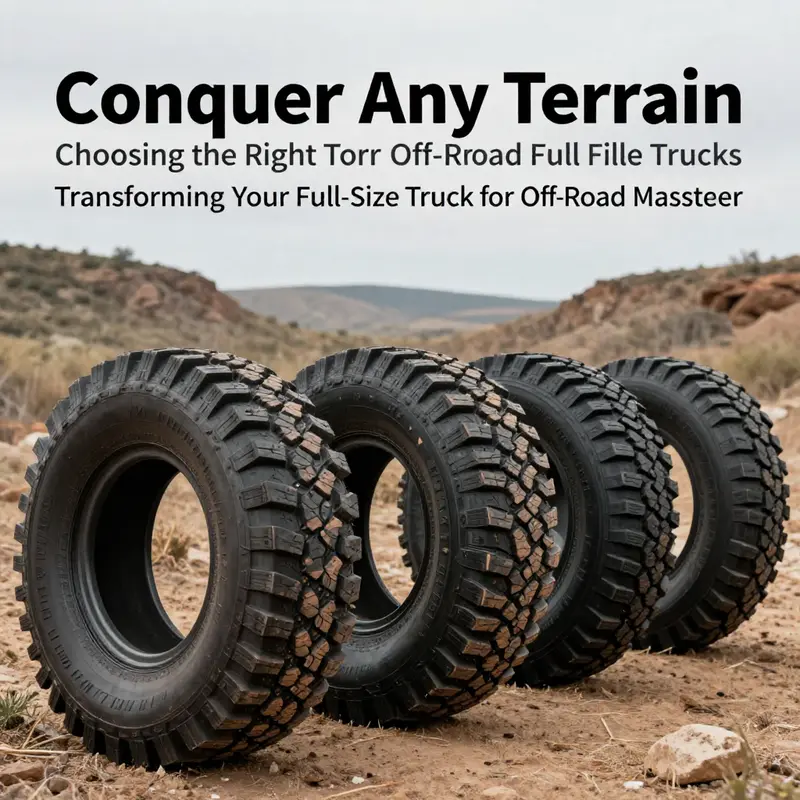
Tires are the most visible and visceral indicator of a truck’s off-road capability. They carry the load, bite into uneven ground, and translate engine torque into forward motion across mud, rock, sand, and snow. In the broader effort to improve a full-size truck for off-road use, tires aren’t a single checkbox to tick; they are a dynamic interface between weight, suspension, drivetrain, and the driver’s technique. The right tire choice sharpens every other system, shaping how ground clearance, approach and departure angles, and traction interact with the terrain. When done thoughtfully, tire selection becomes the hinge on which the rest of the build pivots—from suspension travel and lift height to gearing and torque delivery—into a cohesive, capable off-road machine.
Size matters, but not in isolation. Larger tires can elevate ground clearance, widen the stance, and improve grip on loose surfaces. They can also change gearing, alter speedometer accuracy, and demand more from the suspension and steering systems. For a full-size truck designed to haul loads or endure long work days, a balance must be struck. The idea that bigger is always better is tempting, yet incomplete. In practice, the aim is to maximize usable ground clearance and traction without introducing new compromises that undercut reliability or road manners. Some guidance suggests that larger, robust tires—potentially in the 24-inch range for certain configurations—offer tangible benefits for obstacle clearance and traction on challenging surfaces. Still, the best fit depends on the truck’s weight, wheel choice, and how aggressively the vehicle is used off road. The driver’s goals—whether they are traversing rocky trails, muddy descents, or sandy washes—shape the final decision about tire diameter, width, and construction.
Tire size interacts with wheel specifications and chassis architecture. A proper match to rim diameter and offset is essential. The wheel bead must seat correctly, the tire should not rub or contact fender liners at full articulation, and the tire’s width must be compatible with the available tire carrier and suspension travel. In practical terms, this means that a tire selection process should begin with a clear picture of how the axle loads shift under heavy towing or cargo, how much suspension travel remains when the truck is fully loaded, and how the tires will behave when temperatures swing from desert heat to mountain cold. The load rating becomes a decisive factor here. Heavy-duty trucks demand tires that can carry substantial loads while maintaining sidewall integrity during off-road impacts. A tire with an appropriate load index ensures that the rubber and cords aren’t overstressed when the truck carries gear, tools, or water in a challenging environment. The goal is to avoid situations where sidewall flex or tread deformation undermines handling and steering feedback.
Tread pattern is the most visible distinction between on-road and off-road capability, and the choice between all-terrain and mud-terrain designs is fundamental. All-terrain tires offer a balanced compromise: solid on-road manners, decent wet grip, and sufficient bite on light trails. They are typically designed to deliver steady wear, respectable rolling resistance, and consistent performance across a variety of surfaces. Mud-terrain tires, with their aggressive voids and thick sidewall lugs, excel where traction matters most—deep mud, soft sand, and rocky crossings that demand aggressive bite and robust rigidity. The trade-off is a stiffer ride, higher rolling resistance, and more pronounced noise on pavement. For a full-size truck that spends time both on the highway and off it, a well-chosen all-terrain tire can be tuned for the most practical blend of traction, durability, and daily usability. For those who push into truly challenging ground, a mud-terrain option may be the better tool, provided the vehicle’s suspension, gearing, and braking systems are prepared to handle the change in dynamics. In either case, the tread pattern should be aligned with the most likely terrain and not selected in isolation from the truck’s powertrain and suspension.
Rubber compound matters as much as tread shape. A tougher compound resists chunking and punctures when the surface is abrasive, rocky, or littered with sharp debris. That same toughness, however, can make the rubber less forgiving over irregular surfaces or at low temperatures where some compounds slough torque or stiffen too quickly. A robust compound complements the truck’s capabilities, especially when the vehicle is carrying full payloads into harsh environments. The tire’s sidewall construction is equally critical. Reinforced sidewalls reduce the risk of pinch flats and sidewall punctures on rocky trails, but they can also contribute to a harsher ride if the suspension isn’t tuned to absorb larger impacts. When pairing tire and suspension, it helps to think of the tire as part of an integrated system: the tire’s sidewall stiffness, bead integrity, and tread compound should harmonize with the shocks, springs, and sway behavior to deliver predictable grip and controlled articulation.
The interaction between tires and the truck’s suspension is a central thread in making a full-size machine capable off road. As tires increase in size, the suspension must often provide more travel to keep the contact patch planted as the wheel moves across obstacles. This is why lift kits and upgraded shocks frequently accompany larger tires. But lift and higher-stiffness components should be matched with appropriate wheel geometry so that steering geometry remains precise and steering effort remains manageable. Tire pressure plays a pivotal role too. Off-road driving typically benefits from lower pressures to widen the contact patch and improve grip on soft surfaces, while still maintaining integrity at the bead and avoiding pinch flats. The driver must adjust pressures based on terrain type, load, and speed, keeping a balance between maximizing traction and preserving control. The result is a more forgiving ride that can absorb rock ledges and rut-filled trails without sacrificing the ability to recover quickly when the lane turns unexpectedly.
Beyond the mechanical fit, tire selection shapes how the truck delivers power to the ground. The interplay of tire contact with terrain and the driveline shear forces generated during slow, controlled climbs or deep ruts is what determines whether a vehicle can maintain momentum or stall. In this sense, tires influence the effectiveness of low-range gearing and locking differentials. When the tires bite into loam or clay, the available traction informs throttle input and engine braking strategy. If the tire’s grip is excellent, a driver can maintain momentum with gentle throttle modulation and precise line selection. If grip is uncertain, the driver will need to be more deliberate, using engine braking and smoother throttle transitions to avoid wheel spin. The driver’s technique—line selection, observation of the upcoming terrain, and measured throttle application—remains essential, even with the best tires. In other words, the tires set the stage, but it is the driver who writes the performance script.
Tire maintenance is not an afterthought but a foundational practice. Regular inspection of tread depth, sidewall integrity, and bead seating ensures that the tires can perform as designed on the trail. Rotations help even wear across the entire set, preventing uneven contact that can destabilize handling on uneven surfaces. Proper balancing reduces vibration and micro-wobbles that could compromise control on rocky or rutted tracks. Checking tire pressures before and after off-road use helps manage grip and prevent heat buildup during climbs or high-speed traversal over rough sections. A consistent maintenance routine pays dividends in reliability and confidence, allowing the other upgrades—lift, shocks, differential upgrades, and protective plates—to deliver their promised advantages rather than fighting against preventable tire failures or imbalanced wear.
The tire decision, while technical, should be framed by the realities of the truck’s mission. If the aim is occasional, moderate off-roading with heavy payloads, a carefully chosen all-terrain tire with a robust load rating might be the most sensible path. If the terrain is consistently aggressive, a mud-terrain option becomes a more compelling tool, provided the chassis, suspension, and drivetrain are prepared to translate its bite into controlled progress. In all cases, the alignment between tire choice and the rest of the build determines whether the truck behaves like a confident navigator of rough ground or a vehicle that struggles to find traction and momentum. The best tire strategy respects the vehicle’s weight, the expected terrain, and the driver’s preferred style, delivering steady, predictable performance rather than exhilarating but unreliable flair.
For readers seeking deeper, data-backed validation of tire selection principles, Consumer Reports offers a comprehensive guide on off-road tire selection. This external resource provides tested insights, terrain-specific recommendations, and nuanced evaluations that can supplement field experience and site-specific testing. By integrating independent testing with practical, real-world feedback, readers can refine their tire choices to align with load requirements, terrain expectations, and the overall performance goals of the full-size off-road build. For a broader sense of how tire choice pairs with other upgrade paths, see the surrounding chapters that discuss suspension upgrades, drivetrain considerations, and ground clearance. The tire is the contact point between the truck and the world; choosing wisely makes every obstacle a solvable puzzle rather than a blocking barrier.
External reference: https://www.consumerreports.org/cars/off-road-tires/
Drivetrain Mastery for Rugged Trails: Precision Torque and Control in Full-Size Trucks
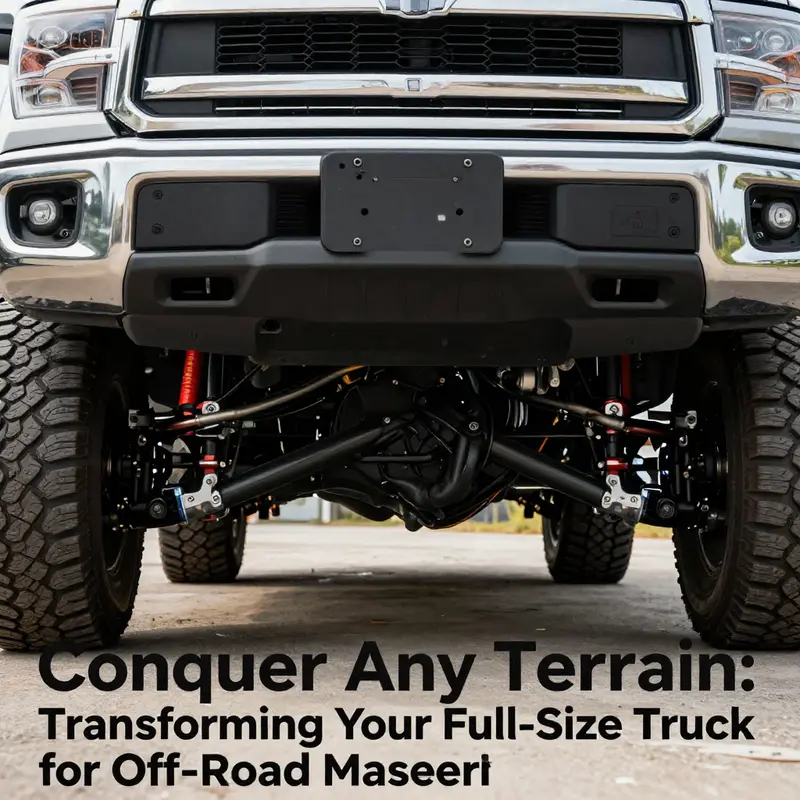
The drivetrain is the beating heart of a full-size truck when the road ends and the terrain begins. It is more than a single component delivering power to the wheels; it is an integrated system where mechanical strength, electronic intelligence, and driver judgment converge. In off-road travel, the drivetrain must transmit consistent torque, manage traction with subtlety, and tolerate extreme loads without fail. While horsepower and torque figures set the ceiling, the orchestration of gears, couplings, and control logic determines whether a truck crawls over a rock face or stalls in mud. The modern solution blends four wheel drive architecture, transfer case gearing, the differential behavior, and traction aids that modulate power in real time. When these elements are aligned, a full-size truck can maintain momentum where others struggle, conserve energy on downhills, and minimize wheel spin on loose surfaces without sacrificing control.
The core of that harmony is the four wheel drive system itself, thriving when the driver can lock axles to force all wheels to rotate together. A well chosen locking differential strategy—part time or full time—transforms traction from a gamble into a predictable law of motion. The essence is in blending mechanical locks with intelligent electronics. Automatic wheel slip detection and electronic engagement activate locks when needed and release them when the terrain smooths. This reduces cognitive load on the driver while delivering grip across crawls and slopes. A rugged drivetrain also hinges on the transfer case and its low range gearing. Slow speed crawling demands high torque multiplication, turning the engine into a precise pump that keeps momentum on rocks, in ruts, or up embankments. The practical benefit is predictability; with a robust low range, the vehicle can retain traction where higher gears would stall and where sudden throttle changes might cause wheel spin or drivetrain shock.
As the drivetrain grows more capable, the control layer—the electronics—must rise in tandem. Traction control systems translate wheel speed data into interventions that brake a spinning wheel or modulate engine power to restore grip. The best systems are adaptive, refining their parameters for changing terrain and sometimes offering an off road mode that reconfigures throttle response, brake bias, and suspension behavior. This dynamic balance between propulsion, braking, and steering creates a predictable experience for challenging sections. Yet the driver remains central: the finest traction systems support human decision making, not override it, rewarding measured throttle input and intentional line choice.
A further layer comes from active differential control and powertrain management. Remote controlled differentials give the driver door-to-door control when needed, while robust mechanical locks provide durability under load. Beyond locking mechanisms, powertrace software tuning can smooth torque delivery and responsiveness in the low speed band used for off road maneuvers. The aim is usable, controllable power in the moments that matter most: when momentum is the difference between a successful crossing and a stall.
Reliable off-road operation also requires foresight and diagnostics. Real time health monitoring is essential on long trips: it can flag overheating trends, leaks, or sensor issues before they become roadside failures. Redundancy—across sensors, power paths, or protective shielding—adds resilience. The driver’s vigilance, combined with solid engineering, keeps the drivetrain a dependable backbone through rough terrain, long climbs, and rapid descents.
To understand how these elements come together, imagine a vehicle designed around a strong 4×4 architecture, with a low range transfer case feeding a multi link suspension tuned for articulation and ground contact. Driven axles pair with robust, rigid connections that resist twisting forces on tough terrain, while electronic controls calibrate slip, braking, and throttle to the moment’s demands. On steep, loose faces the driver relies on locked differentials to keep every wheel contributing to forward progress. On smoother but uneven surfaces the system modulates power to prevent binding and torque rebound that can unsettle the vehicle. This is not a single upgrade but a holistic reimagining of how power, grip, and control are choreographed. The most effective implementations integrate hardware, electronics, and driver input so the truck behaves with confidence when the ground shifts, is slippery, or unpredictable.
A broader context shows drivetrain enhancements work best with coordinated suspension tuning, appropriate tire choice, and thoughtful weight distribution. The aim is to place powertrain within a framework that preserves traction, underbody clearance, and stability through corners and over obstacles. In practice this means balancing weight, gearing, and geometry to favor slow, deliberate movement over aggressive, high velocity driving. It also means that improvements in one area—such as stronger axles or a better transfer case—must be complemented by better ground contact through tires and suspension. The chain is only as strong as its weakest link, but when all links are reinforced, it becomes a reliable conduit for momentum on challenging terrain.
Those principles align with a study backed approach to drivetrain engineering for extreme terrain. A holistic mindset that prioritizes torque delivery, traction assurance, and diagnostics yields a full size truck that climbs obstacles with grace and predictability. For readers seeking deeper concepts, broader explanations of differential locking, transfer cases, and power delivery can provide valuable context. See the external resource for a detailed exploration of drivetrain concepts and rugged family vehicles: https://www.petersen4wheel.com/2026/01/28/roscop-drivetrain-part-1-driveaway-built-family-wheeler/. Practical maintenance guides can help keep the drivetrain in peak condition during off road expeditions. Together these sources illuminate a path from concept to reliable execution, one that honors the truck’s purpose: to conquer terrain with disciplined power, reliable grip, and unwavering forward drive.
Lift, Leverage, and Line the Trail: Elevating Ground Clearance and Approach Angles to Master Off-Roading in Full-Size Trucks
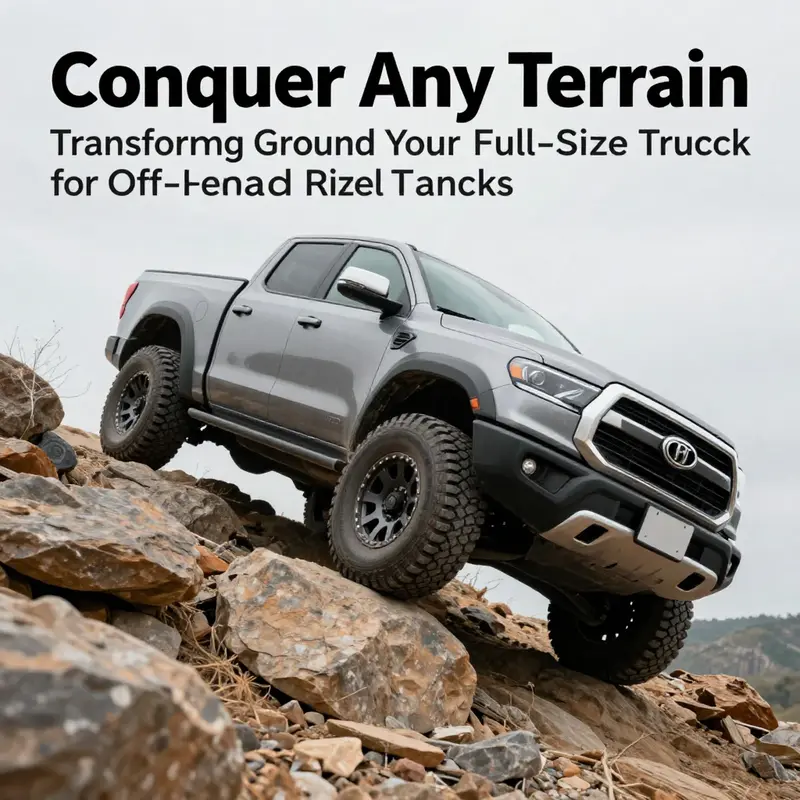
Ground clearance and approach angle sit at the core of a full-size truck’s off-road capability. They are not abstract numbers; they are practical measures that determine whether a vehicle can clear rocks, straddle ruts, and glide over uneven terrain without inviting underbody damage. In many trail scenarios, a modest gain in clearance translates to a meaningful leap in how confidently you can engage obstacles. A well-judged increase in ground clearance changes the geometry of every obstacle you encounter, shaping your line of travel and your risk budget. Even a small improvement can push a rough section from “maybe” to “off it goes,” which is why this chapter foregrounds how to maximize these two metrics in a way that stays aligned with the broader goal: making a full-size truck noticeably more capable off the pavement while preserving daily usability.
Ground clearance is not just about lifting tires higher off the ground. It is about the vertical space available between the lowest point of the truck’s undercarriage and the ground. Industry observations show that increasing clearance by a mere 10 millimeters can enhance obstacle-clearing capability by roughly 15 percent. That relationship matters because most obstacles on typical trails are approached with the vehicle’s underside as a pivot. The key, then, is to push clearance into a practical range for demanding terrain. For serious off-roading, a clearance window of about 180 to 200 millimeters is a sweet spot. On ventures into sand, loose gravel, or rock-strewn paths, that range helps the truck step over irregularities with less risk of bottoming out. In urban settings prone to water ingress during floods or heavy rain, going up toward or beyond 220 millimeters becomes a smart precaution to keep the engine intake away from rising water and to avoid splash-zone concerns that can creep into undercarriage components.
Approach angle, the angle between the ground and a line drawn from the front axle to the lowest point on the front end, plays an equally decisive role. A steeper approach angle means the nose can climb steeper grades without the bumper or lower fender meeting the terrain. Stock designs often limit this metric because of longer front overhangs, bumper profiles, and the way the suspension sits when the truck is built to carry weighty loads on real roads. The practical upshot is that even a truck with ample ground clearance can struggle with the initial contact when a ledge, a rock, or a rut appears in the vehicle’s path. Elevating the approach angle is therefore not just a matter of aesthetics or a single cosmetic bolt-on; it is a functional adjustment that alters how smoothly the truck can transition from flat ground to an uneven surface.
To meaningfully improve approach angles without sacrificing everyday drive quality, a combination of targeted modifications is typically required. Lifting the suspension can raise the chassis away from potential scrapes, effectively increasing the available angle before contact. A front-end upgrade, such as a more aggressive bumper profile, can remove protrusions that would otherwise gouge the lower fascia on a steep ascent. Larger tires with taller sidewalls further contribute by widening the arc through which the tire engages the terrain, smoothing transitions over small obstacles and adding a cushion against impacts. Yet these changes come with tradeoffs that demand thoughtful planning. A higher ride height can alter steering geometry, raise the vehicle’s center of gravity, and influence braking dynamics. Larger tires also impose more load on the driveline and suspension components and can affect fuel economy. The objective is not to chase the highest possible number but to balance clearance, angle, handling, and reliability for the terrain you actually intend to conquer.
In practice, improving both clearance and approach angle involves a coherent package rather than a scattershot set of parts. A lifted suspension, for instance, should be matched with an appropriate recalibration of shock behavior to preserve articulation and control over uneven surfaces. With the right alignment, the wheels can maintain contact with the ground across irregularities instead of skipping over them. A reinforced front bumper, designed to streamline the approach path, reduces the chance of snagging the ground when the front end hits a steep incline, while a judiciously chosen tire size can complement this geometry by increasing the effective clearance without unduly enlarging the vehicle’s overall footprint. The overall effect is a more confident descent into the unknown and a more graceful climb out the other side, preserving momentum where appropriate and reducing the risk of getting stuck due to a single misjudgment.
An illustrative real-world takeaway is the sense that these modifications, when integrated with a truck’s broader off-road system, can deliver a visible jump in capability. A recent testing scenario—without naming models or brands—demonstrated a notable improvement: an upgraded front end and larger AT tires, combined with a lifted chassis, produced a documented approach angle improvement that allowed the vehicle to tackle steeper approaches than its stock counterpart. The result was not simply a steeper angle; it was a more forgiving transition onto an obstacle, a lower likelihood of bottoming out on uneven ground, and a more controllable ascent. The lesson is clear: approach angle is not a single number you chase in isolation; it’s the product of geometry, protection, and tires aligned with the truck’s drivetrain and suspension characteristics.
The discussion of dynamic ground clearance adds another layer of practicality. Static measurements—those numbers you see on spec sheets—are important, but the ability to alter clearance on the fly is equally valuable. A modern air-suspension system can raise the chassis for a rocky cross-section and then, on the highway, lower it for stability and efficiency. This dynamic capability means you could approach an off-road section with maximum clearance, then return to a lower, more stable ride for the road segments between trails. While air suspension adds cost and complexity, its potential payoff in terms of safety, comfort, and performance on varied terrain is compelling for drivers who truly venture off the beaten path.
Beyond the suspension and tires, the undercarriage protection plays a meaningful supporting role. Skid plates shield critical components from the worst of the impact, especially on mid-sized rocks or hard-packed trails. While protection does not replace the need for good lifting and tire choice, it helps reduce the consequences of an inevitable contact. A careful balance between protection and approach geometry ensures you don’t compromise your line in pursuit of extra clearance. The ethos here is integration: you gain more ground with a cohesive plan that respects how each system—suspension, bumper design, tires, and protection—works in concert rather than in opposition.
Driving technique remains a constant multiplier of all hardware choices. The most effective off-road drivers learn to read the trail ahead, maintain steady throttle input to prevent wheel spin, and use engine braking to manage speed on descents instead of hammering the brakes. When you combine careful line choice with higher clearance and steeper approach angles, you gain margin—more time to pick a smoother route and less chance of a sudden misstep that could dent the undercarriage. Preparation matters as well: knowing the trail, packing appropriately, and inspecting the vehicle after a run are all part of preserving the gains you’ve earned through upgrades. A well-executed plan yields a truck that not only climbs obstacles but does so with measured control and predictable behavior in the most demanding conditions.
In sum, maximizing ground clearance and improving approach angles for a full-size truck is not about chasing a single metric. It is about designing an integrated package that enhances the vehicle’s geometry, protects vital components, and preserves the everyday usability that makes full-size trucks viable as daily drivers and capable off-road machines alike. When done thoughtfully, these upgrades translate into greater confidence on rough trails, more consistent climbs, and a safer, more enjoyable experience behind the wheel. For readers who want a deeper dive into benchmarking and testing across different full-size pickups, the broader landscape of approach and departure angle data offers a rich, hands-on resource that complements the metallic and mechanical changes described here.
For additional benchmarking and testing context on approach angles across full-size pickups, explore Car and Driver’s hands-on evaluations: Best Approach and Departure Angles Tested in Full-Size Pickup Trucks – Car and Driver
Chapter 5: Armoring the Trail—Essential Accessories to Turn a Full-Size Truck into a True Off-Road Machine
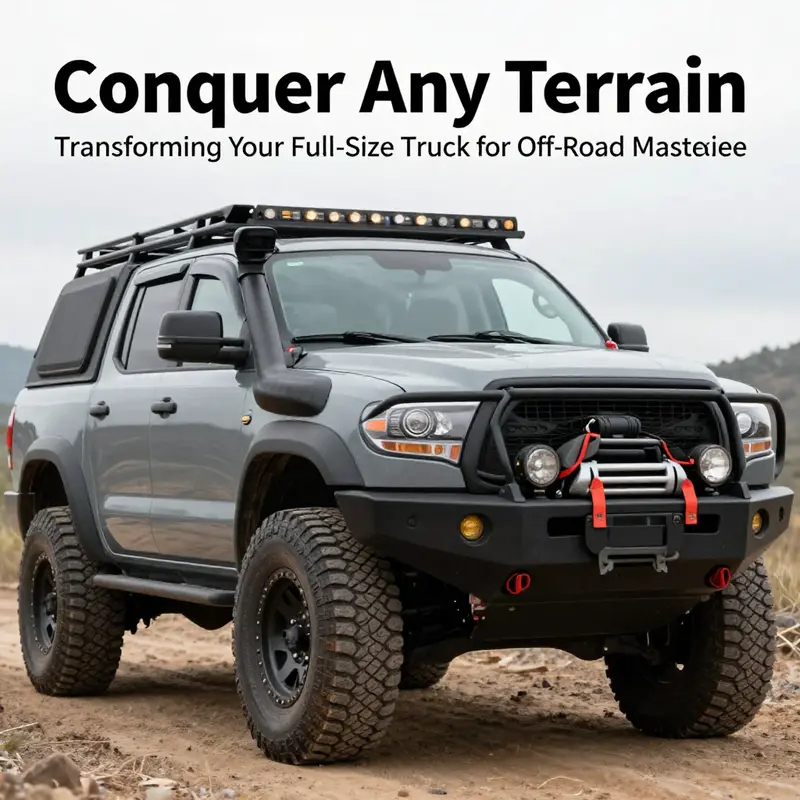
Off-roading a full-size pickup isn’t about chasing raw horsepower alone. It’s about assembling a toolkit of purpose-built accessories that translate grip, protection, and control into real-world advantage on difficult terrain. The factory setup is tuned for pavement, comfort, and predictable behavior. To step onto rocks, mud, or rutted trails with confidence, you need a cohesive package that attends to ground clearance, undercarriage protection, traction, lighting, and practical resilience. The right accessories, chosen with intent, make a truck feel telepathically connected to the trail in a way that a stock rig never can. This is where the practical artistry of off-road readiness emerges from the toolbox and the way you drive, maintain, and adapt to the terrain you encounter.
A robust off-road approach begins with elevation and articulation, and the role of a high-lift suspension system or a lift kit is foundational. Elevating the chassis increases ground clearance and helps the truck clear rocks, deep ruts, and stubborn obstacles without scraping the transfer case or oil pan. The key is compatibility and balance: a lift that respects steering geometry, axle alignment, and suspension travel, so handling remains predictable and safe during side slopes or uneven sequences. A high-lift system or a properly tuned lift kit also improves approach and departure angles, letting you tilt up to meet a ledge without tearing up bumpers or fenders. The goal is not just more space below the frame but smarter space that preserves body control. It’s about achieving a measured increase in clearance while keeping load handling, steering feel, and ride quality coherent with daily usability. In practice, this means selecting components that work with the truck’s drivetrain, whether it is diesel or gasoline, and checking compatibility with tires and wheels so the geometry does not induce bump steering or binding under compression. For those who value long-term reliability, a thoughtful upgrade sits alongside regular maintenance, and the discipline of checking torque, bushings, and alignment after every significant trail outing.
Protection is the companion to clearance. Heavy-duty skid plates are non-negotiable when you aim to explore rocky or abrasive surfaces. These plates shield critical undercarriage components—the transfer case, fuel tank, differentials, and the lower portions of the oil pan—from direct impacts and gouges. Skid protection becomes especially vital when you don’t know the trail layout in advance or when you plan to push through terrain where a misstep can bend heat shields or dent delicate hardware. The best skid plates are robust, yet not so heavy that they unduly load the suspension or ruin articulation. They should be easy to install and inspect, with high-confidence fasteners and access points for service. The effect is not only preventive; it also gives the driver the freedom to test the truck’s limit lines with less fear of catastrophic damage, which in turn fosters more deliberate, precise line choices on the trail.
Traction, possibly the most visible and immediate upgrade, emerges through upgraded tires and wheels. All-terrain or extreme-terrain tires with deeper, more resilient tread patterns deliver the grip needed on loose soil, sand, mud, and rocky surfaces. The right tires also manage heat buildup, a critical factor during long off-road sessions when continuous grip matters. Wider, more robust tires can help on soft surfaces by distributing bite more evenly, but they must be matched to the wheel choice and the vehicle’s overall geometry. A common enhancement is pairing these tires with sturdy, impact-resistant wheels designed to withstand harsh terrain without bending or cracking. This combination reduces the risk of sidewall punctures and helps maintain performance when the trail throws unexpected rocks or hidden hazards. Oversized tires with taller sidewalls can provide additional cushion against impacts, but a careful balance is required to maintain speedometer accuracy, gear ratios, and the truck’s steering response. The tires become a voice on the trail—the difference between a stuck moment and a controlled, measured return to the line you selected.
Lighting is a practical force multiplier after dark or in dusty, low-visibility conditions. LED light bars or auxiliary lighting dramatically extend the usable window for scouting, route finding, and obstacle detection. The value here isn’t merely brightness but the quality of light: the spread of flood beams for close obstacles and spot beams for distant terrain, all calibrated to minimize glare in dust or rain and to avoid blinding other travelers. Good lighting also enhances safety in camp setup, recovery operations, and vehicle checks performed in remote locations. The objective is to illuminate the path ahead with clarity, reducing the chance of surprises that could lead to a sudden, rushed decision on a tricky obstacle.
A trusted winch can define whether a day on the trail ends with a victory lap or a long, stubborn extraction. A front-mounted winch provides a lifeline when traction collapses and recovery becomes necessary. The winch functions as a real-time problem solver for stuck or precarious situations, enabling self-recovery or assistance in a controlled, principled manner. When selecting a winch, consider the rated pull, line length, and whether the line is synthetic or steel. Synthetic rope reduces weight and is easier to handle, though it may require more dedicated care to avoid fraying. The mounting system matters as well: a sturdy bumper, reinforced mounting plates, and proper wiring ensure that the winch performs when needed without compromising electrical reliability or safety. The goal is reliable engagement and smooth operation, providing a predictable tool for self-rescue or for helping others—the mark of a prepared adventurer rather than a recreational rider.
The back half of a capable off-road kit often centers on organization and contingency planning. Interior and cargo management systems keep tools, spare parts, and emergency supplies secure and accessible. A well-organized bed, protected by a durable bed liner or tonneau cover, helps prevent gear from shifting during aggressive maneuvers or sudden stops. Secure storage solutions—toolboxes, mounted drawers, and rooftop carriers—keep essentials within reach, whether you’re carrying air compressors for tire inflation on the trail or recovery gear for a remote roadside fix. In practice, this means thoughtful layout and reliable fasteners, so the gear you need is quick to grab and easy to repack after a day on rough terrain. A clean, tidy space also reduces the risk of loose items interfering with pedals or mechanical linkages, which is a small but meaningful safety gain.
No discussion of essential accessories would be complete without a reliable navigation and trail-planning setup. A dependable GPS navigator or off-road app with topographic maps and current trail data can avert detours into hazardous areas, help you anticipate obstacles, and enable smarter route planning. The app should work offline when cellular service is unreliable, and it should integrate with the vehicle’s electrical system without causing interference or draining the battery in a way that compromises daily usability. The goal is calm, informed decision-making as you move from one segment of the trail to the next, rather than impulsive choices born from poor visibility or uncertain terrain. And because off-roading rarely happens in a vacuum, it is wise to pair navigation with a map of contingencies—where possible, planned exit routes, estimated fuel and water requirements, and a quick-access path to the nearest safe shelter or trailhead.
As the toolkit demonstrates, the synergy between these accessories and the way you drive is what produces the most meaningful gains. Maintainability becomes a recurring theme. A well-equipped truck will still face wear, and that wear shows up in tires, brakes, fluids, and the driveline after a day on the rough. The best operators rotate through their accessory suite with an awareness of heat, stress, and impact, performing preventive maintenance that keeps the system robust. A regular inspection routine—checking lug nuts, fasteners, and the condition of skid plates, as well as monitoring suspension travel and steering alignment—helps ensure that the upgrades deliver their full value over time. When you combine hardware upgrades with disciplined driving techniques—driving slowly, choosing smooth lines, and using engine braking to control descent—you maximize the benefit of every dollar spent on upgrades.
In this context, maintenance and knowledge go hand in hand. For those who want a deeper dive into the mechanical backbone of diesel or gasoline powertrains and how maintenance practices influence overall reliability on the trail, the path laid out by seasoned mechanics is instructive. Mastering diesel mechanics—your step-by-step path to success is a credible resource that underpins responsible upgrade choices and long-term durability. Mastering diesel mechanics—your step-by-step path to success reinforces the idea that upgrades should be matched with a solid maintenance plan and a realistic understanding of how those systems behave under load and in varied temperatures. This blend of hardware confidence and maintenance discipline is what ultimately separates a great off-road setup from a good one.
The philosophy behind these accessories is simple: build capability that respects the trail, protect what matters, and maintain a clear line of sight to your destination. When these elements align, the full-size truck becomes more than a pavement-pounder; it transforms into a capable, predictable off-road partner. It is a vehicle that can soak up punishment and return with confidence, not fatigue. The trail rewards preparation, patience, and prudence, and the toolbox that follows that philosophy makes the difference between a determined test of a trail and a measured, enjoyable expedition. As you map your own adventures, remember that the most effective upgrades are those you understand, maintain, and trust—accessories that extend your reach while preserving the truck’s core integrity and your peace of mind. External knowledge sources, like credible off-road references, can anchor your decisions as you build toward trail-ready confidence.
External resource: https://www.offroad.com/essential-off-road-accessories-for-full-size-trucks/
Final thoughts
Transforming your full-size truck for off-road prowess is a fulfilling journey that requires knowledge and resources. From upgrading the suspension and selecting the perfect tires to enhancing drivetrain systems and ensuring proper ground clearance, each modification plays a crucial role in mastering the rugged trails. Equipping your vehicle with the right accessories serves as the cherry on top, preparing you for any unforeseen challenges. The heart of off-roading lies not just in the destination but in the thrill of navigating uncharted territories and conquering obstacles along the way. Equip your truck wisely and venture into the wild with confidence.