
Off-road haul trucks are the backbone of rugged terrain operations, tasked with hauling heavy loads under challenging conditions. For those who thrive in the dirt and dust, knowing the precise greasing frequency for these powerful machines is pivotal to performance and longevity. Frequent greasing minimizes wear and prolongs the life of critical components, ensuring reliability when you push your vehicle to its limits. This guide delves into the best practices for greasing your off-road haul truck, breaking down daily maintenance checks, interval recommendations based on usage, environmental factors that influence greasing schedules, the consequences of neglect, and the manufacturer’s guidelines that should never be overlooked. Fuel your passion for off-roading with the knowledge to keep your machines in peak condition.
Grease on the Go: A Practical Guide to Daily Lubrication for Off-Road Haul Trucks
Lubrication is the quiet shield that keeps the giant off-road haul trucks rolling through dust, heat, mud, and relentless vibration. In the kind of environments where these machines operate, a daily grease routine is less a suggestion and more a safeguard against sudden downtime and expensive wear. The goal is simple: minimize friction, control contaminants, and extend the life of moving parts that carry enormous loads and endure brutal cycles. When maintenance crews talk about greasing, they are really describing a disciplined rhythm that aligns with the truck’s duty cycle. The cadence isn’t a guessing game but a function of operating conditions, the design of the components, and the guidance tucked into the maintenance manual that accompanies each vehicle. In practice, this means treating daily greasing as a baseline, then scaling up in response to harsher conditions, longer shifts, or higher dust and moisture exposure. The rhythm should feel steady and intentional, not rushed, because the small act of adding grease at the right moment beats the larger bill of failed bearings, seized pins, or worn seals later on. To grasp why this matters, consider the core principle at work: lubrication reduces metal-to-metal contact, carries heat away, and prevents contaminants from taking root in critical joints. When a wheel hub, a kingpin, a steering arm, or a suspension joint runs dry, wear accelerates, seals degrade, and the risk of a catastrophic failure climbs. In the field, technicians typically adopt a daily greasing routine that covers all fittings along the drivetrain and suspension, with particular emphasis on points that see the most stress or exposure to dust. In other words, daily greasing is not a ritual; it is a performance standard that supports reliability, safety, and cost control over the life of the fleet.
The practical details behind the daily routine flow from how the truck works and where wear concentrates. The wheel hubs and kingpins, for instance, are pivotal bearings that bear continuous load and steering forces. When these fittings are neglected, the result can be sluggish steering, rough handling, and, eventually, increased wheel play that compounds tire wear and fuel use. Steering arms and suspension joints are similarly critical. They transfer driver input into precise motion while absorbing the pounding of rough surfaces and heavy gravity. In dusty or muddy conditions, every grease point is under added assault: particulates cling to seals, grease becomes contaminated, and viscosity can break down under heat. Under such circumstances, the rule of thumb shifts toward more frequent checks, sometimes every shift or every few hours, to keep contamination from becoming embedded and to ensure that lubrication remains in the right film thickness. The overarching objective is to keep the moving parts seated in their intended ranges of motion, to prevent metal-on-metal contact, and to retain the protective film that cushions the paths of the axles, shafts, and linkages.
When talking about the frequency, the industry-wide guidance tends to divide the work into two layers: daily checks for critical components and a broader schedule for major chassis and suspension points. Daily maintenance typically includes all grease fittings visible on the drivetrain and suspension, with particular attention to locations that are most exposed to the environment. In harsher environments—where dust, mud, or heat are constants—the frequency shifts toward greasing key points more often, potentially every four to eight hours of operation, just after a heavy-duty cycle or a long shift. This approach helps prevent contamination from taking hold and ensures that each joint has adequate lubrication under peak loads. For major points that bear substantial wear, a broader interval—often cited as a range like 100 to 250 hours of operation—provides a practical balance between maintenance effort and component life. The exact interval, of course, should be guided by the operator’s manual and the specific design of the truck’s lubrication system. It is precisely this nuance—the interplay between hours of operation, environmental severity, and component design—that makes a one-size-fits-all answer insufficient. Fleet managers and operators who establish a dependable lubrication schedule usually implement a preventive maintenance plan that records hours, tracks shifts, and flags deviations caused by exceptional conditions.
To turn theory into a reliable practice, the choice of lubricant matters as much as the cadence. Heavy-duty lubricants selected for off-road service are formulated to withstand high pressure, extreme temperatures, and rapid shear. The grease must remain sticky enough to stay in the fittings under vibration, yet not so thick that it impedes movement or clogs seals. Using the correct grease type protects seals from swelling or cracking and reduces the risk of bearing leakage. Equally important is the discipline of applying grease cleanly. Contaminants must be kept out of pistons and housings, and grease guns should be kept clean to avoid introducing dirt into fittings. The sequence of greasing is practical: start at the most exposed fittings, then move to the central chassis points, and finally circle back to re-check for any signs of seepage or damage. During the routine, technicians should inspect for leaks, worn seals, or cracked fittings. An environmental reminder often accompanies the task: dust, mud, and moisture don’t just rough up surfaces; they also accelerate corrosion and can shorten grease life if not managed with care. This is where the maintenance manual—the trusted source for intervals and grease types—plays a decisive role. Operators should not improvise beyond the guidance it contains. When in doubt, real-world conditions demand adherence to the documented intervals and materials, as these are the inputs most likely to prevent early wear and ensure predictable performance over the truck’s service life.
A broader mechanical perspective helps illuminate why this daily discipline matters. For readers who want a deeper anchor in the fundamentals of engine and drivetrain maintenance, there is a well-regarded resource that outlines the path from basic diesel mechanics to more advanced preventive care. It provides a structured look at how routine maintenance, including lubrication, interacts with other maintenance activities to preserve efficiency and safety. Mastering Diesel Mechanics: Your Step-by-Step Path to Success offers a practical framework for understanding the relationship between lubrication and component wear, without promising quick fixes or shortcuts. This broader context reinforces the idea that greasing is a core element of a holistic maintenance program, not a standalone task.
In the field, the daily greasing ritual becomes a touchstone for reliability. A well-executed routine reduces downtime, stretches component life, and supports safer operation when the truck is under heavy load on rough terrain. Fleet managers who implement a consistent daily procedure also gain the advantage of traceable maintenance records. These records help teams anticipate parts needs, plan downtime around shifts, and identify trends that might signal a deeper issue, such as seal degradation or misalignment. The human element—the technician who performs the greasing with attention to cleanliness and accuracy—remains central to the outcome. The best operators treat each fitting as a small but meaningful opportunity to extend service life, rather than a routine that can be rushed or treated as optional.
External references can complement this practice, providing safety and procedural guardrails that support responsible maintenance. For example, safety and maintenance guidelines published by public health and occupational safety bodies offer evidence-based recommendations on daily maintenance routines, lubrication procedures, and hazard prevention. These resources underscore the importance of PPE, safe handling of lubricants, and hazard awareness during maintenance work. External reference: NIOSH guidelines on heavy equipment maintenance and safety provide a rigorous backdrop for the standards described here and help reinforce best practices across a fleet. https://www.cdc.gov/niosh/topics/hazmat/HeavyEquipmentMaintenance.html
Interval Intelligence: Mastering Greasing Schedules for Off‑Road Haul Trucks
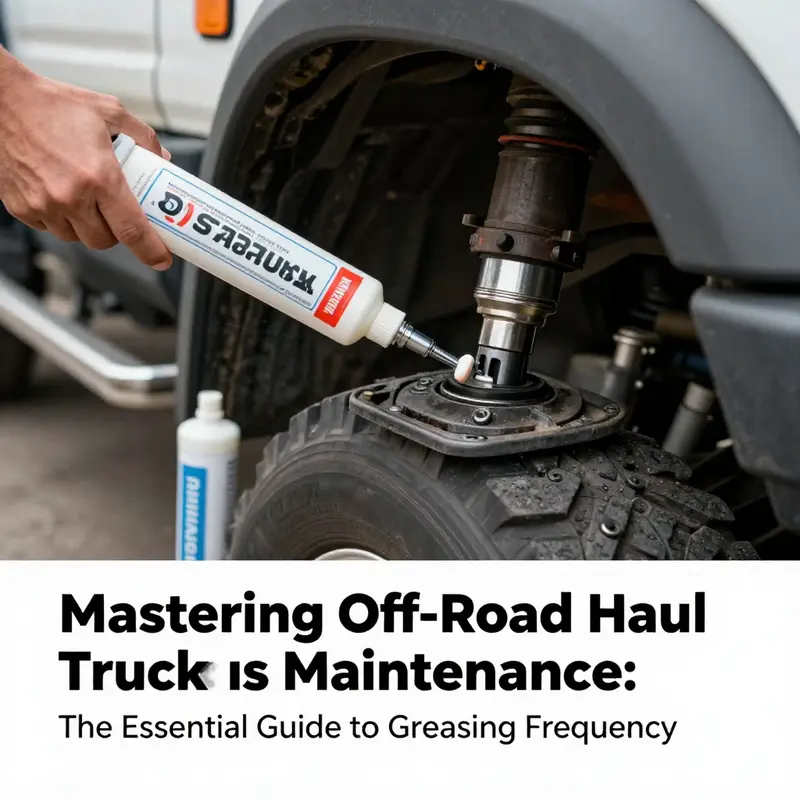
In the harsh world where off‑road haul trucks endure relentless dust, extreme temperatures, and heavy, sustained workloads, lubrication is not a routine afterthought but a line of defense between smooth operation and costly downtime. The accuracy of greasing intervals matters as much as the choice of grease itself. When you push a truck through rock, clay, or desert granules, the smallest edge of friction becomes a lever that can tilt the balance between productive shifts and wrenching repairs. The logic of greasing these machines is not one-size-fits-all; it is a careful calibration that weighs operating conditions, component design, and the guidance that manufacturers provide. The result should feel like a well-tuned system: predictable, reliable, and resilient enough to keep pace with demanding cycles. To begin with, the everyday checks are the foundation. Critical components such as wheel hubs, kingpins, steering arms, and suspension joints deserve attention at least once per day, or per shift, in environments where contaminants are rampant. The goal is to detect early signs of contamination or wear before they translate into misalignment, excessive play, or heat buildup. In practice, this means a quick but thorough inspection of grease fittings, seals, and surrounding housings before the truck leaves the worksite. The same responsibility carries into the way you observe after a long haul in dusty or muddy conditions: if a unit runs through muck all day, the chance of clogging and accelerated wear rises, and a prompt refresh of lubrication can prevent a cascade of failures. Beyond daily checks, the horizon of regular lubrication expands to cover the major chassis and suspension points. For many trucks, the recommended cadence sits in a general band of every 100 to 250 hours of operation. The exact interval depends on how severe the usage is: higher load, rough terrain, and frequent resource-intensive cycles amplify wear forces on joints and bearings. In particularly rugged fleets—where suspensions take the brunt of pounding from rock, ruts, and steep climbs—the interval tends to compress toward the lower end of that spectrum. Conversely, smoother, more controlled operations might extend toward the higher end. This is not a prescription carved in stone; it is a framework that should be interpreted in light of the specific machine model, the nature of the duties it performs, and the environment in which it operates. There are situations that call for even more frequent attention. When trucks run in the harshest environments—dusty deserts, fine‑grained dust that infiltrates every crevice, or rocky terrain that relentlessly abrades joints—the lubrication loop should tighten. In such settings, intervals of 50 to 100 hours can become 25 to 50 hours, ensuring that grease remains a protective barrier rather than a rare anomaly. In practice, operators who live in these extremes often pair visible inspection with real-time cues: a seal that feels warmer than normal, grease that looks unusually dark or gritty, or joints that loosen with less resistance than expected. Each marker signals that the lubrication strategy must shift to preserve bearing surfaces and prevent corrosion, moisture ingress, or seal damage. Crucially, speed of work should never outrun diligence. If a truck transitions from one hard-duty shift to another, the technician’s approach should travel with it. Greasing after a heavy-duty job or after work in extreme dust and mud is not merely recommended; it becomes essential. The rationale is simple: contaminants accumulate quickly where air and moisture meet the grease, and the protective film wears thin under high temperatures and heavy loads. Immediate greasing after such sessions helps reset the lubrication barrier and fortify seals before corrosion or wear initiates a fault that could escalate into an unscheduled downtime episode. The guidance around grease itself is a blend of materials science and practical caution. The prevailing standard in demanding off-road contexts is the use of a high-temperature, EP-grade grease. This type provides superior film strength and oxidation resistance, which translates to longer service intervals and more dependable protection for bearings, bushings, and pins that face repeated cycles of heavy loading and vibration. Yet even with the right grease, over-greasing remains a real risk: excessive smear can force grease into seals, causing leakage or seal failure, while insufficient lubrication invites metal-to-metal contact. The art lies in applying the right amount to fill the gaps without overflowing the housing cavity. A meaningful greasing routine thus blends three threads into a coherent practice. The first is a schedule that mirrors the truck’s workload and environment rather than a calendar date. The second is a touch of diagnostic discipline: every session should include a quick visual check for contamination, signs of moisture ingress, or unusual heat in joints. The third is adherence to the manual—the manufacturer’s service manual, which houses the precise intervals and the exact grease type recommended for each model. This is not a peripheral document but the central compass for maintenance decisions. The manual encapsulates the design intent of the componentry: how seals are mounted, how grease channels are arranged, and how temperature ranges influence grease viscosity and performance. Because off‑road trucks vary widely in alignment, steering geometry, and suspension configurations, reading and following the model-specific guidance ensures that you don’t rely on a generic rule that could misapply to a particular axle or joint. In practice, these principles translate into a narrative of care that is both disciplined and adaptable. For instance, a routine might begin with a quick tour around the vehicle, tracing each grease fitting that girds the wheel hubs and suspension links. The technician then confirms the grease type and fixture compatibility with the grease gun, paying attention to the color, consistency, and presence of any contaminants on the fittings. If the grease appears dirty or gritty, or if a fitting seems hard to thread, it’s a signal to pause, clean, and address any underlying issues before continuing. If a joint feels unusually hot or stiff after a period of service, it’s a caution flag that demands deeper inspection rather than a rushed refill. Such practices turn lubrication from a mechanical formality into a diagnostic act—one that preserves efficiency, safety, and the machine’s longevity. To keep this practice anchored in real options rather than rigid doctrine, it is wise to weave an educational thread into daily routines. A practical primer on diesel systems and maintenance fundamentals—represented in resources that delve into the mechanics behind lubrication and lubrication points—can help technicians interpret warning signs with greater confidence. For a more comprehensive dive into diesel systems and preventive maintenance, see the linked guide: mastering-diesel-mechanics-your-step-by-step-path-to-success. This internal reference serves as a bridge to deeper understanding, reinforcing that greasing is part of a larger discipline of upkeep rather than an isolated task. Ultimately, the healthiest approach to greasing off-road haul trucks rests on aligning the schedule with conditions, staying vigilant for signs of wear or contamination, and treating the manufacturer’s instructions as the authoritative source. The goal is to maintain a continuous, protective film on bearings and joints that can tolerate the punishing cycles characteristic of off-road operation. When done thoughtfully, greasing becomes a quiet, steady rhythm that sustains performance, reduces downtime, and extends the life of a fleet’s most essential mobility assets. For operators seeking current, model-specific intervals and grease recommendations, consult the official maintenance manual provided by the manufacturer. The guidance there reflects the vehicle’s engineering intent and is the most reliable compass for precise schedules. For a broader external reference on maintenance practices, you can review the Haul Truck Maintenance Guidelines at https://www.haultruck.com/maintenance/. External reference: Haul Truck Maintenance Guidelines — https://www.haultruck.com/maintenance/ (This official resource provides comprehensive maintenance guidelines, including greasing intervals based on operating conditions and vehicle models.)
Weathering the Grind: Tailoring Greasing Frequency for Off-Road Haul Trucks in Harsh Environments
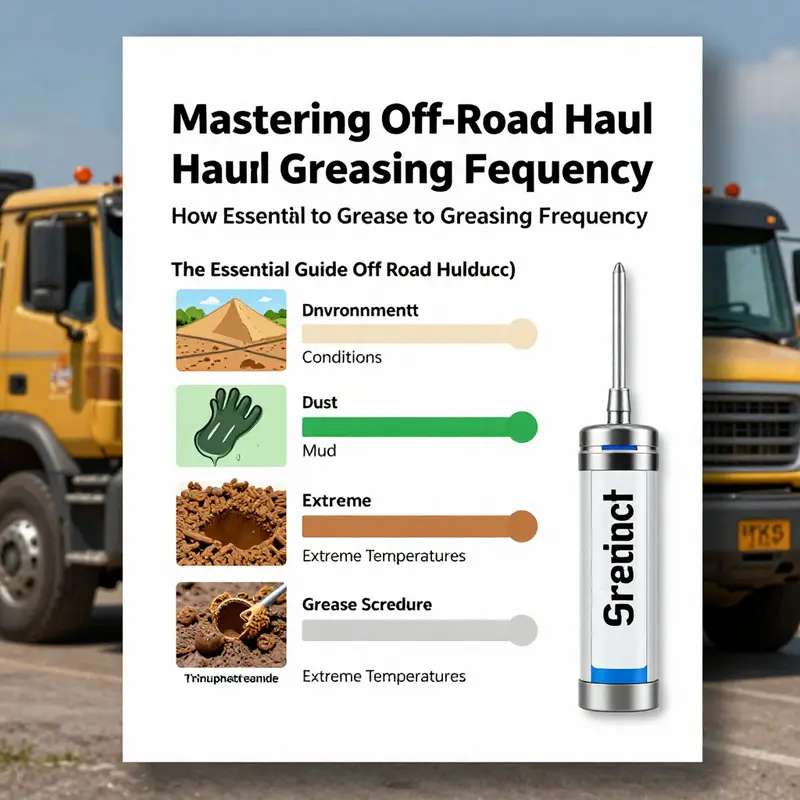
Greasing off-road haul trucks is more than a timing exercise. It is a careful exchange with the environment in which the machine works. The wheels turn, the joints flex, and dust, moisture, heat, or cold all press on the lubrication system in ways that fixed hour schedules often fail to capture. The rate at which grease degrades, contaminant particles accumulate, and seals respond to shifting temperatures is not uniform. Instead, it varies with the conditions the truck faces every day. The chapter you are reading is not a manifesto of rigid intervals but a guide to reading the environment and translating that reading into a grease schedule that protects wear points while avoiding waste and potential damage from over-greasing. In practice, this means balancing three threads: how temperature swings affect lubrication, how contaminants ride into critical points, and how modern greases—along with thoughtful maintenance practice—can stretch service life without compromising protection.
Temperature extremes are the first factor many operators notice when the shop door opens to a new shift. In hot, arid sites, grease can oxidize faster and lose its protective viscosity. The result is thinner films that fail to maintain a robust lubricating barrier between metal surfaces. Surfaces that ride close to failure, such as wheel hubs, kingpins, and suspension pins, become more vulnerable when the grease cannot maintain consistent film thickness under load. In frigid environments, the opposite risk appears: grease thickens, flow slows, and the lubricant can fail to reach where it is needed most. In that scenario, moving joints experience higher friction and accelerated wear. The net effect is a greasing routine that might be adequate in temperate seasons but insufficient when the thermometer spikes or plummets. The key takeaway is that temperature-driven chemistry demands flexibility in scheduling and a preference for greases with robust high- and low-temperature performance specifications.
Contamination compounds the temperature effect. Off-road operations routinely generate airborne dust, dirt, and abrasive particles that ride along seals and fittings. Each particle that penetrates the lubrication pathway accelerates wear and can act as a catalyst that degrades the grease itself. Contaminants can magnify the need for more frequent re-lubrication, especially at points where seals are imperfect or where dust flows into cavities around fittings. Moisture adds another dimension. On wet or humid sites, water ingress is a real threat. Water can wash out existing grease, creating “washing out” conditions that leave metal surfaces exposed and vulnerable to corrosion. The impact is more pronounced when the grease formulation lacks resistance to emulsification or when seals are compromised. The result is a cycle of contamination and dilution that undermines lubrication and shortens component life. Saline or coastal environments intensify these corrosion dynamics, pushing maintenance teams to pay closer attention to seal integrity and to consider greases with superior water resistance.
Together, temperature and contamination push operators toward a practical, condition-based approach rather than a fixed calendar. The most effective schedules emerge from observing how the truck actually performs in its daily environment. Production crews can combine hour-based checks with visual inspections and functional tests. For example, a daily touchpoint might include a quick visual and tactile check of critical joints: are fittings clean and dry, is there any sign of grease leakage, and do joints feel unusually stiff or loose during steering, suspension articulation, or wheel hub rotation? When conditions are harsh—dusty, muddy, wet, or saline—more frequent checks are warranted. In some cases, a job might begin with a high-frequency greasing cadence and taper as the machine runs in milder conditions, then ramp back up if the environment deteriorates again. The aim is not to chase a precise number of hours but to align the lubrication plan with observed wear patterns, an objective reading of contamination in grease samples, and the overall health of seals and fittings.
Lubricant choice remains a central lever in this balancing act. The right grease composition can improve resilience against washing out, preserve viscosity under temperature fluctuations, and extend service life between top-ups. Greases with water resistance and strong calcium-based or lithium complex thickeners often perform well in the dusty, damp, and warm environments typical of large-scale earthmoving. However, no grease is universally perfect. The risk of over-greasing, seal damage, and lubricant entrapment remains a real concern and is as critical as under-greasing. The guidance from manufacturers—through official maintenance manuals—helps ensure the grease type and application method match the specific component geometry, load, and operating conditions. It is easy to assume a more aggressive greasing regime is always safer, but the seal and bearing assemblies are sensitive to lubricant volume and composition. Lubricant choice should be made with environmental considerations in mind, but never at the expense of the machine’s basic lubrication needs.
Another factor shaping greasing strategy is the evolving field of grease technology itself. There is growing interest in bio-based greases derived from natural oils and triglycerides. These lubricants promise better environmental profiles and reduced ecological impact, a benefit on sites where soil and water resources are a concern. Yet, their performance under extreme heat, heavy contamination, or the kinds of shock loads encountered in mining or construction must be carefully evaluated. In practice, switching to bio-based formulations should be accompanied by validation in the field: verify that oxidation resistance, water washout resistance, and shear stability meet the demands of the mission. The trend toward eco-friendly lubricants is encouraging, but it cannot replace the need for performance verification, especially for critical wear points that operate under high load and variable temperatures. Operators should view any lubricant upgrade as part of a broader risk management effort, ensuring compatibility with seals, housings, and greasing equipment.
With these environmental and material considerations in mind, the maintenance rhythm for off-road haul trucks often settles into a hybrid model. For the most critical components—wheel hubs, kingpins, steering arms, and suspension joints—daily checks and light greasing are prudent, particularly in harsh environments where contamination is an ever-present antagonist. For major chassis and suspension interfaces, a baseline of greasing every 100 to 250 hours remains a common reference point, but the exact interval should be tuned to observed conditions. In extreme dust, mud, or after operations in wet, sandy, or saline locales, it makes sense to grease sooner rather than later, ideally immediately after work when contamination is at its peak. The overarching principle is to adopt a schedule based on environment and observable wear rather than relying solely on a factory hour count. This approach lowers the risk of wear and corrosion and can extend the life of bearings and joints, even in the most punishing landscapes. It also aligns maintenance with the broader push toward responsible resource use, reducing the consequences of over-maintenance and wasted lubricants.
To help practitioners translate these ideas into practice, a practical starting point is to couple hours-of-operation with environmental notes. Maintain a simple log that records the ambient conditions, dust levels, water exposure, and the observed condition of fittings after each shift. If the crew notices accelerated wear or signs of washing out on seals, the plan should call for an immediate, targeted grease reapplication and a review of grease type and nozzle accessibility for the joint in question. The long answer to “how often should I grease?” is never a single number. It is a living protocol that responds to the climate, the site, and the machine’s behavior in service.
For a broader view on dependable maintenance practices and how to build a resilient, knowledge-driven maintenance routine, see Mastering Diesel Mechanics: Your Step-by-Step Path to Success. This resource offers practical methods for translating field observations into actionable maintenance plans that protect critical wear points while supporting efficient operations. By combining careful observation, appropriate lubricant selection, and a willingness to adjust schedules in response to environmental cues, fleets can keep off-road haul trucks performing at a high level even under demanding conditions. And as researchers continue to explore bio-based options and advanced grease formulations, the approach remains grounded in three core ideas: know the environment, know the lubricant, and know your machine well enough to adjust the rhythm when the environment changes.
External reference for further reading on formulation and environmental impact of greases: https://www.sciencedirect.com/science/article/pii/S0142961211003875
Grease Now or Pay Later: The Critical Rhythm of Lubrication for Off-Road Haul Trucks
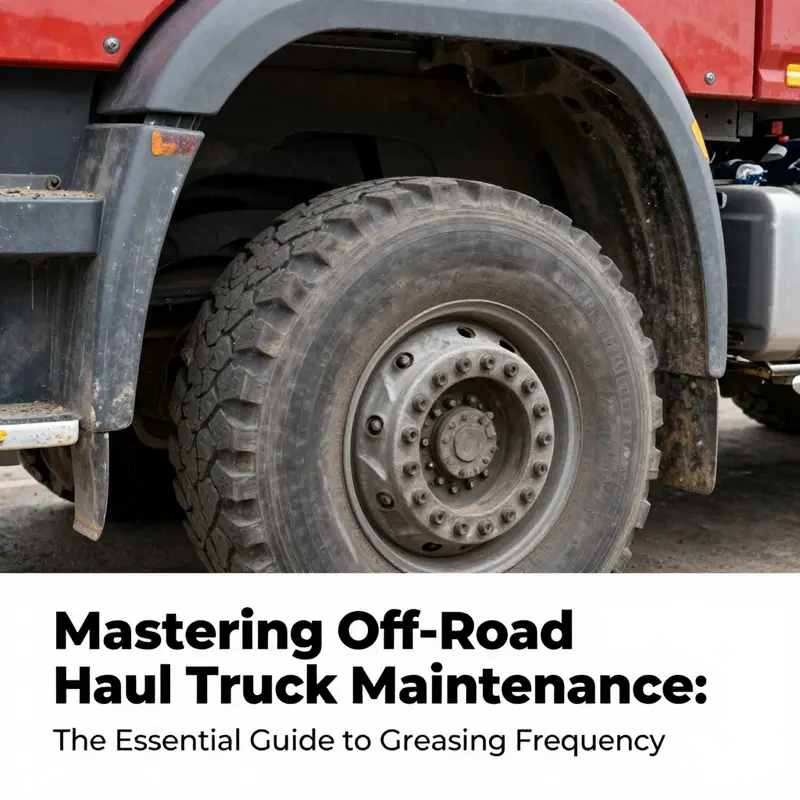
When an off-road haul truck works load after brutal load in dust, mud, and crushing heat or biting cold, its survival hinges on something as simple as grease. Lubrication isn’t a one-off task; it is the steady rhythm that keeps metal from grinding into metal, seals from seeping contaminants, and bearings from seizing when the pressure is highest. In environments where a single stuck joint can sideline a whole shift, the cadence of greasing becomes not just maintenance but a safety and reliability vow. The right frequency is not a fixed needle in a haystack; it is a balance among how the machine is used, the conditions it endures, and what the manufacturer prescribes. The aim is straightforward: maintain smooth motion while preventing the harsh drama of wear, heat, and contamination from spiraling into costly repairs or unscheduled downtime.
To understand the practical rhythm, begin with the components that demand the most immediate attention. Critical joints such as wheel hubs, kingpins, steering arms, and suspension links operate under repeated cycles of heavy load and exposure to abrasive dust. In harsh environments, their lubrication needs are amplified, and neglect shows up quickly as binding, wandering steering, or delaminated suspension bushings. These elements aren’t isolated parts; they are part of a connected system whose performance depends on consistent, clean lubrication. The moment grease thins or dries, micro-welding can begin between surfaces that should slide freely. A small delay multiplies into heat, particulate intrusion, and accelerated wear. In such a system, daily checks and lubrication become the baseline for reliability.
Beyond the daily touchpoints, most manufacturers sketch a broader interval for major chassis and suspension points. The range commonly cited across big heavy-duty fleets sits near 100 to 250 hours of operation, with the exact cadence tuned to severity of use. A mine or construction site that pushes trucks through steep grades, rocky terrain, and continuous cycles will demand the tighter end of that spectrum, while less punishing cycles may land closer to 250 hours. The principle is simple: monitor how hard the machine works and adjust frequency accordingly. As a practical rule, a routine that keeps those major joints greased every few shifts in the most demanding environments can prevent a cascade of wear that would otherwise show up as reduced travel, erratic steering, or noisy operation.
There are situations, however, when the interval needs to shorten even further. After each job or after heavy-duty use, especially where dust and moisture are persistent, greasing all fittings immediately helps prevent the entrance of abrasive contaminants into seals and bearings. In dusty, muddy, or wet environments, contamination becomes a primary enemy. It’s not enough to grease in the morning and assume the job is done; the dirt is always waiting at the gate. A quick post-work grease can lock in a protective film and seal more effectively, reducing the chance of corrosion and wear when the next cycle begins. This practice aligns with the broader maintenance philosophy that greasing is part of a larger cleanliness and protection strategy.
Choosing the right grease matters just as much as choosing when to apply it. Heavy-duty off-road applications typically rely on a high-performance, multi-purpose lithium-based grease. This type of grease offers good film strength, temperature tolerance, and water resistance, which are essential when equipment operates at high loads in variable conditions. Using the wrong grease or greasing too aggressively can cause more harm than good. Over-greasing can blow seals or force grease into areas where it can attract more dirt, while under-greasing invites metal-to-metal contact and bearing failure. The maintenance manual for your truck is not a suggestion; it is the compass. Follow the recommended grease type and application method exactly as the manufacturer prescribes, and document any deviations with a rationale grounded in operating conditions.
A practical grease routine begins with preparation. Before applying new lubricant, clean the grease fittings to remove dust and old residues. Use a grease gun with a pressure gauge to monitor resistance. If the grease won’t flow or the fitting feels blocked, this may indicate a failed seal or internal damage, and the diagnosis should shift from routine maintenance to inspection. Purge old grease so that the new layer can form correctly, and ensure the old film is fully expelled to avoid contaminant pockets. This discipline—clean, purge, apply—keeps the lubrication system from becoming a source of contamination rather than a shield against it.
The consequences of neglecting greasing are not abstract. When lubrication fails, the drive train, wheel hubs, steering linkages, and pivot points begin to suffer. The drive shaft universal joints, for example, can suffer from insufficient lubrication, leading to accelerated wear, overheating, and sudden failure at a moment of heavy load. Such failures do not just end a shift; they risk safety and can trigger expensive downtime. The data behind these risks is stark: industry observations suggest that a large share of mechanical failures in heavy equipment is linked to inadequate lubrication. This is not merely a maintenance cost; it is a reliability and safety issue that affects uptime, throughput, and ultimately the bottom line.
Conversely, the grease routine should not be treated as a ritual devoid of consequence. Excess lubrication or misapplied grease can contaminate seals and bearings, potentially causing seal degradation or grease intrusion into braking systems or linkage assemblies. A trapped or overworked seal can fail, allowing water, dust, or mud to penetrate and accelerate deterioration. The goal is a clean, consistent film that cushions moving parts, not a thick, gumming layer that traps debris. The best practice is to stay within manufacturer intervals and to adjust only as your operating context dictates. When fleets log and review grease hours, operators gain a practical picture of wear patterns, enabling more precise scheduling that balances protection with efficiency.
This approach ties together the mechanical realities with the human discipline of maintenance records. A robust lubrication program is as much about data as it is about grease. Fleet managers should maintain a simple ledger of hours since last service, noting operating conditions such as dust levels, water exposure, and load intensity. In this way, the plan becomes dynamic rather than static, responsive to what the machine has endured rather than a set-and-forget calendar. And when in doubt, the primary source remains the manufacturer manual. Tailoring intervals to the specific model and its components ensures you’re not guessing at risk but following engineering guidance that corresponds to the machine’s design and its intended use.
For those who want a deeper dive into the broader mechanics behind these recommendations, a related path is to explore diesel systems and maintenance practices. A comprehensive resource such as Mastering Diesel Mechanics: Your Step-by-Step Path to Success offers a structured look at how diesel engines and their related subsystems behave under heavy-duty load, reinforcing the idea that careful maintenance is a holistic discipline. Mastering Diesel Mechanics: Your Step-by-Step Path to Success provides context that helps operators understand why greasing sits at a critical intersection of engine health, power delivery, and transmission reliability. The link serves as a practical reminder that lubrication decisions ripple through the entire drivetrain, amplifying the value of disciplined, model-specific maintenance.
The conversation about greasing is incomplete without acknowledging that it is not a one-size-fits-all routine. The frequency and the exact intervals should be calibrated to the machine’s duties, the site conditions, and the wear patterns observed over time. The safety implications are real: properly lubricated joints contribute to predictable steering, reliable braking in adverse conditions, and reduced risk of sudden component failure that could cause loss of control in a hazardous environment. When grease penetrates the right joints at the right times, the truck remains more controllable, the parts stay cooler under heavy loads, and components wear more slowly. This translates into steadier production, lower maintenance costs, and a safer working environment for operators and ground personnel alike.
In the end, greasing is a disciplined, evidence-based habit rather than a mere mechanical chore. It is a practice that protects life, asset value, and the ability to keep moving when conditions press in from all sides. The cadence—daily checks on critical points, 100 to 250 hours for major chassis and suspension, and post-work greasing in extreme environments—reflects the real-world demands of off-road hauling. It is a routine that respects the science of lubrication while honoring the practicalities of field operations. When executed consistently, it yields a quieter footprint of wear, a steadier rhythm of uptime, and a safer, more productive fleet.
External resource: Lubrication Best Practices for Heavy-Duty Off-Road Equipment. https://www.sae.org/publications/technical-papers/content/2023-01-0284/
Lubrication Cadence for Off-Road Haul Trucks: Reading Manufacturer Guidelines Against Field Realities
On rough-duty off-road haul trucks, lubrication is a lifeline rather than a luxury. The right cadence balances the truck design, the environment, and operator discipline to prevent wear, heat, and downtime. Reading manufacturer guidance first provides a baseline, but field realities determine the actual schedule. The overarching rule is to lubricate before wear, and to verify that grease reaches the intended surfaces without causing contamination or seal damage.
Daily checks concentrate attention on critical joints such as wheel hubs, kingpins, steering linkages, and suspension pins, especially where dust, mud, or high temperatures can drive contamination. Visual inspection, cleanliness of fittings, and evidence of leaks should accompany every lubricant application. A daily greasing habit is as much a health check as a replenishment, catching seals that have deteriorated or vents that have begun to leak.
Beyond daily checks, manufacturers typically publish an interval band. A practical range for major chassis and suspension points is roughly 100 to 250 hours of operation, with the exact point inside that band chosen by service severity. In severe service heavy payloads on rocky terrain or persistent dust, the interval tends toward the shorter end.
In extreme-use contexts or in continuous mining and similar operations, intervals may shrink further to the 50-100 hour range for critical joints. Conversely, in milder environments with clean conditions and well maintained components, a routine based on hundreds of hours may be acceptable, provided it is supported by visual checks and pump-driven confirmation that lubrication points remain clean.
Grease selection and quantity matter as much as cadence. The grease must suit the operating temperature, exposure to water and dirt, and compatibility with seals and housings. Too thin grease can vent away; too stiff grease can hinder penetration. Too much grease can contaminate braking components or cause seal extrusion. Modern practice favors calibrated lubrication with appropriate grease type and quantity, and many fleets are moving toward centralized lubrication systems for consistency.
To apply the guidance in the field, adopt a shift-driven routine: record hours since last grease, note environmental conditions, and adjust the next interval based on a concise assessment. In dusty or muddy periods, re-grease after each job or full cycle; after rain or dry spells, err on the side of caution and shorten the interval. The goal is a lean, responsive program that protects bearings and seals without inviting overpressure or downtime.
People remain central. A grease gun is a tool, not a cure-all. Execute before and after checks by looking for grease leakage, seal deformation, unusual heat or vibration, and signs of misalignment. Document hours, conditions, and observed status of fittings to ensure continuity across crews and shifts and to justify interval adjustments when field conditions change.
For deeper context, refer to vendor manuals and broader diesel-mechanics knowledge. A step-by-step study of lubrication as part of a maintenance program helps translate manuals into a field-tested schedule. Official maintenance manuals portals and manufacturer specifications provide precise intervals, locations, and grease types for each truck model. See for example Mastering Diesel Mechanics: Your Step-by-Step Path to Success at https://dirtantrucks.com/mastering-diesel-mechanics-your-step-by-step-path-to-success/ and the official maintenance manuals portal at https://www.cat.com/en/support/maintenance.html.
Final thoughts
Proper greasing is a critical component of off-road haul truck maintenance that can significantly enhance performance and extend the life of your vehicle. Each chapter of this guide has aimed to elevate your knowledge about when and how often to grease your truck for different situations. Whether you’re operating in extreme conditions or just maintaining standard performance, staying disciplined about greasing schedules is essential. Always remain vigilant, consult your manufacturer’s guidelines, and prioritize daily checks to keep your off-road experience as exhilarating and trouble-free as it can be.