
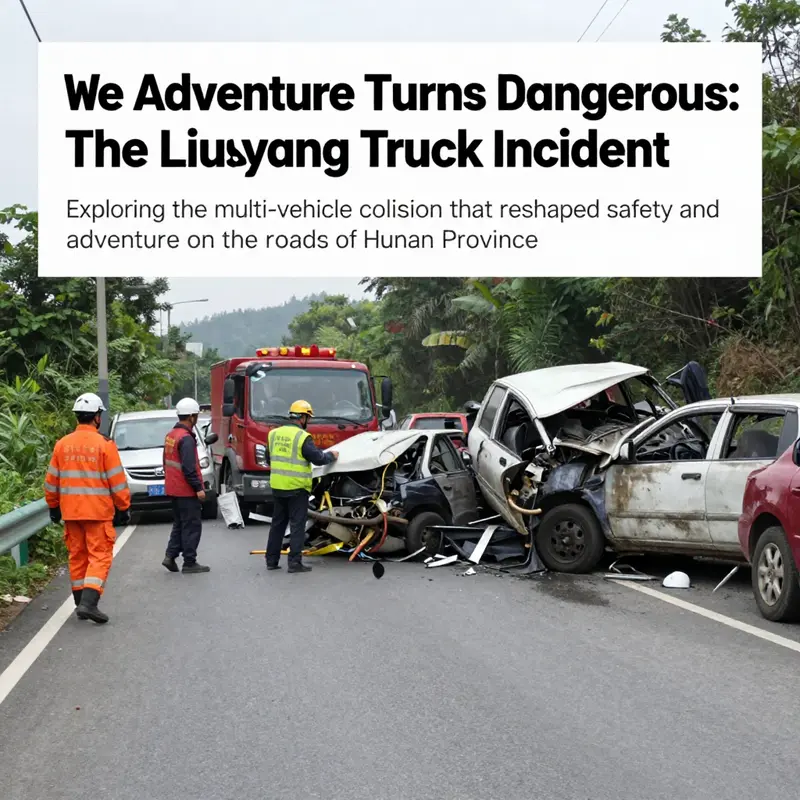
The sun shone bright over Wenjia Shi Town on May 4th, 2017, casting a stark contrast to the tragic events that befell a community enjoying a wedding celebration. What began as a familial journey turned to chaos when a truck, loaded with equipment and ambition, collided with a rural bus, forever altering lives and sparking discussions about safety in off-road adventures and trucking practices. As we delve into the details of this multi-vehicle accident, we will uncover the complex interplay of human lives caught in a moment of unexpected tragedy. Chapter one will recount the incident that unfolded that fateful day, chapter two will highlight the human cost associated with the collision, and chapter three will examine the emergency services’ response and traffic management efforts following the disaster.
Liuyang Collision: Reconstructing Lessons for Safer Heavy Trucks
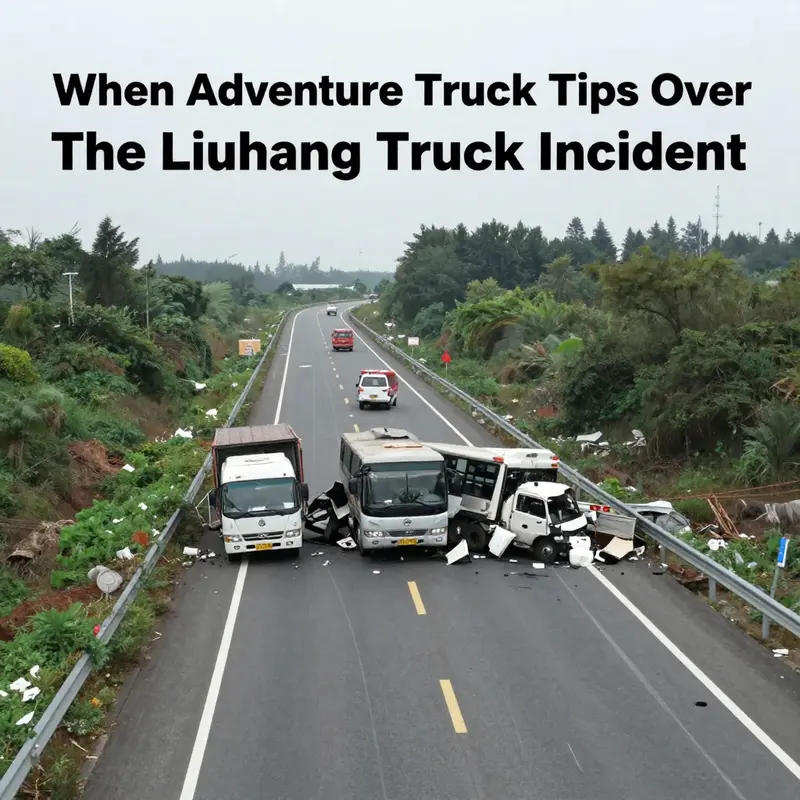
On May 4, 2017, a multi-vehicle collision on a Liuyang highway service area drew attention to heavy-truck safety on mixed roads. Public materials suggest a large truck and a passenger bus collided near a gas station in daylight with dense traffic. Because official reports are not publicly detailed, the case becomes a case study in how road geometry, vehicle loading, and driver situation awareness interact to produce dangerous moments. The chapter reviews how real-time perception, path planning, and automatic braking or steering can mitigate similar events even when data are incomplete. It also stresses the social context: a wedding party traveling with relatives, the role of family expectations, and the impact on communities. From this, fleets can derive practical actions: safer route selection, vigilant maintenance of tires and brakes, balanced loads, and driver training in fatigue management. Policy perspectives include safer shoulder design, clearer signage, and robust safety architectures that remain effective even with imperfect sensor data. The overarching aim is to translate lessons from fragmentary incidents into concrete improvements for safer highways and safer trucks.
When Wheels Drift into the Unknown: Reading the May 4, 2017 Liuyang Run-Off-Road Crash as a Lens on Truck Safety, Family, and Economic Cost
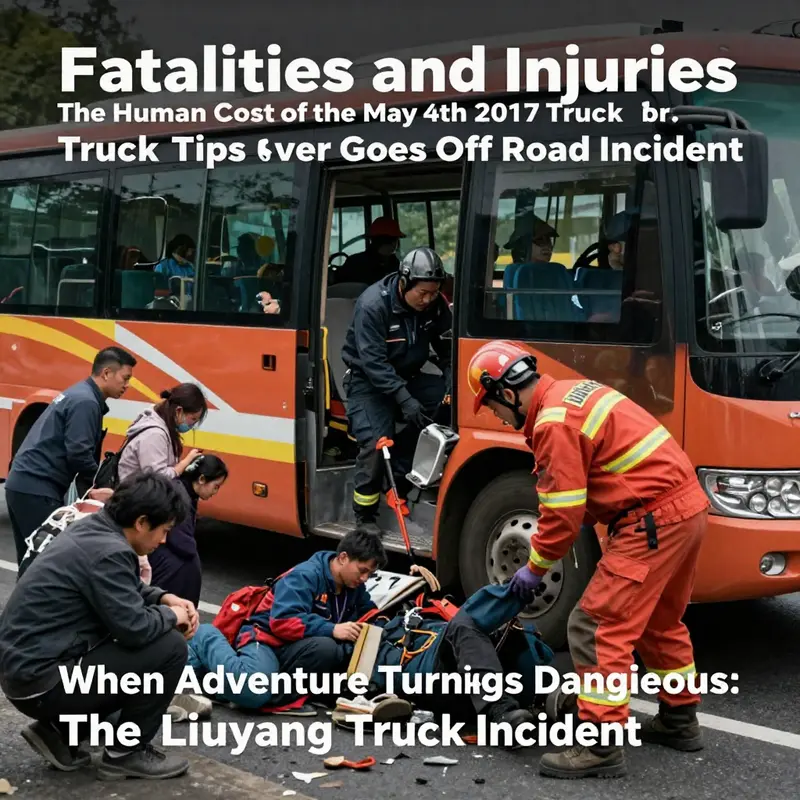
The afternoon of May 4, 2017 carried a quiet, almost ordinary rhythm in many parts of rural China—a sun-warm road, the hum of tires on pavement, and the familiar choreography of a wedding guest list and family departures. On the Dawen Highway near a gas station that afternoon, a multi-vehicle collision unfolded that would redraw attention to a type of danger that often travels under the radar: the run-off-road crash involving a large truck and a rural bus. Reports indicate the truck bore a Jiangxi license plate, GAN C, and that the bus had been chartered to move relatives after a wedding. The scene, captured in late-afternoon light, was not merely a local accident; it was a stark reminder of how quickly a moment of misjudgment, mechanical fault, or road condition can cascade into a broader crisis. Yet the precise tally of fatalities and injuries from that specific moment remains elusive, a gap that echoes across many run-off-road incidents where official records lag behind the lived impact. In this way, the Liuyang event becomes both a singular news incident and a case study in a longer, quieter conversation about how heavy vehicles navigate roads designed for many tempos of life, not just the ones behind the wheel.
What follows in the reach of this chapter is not a search for a single casualty figure but a mapping of the terrain that makes such crashes possible, and the consequences that stretch far beyond the immediate wreckage. A central feature of the broader analysis of run-off-road crashes, including the Liuyang event, is the realization that the human cost is inseparable from the economic and social costs that ripple through families, communities, and regional economies. When a truck veers off, it is not only a question of steel, glass, and speed. It is a question of what safety means in daily life, of what families lose when a wedding party shifts from celebration to mourning, and of what governments and industries pay to repair the damage—financially, socially, and morally.
The available information about the Liuyang crash situates the event within a familiar pattern: a collision that involves at least two large vehicles on a highway near urban-rural interfaces, at a time when traffic flows are dense enough to complicate post-crash responses, yet not so dense as to guarantee quick, organized emergency response. The bus, positioned as a social connector—relatives moving after a family wedding—embodies a crucial social purpose that intersects with transportation risk. The truck, part of the heavy-vehicle fleet that keeps economies moving, represents the other side of mobility: the load-bearing backbone of supply chains, infrastructure, and rural livelihoods. When these two modes of travel cross paths in a ground-level event like a run-off-road crash, the consequences compound in ways that are not always visible in early rescue reports. There is the immediate concern for survivors and the families waiting for word; there is the longer-term shadow of medical costs, lost wages, and the emotional toll that can alter life trajectories for years.
The research landscape surrounding run-off-road crashes offers a sobering frame for understanding the Liuyang incident. While it is not possible to confirm the exact casualty count for this specific day, the broader body of work on run-off-road crashes presents a stark picture. A recent synthesis shows that run-off-road crashes produce enormous economic costs, even when the number of fatalities is not extraordinary. The analysis estimates roughly $64 billion in direct economic losses tied to run-off-road events in the aggregate, with total societal costs reaching about $298 billion. These figures are not incidental; they account for a wide spectrum of consequences—medical expenses, long-term care, wage losses, productivity reductions, property damage, and the ripple effects on families who rely on transportation for work, education, and care. The numbers occupy a substantial share of the overall costs of traffic incidents: roughly 27 percent of all traffic-accident economic costs and about 36 percent of total societal costs. In other words, when a heavy vehicle exits the road and disrupts the flow of movement, the financial and social price is not confined to a single moment or a single road.
This framing matters because it shifts attention from a sensational headline about a crash to a more expansive view of what safety means in the real world. If we listen to the numbers and the reported contexts, we hear echoes of families gathered for celebrations who suddenly become part of a broader statistics ledger—an unwelcome intersection of joy and harm. The Liuyang incident, like many run-off-road crashes, highlights two stubborn truths. First, the risk is not uniformly distributed along the road network; it concentrates at points where heavy vehicles interact with varying road surfaces, speed limits, sightlines, and traffic patterns. Second, the consequences extend beyond the vehicle occupants to the relatives waiting at the other end of the trip, to the towns along the corridor that shoulder the social and economic cost, and to the fleets and infrastructure tasked with preventing such events in the first place.
As a narrative about risk and resilience, the Liuyang scene invites us to consider what safety looks like when it is not merely about avoiding a roll but about shaping the conditions that prevent a close call from becoming something irreversible. The immediate safety response—emergency services, triage, and the rapid clearance of the roadway—matters. Yet so does the longer arc: improvements in driver training, vehicle maintenance, and the design of the road itself. Run-off-road crashes often reveal gaps in protective infrastructure that would reduce the severity of an incident if present in the right places. Guardrails, clear run-off zones, proper signage, and road lighting all function as a collective safety system. When such a system is robust, a momentary misalignment of speed, perception, or weather need not become a tragedy broadcast across social media and family albums. The Liuyang event, then, becomes a cautionary tale about what it takes to turn a hazardous stretch of road into a space where heavy vehicles can travel with a margin of safety that is less precarious and more predictable.
From a human perspective, the absence or ambiguity of exact casualty data for this particular crash should not obscure the broader moral: every run-off-road crash involves real people with real lives, hopes, and obligations. The bus carrying relatives after a wedding evokes a social fabric in which mobility is a fragile thread. When a vehicle leaves the asphalt, that thread can fray in ways that extend beyond the individual passenger or the bus driver. The families involved face the unknown—medical bills, potential injuries that alter the ability to work, and the emotional labor of recovery. In economic terms, the costs accumulate in layers: immediate medical intervention, long-term rehabilitation, the disruption of family income, and the price of rebuilding trust in a system that moves people every day. These layers are rarely visible in the first minutes after a crash, but they accumulate in the weeks, months, and years that follow. The Liuyang incident thus stands as a moment to reflect on how society values and preserves life under pressure, and on how transportation policy, road design, and fleet management intersect with that value.
A central implication emerges when we connect the Liuyang crash to the broader body of evidence on run-off-road events: the need for a more integrated approach to safety that treats trucks not simply as cargo carriers but as moving components of a safety ecosystem. This ecosystem includes the road surface and its maintenance, the speed and behavior of other road users, and the reliability of communication and response systems that bridge the moment of danger to the moment of care. The social context—the wedding party, the family relatives, the rural setting—underscores that safety is not just a mechanical issue but a social one. It requires attention to human factors: fatigue, decision-making under time pressure, the risk of distraction, and the social pressures that influence travel decisions, such as leaving a ceremony to catch a bus, timing a trip to avoid crowds, or rushing to meet schedules. In rural and semi-rural corridors, these factors are magnified by limited alternative routes, fewer mitigating options, and longer distances to emergency services. When such conditions align with a high-dynamic event like a run-off-road crash, the result is a complex cascade that is difficult to capture in a single moment on a single road.
The Liuyang case invites a practical meditation on what kinds of changes could reduce the probability and severity of similar incidents. From the management side, fleets could benefit from stronger pre-trip checks, meticulous maintenance of braking systems, tires, and load securement, and more disciplined adherence to speed limits on roads with known curvature or surface variability. From the infrastructure side, road authorities could invest in improved guardrails, better shoulder design, and more intuitive corridor layouts that create forgiving spaces for heavy vehicles that momentarily drift from their lanes. From the policy side, clearer data collection practices about run-off-road crashes would enable more precise risk profiling, allowing governments to identify hotspots and allocate resources where they matter most. And from the public-safety communications angle, more efficient emergency response networks—coordinated between highway patrol, local hospitals, and roadside services—could shorten the critical minutes when every second counts after a crash. The Liuyang event, like many run-off-road fatalities, becomes a touchstone for a broader insistence that safety is not a discrete intervention but a continuum of improvements that converge over time.
In the scholarly and safety-improvement conversations, the numbers tied to run-off-road losses frame a moral economy: it costs a lot to not invest in prevention, and the payoff of prevention can be measured in lives saved, families spared, and communities kept functioning. If we listen closely to the data, we learn that the cost of a run-off-road crash goes beyond the immediate property damage and medical bills. It includes the degraded ability of a local economy to function when key transport links are impaired, the emotional and cognitive load carried by survivors and relatives, and the longer-term implications for road users who begin to mistrust the very routes they rely on to earn a living or reunite with loved ones. The Liuyang crash stands as a microcosm of this larger calculus. It is a reminder that road safety is not merely about preventing a single incident but about creating a system in which the consequences of missteps are mitigated through redundancy, resilience, and humane design.
In terms of practical takeaways, the Liuyang event emphasizes humility in the face of uncertainty. The precise casualty figures may remain unknown, but the structural vulnerabilities are discernible enough to guide action. For drivers, continuous training that reinforces the critical balance between speed, attention, and vehicle control remains essential. For operators, stricter maintenance regimes and load-management protocols can reduce the likelihood that a vehicle becomes unstable on a curve or an uneven surface. For policymakers, better data capture and transparent reporting enable the kind of evidence-based decisions that prevent similar events or at least lessen their impact. And for society at large, the Liuyang crash underscores the value of community awareness about the real costs of mobility illusions—the belief that travel is simply a matter of getting from one place to another, without recognizing the fragility that can accompany heavy vehicles on mixed-use roads. The wedding bus and the highway lane become more than a travel line; they become a living reminder of how ambition, tradition, and industry converge on a shared path, and how safety must be built into that path with care and investment.
As this chapter moves toward broader reflections, the Liuyang incident is best read not as a solitary misfortune but as a data point in a larger pattern—one that compels readers to ask how roads, fleets, and communities can be aligned to reduce both the likelihood of run-off-road events and the severity when they do occur. The economic figures—tens of billions in direct costs and hundreds of billions in total costs—are not abstractions but the visible toll that accompanies the failure to prevent these events. The human toll, though not fully enumerated in this specific case, is no less real: the faces of relatives waiting for news, the households budgeting for medical care, the towns assessing the disruption to daily life. These are not ancillary concerns; they are the core of what safety is meant to protect. If there is a constructive residue from the Liuyang incident, it is this: a call to action for safer roads, smarter fleets, and a resilient social fabric that can absorb the shock of a run-off-road collision without breaking the families and communities that rely on movement as a daily necessity.
Within this frame, the incident also invites readers to consider the value of cross-cutting safety conversations that extend beyond engineering and economics. The integration of human factors, road design, fleet management, and emergency response requires a language of safety that is accessible to families, local leaders, and workers who depend on reliable transportation. In that sense, the Liuyang event is a narrative about not only what happened on a highway on a spring afternoon but also about what should be done to prevent the next collision from becoming a similar imprint on the memory of a community. It is a reminder that the road is a shared space, and safety is a collective responsibility that demands attention to both the minute details of vehicle dynamics and the larger contours of social life. As such, it should prompt ongoing dialogue among engineers, policymakers, drivers, and residents about how to make the act of traveling a refuge rather than a risk, especially when the journeys are undertaken to reunite families, to celebrate moments of joy, and to keep the social fabric intact despite the uncertainties of the road ahead.
For readers seeking a bridge between this chapter and the broader conversation about road safety and truck performance, a useful reference point is the broader body of crash-test research that informs how vehicle design translates into real-world outcomes. While numbers tell one part of the story, controlled crash-test data illuminate how certain design choices influence the likelihood and severity of injuries in various crash configurations. IIHS crash-test results serve as a reminder that the safety envelope for any heavy vehicle is not merely about strength but about the interplay of restraint systems, crumple zones, control systems, and the human factors that determine how a vehicle responds in the high-stakes moments just after a loss of control. This chapter, while focused on a specific event, is inseparable from that larger inquiry into how engineering and policy can converge to make the road safer for all who travel it. The Liuyang incident thus sits at the confluence of human experience, economic consequence, and technical insight—a triangulation that reframes understanding from a single accident to a holistic agenda for safer movement on every highway and rural route where heavy trucks and bus passengers share the road.
In closing, the May 4, 2017 Liuyang run-off-road crash is not merely an entry in a list of traffic incidents. It is a prompt to examine how society values safety, how data is collected and interpreted, and how investments in infrastructure, vehicle maintenance, and driver training translate into tangible reductions in harm. It is about the moment when a family’s journey—rooted in celebration and connection—intersects with the unpredictable forces of road, vehicle, and environment. And it is about the recognition that the costs of inaction are measured not only in dollars and cents but in the fabric of community life. As the article that frames this chapter continues, the takeaways are clear: safer roads, better trucks, and more robust emergency responses are not luxuries but necessities for a world in which movement is the currency of daily life and safety must be the standard by which every mile is measured.
Aftermath and Response on May 4, 2017: Emergency Services, Traffic Management, and Lessons from a Truck Off Road
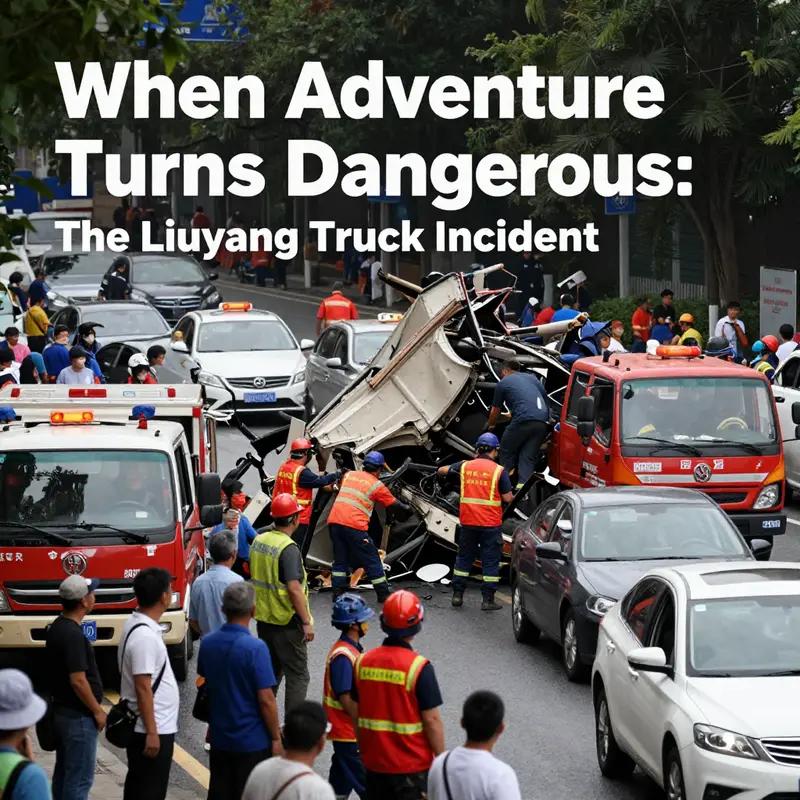
On May 4, 2017, the roads of southern China carried more than the fretful quiet of a weekday dawn. That day, a heavy-duty semi-trailer and its accompanying load were negotiating a curve on a provincial artery when control ebbed away. In Guangxi, along the S511 corridor near the Lotus Mountain Tunnel, a single miscalculation—an overconfident or fatigued moment, a momentary lapse in concentration, or perhaps a combination of factors—set off a chain of events that ended with the truck overturning and its mass blocking the road. The incident began in the pre-dawn hours, a time when visibility is uncertain and the margin for error narrows, especially for vehicles carrying heavy loads through winding topography. The truck involved bore a license plate registered in Guangxi, and it was towing a flatbed trailer. The immediate aftermath demanded a coordinated response that would test the resilience of local emergency services, the efficiency of traffic management, and the public’s adherence to safety norms in moments of danger. While the scene centered on a single vehicle, it resonated with a broader pattern of May 4, 2017, a day marked by multiple road incidents across different provinces, each revealing a different facet of risk and response on China’s fast-moving transport network. In Guangxi, however, the focus was on how a rollover unfolded, how rescue and recovery were organized, and what such a case could teach about preventing future tragedies on similar routes and curves.
From the first moment responders arrived at the scene, the priority was clear: secure the site, protect nearby motorists, and prevent secondary crashes. The early hours of the morning, when light is scarce and speeds tend to be higher due to a false sense of quiet, demand a rapid triage of hazards. The fire and police teams dispatched to the Lotus Mountain Tunnel region encountered a vehicle that had already disrupted the lane and partially blocked the roadway. They worked to establish a safe exclusion zone, ensuring that other drivers would not approach an unstable load or encounter debris, fuel, or cargo that could shift dangerously during subsequent movements. The responders’ tasks extended beyond immediate rescue; they included stabilizing the overturned trailer, preventing spillage, and coordinating with traffic management authorities to re-route vehicles through alternate corridors and service lanes. In the quiet rhythm of incident response, every action had to be deliberate: securing the hazard, guiding oncoming traffic away from the scene, and preparing for the moment when the vehicle could be righted without causing further harm.
The social dimension of May 4, 2017 adds a layer of complexity to the narrative. In other regional accounts from the same day, vehicles carried people off on journeys with social significance, including family members and relatives returning from events such as weddings. These contexts matter because they shape the human stakes of such crashes. They remind responders that every vehicle carries people with lives and responsibilities that extend beyond a numerical casualty count. In Guangxi, the focus remained squarely on the mechanics of accident response and the operational improvisation required when a large heavy vehicle blocks a critical artery. As crews worked to clear the scene, they confronted common challenges: the limited space afforded by tunnels, the need to coordinate vehicle movement through long detours, and the ever-present risk of a secondary collision as other drivers slowed or swerved to avoid the scene. The response had to be both rapid and methodical, balancing urgency with safety, and it required clear lines of communication between traffic police, fire services, and roadway maintenance teams tasked with reopening the passage as soon as practicable.
In the minutes and hours that followed, the investigation began to peel back the layers of causation. According to the official assessment released several years later, the direct cause lay in the driver’s failure to drive safely and to operate in accordance with traffic regulations under the Road Traffic Safety Law. This determination underscores a broader admonition that resonates across similar incidents: when a heavy vehicle loses control on a curve, the margin for error is slim, and the consequences can be severe. The driver, identified in the report as Mr. Liu, was found fully responsible for the accident, a verdict that places emphasis on driver behavior—speed management, route adaptation to terrain, and adherence to operational procedures—as the central risk factors in rollover events. Yet even as responsibility was assigned, the human elements remained in focus. The report notes that the driver wore a seatbelt, a simple act that proved critically life-saving in the immediate aftermath of a rollover. This detail, while small, reinforces a core safety lesson: passenger protection hinges not only on vehicle design and road infrastructure but also on the disciplined choices of those behind the wheel.
The sequence of response actions illustrates what effective roadside management looks like in practice when a truck overturns in a tunnel-adjacent stretch. Fire crews executed a controlled stabilization of the trailer, preventing additional shifts that could aggravate the situation. Police officers established a perimeter rapidly, using cones and temporary barriers to deter other drivers from entering the danger zone. Roadway maintenance teams coordinated with traffic police to implement a phased re-routing plan that minimized confluence of inbound and outbound traffic around the tunnel approach. The aim was not only to clear the crash but to maintain a safety mesh for the broader corridor, preserving access to essential services and maintaining supply chains for the region. The Lotus Mountain Tunnel context added complexity; tunnels concentrate risk due to proximity to fuel sources, limited egress, and the potential for smoke or fumes to impede visibility. In such environments, a staged deconfliction plan—first isolate and secure, then assess and recover, then reopen in controlled increments—often marks the difference between a protracted closure and a swift, orderly return to traffic flow.
Beyond the immediate logistics, the Guangxi incident offered a moment to reflect on how such events intersect with ongoing efforts to improve driver training and enforcement of safety standards. The legislative framework cited in the official findings—specifically the Road Traffic Safety Law and its articulations about safe driving practices—serves as a national standard, but the application of those standards in day-to-day operations depends on training, oversight, and the incentives that shape driver behavior. The case highlighted the delicate balance between allowing crews to perform essential transport tasks and requiring them to exercise precise discipline when confronted with demanding driving conditions. It also drew attention to the resilience of safety practices in the face of human error; the fact that the driver wore a seatbelt offered a concrete example of how personal protective measures can mitigate the risk of fatality in rollover scenarios. The chain of responsibility extended beyond the moment of impact to include pre-trip planning, vehicle inspection, cargo securement, and the monitoring of route risk factors such as curve radii, road grade, and tunnel entry points.
In that sense, the Guangxi rollover becomes more than a news item. It functions as a case study in the ethics and logistics of road safety. The emergency services’ performance—timely dispatch, clear scene management, and an adaptive approach to traffic control—illustrates how well-coordinated response can reduce the potential for cascading crashes that often compound such incidents. The traffic management response—redirection away from the tunnel, use of alternate routes, and a staged reopening—demonstrates how the safety net surrounding a major transport corridor operates in practice. The incident thus informs both frontline responders and fleet operators who must learn from what went right and what could be improved under pressure. For readers who study the mechanics of prevention, the case underscores three enduring priorities: rigorous driver training and oversight, robust vehicle maintenance and load security, and disciplined adherence to regulatory procedures that govern safe operation on curved, congested, or enclosed road segments.
To connect the technical with the practical, consider the value of continuing education resources that help drivers and maintenance personnel anticipate and manage risk more effectively. A resource like the guide on mastering diesel mechanics offers a pathway to deeper technical understanding of how engine performance, braking systems, and traction controls interact under extreme operating conditions. For readers seeking to strengthen hands-on competence in the wake of this incident, a concise reference such as Mastering Diesel Mechanics: Your Step-by-Step Path to Success can provide actionable insights into diagnosing and addressing mechanical vulnerabilities that might arise in heavy-vehicle operation. This kind of knowledge supports both proactive maintenance and informed decision-making during emergencies when seconds count and the road presents a new set of challenges. It is not merely about fixing a problem after it happens but about recognizing signs of wear, understanding failure modes, and applying best practices that reduce the odds of a rollover or other loss-of-control events in the first place.
In terms of public safety messaging, the Lotus Mountain rollover reinforces the importance of visible and consistent reminders about seatbelt use, speed moderation on curves, and the critical role of pre-trip checks. It also reinforces the value of reliable communication between responders and motorists. When a lane is obstructed near a tunnel, clear signage, timely alerts, and well-coordinated detours can prevent a secondary incident caused by sudden braking or abrupt lane changes. Such practices contribute to a safer transport environment and help maintain the integrity of supply chains that rely on predictable, timely movement of goods through complex transport nodes. The incident thus contributes to a broader narrative about road safety that transcends a single location or a single day. It becomes part of a continuous process of improvement that penalizes complacency and rewards disciplined, data-informed action.
The May 4, 2017 occurrences across different provinces underscore the need for knowledge-sharing across jurisdictions. While this chapter follows the Guangxi rollover as a focal point, it remains part of a larger ecosystem of best practices in incident response, traffic management, and safety culture. For policymakers, operators, and researchers, the lessons are consistent: invest in training that emphasizes curve navigation, load securement, and safe driving behaviors; ensure that response protocols are scalable to high-stakes scenes like tunnels; and cultivate a culture in which protective measures—such as seatbelts—are standard, non-negotiable habits among all drivers. In practical terms, this means regular drills for emergency services, reinforced signage and real-time traffic information for approaching motorists, and a continuous loop of feedback from field experiences back into training programs and regulatory updates. It also means acknowledging the human element—the fatigue, the pressure to meet delivery timelines, and the choices that drivers must make in the moment—and supporting safer decision-making through design of roads, vehicles, and work systems that reduce those pressures rather than simply penalizing the individuals who stumble under them.
For readers who want to connect theory to practice, consider the broader implications for fleet management and maintenance. The incident demonstrates that safety is a system property, not a property of one component alone. Vehicle design, maintenance schedules, driver competency, route planning, and accident response capabilities all contribute to the ultimate outcome when misfortune strikes. A practical takeaway is to invest in integrated planning tools that help fleets anticipate risk factors along the route—such as tunnel approaches, curve severity, and load distribution—and link those insights to driver training modules and maintenance checklists. In this way, the response to one rollover can feed into a broader program of prevention, improving outcomes across the entire network of routes a fleet covers. And while the immediate aftermath of the Lotus Mountain incident centered on securing people and clearing the road, the longer arc points toward a culture in which safety is embedded in every decision, down to the smallest operational detail.
As we reflect on May 4, 2017, it becomes clear that the day’s incidents, including the Guangxi rollover, offer more than a narrative of misfortune. They provide a field-tested portrait of how emergency services operate under pressure, how traffic management can keep the network functional, and how safety principles translate into concrete actions on the ground. The lessons are not abstract; they are about the choreography of response—the coordination between responders, the discipline of drivers, and the design of road environments that avert catastrophe when human judgment falters. And in telling this story, we also affirm the value of knowledge resources that help practitioners translate these lessons into prevention, maintenance, and safer driving practices.
External resource: For a formal, investigative account that underpins these observations, see the official report from the Guangxi Highway Traffic Police detailing the Lotus Mountain Tunnel rollover, including the comprehensive analysis of causation and response. https://www.gxjiaotong.gov.cn/traffic-accident-report/2024/0529-lotus-mountain-tunnel-rollover
Internal resource for further technical context: For readers seeking practical, maintenance-oriented insights that complement the safety narrative, explore the guide on mastering diesel mechanics, which offers step-by-step perspectives on diagnosing and addressing mechanical vulnerabilities in heavy vehicles. Mastering-Diesel-Mechanics: Your Step-by-Step Path to Success.
Final thoughts
The tragic incident of May 4th, 2017, serves as a powerful reminder of the fragility of life and the importance of safety in off-road adventures and trucking operations. It not only impacted the lives of those directly involved but also reverberated throughout the community, raising crucial questions about vehicular safety, emergency preparedness, and the connectivity between human emotions and travel. As off-road enthusiasts and adventurers, it is important to honor these stories, learn from them, and ensure we foster a culture that prioritizes safety on every journey. By understanding the gravity of such events, we can better equip ourselves for future excursions while keeping memories alive as a lesson in caution and respect for the road.