
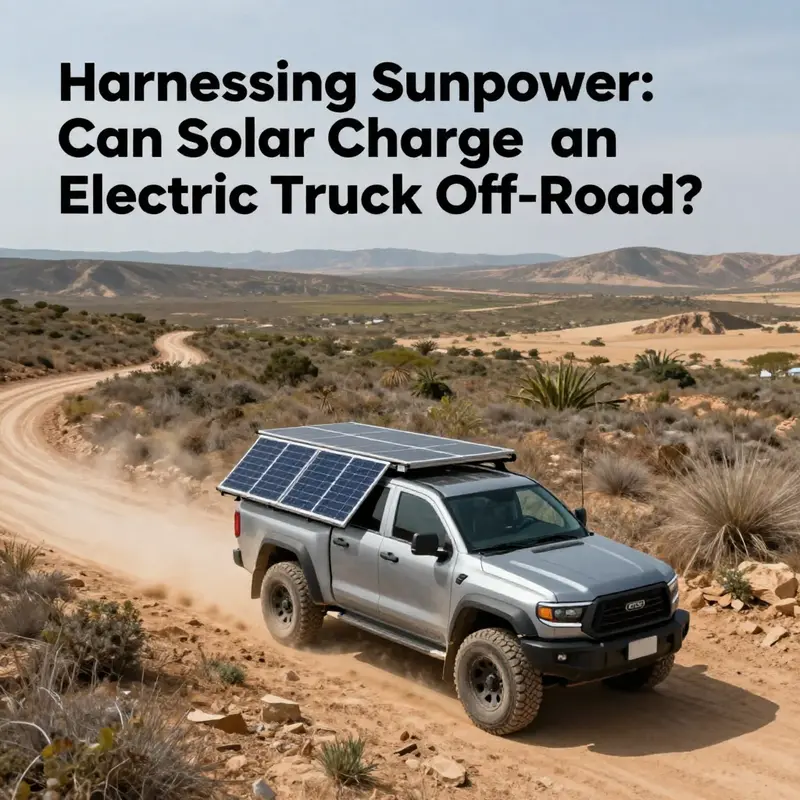
As the off-road community is steadily moving towards more eco-friendly solutions, electric trucks equipped with solar panels are becoming a topic of great interest. But can these solar systems really provide power when the going gets tough? This article dives into the challenges of using solar technology off-road, illustrating real-world success stories, and envisioning the future of electric trucks powered by the sun. From off-road enthusiasts to agricultural landowners, understanding the dynamics of solar power in off-road environments is vital for making informed decisions about vehicle modifications and solar integration.
Sun, Shade, and Steel: The Real Limits of Off-Road Solar Charging for Electric Trucks
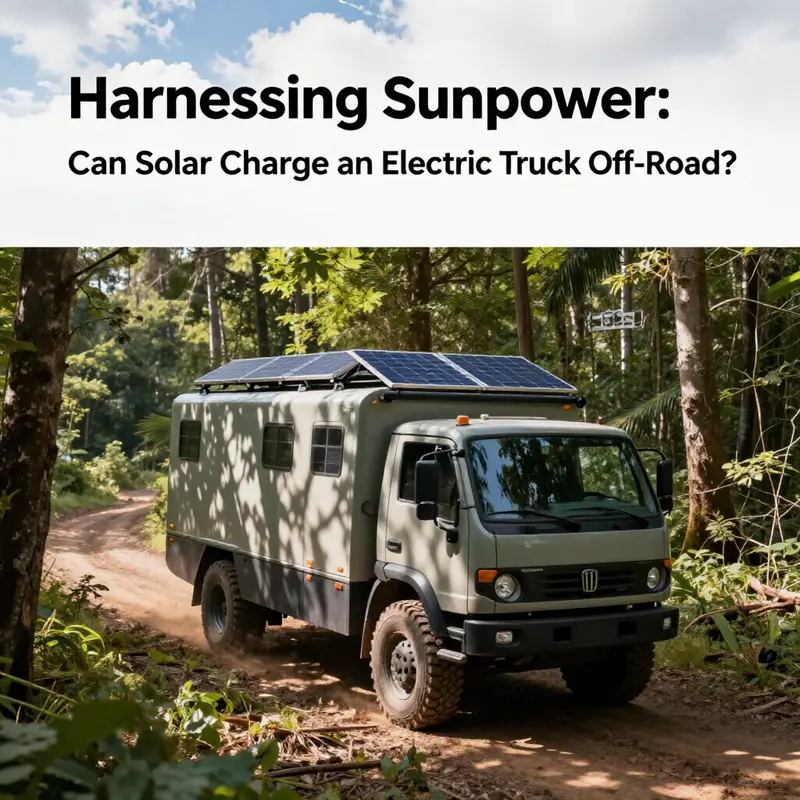
The idea of solar charging an electric truck while venturing off road feels alluring in an era obsessed with clean energy and grid independence. A vehicle that could slip into forests, traverse rocky ridges, or spool up a desert highway powered by nothing more than sunlight promises a seamless blend of mobility and sustainability. Yet as the road surfaces change from asphalt to dirt and the sky shifts from open horizon to tree canopies, the physics behind energy capture and storage tighten the leash on that dream. This chapter follows a single thread across the rough terrain of reality: even though solar panels can contribute energy in off-road settings, the practical limits—energy density, surface area, weather, and the kinetic demands of heavy-duty transport—keep solar from being a reliable primary power source for most off-road operations. The best use of solar in this context is as a supplementary aid that extends range modestly or powers auxiliary systems during stationary charging or downtime, not as a universal propulsion solution that can sustain long, demanding journeys through remote landscapes.
The first line of constraint appears at the core of any continuum between sunlit potential and usable power: energy density. Heavy-duty electric trucks are designed to carry large payloads and clock long daily mileages. Their batteries must store hundreds of kilowatt-hours, sometimes approaching the 600–1000 kWh range for longer-range or highly loaded operations. The energy within such a battery is a function of both capacity and chemistry, but it is also a function of the rate at which it can safely absorb energy. Solar panels, even when highly efficient, deliver power at a comparatively modest rate. The surface area available on a truck—its roof, hood, sides, and even trailers to a limited extent—simply cannot be scaled to produce the energy necessary to offset typical daily consumption. Even the most ambitious panel configurations face a ceiling defined not by technology alone but by geometry. A standard truck roof might hold a few square meters of solar cells at best. Multiply by the efficiency of the cells, and you arrive at a ballpark figure: the maximum daily energy input from a roof-mounted array, in optimal bright sun with perfect orientation, is still a fraction of what the vehicle needs in a day of heavy use. In other words, solar can chip away at the problem, but it cannot replace the large, energy-dense battery pack that underpins heavy-truck electrification.
A second, equally stubborn constraint is the ever-changing nature of daylight when you are off road. The situation is rarely a clean, uninterrupted sequence of hours with direct sun. Off-road environments introduce shading from lone pines, canyons, rolling hills, and cloud shadows, all of which can swing solar output up or down in minutes. The sun’s angle shifts with the vehicle’s motion, too, so even a rooftop array that enjoys a brief window of optimal exposure will quickly lose that advantage as the truck turns or climbs into a shade pocket. The intermittent and variable sunlight becomes more than a bug in the system; it is a fundamental operating pattern that makes solar charging inherently episodic rather than continuous. This episodic nature is manageable if the mission allows downtime or staged charging stops, but it cannot be relied upon for steady propulsion in critical off-road scenarios.
Charging speed and efficiency form the third set of hurdles. Solar panels generate electricity slowly relative to high-power charging stations. The energy that arrives on a sunny hillside during a single hour may not be enough to replenish a depleted battery that has endured a long, demanding ride. Even under ideal conditions, a large surface area might deliver only a few kilowatts of power continuously. For a truck that consumes hundreds of kilowatts per hour when moving, the solar contribution is a drop in the ocean. When you multiply that by the number of hours of daylight in a day, you still must account for nights, cloudy spells, and the vehicle’s own energy management needs. The result is a charging profile that encourages patience and careful planning rather than a sprint toward continuous operation. In practical terms, solar becomes a supplementary stream that can cushion the edge of a battery’s discharge or provide power for auxiliary functions—lights, sensors, refrigeration for payloads, or essential electronics—while the truck rests or operates in a solar-friendly window.
A fourth dimension complicating the math is cost and maintenance. Integrating large arrays into heavy-duty trucks is not a near-term, low-cost proposition. The panels add weight, which punches into efficiency and payload economics. They introduce aerodynamic drag and potential durability concerns in rugged environments. The mounting hardware must withstand vibration, impact, and harsh weather while remaining serviceable for maintenance checks. Over time, the added weight and the degradation of solar cells—though gradual—translate into higher lifecycle costs and more complex energy management software. In financial terms, the energy return on investment for off-road solar is modest at best in current technology, especially when measured against the rapid advancements in battery capacity and the ongoing expansion of fast-charging networks designed for on-road use. Even with improvements in coatings, flexible photovoltaics, or lighter cell materials, the industry is unlikely to leapfrog past the physics that governs energy capture on a moving, off-road vehicle.
These constraints are not merely abstract. They are grounded in the kinds of field experiments and real-world deployments that researchers and engineers monitor closely. The Swiss Peak Evolution project, for instance, demonstrated that solar-powered operation is possible in extreme off-road conditions—but the critical detail is telling: the team paused to deploy solar panels at high altitudes and charge across several hours. The modified Aebi VT450 truck carried six roof-mounted panels and 24 ground-based arrays, enabling it to ascend a volcano on solar energy alone. The key takeaway was not continuous solar charging during a climb but planned stops to maximize exposure and battery recharge. This example highlights a truth that often gets lost in headlines: solar in off-road contexts works best as a planned supplement rather than a source of continuous propulsion.
Similarly, the broader spectrum of off-road and light-duty applications shows a different pattern. Some companies have pursued solar integration on trailer surfaces or within urban last-mile delivery contexts. In ideal sunny conditions, these systems can add a handful of kilometers to the daily range. The scale, however, is modest, and the relevance to heavy off-road trucks is limited. It is instructive to examine these cases not to overstate solar’s capabilities but to understand how and where it can contribute meaningfully. The vehicles used for these trials are often lighter, with shorter duty cycles and less extreme energy demands than a heavy, all-terrain truck. Still, the economic and engineering lessons translate: solar can provide meaningful, albeit constrained, relief to battery management in specific operating envelopes and weather scenarios.
When we consider the broader logistics of off-road electric trucking, the role of solar becomes even more nuanced. A purely solar-fueled mission would require the sun to illuminate the journey from start to finish with no battery debt, which is inconsistent with known weather patterns and terrain-induced shading. The reality is that off-road missions are rarely continuous in their daylight windows, making a single-source solar solution impractical. Instead, the most viable pathway combines multiple energy channels: a robust battery, access to fast charging when the mission is near infrastructure, and solar as a complementary source that extends range or provides downtime power. This hybrid approach aligns with the IEA’s comprehensive perspective on solar PV technology, which emphasizes the importance of matching technology trajectories with usage patterns and energy demand realities. The guidance from authoritative research underscores that solar within heavy vehicles is advancing but remains constrained by fundamental energy balance and lifecycle cost considerations. For readers seeking a deeper, technical framing, the IEA Solar PV Technology Report provides a rigorous overview of what current solar PV can realistically deliver across different sectors and scales.
From a operations perspective, the practical takeaway is straightforward: solar charging should be positioned as a strategic aid rather than a primary propulsion option for off-road heavy-duty trucking. The vehicle design should prioritize a sizable, robust battery pack that can sustain longer cycles between recharges, along with a flexible charging strategy that leverages stationary solar power when the vehicle is parked for tasks such as loading, maintenance, or rescue operations in remote settings. In these circumstances, solar can reduce the peak load on the grid or on on-site generators, contributing to lower operating costs and a smaller carbon footprint for auxiliary systems. It can also support mission-critical equipment that requires continuous power, such as cooling systems for sensitive payloads or communications gear, especially when the truck sits idle under the sun.
Nevertheless, for off-road propulsion, the current technology landscape points toward a demand for alternative or supplementary energy strategies. Fast-charging infrastructures and larger onboard batteries remain indispensable for true off-road capability. A vehicle that relies predominantly on solar to sustain long hauls would confront repeated downtime, reduced mission tempo, and questionable reliability under less-than-ideal weather. The constraints are not a call to abandon solar in this context but a reminder to calibrate expectations and invest in an energy ecosystem that blends solar with other sources and resilient battery technology. This balanced view helps fleet operators and mission planners design routes, dependencies, and contingencies that preserve safety and performance while still pursuing the environmental benefits that solar energy promises.
It is also important to anchor this discussion in the broader strategic ecosystem surrounding off-road electric mobility. The engineering challenge is not simply about packing more solar cells onto a vehicle; it is about integrating energy generation with energy storage, power electronics, thermal management, and predictive analytics that optimize when to draw power from solar, from the grid, or from on-site generation. The energy management system must account for variability in solar irradiance, the state of charge, the battery’s health, and the vehicle’s duty cycle. In practice, this means a sophisticated control strategy that can prioritize battery longevity and reliability over marginal gains in on-board solar energy input. It also means mission design that anticipates energy availability, such as planning for maintenance windows where the vehicle can park in a sun-rich location to replenish energy stores before resuming operations.
Amid these technical and operational considerations, the social and economic dimensions of solar integration cannot be ignored. The up-front cost of solar on trucks competes with ongoing advancements in battery capacity, range optimization, and the expansion of charging networks. In some cases, the cost of additional solar hardware may be justified by the long-term savings in auxiliary power usage or by the reputational and regulatory advantages of a lower-emission vehicle. In other scenarios, the economics do not justify the investment, and resources are better allocated toward improving battery technology, lightweight materials, or on-route charging options. The careful calculus of cost, risk, and return is inherently context-dependent, dependent on the mission profile, the terrain, the climate, and the availability of charging infrastructure near the routes most frequently traveled.
To bring these threads together, consider how a hypothetical but plausible off-road operation would unfold with solar as a supplement rather than a primary driver. The truck starts with a well-charged battery, perhaps after a robust pre-load or stationary solar recharge. It moves through a forested area where sunlight is intermittently obstructed, but the ground-based solar array can catch reflective or scattered light during a planned pause in a sunny glade. The energy harvested during those pauses might top up the battery enough to extend the next leg by a few more kilometers, or to support a critical subsystem during a long, uphill climb where the wind resistance or payload adds to the demand. If the mission times out and weather turns cloudy, the vehicle would naturally lean on its stored energy and the possibility of a nearby fast charger if the route intersects a demand-driven charging corridor. The end result is not a solar-powered miracle, but a practical, hybrid energy approach designed to maximize resilience in uncertain environments while minimizing the environmental footprint when vehicle use is heavy and frequent.
The conceptual clarity behind this model—solar as a strategic add-on rather than a sole propulsion source—helps align expectations with the physics of light, material science, and energy economics. It also shapes how manufacturers and operators approach vehicle design and route planning. A vehicle engineered with a strong battery and smart energy management can make the most of opportunistic solar while developing robust contingencies for days with poor irradiance. Operators, meanwhile, can plan missions with sun exposure in mind, scheduling downtime in sun-rich areas and ensuring access to infrastructure when needed. This pragmatic approach honors the capabilities and limits of solar energy, acknowledges the realities of off-road demand, and keeps the door open for incremental gains as technology evolves.
For readers seeking a deeper technical framework, a rigorous external reference that frames these limitations within a broader solar technology landscape offers valuable context. The IEA Solar PV Technology Report provides a comprehensive, evidence-based backdrop for understanding how solar PV scales across sectors, including automotive and mobility applications. It emphasizes that while solar technology is advancing rapidly, natural constraints such as energy density, surface area, and system integration remain central to practical deployment decisions. This report helps ground the discussion in a larger energy transition narrative and informs how future iterations of solar-enabled off-road mobility might unfold as materials, manufacturing, and grid integration continue to improve. See the IEA Solar PV Technology Report for a detailed technical foundation.
In sum, the prospect of off-road solar charging for electric trucks is best viewed through a lens of measured realism. The energy demands of heavy-duty operation, the finite surface area available for solar capture, and the capriciousness of natural light all conspire to limit solar-powered propulsion in rugged terrain. Yet solar can play a meaningful role as a supplementary power source, especially for stationary charging and auxiliary systems during downtime, as demonstrated by pioneering field experiments and real-world trials. The path forward lies in embracing a hybrid energy strategy, where solar contributes to resilience and sustainability without pretending to replace the essential capabilities of high-density batteries and reliable, fast charging networks. As technology advances, the balance may tilt further toward solar-assisted solutions, but for now the most practical off-road electric trucking model sustains momentum through a thoughtful blend of energy sources, deliberate mission design, and a clear-eyed view of what solar can and cannot deliver in the wild.
Internal link note: when exploring the practicalities of charging infrastructure for electric vehicles in challenging environments, readers may find further context in the discussion about electric fire truck charging infrastructure. Electric Fire Truck Charging Infrastructure.
External reference for deeper technical grounding: https://www.iea.org/reports/solar-pv-technology
Sunlit Trails, Weighty Loads: Realistic Prospects and Limits of Off-Road Solar Charging for Electric Trucks
The idea that solar power can keep an electric truck moving through rugged terrain sits at an appealing intersection of practicality and aspiration. It resonates with the promise of autonomy, reduced emissions, and fewer logistics headaches in remote work sites. Yet the reality is more nuanced than a simple headline about green energy meeting dirt roads. The off-road environment places solar charging in a demanding spotlight: sun is intermittent, terrain shapes exposure, and payloads demand energy at rates that can outpace what a panel array can deliver in the moment. The discussion, therefore, needs both a clear-eyed look at what is technically feasible and a sober view of when solar should be expected to take the lead in an energy strategy and when it should be cast as a supporting role.
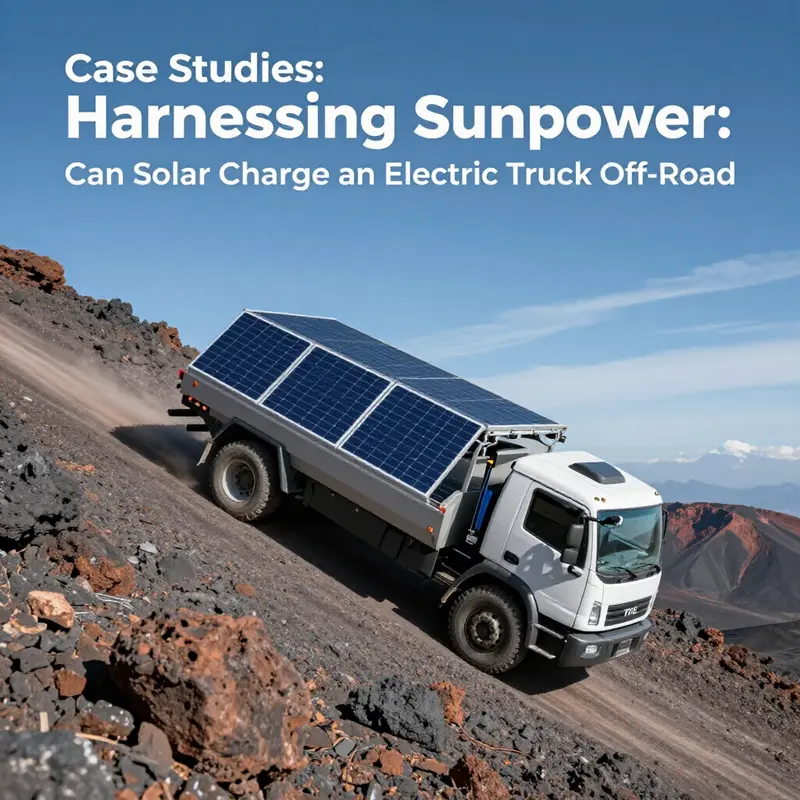
The most vivid real-world demonstration of off-road solar in action is not a routine daily charging routine but a carefully choreographed operation. In the Swiss Peak Evolution project, a modified off-road vehicle—an Aebi VT450—was equipped with a sizable solar deployment: six roof panels and twenty-four ground-based panels. The mission was an ascent of a volcanic summit reaching 6,500 meters. Solar energy drove the journey, but the key was discipline. The crew paused at high altitude to deploy the full panel array and charge the battery over several hours, effectively trading continuous motion for periodic, sun-rich intervals. This is a powerful proof of concept: solar can drive off-road movement, but it is not a perpetual-charge scenario. It requires planning, not just exposure, and it works best when the vehicle encounters environments that allow meaningful pauses in travel to harvest sunlight.
Beyond ambitious prototypes, there are smaller, more incremental signs that solar can contribute in off-road settings. Light-duty, solar-assisted delivery platforms have demonstrated that roof or trailer-integrated solar can close gaps in range in favorable conditions. In ideal sunshine, such systems can add a modest but meaningful amount of daily range—on the order of tens of kilometers—enough to extend a typical mission or provide a buffer for short detours. For truly heavy off-road work—mining, construction, long-haul heavy freight—these gains are inspirational but not transformative. The energy demand of large, high-torque trucks on rough terrain dwarfs what a compact solar array can reliably sustain, especially when the sun is filtered through trees, ridges, or dust, and when the panels are mounted in places not optimized for fixed, persistent exposure during dynamic movement.
A candid look at the state of the field makes this distinction clear: there are currently no publicly documented case studies detailing a complete, continuous off-road charging solution that sustains a heavy electric truck over extended, demanding routes. In other words, while there are exciting experiments and credible demonstrations, there is not yet a published blueprint for everyday, long-range off-road solar charging for the most energy-intensive fleet roles. What exists instead are two strands that inform practical expectations. The first is the concept and experimentation around solar roads and dynamic inductive charging, which aims to replenish energy while a vehicle is stationary or moving over a charged surface. The second strand is the more modest, but perhaps more immediately useful, approach of solar augmentation: small, portable, or trailer-mounted solar installations that add to the energy buffer when the vehicle is parked or idling in sunlit locations. The latter can influence operations by expanding the time between hard charges, reducing the need to return to base or rely on mobile charging, and providing a degree of energy resilience on site. For broader theory and potential architectural ideas, readers can consult the growing literature on solar-powered roads and inductive charging, such as the recent academic discussions that explore integrated solar road designs as a pathway to future vehicle energy ecosystems.
What makes solar’s off-road promise feel plausible is a simple arithmetic truth: panels don’t have to supply a truck’s entire daily energy draw if they can meaningfully extend the window in which the battery stays at a usable state of charge. The practical question is how much energy the panels can deliver when the vehicle is stationary, how quickly that energy can be stored, and how frequently such stations can be accessed during a rugged mission. If a truck can reliably stage at sunlit pauses every few hours, and if the energy harvested during those windows translates into a larger buffer for the next leg, solar becomes a valuable adjunct rather than a replacement for conventional charging or large onboard storage. This framing helps fleet planners and engineers weigh the cost, complexity, and durability of solar installations against the realities of off-road duty cycles and duty cycles.
The roof and trailer are common mounting choices for off-road solar, and they come with trade-offs. Roof mounts keep panels tidy and protected, but exposure can be uneven on uneven terrain. Trailer-mounted arrays can be positioned to maximize sun exposure during specific legs or layovers, yet they introduce a new mechanical load path and require careful balance to avoid destabilizing the vehicle. In dusty or muddy environments, panel cleanliness becomes a recurring maintenance task that, if neglected, erodes gains. These engineering realities remind us that solar augmentation benefits from a design language that favors accessibility, ruggedization, and modularity. Detachable or retractable panels, soft suspensions that limit vibration, and simplified cleaning routines are examples of features that can help solar systems survive and perform in harsh off-road settings.
The energy management logic around off-road solar is equally critical. A vehicle with high torque requirements and significant auxiliary loads cannot count on moment-to-moment solar input to meet peak demand. Instead, it can use solar to extend periods between full charges, store energy during quiet moments, and power non-propulsive systems during stationary breaks with minimal draw on the main propulsion battery. In practical terms, this means designing a battery pack and a charging strategy that tolerate, and even leverage, variable input. If the sun is strong, the system should harvest and fill the buffer. If cloud cover reduces input, the vehicle should gracefully rely on stored energy and prepare for the next charge opportunity, rather than overtaxing the energy system and risking range anxiety mid-mission. The key is to align the energy calendar with sun exposure, mission steps, and maintenance windows so that each sunlit hour translates into tangible operational capacity.
From a policy and economics perspective, the case for off-road solar charging grows when fleets operate in remote locations with expensive energy logistics or where bringing heavy charging hardware to a site would be disruptive. Solar augmentation can reduce fuel logistics, improve energy resilience, and provide a softer, more flexible approach to energy management. However, these advantages only materialize if the system is reliable enough to survive the rigors of the environment, affordable enough to justify the investment, and simple enough to operate with minimal specialized staff. Therefore, pilots and phased rollouts are prudent: begin with modular solar modules that can be deployed at key staging areas, measure impact on energy use, and gradually expand placement where the cost-benefit ratio is favorable. The human and organizational dimensions—training, maintenance, and data-driven optimization—are as important as the hardware. An effective off-road solar program requires a credible plan that couples hardware resilience with operational discipline.
For readers seeking a broader theoretical context, the field is actively exploring the feasibility of integrating solar ventures into the energy supply network for moving vehicles. A line of inquiry examines solar roads and inductive charging for dynamic in-motion replenishment. While these ideas push the envelope of what is possible, they remain largely experimental or prototype in off-road contexts. The technical hurdles—durability under heavy loads, maintenance costs, and efficiency losses when power must be captured at non-ideal angles or through shaded routes—are nontrivial. Even so, the ongoing research and early-stage demonstrations provide a sturdy blueprint for the kinds of innovations that could transform off-road charging if engineering challenges can be resolved and economics tilt in favor of broader deployment. For readers who want a deeper dive into the theoretical underpinnings and experimental milestones in this space, a foundational resource examining integrated solar road designs and inductive charging systems is available in the scholarly literature: https://www.mdpi.com/2076-3417/14/3/1234.
As a practical takeaway, fleets exploring off-road solar charging should anchor expectations in three core realities. First, solar can be a meaningful supplementary power source, particularly when the vehicle is parked in sunlit locations or following planned pauses in the route. Second, continuous solar recharging while the vehicle is actively traversing challenging terrain is unlikely to meet high-demand energy profiles without significant panel area, an exceptionally efficient configuration, or supplementary charging modalities. Third, the value of solar grows with intelligent scheduling, robust battery systems, and maintenance regimes that keep the panels clean and oriented toward the sun as much as possible. In other words, the sun can be a friend to off-road operations, but it does not replace the need for a resilient, multi-faceted energy strategy that accounts for the unpredictability of remote work environments.
Within this framework, the integration of solar into off-road freight and mining fleets becomes a question of balancing risk and reward. Operators should plan for a layered energy architecture: a primary, dependable charging pathway that can be deployed in harsh environments, combined with solar augmentation that provides a reliable, low-cost buffer when and where conditions permit. The design objective is not to create a perfect solar-drenched expedition but to ensure that every sunlit pause adds measurable value to mission readiness and energy security. In practice, that means thoughtful placement of solar arrays, consideration of payload and vehicle dynamics, and a pragmatic view of where solar fits best within the larger logistics and energy management system. When approached this way, off-road solar charging becomes a credible, if modest, contributor to the energy resilience of electric trucks rather than a cure-all solution. The path forward is iterative: pilot programs, data collection from real-world missions, and incremental improvements in materials, tracking, and integration with intelligent fleet software will gradually lift the capability curve.
As you reflect on the practicalities of off-road solar charging, it helps to connect the technical discussion to real-world decision-making. Fleet managers will weigh capital expenditures against operating expenses, evaluate the value of energy resilience in specific jobsites, and assess how much of the mission profile can realistically benefit from solar during stationary periods. The verdict at this stage is nuanced: solar charging is not a universal substitute for robust charging networks and large batteries in heavy off-road contexts, but it can deliver tangible benefits in the right conditions and with the right planning. It can reduce the frequency of returns to base, extend the usable window between full charges, and provide a modest energy cushion for the occasional long, sun-rich layover. In many cases, the best deployment will be a hybrid approach—one that treats solar as a valued member of the energy toolkit, alongside dependable charging options and a battery system engineered for rough terrain and variable duty cycles.
To connect this discussion to broader fleet-level considerations, a comprehensive energy strategy should also address maintenance and reliability. Off-road environments accelerate wear on exposed components, including solar arrays, wiring harnesses, and connectors. The most resilient configurations use ruggedized panels, weatherproof mounts, simple cleaning protocols, and remote monitoring to detect performance drops early. The payoff is not only reduced downtime but also the assurance that the solar system continues to contribute when the sun is generous and the mission demands it. In short, off-road solar charging is best seen as a strategic enhancement—one that strengthens energy autonomy in the field while acknowledging that the core energy architecture for heavy trucks still depends on dependable charging infrastructure and ample onboard storage. For readers who want to explore a concrete example of how such considerations translate into policy and practice, the broader discussion of electric-fire-truck charging infrastructure offers relevant lessons about designing resilient energy ecosystems in demanding environments. See Electric Fire Truck Charging Infrastructure for a related perspective.
In sum, solar charging for off-road electric trucks is a field that has moved beyond theoretical appeal into practical demonstrations, albeit with clear limitations. The most credible path forward combines targeted solar augmentation with a robust, scalable charging backbone. The off-road environment will always test energy systems with variable light, gravity, and exposure. But with disciplined planning, durable hardware, and adaptive energy management, solar can contribute to longer, more energy-secure missions. The onus now lies on engineers, operators, and policymakers to translate these early demonstrations into dependable capabilities that work across different climate zones, terrain types, and mission profiles. The sun is an ally, but not a guarantee, for the heaviest off-road work. By acknowledging its limits and embracing its benefits, fleets can craft energy strategies that keep trucks moving where it matters most, even when the sun’s hours are not perfectly aligned with the journey ahead.
Harnessing Sun and Terrain: The Future of Off-Road Electric Trucks and Solar Charging Solutions
In the rugged margins where wilderness meets the grid, the prospect of off-road electric trucks powered in part by the sun has shifted from a provocative idea to a rolling reality. The optimism rests on three pillars: smarter energy harvesting, resilient energy storage, and intelligent power management that can coordinate sun, weather, and vehicle demand in real time. Yet this vision is not a promise of endless sunlight on demand. It is a carefully hedged bet that solar charging, when integrated with robust battery systems and adaptable infrastructure, can extend range, reduce downtime, and improve autonomy in remote or off-road environments where traditional charging stations are scarce or non-existent. The balance is delicate. Solar capacity is contingent on weather, canopy, angle, and exposure, while the terrain itself imposes heat, dust, and shock that stress powertrain components. The challenge, then, is to design a system that remains efficient where a conventional on-road truck would already have a predictable charging cadence and traffic patterns. The answer lies in optimizing flow rather than forcing continuous solar input while under load. The future, in short, is less about solar as a primary energy source for long hauls and more about solar as a complementary, reliability-boosting partner that keeps off-road work moving when the grid cannot.
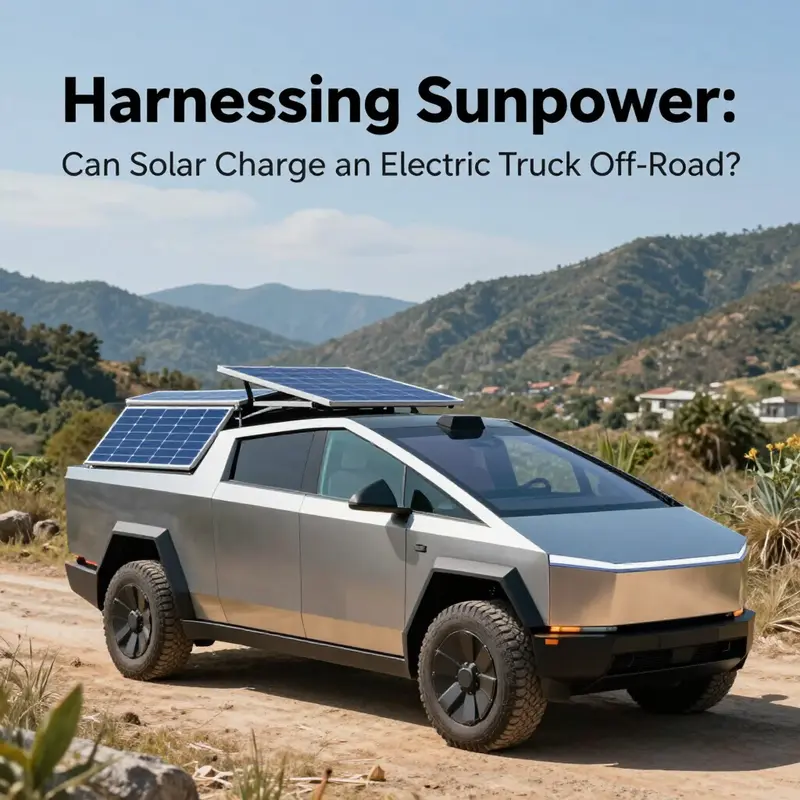
On the design side, the most promising path is to weave solar harvesting into the vehicle’s architecture rather than tacking it on as an afterthought. Roof-mounted panels and forward-leaning panels on the hood or sides can deliver meaningful energy during pauses, while portable or modular arrays can be deployed in bivouacs, camps, or work sites where sun exposure is highest. The operational logic shifts as well. Rather than expecting full-time solar input during a dynamic, high-load climb, fleets can plan for intervals of solar charging during idling or at rest breaks. This quiet, patient approach mirrors the reality of off-road ventures, where the sun may break through a break in the canyon walls or dip behind a ridge, and where a long, steady sunlit lull can be converted into a battalion of amp-hours.
The available data from early experiments—though framed in specific prototypes and challenges—already illustrate the practical boundary conditions. Solar charging can meaningfully push a battery’s state of charge when the vehicle is stationary and exposure is maximized. In real-world mobile operations, however, the strongest gains come from a hybrid strategy: a high-capacity, ruggedized battery pack that handles high-draw demands, paired with a solar harvesting system that compensates for downtime and reduces the frequency of grid-based top-ups. This approach matters not only for the range equation but for uptime. In remote operations like mining, forestry, or disaster-response scenarios, the ability to coax extra miles from a sunny field or a sun-warmed bivouac translates into fewer trips to fixed charging hubs, shorter cycles in the work plan, and a more predictable budget for energy use.
From a technology standpoint, the most consequential advances are occurring in three areas: the integration of solar charging into the vehicle, the chemistry and management of the battery systems, and the emergence of modular energy ecosystems that couple solar input with mobile storage. When solar harvesting becomes part of the core design, engineers can optimize panel placement, wiring, and thermal management to maximize efficiency without compromising durability. For example, in desert or high-dust environments, thermal control becomes critical. A battery bank and electronics that dissipate heat effectively maintain performance and longevity when the ambient temperatures surge or when filters require frequent cleaning. The packing of the battery modules, their cooling strategy, and the path of least resistance for heat all influence how much solar energy actually translates into usable kWh under off-road conditions.
A central narrative in the future of off-road electrification is the idea of modular energy solutions. Think of a system where the vehicle carries a high-density battery pack as the core energy reservoir, supplemented by portable or semi-permanent solar arrays that can be deployed at the work site or during maintenance windows. These portable arrays can be compact, rugged, and easily rigged to a vehicle or a stationary stand, enabling rapid deployment in sun-rich zones. The use of mobile energy storage units—think of them as rolling or semi-mobile battery banks—allows a fleet to build a local micro-grid for a worksite, charging vehicles and powering auxiliary equipment without heavy reliance on distant charging infrastructure. This concept dramatically reduces downtime and increases the practicality of electrified fleets in remote locations.
In parallel, battery technology is advancing in ways that directly influence off-road viability. Research and development is pushing higher energy densities, improved thermal management, and better protection against dust and vibration—all essential for harsh environments. Solid-state and advanced chemistry developments promise higher round-trip efficiency and safer operation at temperature extremes. The benefit to off-road operations is not simply longer range; it is better resilience under load, more predictable charging performance, and lower risk of thermal Runaway in exposed or dusty sites. A battery system designed to tolerate desert heat, maintain performance after heavy vibration, and recover efficiently from partial charges makes solar supplementation more reliable. When you couple this with an efficient, smart energy management system that can orchestrate charging cycles, the result is a more robust energy ecosystem. The vehicle can, for example, enter a high-demand phase knowing it has already racked up a proactive solar gain during a stationary interval, then ride out the next stretch with a battery tailored to the terrain’s demands.
All of these developments are converging alongside structural and regulatory shifts that favor electrification in rugged sectors. Governments are tightening emissions standards and providing incentives to fleets that adopt clean technologies. This pushes manufacturers and operators toward solutions that reduce diesel dependence not only in urban logistics but also in remote operations where the cost of diesel logistics can be a major factor in total cost of ownership. The economics of solar charging in remote settings hinge on three intertwined factors: the total energy demand of the mission, the daily solar window available at the worksite, and the capital cost of the integrated system. As supply chains, battery packs, and solar materials mature, the breakeven point shifts in favor of solar-inclusive designs for certain work profiles. Utilities and mine operators, in particular, are noticing that the intermittency of solar is manageable when paired with storage and intelligent load management. The result is a gradual shift from a pure battery-plus-grid approach to a hybrid model in which solar harvesting becomes a persistent, predictable contributor to energy budgets.
The market trajectory mirrors this shift. While on-road heavy-duty trucks see rapid adoption driven by policy, the off-road segment is propelled by a slightly different calculus. It weighs the value of autonomy in a remote site, the risk reduction from eliminating or reducing diesel deliveries, and the potential for on-site renewable micro-grids. In rugged sectors like mining or construction, the electrification wave is less about replacing every kilowatt and more about reconfiguring energy use to fit the environment. Here, solar charging is not a luxuriously sunny add-on but a practical tool to extend field operations, ensuring that crews can complete a project within a day or two without depending entirely on distant charging corridors. The future, then, envisions a fleet that can operate on a combination of stored energy and solar input, with the sun serving as a patient, low-cost replenisher rather than the sole energy source during peak demand periods.
Implementation routes are already being tested in a few strategic ways. Some fleets envision roof or canopy panels integrated into the truck’s structure, optimized for light exposure during typical on-site tasks. Others experiment with portable solar arrays that can be deployed on flat ground or attached to trailers when the vehicle is parked. The common denominator is a disciplined approach to energy flow: harvest when possible, store aggressively, and use smart energy management to align charging with workload. The broader lesson is not to pursue continuous solar input during movement but to design for high solar input during pauses, stacking this with a battery system that can ride through non-sunny stretches. In practice, this means planning for optimal charging windows, rather than expecting solar to fulfill demand in real time on every mile.
The integration challenge goes beyond the vehicle itself. Off-road work sites often lack reliable infrastructure—no grid, no steady power supply, and in some cases, unpredictable access to heavy-duty charging stations. To counter this, the industry is exploring modular energy ecosystems that combine solar harvesting with mobile storage, micro-grids, and even rapid-connect charging concepts that can be deployed at the work site. These systems are designed to be resilient to dust, temperature swings, and the rough handling that accompanies field operations. They also incorporate smart energy management that forecasts sun exposure, weather changes, and the vehicle’s upcoming load profile. When the system can predict a period of high solar yield in the day and the truck’s energy trajectory for the next hours, it can pre-charge confidently and minimize downtime.
A practical takeaway from current explorations is that solar charging, in the off-road context, shines brightest when it reinforces a broader energy strategy rather than standing alone as a singular solution. It acts as a supplementary layer that improves uptime and reduces the need for frequent top-ups at fixed charging hubs. This is especially true in mining and disaster-response scenarios, where every day involves long periods of field work with intermittent access to infrastructure. In these settings, a solar-ready truck is more than a vehicle: it becomes a node in a small, self-contained energy network. And because the sun does not answer to the work schedule, the system must be forgiving. It must gracefully handle partial sun, shading in valleys, and the occasional extended cloud cover, trading a portion of instantaneous power for steadier overall energy availability across the shift.
As the industry advances, the role of regulatory and market signals should not be underestimated. Emission targets, procurement policies for government and corporate fleets, and incentives for renewable energy integration all tilt the economics toward solar-enhanced off-road electrification. The imminent decades are expected to bring a surge of interest from utility-scale operators and industrial sites that want to minimize fossil-fuel logistics. In these contexts, a fleet manager can look at solar charging as a strategic asset, not merely a compliance feature. The ability to reduce fuel deliveries and associated emissions is increasingly framed as a productivity matter, with clear links to uptime, maintenance costs, and workforce safety. The practical implication is that manufacturers and operators will increasingly prioritize not only battery resilience and solar capacity but also the orchestration of these components through sophisticated energy management software. This software can optimize when to draw from the grid, when to rely on solar, and how to allocate stored energy to different vehicles within a fleet, all while keeping a careful eye on battery health and thermal limits.
The broader implications for the industry are manifold. First, the push toward integrated solar harvesting may accelerate the standardization of interface protocols for portable arrays and stationary micro-grids, making it easier for fleets to mix and match components from multiple suppliers without compatibility headaches. Second, the visibility of solar augmentation in off-road tasks could reshape maintenance practices. Technicians would monitor the health of solar wiring, panel efficiency under dusty conditions, and the integrity of charging hardware in rugged environments. Third, the composition of the fleet could evolve to balance long-duration energy storage with modular solar arrays, enabling operators to scale energy capacity up or down in response to project size or geography. Finally, the environmental calculus—the total life-cycle impact of batteries, solar modules, and supporting hardware—will receive increasing attention as regulators and stakeholders demand transparent, accountable sustainability metrics.
The chapter’s throughline rests on a simple but consequential idea: off-road electric trucks will not rely on a single technology to carry them through every mile. They will rely on a network of technologies that leverage solar energy when it makes sense, embed it where it can be most effective, and compensate for intermittency with robust storage and intelligent energy management. In this sense, solar charging for off-road trucks becomes less a stand-alone feature and more a strategic design principle—an approach that aligns with how rugged operations actually unfold in the field. The sun provides a patient, renewable energy source that, when harnessed intelligently, contributes to vehicle uptime, reduces operational risk, and broadens the geographic reach of electrified work.
This vision of integrated solar capability also echoes a broader trend toward rethinking energy in heavy-duty and off-road contexts. It suggests that the next generation of electric trucks will not simply be lighter diesel replacements but smarter hybrids of energy capture, storage, and use. The practical implementation of this idea will depend on continued advances in materials science, battery chemistry, and power electronics, as well as on the development of flexible, field-ready infrastructure that can be deployed quickly and reliably wherever work happens. If these elements converge, solar charging will be a standard feature in rugged fleets, a component of a resilient energy system that keeps operation moving forward, even when the grid is far away and the terrain is unforgiving.
For readers seeking a deeper exploration of the broader shift toward energy harvesting in heavy-duty applications, one can follow industry explorations into integrated solar energy harvesting for large vehicles. This evolving narrative emphasizes that the future off-road electric truck is not a solitary asset but a node in a wider network of energy resilience, capable of drawing from the sun while staying aligned with the demanding rhythms of field work. The takeaway is that practical, sustainable off-road electrification will hinge on designing systems that maximize solar exposure during pauses, optimize battery management under extreme conditions, and leverage modular energy solutions to bridge gaps when sun is scarce. In doing so, off-road fleets can realize meaningful gains in uptime, reduce maintenance complexity, and contribute to a cleaner, more resilient footprint across rugged industries.
To learn more about contemporary collaborations and the direction of integrated energy harvesting in rugged fleets, see the broader movement toward electric construction equipment and the ongoing exploration of solar-assisted power systems—an enduring trend that points toward a future where the sun quietly powers the most demanding work in the world. electric construction equipment revolution
Internal link: electric construction equipment revolution
As the narrative expands, these ideas form a coherent picture: solar charging is not about making every mile possible purely on sunlight. It is about extending range, reducing downtime, and enabling operations to function in places where traditional charging infrastructure would be prohibitive. The sun becomes a strategic ally, the battery a dependable reservoir, and the management system the conductor orchestrating a complex energy ballet across distant sites and challenging landscapes. With battery technology advancing, materials becoming more durable in dusty environments, and portable energy solutions growing more capable, the off-road electric truck ecosystem is moving toward maturity. The future is not a static target but a dynamic system in which solar harvesting complements and enhances existing energy strategies, enabling rugged work in ways that were unimaginable even a decade ago.
External reading: For a broader view of solar-augmented electric vehicles and the engineering principles behind integrated solar energy harvesting, you can explore industry discussions and long-term projections at this external resource: https://www.lightyear.one/
Final thoughts
In conclusion, while solar panels offer promising potential for charging electric trucks in off-road scenarios, significant challenges remain that can hinder their effectiveness. Case studies reveal that with strategic planning and solar deployment during stationary periods, solar charging can extend the range of electric trucks and provide essential power. As technology continues to evolve, the future may hold innovative solutions that better integrate solar energy into off-road adventures. Embrace the possibilities while understanding limitations—those who do will be well-equipped for the rugged terrains ahead.