
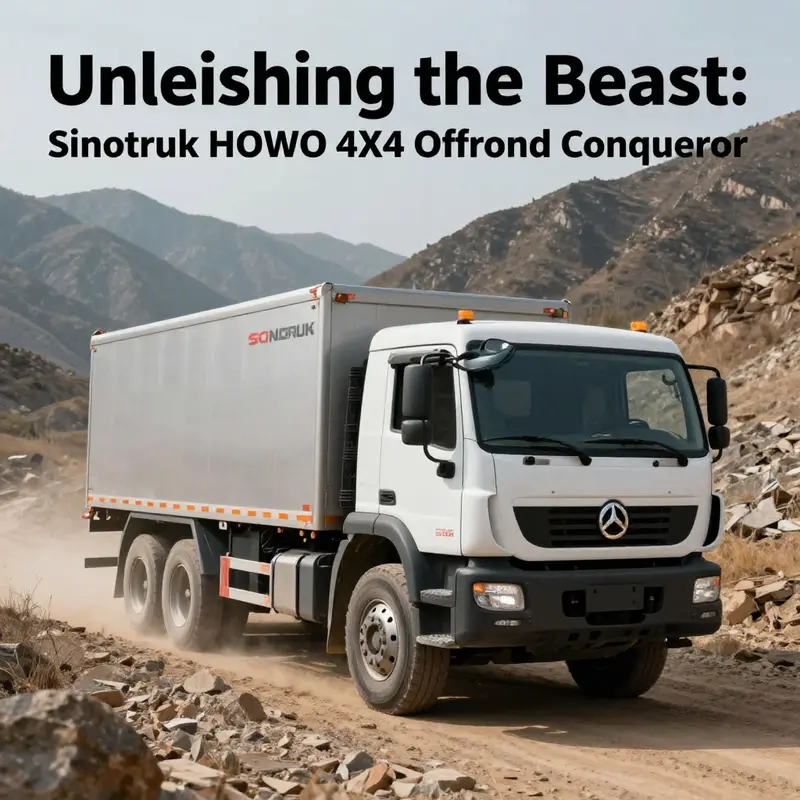
For off-road enthusiasts, adventurers, and rural landowners alike, the Sinotruk HOWO 4X4 Offroad Mobile Workshop Truck is more than just a vehicle; it’s a lifeline. Designed to tackle rugged terrains and deliver maintenance solutions in the field, this truck represents the zenith of off-road engineering. In the following chapters, we will delve into the comprehensive overview of the Sinotruk HOWO, explore its robust design features ensuring durability, and examine its multitude of applications tailored for the most demanding environments. Each chapter builds upon the last to provide a holistic understanding of what makes this truck an unmatched companion for both adventure and work.
On Tough Terrain, a Mobile Workshop Speaks: Decoding the Language of a 4×4 Off-Road Workhorse
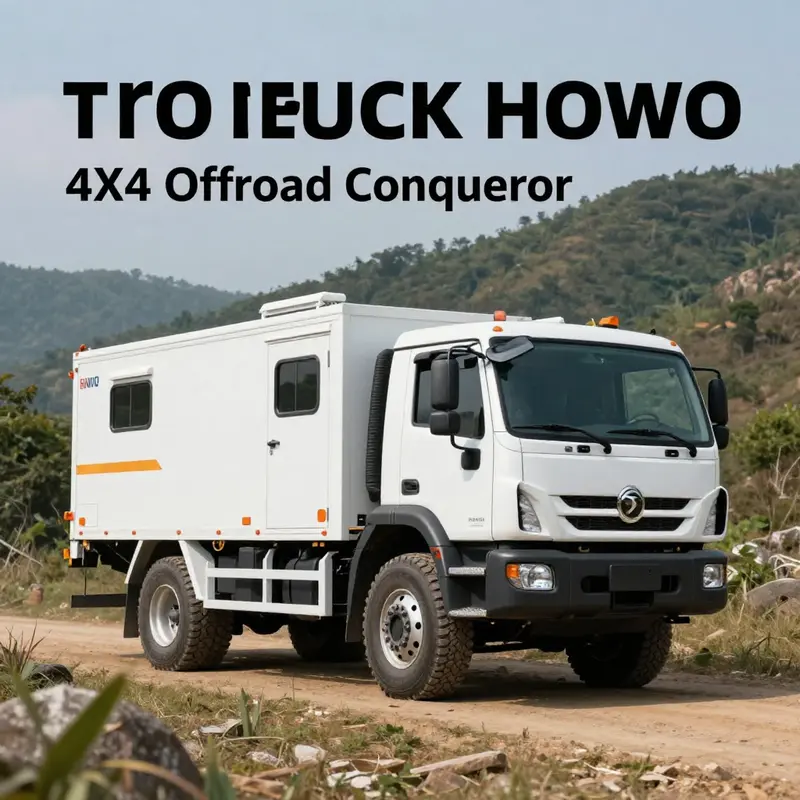
The landscape where field service meets rugged transport is a language in itself. Every mile driven on uneven ground, every obstacle negotiated, speaks a sentence about the vehicle that carries the tools, the spare parts, and the power plant behind a closed workshop door. In this chapter we listen closely to what a four wheel drive off road workhorse with a mobile workshop configuration communicates. It is not merely a truck; it is a statement about capability, readiness, and the strategic promise that on site maintenance can be as efficient as a shop in the city. The language is both practical and aspirational, weaving together braced frames, high torque powertrains, and a modular body that can morph from a cargo carrier to a full service repair bay in the span of a single site visit. As with any complex piece of machinery, the apparent sturdiness of the chassis and drivetrain is less about bravado and more about the precise decisions that keep operations moving when the terrain insists on resistance.\n\nTo begin with, the core message a 4×4 off road truck communicates is resilience. The four wheel drive layout is not a luxury; it is a necessity in environments where traction is the gating factor. In mining outposts, remote construction zones, forestry clearings, and oil and gas sites, a vehicle that can distribute power to all wheels, adjust torque distribution, and maintain stability across uneven slabs of earth is a platform for reliability. The drivetrain becomes a language of confidence: the operator speaks in terms of low end torque and predictable response, while the machine translates that intent into traction, control, and the ability to keep moving without pause. The phrase that comes to mind is not merely more power, but consistent progress over unpredictable ground. In practical terms, this consistency is achieved by a robust transfer case, a durable coupling between the engine and axles, and a suspension system designed to absorb shocks without letting the load shift or the crew lose balance inside the cab. The result is a vehicle that can maintain speed and momentum through ruts, mud, and rocky stretches where a regular two wheel drive truck would flounder. The language here is not about speed; it is about survivability and steady throughput under conditions that demand patient, deliberate motion.\n\nThe chassis and suspension are the next lines in this dialogue. A heavy duty frame must withstand the repeated stresses of off road operation while supporting the complex equipment of a field workshop. The chassis acts like a backbone, keeping the body aligned and the powertrain harmonized with the wheel bases upon which every attachment and tool is mounted. The suspension, meanwhile, is the voice of comfort and control. It translates the irregularities of the ground into manageable, controllable movements inside the cabin. In an off road mobile workshop, the suspension does more than smooth ride quality; it preserves delicate instrumentation, keeps hydraulic lines free from flexing, and maintains the alignment of cranes, hoists, and power generation gear that are heavy enough to shift a lighter truck off its intended course. A well tuned suspension can mean the difference between a quiet day of repairs and a rough episode of fatigue and misalignment that endangers the crew and complicates the job.\n\nThe powertrain is the engine room of intent. In off road applications, engines are selected for high torque output and reliable operation at low rpm. The emphasis is not solely on horsepower numbers that look good on brochures, but on how effectively the engine converts that energy into controlled movement when the tires bite unevenly into soil, rock, or sand. A high torque engine, combined with a well matched transmission and a transfer case that can split torque between axles with minimal delay, delivers a responsive and predictable drive train. Operators value the ability to crawl through gradients or slowly navigate slick surfaces without triggering wheel slip or a sudden loss of traction. The design logic here is practical: power delivery that matches the demands of the environment, fuel efficiency considerations that do not force compromise on capability, and reliability that is measured by uptime rather than top speed.\n\nIn the field, the body of a mobile workshop truck does more speaking than the cab alone. The phrase mobile workshop describes a configured space that is, in essence, a compact, self contained repair shop on wheels. The body is typically engineered to house a suite of mechanics tools, diagnostic equipment, power suppliers, and consumables in a way that minimizes the number of trips back to a base shop. The benefits of this are not merely convenience; they are deeply financial. When a diesel pump tears or a hydraulic hose bursts at a remote site, waiting for a parts truck or a shop service crew can mean hours of lost productivity. A mobile shop reduces this downtime by bringing the repair capability to the fault zone. It is a wholesale shift from repair postponed to repair happening now. The equipment inside is modular by design: a folding crane or a compact hoist for lifting heavy components, a robust generator to power pneumatic tools and welding equipment, a well organized cabinet system for bolts, seals, gaskets, and lubricants, and a clean insulated space to conduct diagnostics in comfort despite the outside weather. The interior must also be configured for safety: secure anchor points for heavy tools, proper ventilation for fumes, and lighting that turns night into workable day. When a crew can depend on a stable, organized interior, the entire job site workflow tightens up. The metaphor here is not a static toolbox but a dynamic, self sufficient workspace that can be deployed wherever a challenge arises.\n\nThe variations in body configurations reflect different operational roles, and this is another layer in the language of the four by four off road platform. A folding crane truck within this family tells a particular story; it speaks to lifting and positioning heavy components at height or in tight spaces, enabling on site servicing of equipment that would otherwise require access to a fixed workshop. A fuel tanker variant, particularly with large capacity, signals a role in fueling operations across miles of rough terrain or in remote industrial camps where fuel delivery is part of the day’s routine. A dump tipper variant speaks to bulk material management on a worksite where the road from mine to processing area is a portion of the job itself. Yet the mobile workshop remains the hinge that unites these jobs. It embodies the ideal of mobility and readiness, a portable service hub that travels to the problem rather than expecting the problem to travel to it. The design details the number of tool cabinets, the layout of the workbench, the routing of air lines and electrical up to the generator are all statements about how field service is envisioned and delivered. The absence of a workshop fixed walls is replaced with a disciplined organization and a precisely engineered environment that supports both the repair process and the safety considerations that come with working in remote areas.\n\nFrom an operations perspective, the four by four off road platform communicates a philosophy of minimize downtime and maximize uptime. It is not enough to be able to reach a troubled site; one must also be able to resolve the trouble quickly and prevent recurrence. The modular approach to the workshop equipment, the careful selection of high quality fasteners and consumables, and the use of protective coatings and corrosion resistant materials all signal a culture of long life and low maintenance cost. In harsh environments where dust can infiltrate tools, water can corrode connectors, and temperature swings threaten performance the design must anticipate, accommodate, and endure. The vehicle communicates through its resilient coatings, sealed air intakes, robust electrical harnessing, and redundant power systems. Every inch of the configuration is a direct answer to the question what if the environment challenges this component. This mindset reduces the risk of unexpected downtime and makes on site service viable as a repeatable, predictable process rather than a series of improvised improvisations.\n\nA broader implication of this equipment language is the way it integrates with logistical planning. Fleets operating in remote or rugged regions must consider not just the vehicle on road capabilities but the entire chain of support around it. The four by four off road platform is a node in a larger network of field operations, a mobile hub that connects technicians, tools, spare parts, and power to the job site. The crew workflow, the maintenance schedule for the truck itself, and the replenishment cycle for spare parts hinge on the reliability and flexibility of this platform. The language here extends to how dispatch planning is performed, how technicians are deployed, and how supply chains are managed for critical components. When a truck can perform a broad set of tasks on site lifting, welding, diagnosing, and refueling all within a protected working envelope it transforms the economics of field service. The efficiency gains compound: faster repairs reduce downtime, better fuel efficiency lowers operating costs, and fewer returns to base reduce travel time and wear on equipment. In this way, the four by four off road mobile workshop becomes a strategic asset rather than a transportation solution alone.\n\nThe literature on these vehicles often speaks in similar terms without revealing every component. The emphasis remains on the core requirements: durability, reliability, and the capacity to deliver on a field service promise. The bodies are designed with the rigors of remote environments in mind: reinforced chassis points, protective skid plates, robust hydraulic lines, and mounts that keep critical equipment secure in motion. The operator benefits from a predictable control experience: the truck responds in a controlled way to the driver inputs, even when the ground is unstable. The engineering choices underpin a simple, honest goal: keep the operator and the site productive. In practice, this means that technicians do not need to improvise a temporary workshop in torn tents or in makeshift shelters. Instead, they have a purpose built space that mirrors the reliability and organization of a permanent workshop, only with the mobility to reach where it is most needed.\n\nAs we consider the broader ecosystem of heavy road off road trucks, it is important to recognize that distinct segments of the market pursue similar ends with different emphases. Some configurations lean toward raw hauling capacity and extreme towing. Others emphasize precision in maintenance tasks, with specialized toolsets and lifting capabilities integrated into the body. The mobile workshop variant, however, occupies a unique position: it is the convergence of transport, service, and power generation. It is the embodiment of a philosophy that the road is not an obstacle to service but a corridor for serviceability. The truck speaks the language of field resilience through its gear ratio choices, torque delivery characteristics, and the thoughtful distribution of weight and power. It speaks through the careful arrangement of the workshop itself how tools are organized, how space is allocated for technicians, and how the environment is kept safe and functional despite wind, dust, and rain. This is not a mere package of features; it is a coherent operating model that makes remote maintenance feasible, efficient, and repeatable.\n\nIn closing, not every label you encounter in the market will align perfectly with a formal product name. The designation TRO 4×4 Off Road may appear in some distributor catalogs or regionally specific listings, but the deeper reality lies in the characteristics described above. The vehicle communicates a clear message: a rugged, capable drivetrain paired with a purpose built mobile workshop platform can transform how maintenance is performed on the most challenging sites. It is a reminder that the road can be a partner rather than a barrier when the right vehicle is chosen, equipped, and deployed with a disciplined operational mindset. For practitioners on the ground, the lesson is straightforward. Look beyond the badge to the alignment of power, chassis strength, suspension resilience, and the workshop design. Understand how each element contributes to uptime, safety, and the ability to deliver critical services where traditional workshops cannot reach. In this sense, the four by four off road platform with a mobile workshop is less about the vehicle itself and more about the working method it enables a method that keeps maintenance moving forward wherever the terrain may lead.
Beyond the Trail: The Design Dialect and Durability of a 4×4 Off-Road Work Truck
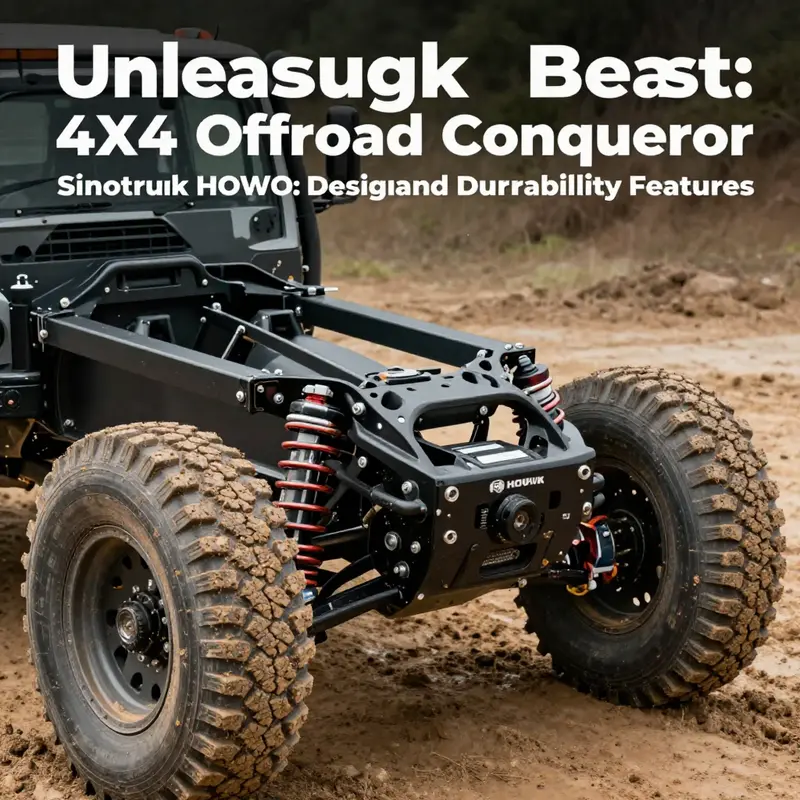
A four wheel drive off-road work truck speaks in a language of grit, geometry, and a kind of stubborn reliability that only terrain with a mind of its own can demand. When you listen closely, you hear not a whisper but a conversation about traction, strength, and the quiet promise that a vehicle can carry a workshop in its wake. The mobile workshop concept, central to the idea of a 4×4 off-road work truck, frames every choice the engineers make. It demands a chassis that can bear weight and rough terrain at the same time, a drivetrain that can transfer torque with precision across unpredictable surfaces, and a body that can endure dust, heat, cold, and the kind of vibration that shakes out the weak links. In this imagined TRO 4×4 off-road design, the truck becomes less a mode of transport and more a portable service bay with wheels, a story told in steel, rubber, and form that earns trust through every mile of travel into inaccessible zones.
If you think of a 4×4 off-road work truck as a chassis of intent, the first thing you notice in its speech is a commitment to traction. The drive system is not a single device but a conversation among components: a robust transfer case that can bottleneck the ride into low ranges when the going is steep or loose; no mere on/off switch, but a set of carefully timed engagements that can be felt rather than seen. The classic 4×4 has rear and front differentials connected by the transfer case, yet in an off-road work truck the emphasis shifts toward deliberate control. Locking differentials may come into play, not as a luxury but as a practical tool to reclaim momentum when one wheel finds a ledge, another finds a rut, and the gradient demands more than raw horsepower can supply. The torque curve, tuned for low-end response, speaks of a powertrain designed to pull heavy payloads from a standstill and keep them moving on surfaces that would otherwise surrender energy to slip or spin.
The engine, whether it be a diesel core or a redesigned, modernized alternative, is chosen for endurance rather than speed. It is a partner that prefers to push with patient force, delivering torque where it matters most and maintaining a reserve that the operator can tap when a site demands the truck carry a heavy tool chest, a generator, and a set of spare parts into the heart of a work zone. Engine power in such trucks tends to sit in that practical middle ground—enough to climb a steep dune with a full load, enough to maintain a steady pace on a rutted country road while the crew tunes and calibrates a mobile workshop, and enough to keep the auxiliary systems running as a second, rolling workspace. The goal is not raw speed but predictable, repeatable capability under stress, with an eye toward long service life and minimal downtime.
A second voice in this design dialect is the frame and undercarriage. The vehicle must carry heavy payloads, hold up under repeated impacts from rock and root, and still present a monitored profile to the operator. The frame is typically a heavy-duty ladder or boxed design, reinforced at corners and crossmembers to resist bending moments that would threaten alignment or the integrity of mounted equipment. Materials are chosen with corrosion resistance in mind, because a truck that travels through dust, dampness, and truck wash enclosures will encounter salt wind near some sites and abrasive dust in others. The underbody protection—skid plates, rock rails, and shieldings for the fuel tank and exhaust system—speaks volumes in silence. It says that the truck is ready to take the long way around a rough patch rather than punishing the operator with a fragile, expensive repair bill after a single misstep.
Suspension is the third crucial facet of the truck’s dialogue. In rugged field service, the suspension must bridge the gap between comfort and capability. Leaf springs offer durability and simplicity for heavy loads, while coil springs with sophisticated dampers can deliver better wheel travel and more predictable behavior on irregular terrain. The choice is rarely a matter of one or the other; it is about achieving a balance between load stability and the ability to absorb the kind of jolts that would otherwise shake apart sensitive workshop equipment on board. Longer travel suspension strategies become a quiet pledge that the vehicle can maintain control when the ground gives way or when a wheel drops into a trench. Suspension geometry that keeps tires in contact with the surface, even as the axle moves, reduces the likelihood of a sudden loss of traction when the operator needs to reposition tools, connect a hydraulic hose, or assemble a portable welding rig within the truck’s own interior space.
Tire selection, often overlooked in the glow of power numbers, tells a lot about the truck’s attitude toward terrain. A 4×4 off-road work truck leans toward tires that can blend durability with the ability to bite into loamy soil, compacted gravel, or desert sand. Sidewalls that resist puncture and treads designed to shed mud while maintaining self-cleaning capability are part of the same conversation that governs ground clearance and approach/departure angles. A higher ground clearance is not merely about clearing a rock; it signals that the truck values the chance to traverse a corridor of earth where other vehicles would hesitate. Off-road performance, in this frame, is a mosaic of ground clearance, wheel articulation, tire carcass structure, and the interdependence of all four corners working in harmony to maintain traction, stability, and control.
Durability is the thread that threads through every system. The protective coatings that guard the body from heat, sun, and abrasive dust are not cosmetic; they are part of a stewardship plan for long life under demanding conditions. The electrical harnesses and protection tubes are laid out with serviceability in mind. In field service, the ability to tighten a loose clamp, replace a sensor, or reseal a joint can mean the difference between completing a job and returning to base with a half-done task. That is why the truck’s electrical and hydraulic systems tend to be simplified yet robust: fewer failure points, easier diagnostic paths, and modular components that can be swapped with minimal downtime. Even the interior is designed with durability in mind, using materials that resist wear and tear in a setting where work gloves and oily rags are common companions and where every control is accessible from the seated position.
The interior itself contributes to the truck’s narrative as a workshop-on-wheels. A mobile workspace hinges on modularity: tool cabinets that lock, power outlets that tolerate rugged use, and a layout that allows technicians to reach a cutting torch, a small air compressor, or a diagnostic scanner without stepping outside into dust and heat. A well-planned interior reduces the need for frequent trips back to a permanent workshop and keeps downtime to a minimum. This is a pragmatic design that respects the realities of remote projects: dusty environments, limited shelter, and the need to conserve fuel and time. The operator seat, the control layout, and the visibility from the cab all matter, not for comfort alone but for ensuring that the technician can observe, analyze, and react to a situation with speed and confidence. The truck’s own systems are often synchronized with the operator’s workflow, with dashboards tuned to deliver critical readings at a glance and with redundancy built into the most important indicators so a failure does not escalate into a full stop in the field.
If one looks at the truck as a whole, the body is built to withstand not only the environment but also the demands of field maintenance. Storage compartments beneath and behind the cab can hold spare parts, hoses, and electrical cables. The tail section might be configured to host a compact generator or an auxiliary air supply, with outlets placed so the technician can power a grinder or a welder while keeping the machine strapped and ready for transport. The body lines, flanges, and joints are designed to minimize snag hazards when passing along narrow trails or across rugged loading docks on job sites. The vehicle communicates a readiness to adjust its own configuration to match the day’s needs: a compression nut for a hydraulic line; a small repair kit for a leaky hose; a spare filter tucked into a dedicated pocket that keeps it clean during travel. The design language here is not flamboyant; it is sober, purposeful, and relentlessly useful.
For a truck that is meant to enter the harshest environments, cooling and filtration are not afterthoughts. Efficient cooling systems, with radiators positioned to receive clean air and with fans that can handle prolonged operation in hot climates, are a quiet part of the truck’s resilience. Air intake paths are designed to minimize dust intrusion, and filtration media are chosen for high dust environments. This attention to thermal management preserves engine life, keeps hydraulics stable, and ensures that the generator and auxiliary equipment do not overheat during a long shift at the edge of civilization. The electrical system benefits from well-designed grounding and protection against moisture, which matters when the truck operates in damp creeks or in wind-driven dust storms. In sum, durability is not a single feature but a holistic philosophy that touches every seam and every system, ensuring that the truck remains a reliable platform for field labor even after months of service in austere conditions.
To understand why this 4×4 off-road work truck would carry a mobile workshop in its heart, one can reflect on the real-world demands of remote sites. In mining, construction, and agriculture, teams must access locations where roads disappear and improvisation becomes a skill. A truck that can rally to a spill, set up a hydraulic rig, diagnose a machine, and return to operation without waiting for a distant service convoy earns its keep in a way that a conventional carrier cannot. The ability to deliver a full suite of repair capabilities—air, power, light, welding, diagnostic testing—from the truck itself turns the vehicle into a portable base camp. The operator becomes a field engineer, not simply a driver, and the truck becomes a stage from which the work can proceed with minimal interruption. This is not just about moving tools from point A to point B; it is about shifting the entire workflow so that maintenance arises from a single, dependable source that can meet the site on its own terms.
In the absence of a named model, the design cues of a TRO-like 4×4 off-road truck become clear through inference. The vehicle would be built to endure deserts where heat bakes metal and sunlight dictates labor hours; to endure mud, where traction becomes a matter of maintaining momentum while protecting the workshop equipment within; to endure rocky passes, where approach angles and ground clearance determine whether a task can be started without retreat. It would feature a powertrain tuned for low-end torque that can push heavy backups without groaning, a frame that refuses to yield under stress, and a suspension that keeps the passenger and the technicians in the cab steady enough to maintain focus on the work at hand. It would be the kind of machine that does not boast about speed but demonstrates through reliability that remote work is possible, practical, and economical. In this narrative, the truck becomes more than a vehicle; it is a compact, rolling service center, a testament to engineering that prioritizes access, serviceability, and perseverance.
The conversation about durability would be incomplete without acknowledging the role of maintenance and field readiness. A truck designed for off-road service must also be resilient in its own maintenance cycles. Components designed for quick inspection and rapid replacement reduce downtime. Spare parts can be stored in dedicated, easily accessible compartments. Quick-connect fittings for fuel, hydraulic lines, and air systems minimize the tools and time needed for routine tasks. The operator’s day can be measured not only by miles traversed but by the number of tasks completed without returning to base. In this light, the truck becomes a facilitator of productivity, a mobile hub that keeps critical operations moving on the most challenging frontiers. It is a machine that communicates through every detail—the sturdiness of its welds, the robustness of its fasteners, and the clarity of its instrumentation—so that field crews can focus on the job while trusting the vehicle to bear the burden of travel and the weight of their tools.
In a broader sense, this imagined TRO 4×4 off-road truck mirrors a larger industry truth: when the terrain is unforgiving and the service demands are high, the design vocabulary shifts from sleek to sturdy, from clever to reliable, and from aspirational aesthetics to practical dependability. The vehicle speaks to engineers, operators, and site managers with a common language of performance under pressure. It tells a story about how mobility and serviceability can coexist: a truck that carries its own power, its own shelter, and its own set of intelligences that help the crew achieve their objectives in the harshest places. The design is not solely about how far it can go or how fast; it is about what it can carry, how it supports people who fix, maintain, and build, and how long it can keep doing so without surrendering to the elements.
In terms of guidance for readers who are charting the future of mobile workshop capabilities, the chapter invites a focus on system integration. The best performing off-road work trucks are not compromised by trying to satisfy too many demands at once. They excel by orchestrating a choreography of components: a drive system that ensures synergy between traction and stability, a frame that anticipates heavy loads and rough landings, suspension that negotiates irregular surfaces while preserving operator comfort, and an interior that serves as an efficient workspace. The truck’s durability is built into its cadence: it can swing through a dust storm, pause to assemble a portable power unit, patch a hydraulic line, and resume work without requesting a tow to a distant facility. This is the essence of the design dialogue: systems that speak clearly to field conditions, not systems trained to perform in pristine laboratories.
For readers seeking a tangible gateway into the technical heart of such a vehicle, the practical path lies in the engines and their supporting subsystems. The reference to robust diesel engines in similar platforms points to a strategic emphasis on torque and reliability. An engine designed with ample low-end torque can move a heavy payload from stop to crest with confidence, while a durable cooling system prevents overheating during sustained idling when technicians run tools and diagnostics at the same time. The fuel system, filtration, and air intake are engineered to resist clogging from dust and sand, a common adversary in remote locations. Electrical systems emphasize redundancy and ease of service, with accessible fuses, clearly labeled circuits, and protective sheathing that reduces wear on wires that must endure constant motion and vibration. The overall package—engine, cooling, filtration, and electrical—forms a triad of durability that supports the mobile workshop concept and ensures long-term resilience in field conditions.
Engineers designing such a vehicle must also think about ergonomics near the point of work. The operator’s cabin is not a showroom; it is a cockpit designed for precise and often long days. Controls are laid out for quick recognition and minimal reach, with tactile feedback so that a technician can make adjustments without taking eyes off the terrain. Lighting is crucial for nighttime maintenance, with floodlights integrated into the body and canopy that provide broad coverage without creating glare for the driver. Climate control can be a quiet ally in extreme heat or cold, helping maintain focus and reducing fatigue. The interior materials must resist wear but also be resilient to spills, oils, and solvents used in field repairs. If the vehicle is to travel a path through a desert at dawn and then into a damp trench at noon, the cabin must perform across a spectrum of heat and moisture, preserving the comfort and efficiency essential to complex tasks.
The chapter, in concluding its exploration of this TRO-inspired concept, returns to the central idea: the truck speaks through its capabilities and its omissions. It reveals what a 4×4 off-road mobile workshop must do to survive and succeed in environments where a traditional workshop is a distant luxury. It emphasizes traction, structural integrity, and field-ready practicality, while it quietly acknowledges the value of modularity, serviceability, and operator-centric design. The absence of a single, branded model in this discussion is deliberate. The aim is to illuminate the core principles that define any machine tasked with moving a workshop into the field rather than the graphic identity of a specific product. When teams plan for remote maintenance and field services, these principles translate into decisions about drive layout, frame strength, suspension character, power delivery, and the efficiency of on-site repairs. In this light, the 4×4 off-road work truck is less a separate type of vehicle and more a philosophy of mobility, capability, and perseverance under pressure.
To readers who want to deepen their understanding of the technical backbone behind this rugged performance, consider the engine and systems insights linked in the discussion. For practical, hands-on exploration of diesel mechanics and how those fundamentals translate into field reliability, you can explore resources such as mastering diesel mechanics. This link points toward a structured path for turning theory into action in the workshop, especially when confronted with the special challenges of remote maintenance. By grounding the discussion in a concrete, though generalized, set of engineering choices, the chapter connects the everyday realities of field service with the larger design choices that make remote work feasible and efficient.
As the trail unfolds and the terrain shifts—from stony ascents to soft, yielding sand—the truck remains a stable narrator. Its stance is confident, its geometry purposeful, and its systems quietly aligned to support the people who rely on it most. In its voice is a lesson about durability that extends beyond the mechanical. It is a lesson about reliability as a practice: anticipate, optimize, and maintain. The result is a vehicle that not only endures but enables the work to proceed, enabling crews to stay in the field longer, solve problems on site, and keep projects moving forward when every other route would require retreat. This is the essence of what a TRO 4×4 off-road design would strive to embody—the quiet confidence that a rolling workshop, built with care and reinforced by experience, can meet the demands of the road less traveled and still deliver the essential services that keep communities, industries, and infrastructure alive on the edge of the map.
External resource: https://www.sae.org/standards/content/j2969/
What a ‘TRO 4×4 Off Road’ Truck Means in the Field: Roles, Capabilities, and Practical Utility
What a ‘TRO 4×4 Off Road’ Truck Means in the Field: Roles, Capabilities, and Practical Utility
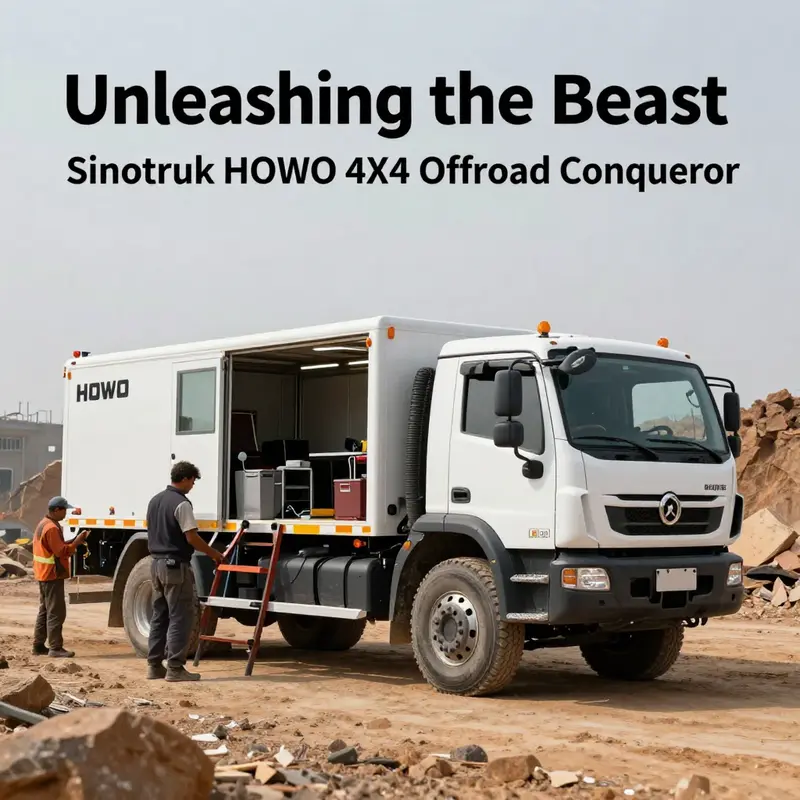
A 4×4 off-road mobile workshop truck is more than a vehicle; it is a field-ready problem solver. Designed to travel where standard trucks cannot, this class of vehicle blends heavy-duty construction with modular interiors to deliver services in isolated or rugged environments. The defining trait is the four-wheel-drive drivetrain, which provides traction and mobility across soft soil, steep grades, and uneven surfaces. That mobility is the foundation for everything else: water and fuel transport, firefighting response, on-site maintenance, cargo delivery, and even command-and-control functions. Understanding how such a truck operates and delivers value requires a close look at its capabilities, the environments it serves, and the trade-offs fleet managers and operators must weigh.
At the heart of this vehicle’s design is a strong chassis and reinforced bodywork. The frame supports large-capacity tanks and secure mounting points for workshop modules. Tanks commonly reach several thousand liters, enabling long-range delivery of water or fuel without frequent refills. Structural strength also allows for mounted pumps, compressors, generators, and heavy tool cabinets. Because missions vary widely, the chassis and superstructure are engineered for modularity. A single platform can host interchangeable modules: a tank and pump package for fire suppression, a fully fitted workshop box with benches and storage, insulated fuel tanks, or a cargo bed with refrigerated or secure storage. That flexibility makes procurement simpler. Operators can standardize on one chassis and swap modules rather than maintain multiple specialized vehicles.
Mobility matters in remote operations. A capable 4×4 system, combined with high ground clearance, low-range gearing, and robust suspension, permits access to work sites in challenging terrain. Mountainous regions, muddy construction sites, remote mines, and sprawling agricultural fields all present obstacles that ordinary trucks will avoid. In emergency scenarios, the ability to reach a location quickly can determine outcomes. A water carrier that navigates steep, single-lane tracks to deliver thousands of liters directly to a wildfire’s perimeter can dramatically shorten response times. A mobile workshop that reaches a broken-down crawler excavator at a remote mine keeps operations moving and prevents costly delays.
The practical applications are diverse but consistent in one requirement: durability. For firefighting, these trucks must carry large-capacity water tanks and high-flow pumps. They must also carry hose reels, nozzles, and foam systems. In areas without hydrants or reliable water sources, these vehicles act as the primary supply. They deliver mass, pressure, and persistence. For fuel transport, tanks require baffled compartments and secure fittings to manage fluid dynamics over uneven ground. The workshop variant needs power generation, compressed air, spare parts, and a secure, weatherproof interior that functions as a full-service garage. Cargo delivery variants emphasize load security and access features like side doors, tail lifts, and reinforced tie-downs.
Outfitting choices change mission performance. A fire-focused fit prioritizes pump capacity, hose length, and rapid-deploy fittings. A workshop emphasizes space for tools, a reliable power source, and safe storage for hazardous materials. Fuel carriers emphasize safety systems: grounding equipment, ventilation, and pressure relief. The modular nature of the platform lets operators tailor equipment to mission profiles without redesigning the vehicle. That reduces lifecycle costs because the same cab and chassis can serve different roles as organizational needs shift.
Deployment planning is as important as vehicle capability. Field teams must think in systems. Fuel consumption rises when an off-road truck works in rough terrain. Engines often run at higher loads for longer periods, especially when powering auxiliary equipment. That raises logistics needs: where will refueling occur, and how many support assets are required to keep the truck mission-capable? Teams must schedule maintenance and parts inventory around the vehicle’s expected duty cycle. A mobile workshop may spend weeks in a forward location, so consumables and spare parts must be stocked accordingly. Predictive maintenance programs and technician training reduce downtime. Standardizing components across a fleet simplifies parts logistics and repairs.
Safety and regulatory compliance weave through every decision. Vehicles carrying water, fuel, or hazardous materials face specific rules around tank construction, fittings, and emergency shut-offs. Fire suppression units must meet standards for pump performance and hose deployment. Workshop modules must secure tools and heavy equipment to prevent movement during transit. Operator training is essential: driving off-road requires different skills than highway hauling. Drivers must manage torque, braking on grades, and recovery techniques. Crews using pumps and fuel-handling equipment require instruction in safety protocols to prevent spills, fires, or injury.
Beyond equipment and rules, the human element shapes effectiveness. A well-designed mobile workshop must be intuitive to use. Tool layout, drawer labeling, and ergonomic work surfaces save time on-site. Quick-access storage for common items prevents repetitive, time-consuming searches. Clear maintenance procedures and checklists help resident technicians and visiting crews operate consistently. For firefighting crews, hose stowage and rapid-deploy mechanisms reduce the time from arrival to action. Simplicity under pressure matters more than a long list of features.
Interoperability with other assets expands utility. A 4×4 mobile workshop often works alongside heavy equipment, command vehicles, and light support trucks. Standardized fittings for communication radios, power inverters, and tow points make cooperation seamless. In incident command scenarios, the truck can act as a forward logistics post or temporary repair bay. Its ability to generate power and air enables remote tools and lighting systems. When tasks require prolonged presence, the vehicle can support crew welfare needs with basic shelter, cooling, or heating systems that keep operations sustainable.
Cost management is inevitable. Off-road-ready trucks demand higher initial investment than standard vans. Reinforced frames, off-road drivetrains, and specialty bodies increase acquisition costs. Operational expenses follow: off-road fuel consumption and increased wear on drivetrain and suspension components raise lifecycle costs. However, these expenditures often offset themselves through reduced downtime and fewer third-party support calls. A company that can repair equipment on-site avoids the cost of hauling heavy machinery to a distant workshop. Emergency operations that quickly suppress fires or refuel generators can prevent much larger losses.
Procurement choices should consider total cost of ownership. Look beyond purchase price. Examine maintenance intervals, parts availability, and service network reach. Modular design reduces the need to buy several single-purpose trucks. Leasing options or rental support for rarely used modules may suit some operators. Consider resale value and adaptability: a platform that accepts multiple modules will likely be valuable to a broader range of buyers at trade-in time.
Environmental and energy considerations are becoming relevant even for off-road fleets. Traditional diesel power remains dominant due to energy density and refueling agility. But trends toward lower emissions and electrification influence planning. Hybrid systems can reduce idling emissions and provide quieter operation where noise and exhaust matter. Full electrification is emerging in some segments, but it poses challenges for long-range, heavy-load off-road missions due to energy density and charging infrastructure. Planning for a mixed fleet may be prudent: retain diesel for heavy-duty primary tasks and adopt electric units for lighter, repetitive tasks in areas with charging support. For firefighting, charging infrastructure for electric apparatus is an active topic of industry discussion, and readers can learn more about charging needs and solutions from resources on electric fire truck charging infrastructure.
Operational doctrine should align with mission realities. For recurring tasks in remote mines or long-term construction sites, a permanently deployed mobile workshop may be more economical than rotating teams. For emergencies, a rapid-deployment model with pre-configured modules and trained crews yields quick response. Scheduling must factor in the truck’s unique needs: off-road travel times, extra fuel use, and potential requirement for escorts when carrying hazardous materials.
Maintenance strategy deserves emphasis. Heavy off-road duty is abrasive. Chassis, suspension, driveline, and brake systems endure more stress than highway operation. A preventative maintenance program based on operational hours and terrain metrics is more effective than one based solely on mileage. Frequent inspections of seals, bushings, and fasteners mitigate the risk of catastrophic failures in the field. Crew-level daily checks catch immediate problems before they escalate. A robust parts inventory, especially for commonly worn components, reduces repair times.
Training makes technology useful. Driver instruction in low-speed control, differential locks, and recovery gear turns a capable vehicle into a safe asset. Technician training ensures the workshop module can service a broad range of equipment. For firefighting and fuel handling, cross-training between drivers and operations personnel increases flexibility and safety. Exercises and field drills test procedures, refine tool layout, and reveal missing resources before real emergencies occur.
Adaptation to mission realities also touches insulation and climate control. Remote operations often expose crews to temperature extremes. Insulated workshop modules maintain a stable environment for both crew and sensitive tools. Heating systems prevent fuel or fluids from gelling in cold climates. Cooling protects electronics and helps crew endurance in hot environments. Power management systems that prioritize critical loads and allow staged operation of pumps, compressors, and lights extend operational windows when the generator or vehicle alternators are the only power sources.
Logistics chains must account for replenishment and waste handling. Water and fuel tanks require documented refill points. Waste fluids and used oil from on-site repairs need proper containment and disposal. Compliance with local environmental regulations is crucial; improper disposal can result in fines or operational shutdowns. Storage for hazardous materials should follow best practices, with secondary containment and spill response kits readily available.
Finally, consider the future. As fleets modernize, data acquisition and telematics become standard. Monitoring vehicle health, fuel consumption, and auxiliary system performance allows managers to make informed deployment decisions. Telematics can alert to maintenance needs and notify logistics teams when refills are required. Over time, data enables optimization of module layouts, mission planning, and procurement specifications.
A 4×4 off-road mobile workshop truck is a strategic tool when matched to mission needs. Its value is less about individual specifications and more about how it integrates into operations. The platform’s strength lies in mobility, modularity, and durability. Those qualities let teams deliver services in places without fixed infrastructure. They enable fast firefighting response, on-site repairs, secure fuel delivery, and reliable cargo transport into remote areas. Achieving cost-effective operation requires careful procurement, thorough training, and proactive maintenance. When planners think in systems — logistics, safety, human factors, and lifecycle costs — these trucks move from expensive assets to indispensable enablers of field operations.
For detailed manufacturer specifications and technical details for a representative 4×4 off-road truck platform, refer to the official product documentation: https://www.sinotruk.com/en/products/4×4-off-road-truck/.
For additional context about electrification trends and infrastructure considerations in emergency vehicles, see discussions about electric fire truck charging infrastructure: electric fire truck charging infrastructure.
Final thoughts
The Sinotruk HOWO 4X4 Offroad Mobile Workshop Truck stands as a robust solution for off-road enthusiasts and rural landowners, merging durability with utilitarian design. Its remarkable features allow it to excel in environments where other vehicles falter, from construction sites to remote agricultural fields. Embracing a lifestyle of adventure and resilience, this truck isn’t just a means of transportation; it’s a vital tool for those who dare to tread off the beaten path.