
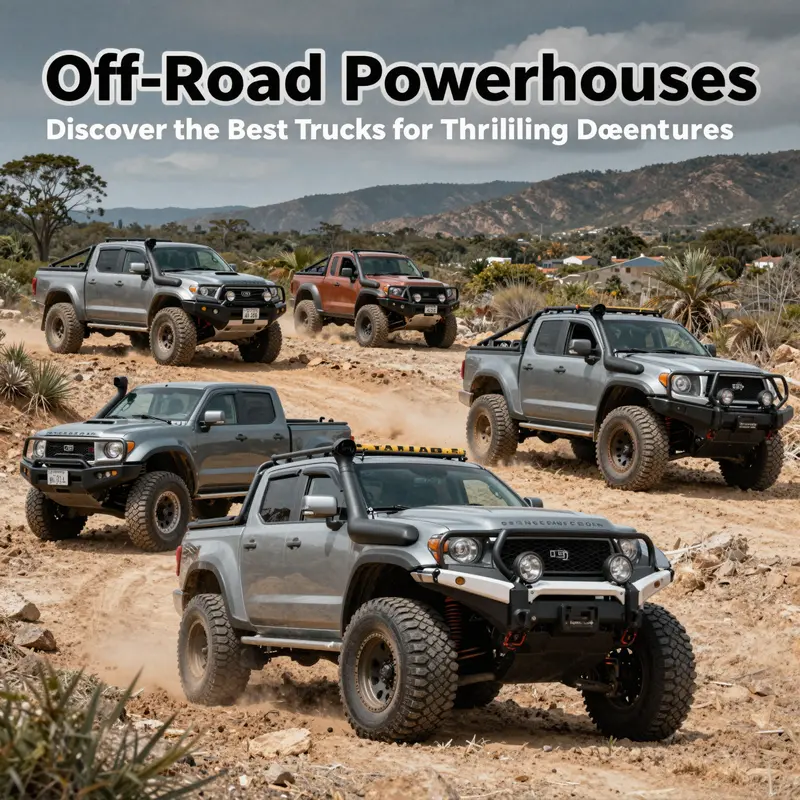
For off-road enthusiasts, the right truck is more than just a vehicle; it’s an extension of their adventurous spirit. Whether you’re blazing new trails, racing across rugged terrain, or simply seeking reliable transport across agricultural land, choosing the ideal off-road truck is essential. Reliability, durability, and the right features must be at the forefront of your mind. This comprehensive guide embarks on a journey through four premier trucks that embody the perfect balance of performance and dependability: the Toyota Tacoma, Ford F-150 Raptor, Jeep Wrangler, and Toyota Land Cruiser. Each chapter will delve into the unique strengths and capabilities of these trucks, empowering you to make an informed decision tailored to your off-roading ambitions.
null
null
What Truck to Buy Off Road: Ford F-150 Raptor – Built for Extreme Terrain
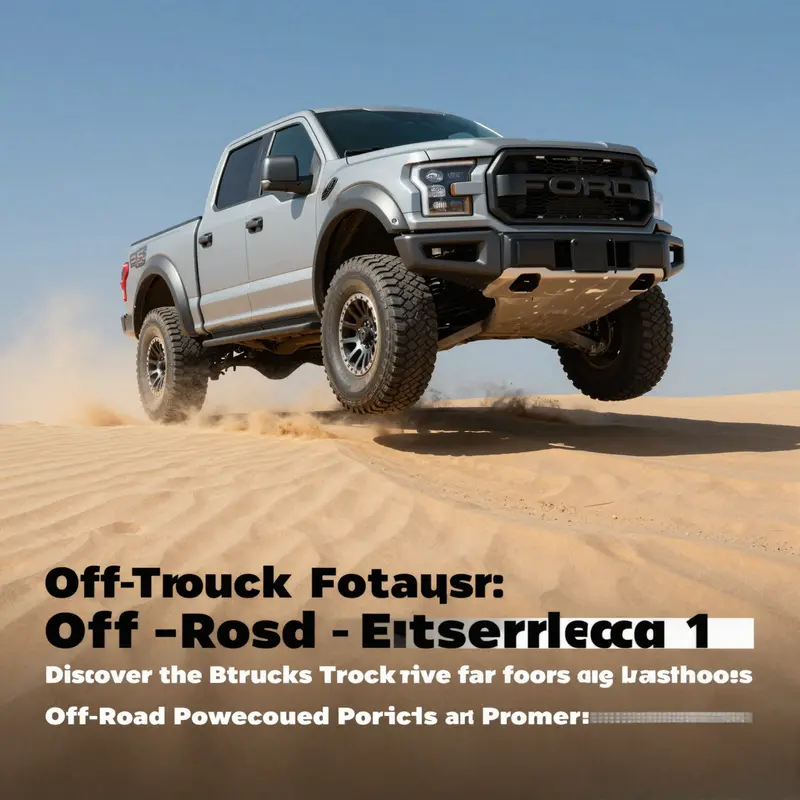
When you push a truck hard off the pavement, you are testing more than speed. You are testing resilience, traction, and a machine that can translate power into controlled progress across rocks, sand, and water. Among the field of capable off road pickups, the Ford F-150 Raptor stands out as a flagship that lives for extreme terrain. This chapter centers on why the Raptor is often the choice for drivers who want to push beyond the safe trail and into the kind of landscape where the ground rules change with every mile. The core idea is simple: if your goal is to conquer the most demanding backcountry routes, you want a truck built from the ground up for that job, not a half-measure built for comfort plus occasional dirt roads. The Raptor is engineered with a singular focus on off road domination, and the 2025 model is a culmination of racing tech, proven durability, and software intelligence that helps the driver manage fearsome terrain rather than be overwhelmed by it.
The heart of the Raptor is its powertrain. The 2025 version is driven by a 3.5 liter EcoBoost V6 twin turbo engine that delivers substantial muscle when you need it. Power pushes toward the upper end of the segment, supported by a 10 speed automatic transmission that keeps the engine in its sweet spot whether you are crawling over a boulder field or lifting off into a desert crest. The numbers matter not just as bragging rights but as real capability: hundreds of horsepower and torque that is available on demand. The fact that this truck can run efficiently on regular 92 octane fuel adds a layer of practicality to an otherwise extreme machine. It means you can plan longer trips without the constant worry of premium fuel while maintaining the performance envelope you expect from a high performance off road package.
But raw horsepower is only part of the story. The Raptor excels where most trucks falter because it uses a sophisticated suspension system to keep wheels in contact with the ground. The Fox Live Valve shocks in the current generation bring real time damping adjustments. These shocks sense the terrain and adjust damping on the fly, preserving traction as you navigate rough stair steps of rock, loose sand, or whoops that would unsettle a less capable setup. This is the kind of feature most drivers feel rather than fully understand until they need it. When you are climbing a steep wash or coming off a dune crest, the live valve system smooths the ride without robbing the wheel of contact. The result is a smoother ride through rough terrain and more precise steering control when the terrain demands exact placement.
Tire choice and geometry matter just as much as the shocks. The 35 inch all terrain tires provide a platform for ground clearance and bite in a wide range of surfaces. They work in concert with a relatively tall chassis and a robust frame design, which together create the willingness to take on rough trails with a sense of security. The raptor balances leverage and grip so you can approach a rock crawl with the confidence that torque and traction will be transmitted effectively to the wheels that can actually move you forward. When the trail narrows or the path crosses a water obstacle, the Raptor feels more like a partner than a tool, with the ability to modulate power and traction in response to the terrain rather than fight it. The chassis architecture, including a full box frame, reinforces rigidity while protecting sensitive components through rough terrain, so you have less fear about sustaining minor abuse on a weekend adventure.
On the technology front, the Terrain Management System offers seven distinct driving modes, including a Baja setting designed for high speed cross country runs. The Baja mode optimizes throttle response, traction control, and suspension damping for dry or soft surface conditions, where you want to maintain speed without losing stability. The system is the kind of feature that makes the Raptor approachable for a driver who does not grow up tuning suspensions or reading the terrain like a pro racer. It translates a complex combination of inputs into a straightforward experience: you pick the surface you expect to encounter, and the vehicle adjusts itself to maintain traction and stability. Coupled with an electronic locking rear differential and torque vectoring, the Raptor can distribute torque precisely where it is needed. The result is a vehicle that can climb, traverse, and crawl through obstacles that would slow or stall a more conventional pickup.
A close look at the numbers reveals more than power. The approach and departure angles, combined with a respectable breakover clearance, allow the Raptor to approach rock faces and crest ridges with a degree of forgiveness. Water crossings up to substantial depths are manageable, and the long travel suspension helps maintain wheel contact on uneven surfaces. The 7 inch front and rear lift adds fuel to the performance claims, giving the tires the room they need to grip where a lower truck would struggle. Real-world testing has shown the Raptor to be extremely confident at speed on rough terrain, a consequence of the integration of suspension, chassis rigidity, and power delivery working in harmony. The digital cockpit provides immediate feedback on suspension mode, terrain conditions, and vehicle dynamics, enabling a driver to tune their approach in real time. The combination of information and control, rather than brute force alone, is what makes the Raptor so compelling for extreme terrain.
Of course there are tradeoffs. The Raptor sits at a higher price point and consumes more fuel than many standard pickups. It is not designed for the most efficient daily commute; it is designed for serious off road performance, with daily usability as a secondary benefit. Maintenance costs can be higher than a basic truck, given the advanced hydraulic systems and electronic controls. However, many owners report that the reliability and durability of the package pay dividends in the long run, especially when you factor in the resale value and the confidence that comes with owning a vehicle that has seen success in endurance events and professional competition. The Raptor is part of a lineage that includes racing heritage and a long track record of meeting extreme demands, and that heritage translates into a sense of reliability that you feel when you drive it through the wild.
The ownership experience goes beyond the engine and the chassis. The interior, while tuned for performance, includes a modern digital cockpit that keeps you connected to the critical data you need when you are braving the elements. Real-time data on suspension settings, terrain conditions, and vehicle dynamics becomes a practical tool rather than a distraction, helping you to stay in control when you are negotiating a rocky pass or entering a sandy wash at high speed. For those who want to understand the mechanical foundations more deeply, a deeper dive into the fundamentals of drivetrain and suspension can be helpful. For readers who want a deeper dive into the fundamentals of powertrains and drive-line reliability, see Mastering diesel mechanics for broader context and insight into how these systems perform under load. Mastering diesel mechanics.
The practical truth about choosing a truck for off road is that you must align your choice with your terrain, your driving style, and your budget. The Raptor is the apex predator when the terrain asks for high-speed, high-consequence maneuvering. It shines where you need the blend of race-proven engineering and desert-dirt tenacity. It can accelerate through dips and over obstacles that would challenge more conventional trucks, and it can do so while maintaining confidence for the driver. If your trails routinely include rock gardens, deep whoops, or sandy dunes that require real speed to avoid bogging down, the Raptor makes a compelling case as the top-tier option. It is the obvious pick for those who want the best possible off road performance packed into a daily-drivable, street-legal bundle.
That said, the broader field of off road trucks remains surprisingly diverse. A mid-size option may offer better reliability and lower running costs for those who tackle lighter trails or who need a more compact vehicle for tight canyons. A rugged, proven off road platform with great low-end torque and predictable handling can still surprise you with capability in challenging environments. When you are evaluating a choice for off road, you should consider how much time you plan to spend in remote locations, the type of terrain you love, and how much money you are comfortable investing. The Raptor’s strengths are most evident when the terrain demands high speed in rough conditions, strict control, and the ability to adapt quickly to changing ground. If those are the priorities, the Raptor is a compelling choice that represents the peak of modern off-road engineering.
Still, the decision is not made in isolation. The overall article you are reading balances a collection of perspectives on off road trucks, showing how different models trade off capability, durability, and daily usability. The Raptor acts as a benchmark for extreme terrain performance, while other models from the same family, and other brands, might offer different strengths that better align with individual needs or budgets. The goal is to honor the terrain while respecting the practical realities of ownership. When you plan your trip into the backcountry, you should be mindful of frame condition, rust, and potential corrosion, particularly if you operate in snowy or salty environments. Do not neglect preventative maintenance, and consider adding practical upgrades such as a winch, a protective bumper, a roof rack for extra gear, and recovery equipment to keep you safe on remote trails. A careful, thoughtful approach to buying and maintaining an off road truck translates into more time on the trail and less time in the shop, which is exactly what serious off road enthusiasts are seeking.
For readers who crave broader context delving into the theory behind the performance, you can explore related material on the topic of performance off road systems and how professional teams tune suspensions for rugged environments. External sources provide detailed reviews and tests that can help you calibrate expectations against real-world data. For a detailed, numbers-driven test of the 2025 model, see MotorTrend’s review linked here: https://www.motortrend.com/cars/ford/f-150-raptor/2025/
Trail-Ready Choice: Why the Latest Wrangler Excels When You’re Choosing a Truck for Off-Roading

The latest Wrangler generation stands out when you’re deciding what truck to buy for off-road use because it was engineered with off-trail driving at its core. Its strengths are not isolated features piled together; they form a cohesive package that makes trail driving predictable, repairable, and—importantly—fun. When you evaluate a truck for off-road work, you want systems that play well together: a drivetrain that talks to the suspension, a chassis that tolerates abuse, and an ecosystem that lets you modify or repair without wasting weekends. The Wrangler delivers on all three, and understanding how and why helps you judge it against other options.
At the center of the Wrangler’s appeal is its commitment to proven mechanical simplicity married to modern controls. The solid front and rear axles are a great example. Unlike independent suspensions that can limit wheel articulation under extreme loading, solid axles give more predictable wheel travel and maintain tire contact over uneven surfaces. That articulation translates into traction: when one wheel drops into a rut, the opposite wheel can stay planted and pull you through. For trail driving, that predictability beats a marginal improvement in on-road comfort every time. In practical terms, the solid axle setup reduces the number of surprise slides and chassis shimmies you encounter on rough rock sections and uneven two-track roads.
Traction control and locking differentials are the next piece of the puzzle. Electronic aids like selectable four-wheel-drive modes let you tailor the vehicle to sand, mud, snow, or rocks at the flip of a switch. Mechanical solutions such as locking differentials take that a step further by forcing both wheels on an axle to spin together, which is often the only answer on slippery, off-camber climbs. The combination of electronic systems and dependable mechanical lockers means you can tackle varied terrain without needing constant driver intervention or complex driving techniques. That reduces driver fatigue and increases the margin for error—critical when you’re far from paved roads.
High ground clearance and protective underbody armor matter as much as they sound. The newest models push clearance figures past 11 inches in their most capable trims. That number isn’t just marketing; it directly affects what you can pass over without risking damage. Combine that clearance with heavy-duty skid plates and you protect the oil pan, fuel tank, and transfer case from impact—parts that are expensive and difficult to repair in the field. A reinforced frame complements this protection. Rather than a flimsy ladder, the Wrangler uses a robust structure that resists twist and flex. On trails that demand sharp steering inputs and abrupt weight transfers, the reinforced frame keeps body mounts and suspension geometry aligned, which preserves predictable handling after thousands of miles of hard use.
One of the most practical advantages of the latest generation is its modular, owner-friendly design. Removable doors and roofs are not merely gimmicks; they make body access easier for repairs, ventilation on hot deserts, and visibility when picking lines on tight trails. The design also reflects how the vehicle is used: an off-road truck that embraces exposure is implicitly built for easy maintenance and rapid modifications. That ties into the extensive aftermarket support available. You can buy lift kits, larger tires, bumpers, winches, and recovery points that bolt on without major chassis surgery. That ecosystem keeps long-term ownership affordable because you can upgrade incrementally and source replacement parts from multiple suppliers. If you’re someone who likes to tinker, that aftermarket breadth means aftermarket parts are common, affordable, and well-documented—far better than a closed, proprietary platform.
Durability and reliability are not only about the factory hardware; they’re also about design philosophy. The latest Wrangler emphasizes mechanical robustness where it matters most—transfer case, axles, and frame—while integrating modern conveniences that do not compromise durability. That balance reduces complex failure modes seen in some modern SUVs where electronic systems are deeply integrated into mechanical functions. When you’re off-grid, a vehicle that remains operable with basic tools is invaluable. That design thinking also improves resale value because long-term buyers prioritize maintainability.
Off-road capability is often judged by headline specs—tires, shock travel, approach and departure angles—but the Wrangler’s real-world success comes from the way those specs are implemented. For example, factory shocks and suspension geometry are tuned for a wide range of loads, from solo weekend runs to lightly loaded overlanding. The baseline setup is forgiving enough for casual drivers yet upgradeable for those who require specialized tuning. The steering geometry supports low-speed precision on rock gardens without creating twitchy behavior at highway speed. That dual-purpose tuning makes the truck more versatile for owners who want one vehicle to do many jobs.
Customization is not just about performance. Practical aftermarket options such as locking storage, roof racks, and modular bumpers make it easier to carry recovery gear, spare fuel, and camp supplies. Winches and heavy bumpers add weight, so the ability to tune suspension and brakes for the load you actually carry is essential. Because the platform is so widely used, you can find expert installers and community knowledge that reduce the learning curve for complex upgrades. This network effect is a real advantage when you compare the total cost of ownership over five to ten years.
Safety and usability when off-road deserve attention too. Modern traction and stability controls let you push limits with an added layer of security. While these systems won’t replace driver judgment, they reduce the probability of getting into an unrecoverable situation. Off-road lighting and visible recovery points are practical choices that help when daylight fades or a simple recovery becomes necessary. The Wrangler’s design includes these features or offers them as straightforward upgrades, so you can assemble a setup that matches how far you plan to go and how remote your trips will be.
Maintenance and inspection habits make a big difference in long-term ownership. A truck that tolerates routine checks—fluid inspections, frame rust monitoring, and bolt torque checks—without needing dealer-only diagnostics will save time and money. The Wrangler’s accessible components simplify many of these tasks. That accessibility is essential when you factor in the most likely failure modes on a trail: punctured tires, torn CV boots, or damaged skid plates. Easy component access means faster field repairs and shorter downtime.
Finally, consider the intangible but practical value of community knowledge. Owning a widely supported off-road truck gives you a library of experienced advice, trail-tested modifications, and local clubs. Those resources are invaluable for route planning, troubleshooting, and learning to use the vehicle effectively. If you plan to buy aftermarket upgrades or need help after a breakdown, the local and online communities around this platform are reliable, active, and full of experienced owners who share tips that save money and prevent mistakes.
If you want a condensed assessment: the latest Wrangler generation provides a coherent package for off-road buyers seeking a dependable, upgradeable, and trail-competent truck. It balances mechanical simplicity with modern aids, offers high clearance and protection, and benefits from a massive aftermarket and owner community. For anyone deciding what truck to buy off road, these traits make it a top choice for trail versatility and long-term ownership. For more detailed specifications and official feature lists, visit the manufacturer’s vehicle page: https://www.jeep.com/vehicles/wrangler.html
For owners who want to get hands-on with maintenance and better understand the mechanical underpinnings of their off-road vehicles, an introductory resource like the mastering diesel mechanics guide can be a helpful reference for developing practical shop skills. https://dirtantrucks.com/mastering-diesel-mechanics-your-step-by-step-path-to-success/
Legendary Long-Range Off-Roader: Durable Full-Size Cruiser (2022–Present)
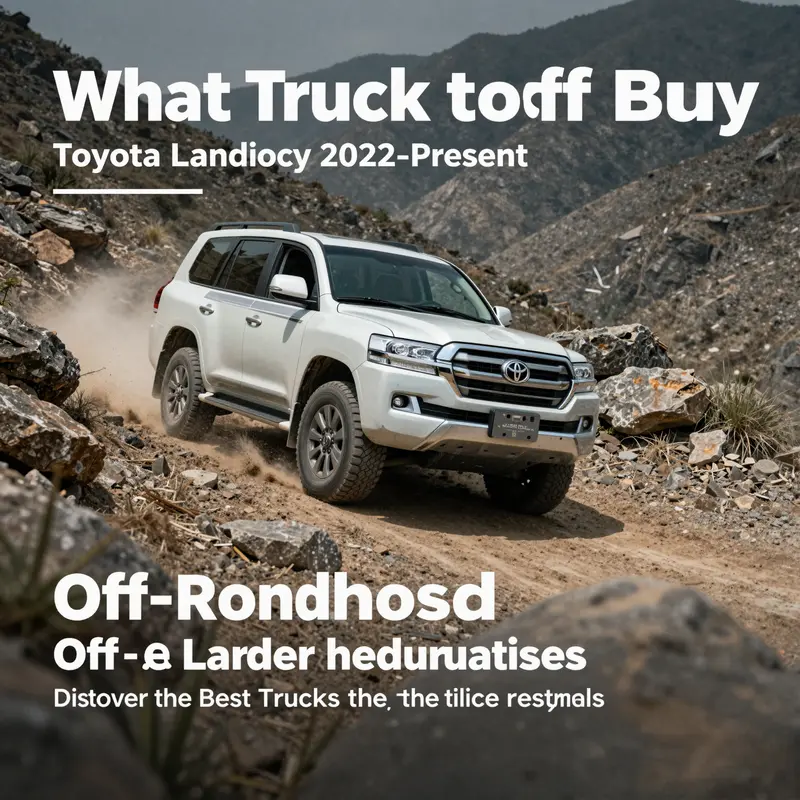
A truck built to be depended on is the foundation of every serious off-road kit. For buyers who plan extended expeditions, remote overlanding, or repeated heavy-duty use, durability matters more than flash. The full-size cruiser introduced in 2022 carries a lineage defined by enduring hardware, conservative engineering choices, and systems tuned to survive harsh environments. It is a vehicle designed to be repaired, not replaced, in places where help is days away rather than hours.
Start by considering the heart of any off-road rig: the powertrain. The modern cruiser pairs a compact twin-turbo V6 with a ten-speed automatic. That powerplant produces strong peak output and impressive torque low in the rev range, which makes a real difference when crawling over rocks or hauling a loaded trailer on steep gravel descents. The result is linear, controllable power delivery; you can modulate throttle precisely at walking pace and still have the oomph for high-speed desert runs. Unlike overly complex hybrid systems, this setup favors mechanical simplicity and ease of service in the field. It runs on mid-grade fuel and manages consumption reasonably well for its class, which matters when fuel stops are scarce.
A transmission that shifts smoothly across a wide spread of ratios complements the engine. The ten-speed automatic keeps the engine in the sweet spot more often, improving drivability on mixed terrain and enabling quieter, more efficient highway cruising with a heavy load. More importantly for off-road use, modern calibrations ensure predictable low-speed behavior. When paired with a robust transfer case and a three-way locking differential arrangement—front, center, and rear—the drivetrain creates a platform that maximizes traction on unpredictable surfaces. Locking differentials are not a luxury here; they are the difference between getting stuck for hours and maintaining momentum through deep mud, sand, or technical rock sections.
Suspension design is the other pillar of off-road capability. This cruiser uses a dynamic suspension system that adjusts damping in real time. The system softens to enhance wheel articulation off-road and firms up for stability at speed, without requiring manual toggles for most conditions. That balance pays dividends when you transition from tight forest trails to open washboard tracks. Coupled with a high factory ground clearance, the vehicle can clear significant obstacles without aftermarket lifts. Approach and departure angles are engineered with real-world trail use in mind, which reduces the need for heavy modification before hitting serious lines.
Underbody protection and component packaging show the vehicle was engineered by people with practical off-road experience. Skid plates protect the oil pan, transfer case, and fuel tank. Critical control arms and mounting points are situated to minimize exposure to direct impacts. The result is a chassis that can be bash-resistant while remaining serviceable. Where many modern vehicles hide sensors and wiring in vulnerable locations, this cruiser organizes key systems to be less fragile and more accessible for field repairs.
Reliability runs through both design and supply chain support. Components are chosen for longevity and parts networks are global. That means, in remote regions, it is more likely you can source a replacement module or a mechanical part. Dealers and independent shops familiar with the platform exist in most countries, simplifying logistics if you need long-term servicing during an extended trip. The vehicle also benefits from decades of iterative improvements on core architectures; many failure modes have been engineered out over the generations that preceded it.
Practicality shows itself not just in big-ticket mechanical choices but in small, usable details. Interior spacings accommodate long drives and camping gear. Storage is arranged with robust tie-down points and flat surfaces to mount auxiliary equipment. The electrical architecture supports adding accessories without overtaxing the factory systems: auxiliary switches, heavy-duty alternator options, and prewired grounds are available for common mods like winches, fridge units, and additional lighting. Water fording capacity is considered during intake and sensor placement, and drain points are integrated so that the vehicle can be cleaned out effectively after a river crossing or a salty beach run.
No off-road vehicle is perfect out of the box, and the cruiser is no exception. The infotainment system is large and clear but feels less nimble than modern smartphone-first interfaces. For buyers who prioritize seamless phone integration and the latest app dynamics, this is a minor annoyance rather than a deal-breaker; the core vehicle systems are aimed at durability and mission-readiness. Steering is weighted for stability but can become taxing over long highway stints when compared to lighter steering setups found in softer-duty trucks. These trade-offs reflect a design philosophy: prioritize composure and predictability under load and in rough terrain.
Before buying, inspect specific items that determine long-term ownership costs. Check for frame integrity and rust, especially if the candidate truck has spent time in coastal or winter-salted regions. Confirm service history for scheduled maintenance that prolongs engine and transmission life. If the vehicle has been outfitted with aftermarket parts, ask about the quality and installation—poorly done modifications can be more detrimental than no mods at all. For example, oversized tires without recalibrated suspension and gearing can stress axles and the drivetrain over time.
For many buyers, the argument for the cruiser hinges on its balanced approach to zero-fail reliability and true off-road functionality. It is not the lightest, nor the most luxurious, nor the absolute fastest in a straight line. Instead, it is engineered to tolerate neglect and to be maintained easily, to accept heavy-duty service upgrades, and to perform in extreme environments where failure is unacceptable. It is the sort of truck you can take across continents and still expect to use for years afterward with minimal surprise repairs.
If you plan to modify, begin with serviceable, proven upgrades. A modest lift helps with larger tires and improves approach angles while keeping stress on factory suspension components manageable. Replace factory tires with durable all-terrain rubber before hitting rough roads; that yields the most immediate improvement in traction and protection. Consider adding a winch and heavy-duty bumpers only where they are necessary and installed professionally to preserve sensor functionality and load paths. Wiring upgrades and an auxiliary power system are smart early investments for overlanders who will run fridges, satellite equipment, and additional lighting for long periods.
Maintenance philosophy matters as much as the vehicle itself. Regular inspection of seals, fluid condition, and fasteners after hard use will catch problems before they become show-stopping failures. Keep a small toolkit and key spares on board: common sensors, belts, hoses, and a spare wheel bearing kit can save days in the field. Train with the vehicle so you understand its behavior under different loads and how the driver aids interact with manual inputs. The more familiar you are with your truck’s limits, the better decisions you will make on the trail.
Ultimately, this cruiser is a compelling pick for buyers who need a go-anywhere platform that won’t let them down in remote places. It delivers a pragmatic mix of modern power, intelligent suspension, and field-focused engineering. Expect solid on-road manners, deliberate off-road capability, and long-term serviceability. If your priorities are long-range travel, tough conditions, and a vehicle that rewards sensible maintenance and thoughtful upgrades, this model sits near the top of the shortlist for off-road purchase consideration.
For deeper technical detail and real-world evaluation from an automotive expert, see the full review linked here: https://www.caranddriver.com/land-cruiser/reviews/a40857722/2026-toyota-land-cruiser-review/.
Final thoughts
Selecting the best truck for off-road use is a journey through various options, each offering unique features that cater to different adventure levels. From the robust reliability of the Toyota Tacoma to the power-packed Ford F-150 Raptor, each vehicle excels in its own right. Meanwhile, the Jeep Wrangler stands out for trail versatility, and the Toyota Land Cruiser promises legendary durability for the most demanding environments. Ultimately, your choice should align with your specific needs, whether navigating tough landscapes or embarking on extended expeditions. Diligent preparation and informed decision-making will elevate your off-road experience and ensure your adventures are nothing short of thrilling.