

Introduction
In an era of environmental concerns, Volvo’s electric construction equipment is transforming demolition sites. By utilizing electric machinery for urban projects, Volvo emphasizes sustainability and sets a new standard in construction innovation.
The all-electric demolition job at Siemens Technology Campus in Erlangen, Germany, showcased the potential of electric heavy machinery. These machines perform comparably to diesel alternatives but significantly reduce emissions and noise pollution.
As cities face strict regulations and a need for greener practices, Volvo’s electric construction equipment offers a glimpse into the future of urban demolition. This shift highlights the intersection of environmental responsibility and economic viability in construction, showing how technological advancements can reshape our cities for the better.
Significance of Volvo’s All-Electric Demolition Job
The execution of the world’s first all-electric demolition job at the Siemens Technology Campus in Erlangen, Germany, marks a groundbreaking milestone in the construction industry. This significant achievement not only showcases the capabilities of electric machinery but also sets a precedent for how urban construction and demolition will evolve in the future.
Volvo Construction Equipment’s initiative highlights a pivotal shift toward sustainability in urban environments. Traditional demolition practices often exacerbate environmental concerns through noise, emissions, and operational inefficiencies. However, the all-electric approach demonstrates reduced noise pollution by approximately nine decibels compared to diesel equipment, paving the way for more harmonious construction activities in densely populated areas.
With electric machines capable of a productive runtime of 7-9 hours on a full charge, the operational viability of these vehicles is proving strong. The implications extend beyond immediate project sites; they challenge industry norms and encourage cities to adopt greener practices, aligning with regulatory frameworks aimed at mitigating climate change.
Moreover, this achievement contributes significantly to sustainability goals by enabling projects to reduce their overall carbon footprint. As cities grapple with environmental responsibilities, Volvo’s commitment offers a sustainable pathway forward that not only caters to ecological considerations but also presents a compelling business case for electric machinery—where lower operational costs and government incentives close the financial gap left by traditional methods.
In essence, Volvo’s all-electric demolition job is more than just a successful project; it signifies a paradigm shift in the construction industry, illustrating how advancements in technology can lead to environmentally friendly practices. As these innovations become mainstream, they have the potential to redefine urban demolition, making it cleaner, quieter, and more efficient. Thus, the future of urban construction looks brighter, thanks to initiatives like this that blend technology with sustainability for a better tomorrow.
Advantages of Electric Construction Equipment
Electric construction equipment provides a multitude of benefits compared to traditional diesel machines, particularly in productivity, cost efficiency, and environmental impact. Volvo’s recent projects demonstrate these advantages clearly, establishing a compelling case for the shift towards electrification in the construction sector.
Productivity and Performance
Electric machines are known for their instant torque, leading to quicker and more responsive operation. For example, the Volvo ECR25 Electric excavator offers immediate hydraulic response, which significantly enhances both operator comfort and overall productivity during operation.
Cost Efficiency
When it comes to operational costs, electric equipment typically presents a more economical choice. The reduced idle time and lower maintenance requirements associated with electric machinery contribute to this cost-effectiveness. Unlike diesel engines that remain operational during idle periods, electric motors can shut off completely, resulting in minimal accumulated operating hours and reduced wear. Additionally, electric equipment minimizes the need for engine maintenance, including oil changes and filter replacements, which can lead to decreased downtime and labor expenses.
Environmental Benefits
One of the most significant advantages of electric construction equipment is its zero emissions at the point of use, drastically lowering the carbon footprint associated with construction activities. In a year-long pilot conducted by Volvo, their electric machines collectively reduced carbon dioxide emissions by 6 metric tons during 400 operational hours when compared to diesel machines.
Noise Reduction
Electric machines operate much quieter than their diesel counterparts, making them especially favorable in noise-sensitive environments. For instance, the Volvo ECR25 Electric excavator achieved a noise level reduction of approximately nine decibels, translating to a 90% decrease in sound power compared to diesel machines. This feature allows construction work to continue without disturbing nearby residents or businesses, particularly in urban settings.
Operational Hours
Another key advantage is the operational versatility of electric machines, which can operate in areas where diesel equipment might be restricted, such as indoors or during nighttime hours. Their zero-emission and lower noise profile allow contractors to extend their working hours and gain access to projects in noise-sensitive or enclosed environments.
In conclusion, the shift to electric construction equipment presents enhanced productivity, cost savings, environmental benefits, noise reduction, and greater operational flexibility compared to traditional diesel machinery, clearly demonstrating the potential for a greener and more efficient future in the construction industry.
| Feature | Electric Equipment | Traditional Diesel Equipment |
|---|---|---|
| Operating Hours | 7-9 hours on a full charge | Varies, typically longer with refueling |
| Noise Levels | Reduced by approximately 9 decibels | Generally louder, varies by engine |
| Cost of Electricity vs. Diesel | Electricity is often cheaper and stable | Diesel prices fluctuate, often more expensive |
| Emissions | Zero emissions at the point of use | Significant CO2 and other emissions |
| Maintenance Costs | Lower due to fewer moving parts | Higher due to more frequent maintenance needs |
| Environmental Impact | Significantly lower carbon footprint | Higher carbon footprint due to emissions |
This comparison table provides a clear visual reference illustrating the advantages and characteristics of Volvo’s electric construction equipment compared to traditional diesel equipment, emphasizing the potential for improved sustainability and efficiency in the demolition industry.
Financial Aspects of Ownership: Electric vs Diesel Construction Machinery
The financial implications of choosing electric construction machinery over traditional diesel models are profound and multi-faceted. At the heart of this decision lies the concept of Total Cost of Ownership (TCO), which encompasses initial purchase price, operating costs, maintenance expenses, and potential government incentives.
Total Cost of Ownership
Electric construction equipment typically comes with a higher upfront cost, often 20 to 40 percent more than their diesel counterparts. For example, a mid-sized electric wheel loader might be priced between $200,000 and $240,000 compared to $150,000 to $180,000 for a diesel option. However, this initial investment becomes increasingly justifiable when evaluating the long-term savings.
Operating costs for electric machinery present a substantial economic advantage, predominantly stemming from fuel savings. Electricity generally costs significantly less than diesel over time, with some estimates suggesting a possible savings of $75,000 throughout the equipment’s lifecycle. This is bolstered by reduced fuel variability, providing financial predictability as diesel prices fluctuate. Moreover, as one industry leader pointed out, “First, electricity is cheaper and more stable than diesel in most places.”
Maintenance Savings
Maintenance expenses further amplify the economic benefits of electric machinery. With fewer moving parts and a simpler operational design than diesel engines, electric equipment can reduce maintenance costs by up to 50%. This not only means lower out-of-pocket expenses for parts and service but also translates into decreased downtime and increased productivity. Equipment operators can rely on electric models continuing to perform consistently without the frequent need for repairs associated with diesel engines.
Emotional Appeal: Sustainability and Corporate Responsibility
The conversation around economic drivers is increasingly intertwined with sentiments of corporate responsibility and environmental sustainability. With stringent regulations targeting emissions, companies adopting electric construction machinery not only mitigate potential fines but also align with broader societal goals. As one executive noted, “It’s being driven not just by green ideals, but by a strong business case,” illustrating how profitability now dances hand in hand with sustainability.
By investing in electric machinery, construction firms can portray themselves as innovators committed to reducing their carbon footprint and promoting cleaner urban environments. This approach resonates well with clients and stakeholders who prioritize sustainability, enhancing their corporate image while driving new business opportunities.
Conclusion
In light of the financial aspects of ownership, electric construction machinery emerges as a shrewd investment for companies looking to balance economic viability with environmental considerations. While upfront costs may be higher, operational savings, maintenance efficiencies, and potential subsidies can lead to a reduced Total Cost of Ownership over time. By embracing this transition, construction companies not only position themselves for financial success but also take significant steps toward a more sustainable future, enhancing their reputation in a competitive marketplace.
User Adoption Success Stories in Electric Construction Equipment
The rise of electric construction equipment in urban environments has been marked by impressive user adoption rates and compelling success stories, showcasing both environmental and economic benefits derived from this transition.
Environmental Benefits and Adoption Rates
Electric construction machinery is leading the charge toward more sustainable urban construction practices. Cities like New York, Los Angeles, and Toronto have seen over 42% of their municipal fleets integrate electric equipment. Approximately 31% of equipment rental firms in the U.S. now offer electric models, highlighting a trend toward reduced emissions. In Europe, more than 50% of EU-funded projects are favoring electric or hybrid models, with countries like Germany and Sweden reporting electric purchases at 47%. In the Asia-Pacific, China alone accounts for over 41% of global electric construction machinery output.
Success Stories
- High Line Project, New York City: Utilized electric excavators leading to a 63% reduction in noise complaints and a 40% decrease in particulate matter emissions, establishing a new standard in sustainable urban construction practices.
- Skanska’s Los Angeles D Line Subway Extension: A pilot project using an all-electric Volvo EC230 excavator recorded a 66% reduction in hourly carbon emissions and a 74% decrease in costs compared to diesel equipment.
- Electric Worksite Project, Gothenburg, Sweden: Demonstrated electric machines performing to the same standards as diesel counterparts with zero exhaust emissions, enhancing urban construction environments.
Economic Benefits
In terms of financial viability, the operational cost savings from electric machinery are substantial, with some projects achieving energy cost reductions of up to 86%, representing payback periods of less than two years. For example, during a year-long pilot program, Volvo’s electric machines collectively reduced CO2 emissions by 6 metric tons over 400 operational hours compared to diesel machines. This aligns with broader market expectations; the global electric construction equipment sector is anticipated to expand from $2.45 billion in 2025 to over $6.07 billion by 2032, reflecting a notable compound annual growth rate (CAGR) of 13.8%.
Conclusion
These success stories and statistics highlight that the transition to electric construction equipment is not solely driven by environmental goals but is also a smart economic decision. As cities and construction firms prioritize sustainability, the move towards electric equipment paves the way for cleaner, quieter, and more efficient urban demolition and construction operations, illustrating that the future of urban development lies in the electrification of construction machinery.
Conclusion
As the construction industry confronts pressing environmental challenges, the adoption of electric construction machinery emerges as a pivotal shift toward sustainability and efficiency. Volvo’s groundbreaking initiatives, such as the world’s first all-electric demolition at Siemens Technology Campus, highlight the feasibility and performance of electric equipment, underscoring that innovation does not need to compromise productivity. These electric machines not only demonstrate operational capabilities comparable to their diesel counterparts, but they also significantly reduce emissions and noise pollution, paving the way for more harmonious construction practices in urban settings.
Moreover, the economic advantages of transitioning to electric equipment—such as lower operating costs, reduced maintenance needs, and essential government incentives—make for a compelling business case. These factors are driving municipalities and private companies alike to integrate electric machinery into their fleets, evident in remarkable success stories from projects in cities like New York and Los Angeles, where substantial reductions in emissions and costs have been realized.
Looking to the future, the continued electrification of construction machinery is poised to reshape urban landscapes and redefine standards in the industry. By embracing this transition, construction firms can play a vital role in fostering sustainability, showcasing responsible corporate practices, and meeting the demands of a rapidly evolving regulatory environment. As Tomás Kuta, President of Region Asia at Volvo Construction Equipment, states,
“The road to a sustainable future is one we must build together, and Volvo CE is paving the way by creating a range of machines and technologies that will make this a reality while also providing financial and operational benefits to its customers.”
This quote encapsulates the essence of collaborative innovation in achieving sustainability. As we champion these advancements, it is clear that the path toward a cleaner, more efficient, and more innovative approach to urban construction is illuminated by the electric revolution in the construction sector.
Recent Innovations in Electric Construction Technology for Urban Demolition
The landscape of urban demolition is evolving, with several companies contributing significant advancements in electric construction technology that align with Volvo’s pioneering initiatives. The focus on sustainability and efficiency is evident in the following breakthroughs:
Volvo’s Groundbreaking All-Electric Demolition
In September 2025, Volvo Construction Equipment (Volvo CE) executed the world’s first all-electric demolition project at Siemens’ Technology Campus in Erlangen, Germany. Utilizing a diverse fleet of electric machines, including excavators and wheel loaders, Volvo demonstrated a significant reduction in CO₂ emissions and noise pollution, successfully replacing fossil fuels in a substantial urban demolition effort. Therese Schmitz-Hillebrecht, Head of Market Area Central Europe at Volvo CE, remarked, “Our transformation is no longer a vision, but a reality,” underscoring the feasibility of sustainable urban demolition.
Bobcat’s Battery-Powered Solutions
Bobcat is leading the charge towards emission-free urban demolition with its introduction of electric equipment, such as the E10e and E17e excavators. These machines are designed for heavy-duty work while ensuring zero emissions and requiring minimal maintenance. The state-of-the-art lithium-ion batteries provide a full day’s runtime, making them ideal for indoor and urban demolition projects, therefore minimizing environmental impact while maximizing operational efficiency.
Hyundai’s Electric and Hydrogen Alternatives
Hyundai made waves at bauma 2025 by unveiling its HX19e electric mini excavator and HW155H hydrogen fuel cell-powered excavator. The HX19e offers over six hours of operation with rapid charging capabilities, while the HW155H provides a sustainable solution with eight hours of continuous operation. Both innovations represent Hyundai’s commitment to reducing emissions and enhancing operational workflows in urban environments.
Built Robotics’ Autonomous Equipment
Automating the demolition process is also on the rise, as Built Robotics introduces its aftermarket kit, the Exosystem, which adds autonomous capabilities to existing heavy machinery. Using GPS and artificial intelligence, this solution enhances safety and efficiency for urban demolition projects, allowing machines from various manufacturers to operate autonomously—further pushing the boundaries of urban construction.
Komatsu’s Emphasis on Local Environmental Sensitivity
In Europe, Komatsu has launched new electric mini excavators that cater to the specific needs of emissions-sensitive areas. Models such as the PC20E, PC26E, and PC33E have been designed to foster a sustainable approach toward urban construction, ensuring that demolition projects contribute positively to their local environments.
Conclusion
These innovations collectively reflect a paradigm shift in urban demolition, where electric and autonomous technologies are not merely adjuncts but essential components of construction strategies focused on sustainability. The advancements by Volvo, Bobcat, Hyundai, Built Robotics, and Komatsu signify a growing recognition within the industry of the need for greener practices, as cities worldwide demand cleaner, quieter, and more efficient solutions for demolition. This fundamental transformation underscores the increasing importance of electric construction technology as we move toward a sustainable future in urban development.
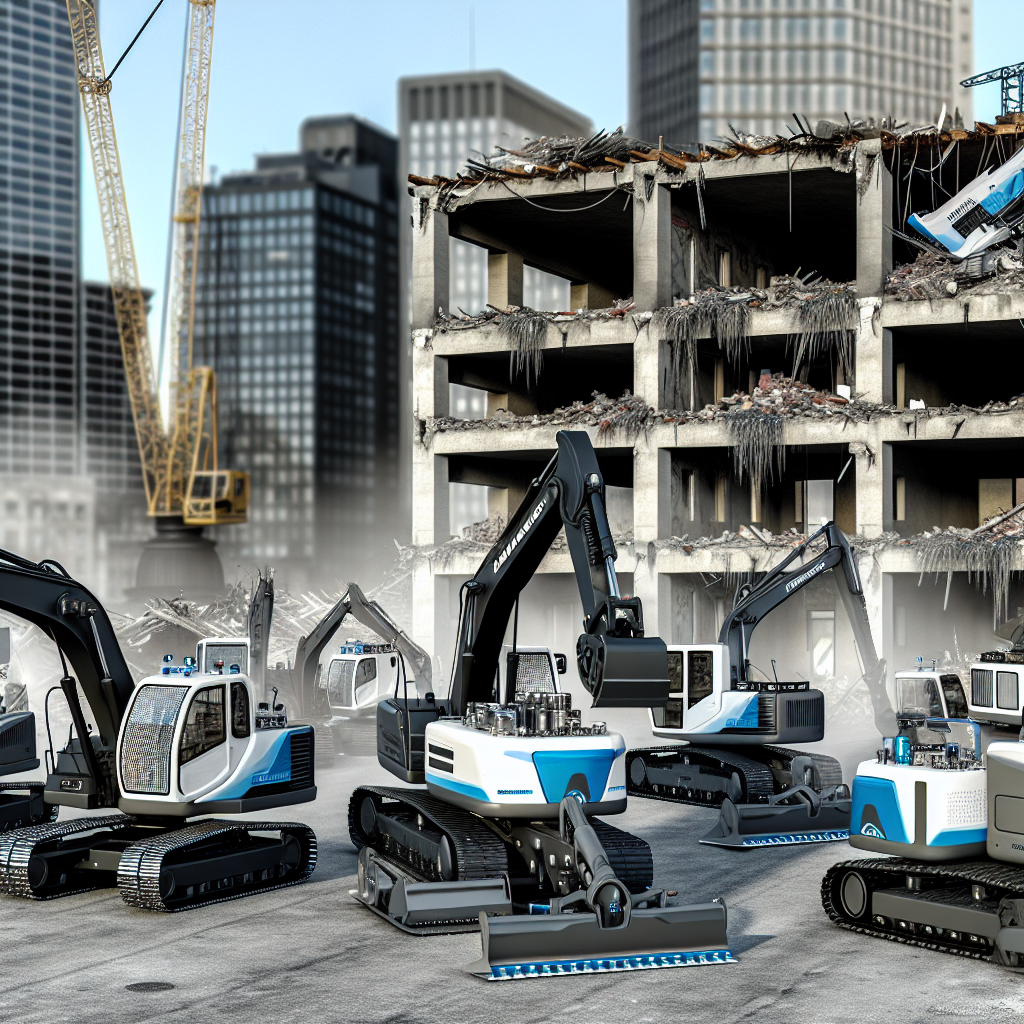
An action scene depicting electric construction equipment at a demolition site, showcasing the contrast between modern electric machinery and traditional diesel machines, emphasizing innovation in construction technology.
Future Trends in Electric Construction Equipment
The future of electric construction equipment is set to transform the construction industry significantly. Here are some expected trends that will influence construction practices, regulations, and urban planning:
-
Electrification of Heavy Machinery
A broader range of manufacturers will introduce electric models, expanding the options for construction companies looking to transition away from diesel. -
Government Regulations
As sustainability becomes a priority, new policies may mandate the use of electric machines in public works, incentivizing their adoption through grants or subsidies. -
Urban Planning Integration
City planners are likely to design environments that support electric construction, including infrastructure like charging stations strategically located around construction sites. -
Workforce Training
As electric machines gain traction, there will be a need for specialized training programs for the workforce to effectively operate and maintain these new technologies. -
Data-Driven Construction
The integration of IoT technology in electric machinery will lead to smarter operations, with data analytics providing insights on efficiency and productivity. -
Increased Demand for Clean Construction
With urban areas moving toward sustainable practices, the demand for electric equipment will continue to escalate, particularly in densely populated cities. -
Technological Advancements in Batteries
Continued improvements in battery technology will enhance operational efficiency, allowing electric machines to run for longer durations without needing a recharge. -
Partnerships for Sustainability
Collaborations between construction firms and technology companies will likely focus on developing new, efficient electric machinery and optimizing existing models for reduced environmental impact.
In summary, the electric construction equipment trend is driven by a confluence of government regulations, technological advancements, and societal demands for greener urban environments. This shift not only reshapes construction practices but also influences future urban planning initiatives.
Urban Demolition and Its Environmental Benefits
Urban demolition plays a crucial role in the redevelopment of cities, often leading to new infrastructure and urban spaces. However, the traditional practices surrounding demolition often come with significant environmental costs, including increased carbon emissions, noise pollution, and waste. By integrating electric construction equipment into urban demolition projects, companies like Volvo are addressing these challenges head-on.
Minimizing Emissions
One of the most compelling benefits of utilizing electric machinery in urban demolition is the substantial reduction in emissions. Electric machines produce zero emissions at the point of use, drastically lowering the carbon footprint associated with construction activities. This is vital in urban areas where air quality is a pressing concern. For instance, during a year-long pilot program, Volvo’s electric machines collectively reduced CO2 emissions by 6 metric tons compared to their diesel counterparts. Such reductions not only comply with increasingly stringent urban regulations but also contribute positively to public health.
Noise Reduction
The impact of noise pollution in urban areas is another critical factor in demolition projects. Traditional diesel machinery tends to generate significant noise, creating disturbances for nearby residents and businesses. Electric equipment, on the other hand, operates much more quietly, reducing noise levels by approximately nine decibels. This reduction allows demolition activities to take place with minimal disruption, fostering better relationships with local communities.
Waste Management and Recycling
Additionally, electric machinery supports efficient waste management processes during demolition. Many electric compaction machines can be paired with advanced recycling technologies that optimize material recovery from demolition sites. By promoting recycling and minimizing waste, electric equipment aligns with principles of sustainable urban development, contributing to circular economy practices where resources are reused and repurposed rather than discarded.
Economic Viability
The shift to electric construction equipment is not solely an environmental consideration; it also presents economic advantages. As operating costs for electric machines decrease due to lower fuel expenses, reduced maintenance needs, and potential government incentives, project budgets can be optimized. This economic viability supports municipalities and developers in their transition toward cleaner, more sustainable urban construction practices.
In summary, urban demolition, when combined with electric construction technology, allows cities to not only reconstruct but also rejuvenate their environments. By prioritizing practices that minimize emissions, reduce noise, and streamline waste management, electric machinery is paving the way for a more sustainable and harmonious approach to urban development.