
What Is an Off-Road Truck Driver? The Soul Behind the Wheel
You feel it before you hear it. A low, guttural growl rising from the earth as knobby tires chew through mud, gravel, and rock. Mud splatters across the windshield like war paint. The suspension groans, flexing against terrain that would swallow a lesser machine whole. This isn’t just a drive to work. This is a battle. And at the center of it-hands welded to the steering wheel, eyes locked on the horizon-sits the off road truck driver.
Let’s be clear from the start: an off road truck driver is not merely someone who happens to drive a truck on unpaved surfaces. That definition is too tame. Too sterile. The real off-road truck driver is a modern-day explorer, a master of machine and landscape who reads dirt like a sailor reads the sea. They know the precise angle to approach a 40-degree incline. They can feel when the rear axle is about to lose traction on loose shale. They understand that a truck isn’t just transportation-it’s an extension of will, a steel-and-rubber beast that answers only to those who respect it.
This driver lives where pavement ends and possibility begins. Whether they’re hauling livestock across a rutted ranch road, crawling over boulders in Moab, or launching through whoops in the Baja 1000, they share one thing in common: an unshakable hunger for the wild. The mud under their fingernails and the dust in their lungs are badges of honor. The growl of a built V8 or the whine of a locked differential is their soundtrack.
So what does it truly take to become one? Is it the right tires? A suspension lift? Raw horsepower? Or is it something deeper-something forged in the grit between the driver’s ears? Buckle up. We’re about to tear down the dirt road and find out.

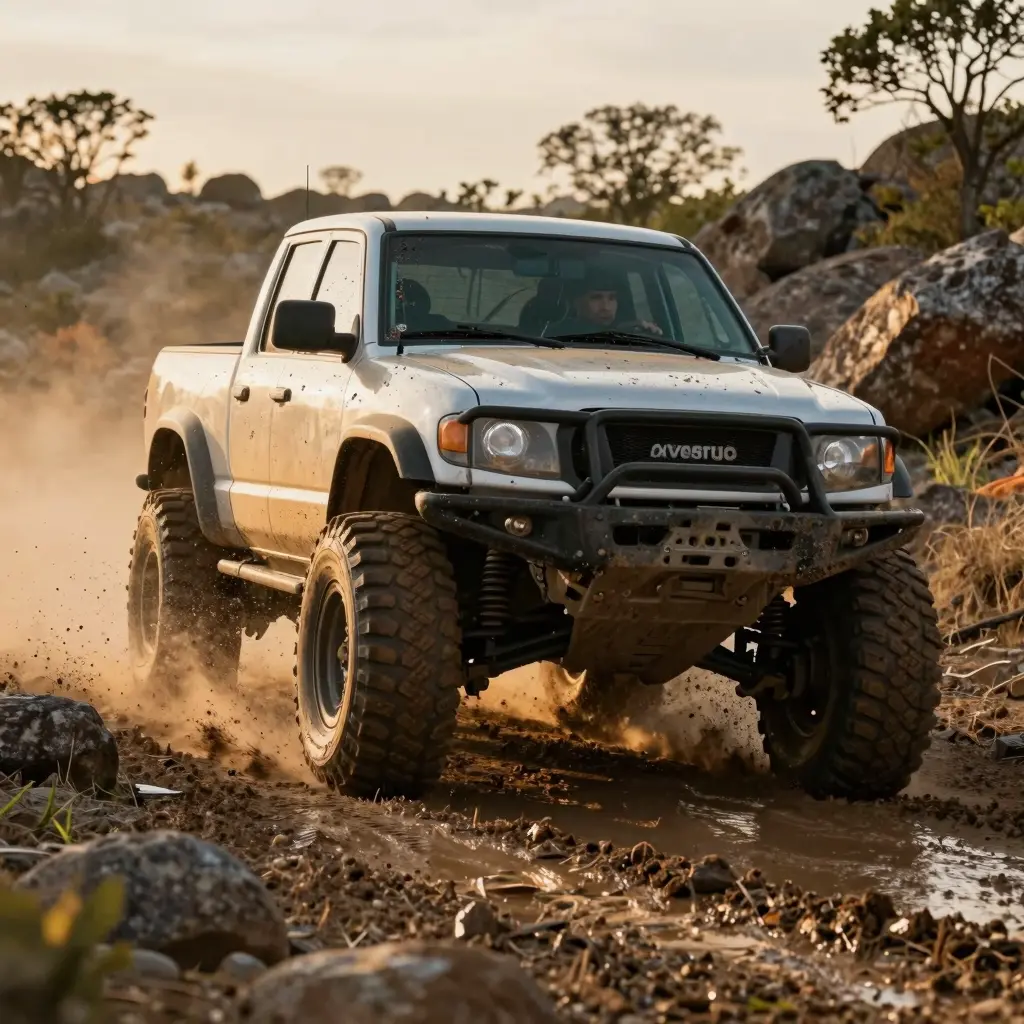
Note: The above image represents the dramatic, action-oriented visual tone of off-road trucking. A rugged 4×4 with oversized mud-terrain tires powers through a deep mud puddle on a forest trail, with golden hour sunlight filtering through the pines and mud spraying aggressively from the wheels – capturing the raw thrill and power of off-road driving.
Who Is an Off-Road Truck Driver? (And Who Is Not)
Let’s get one thing straight from the jump: an off-road truck driver is not someone who merely drives a pickup truck to the grocery store or tackles a gravel driveway on the way to work. An off-road truck driver is a person who deliberately operates a 4×4 truck or off-road vehicle on unimproved, rugged terrain – for recreation, competition, utility, or survival.
What They Are Not
- Daily commuters – Driving a lifted truck on pavement doesn’t make you an off-road driver. It makes you a pavement princess.
- Casual SUV owners – Taking a stock SUV down a flat dirt road once a year is a Sunday cruise, not off-road driving.
- Professional on-road truckers – CDL holders hauling freight on highways operate in a completely different world. They run asphalt. Off-road drivers run rock, sand, mud, and mountain.
The Sub-Types of Off-Road Truck Drivers
Recreational Trail Blazers
These are the weekend warriors. They fire up their 4×4 truck on Friday evening and head for national forest trails, fire roads, and technical two-tracks. They’re not racing – they’re exploring. The goal is to reach a viewpoint, a campsite, or simply conquer the trail. For them, off-road driving is an escape from the paved world.
Desert Racers
Speed is the name of the game. Desert racers pilot trophy trucks and pre-runners across open desert at 100+ mph. They battle whoops, silt beds, and washouts. Events like the Baja 1000 and King of the Hammers define this breed. These drivers are athletes, and their off-road vehicle is a finely tuned race machine.
Rock Crawlers
Patience, precision, and a suspension that flexes like a contortionist. Rock crawlers inch their rigs over boulder fields, vertical ledges, and technical obstacles that would destroy a stock truck. Every degree of articulation matters. This is chess played with 40-inch tires and lockers.
Overlanders
Overlanders are the long-haul adventurers. They build their trucks for self-sufficient travel – rooftop tents, auxiliary fuel tanks, water storage, and recovery gear. They cross continents, sleep under the stars, and rely on their 4×4 truck as both transport and home. This is off-road driving with a purpose: the journey itself.
Agricultural and Utility Drivers
Not all off-road driving is for fun. Ranchers, farmers, foresters, and oilfield workers operate heavy-duty trucks and specialized off-road vehicles daily to cross pastures, haul feed, navigate muddy fields, and access remote work sites. For them, off-road driving is a job requirement. Their trucks are tools, not toys.
The Bottom Line
An off-road truck driver is defined by intent and terrain. If you’re behind the wheel of a 4×4 truck and the road ends – that’s where you begin. Whether you’re chasing a trophy, crawling a boulder, crossing a continent, or working the back forty, you belong to the tribe. And if you’re serious about keeping your rig trail-ready, mastering diesel mechanics is a skill every off-road driver should have in their toolbox.
Not every off-road driver is cut from the same rock-and their rigs shouldn’t be either. From granite-streaked canyons to open desert flats, the terrain dictates everything: suspension travel, tire selection, gearing, and the skill set behind the wheel. Whether you’re crawling boulders at 2 mph or hauling gear across state lines off the grid, your build must match your mission. Here’s how the major driver types stack up.
Off-Road Truck Driver Types at a Glance
| Driver Type | Primary Terrain | Vehicle Focus | Key Skill | Typical Rig |
|---|---|---|---|---|
| Rock Crawler | Granite boulders, steep ledges, technical canyon trails | Extreme articulation, low gearing, locking diffs, 37″+ aggressive tires | Precision throttle control & obstacle reading | Jeep Wrangler Rubicon, Toyota Tacoma on long-travel suspension, custom tube-chassis buggy |
| Desert Racer | Open desert washes, whoops, dry lake beds at high speed | Long-travel suspension (20″-34″), 850+ hp engines, reinforced tubular frames | High-speed navigation & split-second reaction time | Trophy Truck (Ford Raptor-based or custom), Class 1 buggy, pre-runner Ford F-150 |
| Overlander | Forest trails, mountain passes, remote cross-country routes | Payload capacity, onboard power (solar), water storage, roof-top tents, winch | Self-sufficiency & route planning | Toyota 4Runner, Land Cruiser 200 Series, Ford F-350 with camper setup, Mercedes Sprinter 4×4 |
| Trail Rider | Moderate dirt trails, mud holes, fire roads, weekend forest tracks | Balanced lift (2″-4″), all-terrain tires, skid plates, lockers for versatility | Reading trail lines & vehicle recovery | Jeep Wrangler JL, Ford Bronco Badlands, Toyota Tacoma TRD Pro |
| Agricultural / Utility Driver | Farm fields, ranch pastures, construction sites, muddy job lots | Durability, towing capacity (10,000+ lbs), load range E tires, steel bumpers | Terrain adaptation under load & equipment management | Ram 2500 Power Wagon, Ford F-250 Super Duty, Polaris Ranger UTV, custom flatbed farm truck |
Each type demands a fundamentally different approach to suspension, gearing, and electronics. A trophy truck built for 120-mph desert blasts would be useless in a boulder field-and a rock crawler would get swallowed by a Baja whoop section. Know your terrain, build your truck, and drive with purpose. For those managing fleets across varied off-road conditions, leveraging dispatch software for fleet management can help coordinate multiple rigs that serve different roles-from utility trucks on the ranch to overlanders on expedition.
The Mindset and Skills of an Off-Road Truck Driver
Horsepower gets you noticed. But it is skill and mindset that get you home.
Behind the wheel of an off-road truck, you aren’t just a driver-you are a navigator, a mechanic, a risk analyst, and a philosopher of terrain. The trail doesn’t care about your truck’s lift kit or your LED light bar. It demands something far more valuable: mastery of the fundamentals.
Reading the Terrain Like a Language
Every rock, every rut, every patch of sand tells a story. Learning off-road driving skills begins with terrain reading-the ability to scan 50 yards ahead and predict what your tires will meet. Is that washout packed hard or hiding soft silt beneath? Will that crest send you airborne or settle you gently? A seasoned driver reads the dirt the way a sailor reads the sea: with respect, intuition, and constant vigilance.
The Art of Vehicle Control
On loose surfaces, every input matters. Throttle modulation is your grace note-too much gas and you dig; too little and you stall. Braking on gravel or sand requires featherlight touch; lock a wheel and you trade control for momentum. Steering must be patient, never jerky. These aren’t just techniques-they are a dialogue between driver and machine.
Mechanical knowledge is non-negotiable. When you’re miles from pavement, a loose belt or a weeping hose isn’t a shop call-it’s a survival problem. Understanding your drivetrain, suspension geometry, and recovery gear transforms a breakdown into a minor delay. For those looking to deepen their technical foundation, mastering diesel mechanics is a powerful step toward true self-reliance.
Recovery: The Quiet Crisis
Every off-road driver gets stuck. The question is whether you panic or problem-solve. Recovery techniques-winching with proper anchor points, using traction boards, airing down tires-are the difference between an adventure story and a rescue mission. Risk assessment means knowing when to push and when to turn back. Sometimes the strongest move is the decision not to drive that line.
Patience as a Superpower
Speed is easy. Patience is hard. The best off-road drivers move slowly, deliberately, with the calm confidence of someone who has nothing to prove. They know that momentum is a tool, not a crutch. They breathe before the obstacle, not after.
This lifestyle of self-reliance-where your truck is your partner, not just your vehicle-is what separates enthusiasts from true off-road drivers. It’s a path forged in dirt, dust, and deliberate practice.
And once the mindset is right, the next step is making sure your truck is ready for what you’ve learned to handle. That brings us to modifications-the art of building a machine as capable as the driver behind the wheel.
What the Mud Does to a Man
To understand what an off-road truck driver truly is, you have to look beyond the lift kits, the mud-terrain tires, and the aftermarket suspension. You have to understand the spiritual shift that happens when you point a 6,000-pound machine at a mountain and don’t flinch. Nobody climbs behind the wheel of an off-road truck for logic. They do it because something ancient wakes up inside them-something that remembers when dirt was home and asphalt was a cage.
Few people articulate this transformation better than those who have spent decades eating dust and drinking adrenaline. Jess Marlow, a 20-year veteran of the Baja 1000 and owner of Marlow’s Off-Road Fabrication in El Cajon, California, has seen the look in a thousand rookies’ eyes. He put it this way:
“People think we’re crazy for dropping fifty grand on axles and sleeping in a truck bed covered in silt. But here’s the thing-once you’ve felt a trophy truck hook up through a whoop section at 90 miles an hour, everything else feels like watching paint dry. The comfort, the money, the clean clothes-none of that matters. You start breathing different out there. The desert doesn’t care about your mortgage or your boss. It just dares you to keep the pedal down. And once you answer that dare, you can’t un-answer it. You spend the rest of your life chasing that moment where the truck, the terrain, and your nerve all line up at once. That’s not a hobby. That’s a religion with dirt under its fingernails.”
The rawness in Marlow’s voice echoes what every off-road truck driver discovers sooner or later: this lifestyle isn’t about the vehicle. It’s about the version of yourself that only exists when the pavement ends. Whether you’re bombing across the Baja peninsula or navigating a muddy cutline on your own property, the transformation is the same. For those looking to dive deeper into the mechanical side of building these beasts, mastering diesel mechanics is a critical step toward keeping that dream alive.
Truck Modifications and Essential Gear: Build Your Rig for the Backcountry
A stock truck can get you down a gravel road, but if you’re serious about conquering rock gardens, rutted trails, and axle-deep mud, you need to invest in the right truck modifications. From the frame rails up, every component you choose determines whether you crawl forward or get towed out. Let’s break down the essential off-road truck upgrades that separate weekend warriors from backcountry legends.
Suspension Lifts: The Foundation of Capability
A quality suspension lift does more than give your truck an aggressive stance. It increases ground clearance, allows for larger tires, and improves articulation so your tires stay planted on uneven terrain. For rock crawling, a 4-6 inch lift with long-travel shocks is ideal. For overlanding, a moderate 2-3 inch lift with coilovers balances highway comfort with trail prowess. Don’t cheap out on lift kits – budget springs sag and budget shocks fade. If you’re serious about mastering the mechanical side of your build, learn more about diesel mechanics and technical expertise to complement your suspension knowledge.
All-Terrain vs. Mud-Terrain Tires: Choose Your Weapon
Your tires are the only thing connecting your rig to the earth. All-terrain (AT) tires feature tighter tread patterns with siping for highway stability, wet-road grip, and decent off-road traction – perfect for overlanders who drive miles of pavement to reach the trail. Mud-terrain (MT) tires use aggressive, widely spaced lugs that self-clean in thick mud and dig into loose soil, but they hum loudly on asphalt and wear faster. For mixed use, ATs win. For dedicated trail assaults, MTs are non-negotiable.
The Top 8 Off-Road Truck Modifications
Here are the eight essential 4×4 accessories every off-road driver should consider:
- Suspension Lift – Increases ground clearance and wheel travel, allowing you to clear obstacles and maintain traction over uneven terrain.
- All-Terrain or Mud-Terrain Tires – The single biggest performance upgrade; choose ATs for versatility or MTs for extreme traction in soft, muddy conditions.
- Skid Plates – Armor your undercarriage against rocks, stumps, and hidden ledges that can punch holes in oil pans, transmissions, and differentials.
- Winch (12,000 lbs+) – Your get-out-of-jail-free card; when momentum fails, a winch with synthetic rope and a snatch block can self-recover from nearly any situation.
- Heavy-Duty Bumpers – Replace flimsy factory bumpers with steel units that offer recovery points, winch mounts, and approach angle improvements.
- LED Lighting – A 30-inch light bar or ditch lights turn night into day, revealing trail hazards and camp setups long after the sun drops.
- Snorkel – Raises your air intake to roof height, preventing hydrolock when crossing deep water crossings and reducing dust ingestion on dry trails.
- Lockers & Onboard Air – Locking differentials force both wheels on an axle to spin together, while onboard air lets you air down for traction and air back up for pavement.
Why Each Mod Matters by Terrain
Rock crawling demands skid plates, lockers, and a winch – you’ll bash your belly and need to pick your way over boulders inch by inch. Mud bogs require aggressive MT tires, a snorkel (mud pits are deeper than they look), and a winch with a long synthetic line. Overlanding benefits from moderate lifts, AT tires, onboard air, and auxiliary lighting for nighttime camp setup. Desert running calls for a suspension that can soak up whoops at speed, plus a quality light bar for high-speed night navigation.
The Bottom Line
Your truck is only as capable as the parts you bolt onto it. Whether you’re installing a simple leveling kit or building a full expedition rig, the quality of your truck modifications determines whether you drive home under your own power or call for a recovery. And here’s the thing – that principle of quality-first extends beyond the trail. From the gear in your garage to the tools of your trade, investing in reliability pays dividends. Whether you’re upgrading your 4×4 or optimizing the way your truck fleet operates, quality parts and quality people make all the difference. Build smart, drive hard, and never compromise on the components that keep you moving forward.
What the Numbers Say About Off-Road Drivers
Every bolt, bracket, and bumper a driver bolts onto their rig tells a story. The modification choices truck owners make reveal what truly matters when the pavement ends – whether it’s conquering rock gardens, fording mud pits, or surviving a brutal desert trail. The data below, drawn from enthusiast surveys and aftermarket sales trends, shows exactly where the off-road community invests its time and money to build trail-ready beasts.
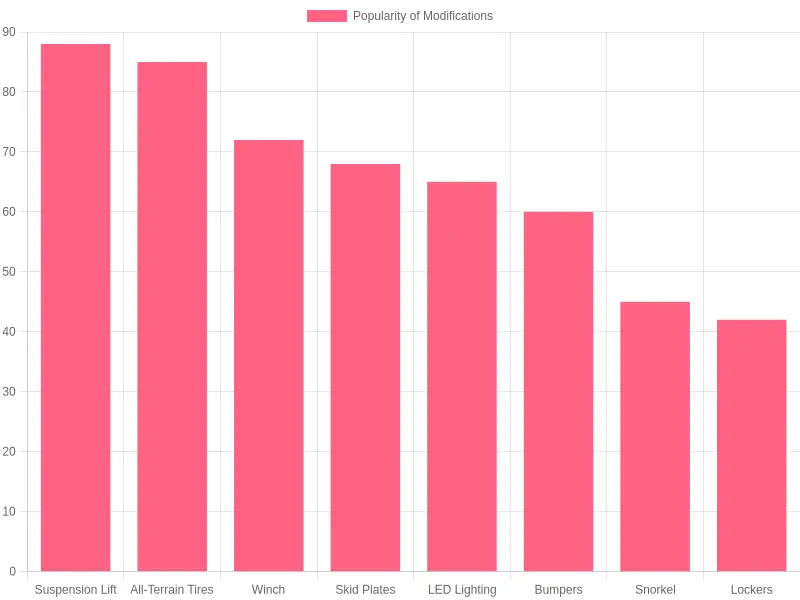
Chart: Most Popular Off-Road Truck Modifications – Data sourced from enthusiast surveys and off-road industry reports.
Breaking Down the Numbers
Suspension Lift (88%) and All-Terrain Tires (85%) sit at the top – and that’s no surprise. These two upgrades form the absolute foundation of any serious off-road build. Without clearance and grip, you’re not going anywhere worth going. A quality lift kit opens up the ability to run larger tires, increases articulation over uneven terrain, and provides the ground clearance needed to clear rocks and ruts.
Winch (72%) and Skid Plates (68%) round out the top four, underscoring a critical truth: off-road drivers prepare for the worst. A winch is your get-out-of-jail-free card when the trail turns against you, and skid plates protect the vital organs of your truck – oil pan, transmission, transfer case – from the jagged surprises hidden beneath the trail.
LED Lighting (65%) and Bumpers (60%) follow closely, showing that visibility and protection go hand in hand. Whether you’re navigating a moonless night on a forest service road or pushing through a dust cloud in the desert, serious lighting is non-negotiable. Heavy-duty aftermarket bumpers provide both armor for the front end and mounting points for winches and auxiliary lights.
Snorkel (45%) and Lockers (42%) round out the list – less common, but absolutely essential for the drivers who push their rigs into water crossings and technical terrain where factory open differentials just won’t cut it.
The Takeaway
This data paints a clear picture: the modern off-road truck driver is methodical, practical, and prepares for the worst while hoping for the best. The modifications at the top of this list aren’t about flash – they’re about function. Suspension, tires, recovery gear, and protection dominate because they directly impact capability and survivability on the trail. Whether you’re a weekend warrior or a seasoned overlander, these numbers confirm what every dirt-and-grime veteran already knows: build for the obstacle, not the parking lot.
Every off-road truck driver knows the rubber meets the road – and the rock, sand, and mud. The journey doesn’t just test your rig; it forges the driver behind the wheel. From axle-snapping boulders to bottomless silt beds, these five off-road destinations separate the weekend warriors from the true trail masters. If you’re looking to push your build and your skill to the limit, strap in – these are the off-road trails that define the sport.
1. Moab, Utah
Location: Southeastern Utah, near Arches National Park
Best Season: Spring & Fall (March-May, September-November)
With over 400,000 miles of slickrock trails like Hell’s Revenge and Poison Spider Mesa, Moab is the undisputed off-road capital of the world. It tests every inch of your suspension, gearing, and nerve – and rewards you with otherworldly red-rock vistas that stretch to the horizon. The sheer traction of the Navajo sandstone lets you climb at angles that defy physics, but one wrong line means a tumble you won’t forget.
2. Rubicon Trail, California
Location: El Dorado & Tahoe National Forests, near Lake Tahoe
Best Season: Summer & Early Fall (July-September)
The 22-mile Rubicon is the Mount Everest of off-road trails – a relentless gauntlet of granite boulders, off-camber ledges, and axle-twisting climbs that demands a fully built rig and a steady hand. It’s a badge of honor earned meter by brutal meter, and the alpine lakes and pine forests along the way make every dent in your rock sliders worth it. Proper mastering diesel mechanics is a must before attempting this beast.
3. Outer Banks, North Carolina
Location: Barrier islands along the NC coast, including Corolla & Cape Hatteras
Best Season: Spring & Fall (April-May, September-October)
Shifting sands, tidal surprises, and the constant threat of getting stuck in soft beach terrain make the Outer Banks a unique off-road challenge. Here, you master tire pressure, momentum, and tidal timing – or you dig. The reward? Miles of pristine Atlantic coastline, wild Spanish mustangs roaming the dunes, and a sense of solitude that only the beach at dawn can deliver.
4. Ouray, Colorado (Alpine Loop)
Location: San Juan Mountains, connecting Ouray, Silverton & Lake City
Best Season: Summer & Early Fall (July-September)
The 63-mile Alpine Loop climbs to 12,800 feet through narrow shelf roads, boulder fields, and abandoned mining passes. Thin air punishes poor throttle control, and altitude sickness is a real threat. But the payoff is a 360-degree alpine panorama of Colorado’s most rugged peaks, wildflower meadows, and ghost towns that feel frozen in time. This is high-altitude wheeling at its finest.
5. Baja Peninsula, Mexico
Location: Stretching from Ensenada south to Cabo San Lucas
Best Season: October-June (avoiding summer heat & hurricane season)
Home of the legendary Baja 1000, this unforgiving desert terrain of silt beds, whoops, and washouts tests your endurance, navigation, and recovery skills like nothing else. The Baja Peninsula rewards drivers who embrace the dust, the heat, and the raw, untamed wilderness with a sense of adventure few roads on Earth can match. It’s not a trail – it’s a rite of passage.
Trail Comparison at a Glance
Below is a chart comparing difficulty ratings and elevation across the top five destinations to help you plan your next build and trip.
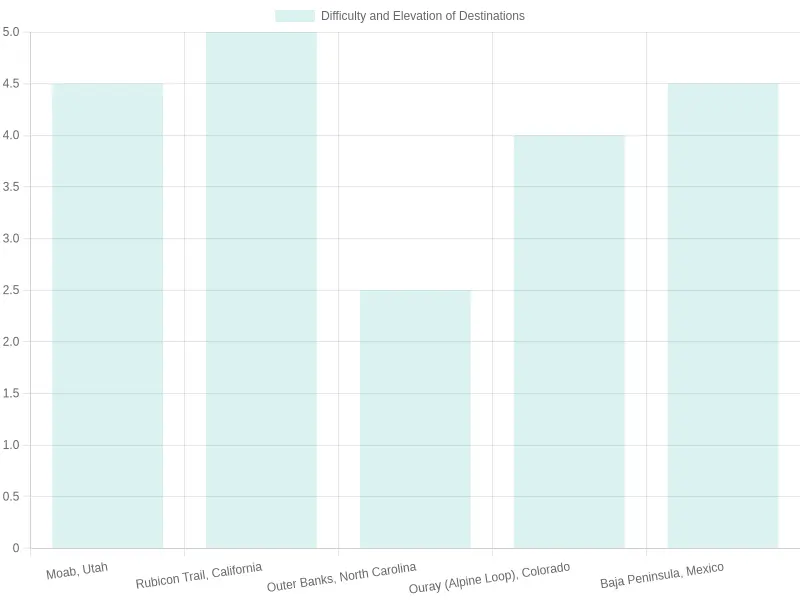
Chart: Difficulty rating (1-5 scale) vs. elevation in feet for each destination.
| Destination | Difficulty (1-5) | Elevation (ft) | Best Season |
|---|---|---|---|
| Moab, Utah | 4.5 | 4,000 | Spring & Fall |
| Rubicon Trail, California | 5.0 | 6,600 | Summer & Fall |
| Outer Banks, North Carolina | 2.5 | 10 | Spring & Fall |
| Ouray (Alpine Loop), Colorado | 4.0 | 11,000 | Summer & Fall |
| Baja Peninsula, Mexico | 4.5 | 1,500 | Oct-June |
Whether you’re navigating slickrock in Moab, clawing up granite on the Rubicon, or carving through Baja’s desert dust, each of these off-road destinations offers a unique crucible for driver and machine alike. For more insights on keeping your rig trail-ready, check out our guide on optimizing fleet management for long-haul performance.
The Payoff: Where the Trail Meets the Sky
After reading through the destinations, the gear lists, and the skills it takes to handle the backcountry, you might be wondering: What’s the point of it all?
This image answers that question.
Image: A cinematic photograph of a heavily modified off-road truck – lifted suspension, aggressive mud-terrain tires, a roof rack laden with recovery boards and camping gear, and an LED light bar cutting across the roofline – climbing a steep, rocky trail at an angle. Dust kicks up from the tires as the truck digs into the terrain. In the background, dramatic snow-capped mountain peaks rise against a vibrant, clear blue sky with wispy white clouds. Golden hour light casts warm orange tones across the scene, illuminating the dust trail and the truck’s silhouette. No text, no logos. Just the raw beauty of a well-built rig doing what it was meant to do.
Alt Text: Heavily modified lifted off-road truck with roof rack, LED light bar, and mud-terrain tires climbing a rocky mountain trail under a clear blue sky with snow-capped peaks in the background during golden hour.
This is the payoff. Every weekend spent wrenching in the garage. Every budget stretched for that next upgrade. Every hour researching suspension geometry, tire psi, and recovery techniques. It all leads to this moment – the truck, the trail, and the horizon.
There’s a reason the off-road truck modification community is one of the most passionate in the automotive world. It’s not just about bolt-ons and lift kits. It’s about building a machine that can earn its way up a mountain. It’s about the confidence that comes from knowing your rig won’t let you down when the trail gets technical. And it’s about the views – the kinds of views you can only reach when your truck is capable enough to take you beyond the pavement.
Whether you’re a weekend warrior hitting the local OHV park, a seasoned overlander crossing state lines, or a shop owner building customer rigs for the next expo, this is what we’re all chasing. That moment where machine, driver, and landscape become one. Where the modifications you chose – that 4-inch lift, those 35-inch tires, that LED bar that turns night into day – all prove their worth in a single, beautiful line of ascent.
That is what it means to be an off-road truck driver.
Challenges, Rewards, and the Off-Road Community
Let’s be honest: off-road truck driving isn’t for the faint of heart. The challenges are real, and they hit hard. Between the cost of modifications, the constant threat of vehicle damage, the inherent danger of remote terrain, and the gut-wrenching dread of a breakdown miles from the nearest paved road – this sport will test your wallet, your nerves, and your willpower.
A single bad line through a rock garden can shatter an axle. A deep-water crossing can flood your drivetrain. And when you’re stranded on a trail with no cell service, you quickly learn that Mother Nature doesn’t care about your schedule. Recovery costs, repair bills, and the steep learning curve of mastering your rig are all part of the deal.
But here’s the truth that every off-road truck driver knows in their bones: the rewards absolutely dwarf the risks.
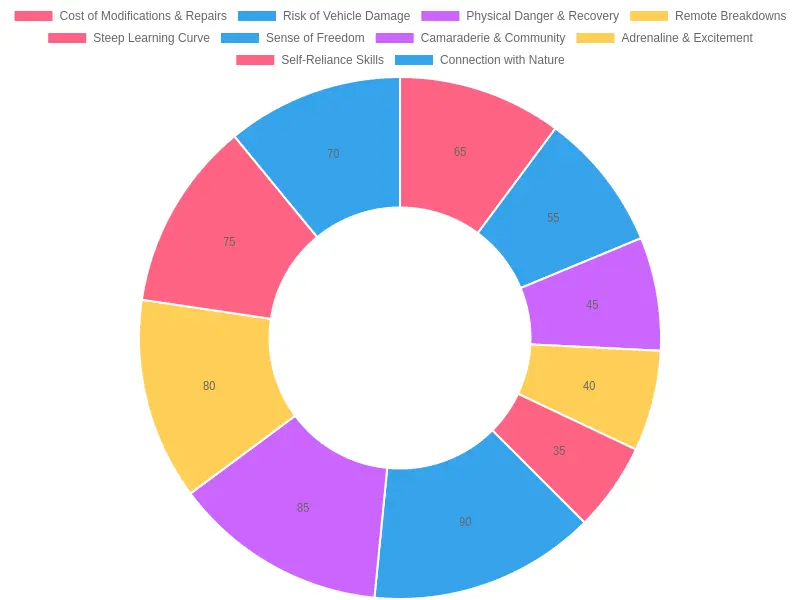
What You Gain When You Leave the Pavement
- Unfiltered Freedom – No trail is a dead end. You chart your own path, conquer your own obstacles, and answer to no one.
- Camaraderie Like No Other – Nothing bonds people like pulling a stranded rig out of a mud pit at 2 a.m. The friendships forged in the dirt are forged for life.
- Adrenaline That Strikes Pure – The surge of making it up a near-vertical climb or clearing a boulder field is unmatched by anything on asphalt.
- Self-Reliance You Can’t Buy – You learn to diagnose, repair, and adapt. Mastering diesel mechanics and trail-side fixes becomes second nature.
- Raw Connection with Nature – You see landscapes most people never will – remote canyons, high desert plateaus, alpine passes that exist only in dreams.
The Off-Road Community: Your Tribe Awaits
This is where the real magic happens. The off-road community is one of the most welcoming, generous, and knowledge-rich subcultures on the planet. Whether you’re a green rookie or a seasoned trail leader, you’ll find your people.
Clubs like the Toyota FJ Cruisers, Jeep Jamborees, and local 4×4 groups host regular meetups, trail rides, and recovery trainings. Online forums like Pirate4x4, Reddit’s r/4×4, and dedicated Facebook groups are treasure troves of trail maps, gear reviews, and mechanical wisdom. Veterans share their hard-won knowledge freely – because in this community, we rise together or we don’t rise at all.
Being an off-road truck driver means joining a tribe of like-minded adventurers who value grit, resourcefulness, and mutual respect above all else. You don’t just buy a truck – you earn a place among people who will drive six hours to pull you out of a ditch, then share a beer by the campfire and laugh about it.
The Right Gear Makes All the Difference
Of course, none of this matters if your rig isn’t up to the task. The challenges are real, but the right gear – from winches and recovery boards to suspension upgrades and all-terrain tires – transforms risk into manageable adventure. When you equip your truck with the tools and knowledge it demands, the dirt doesn’t stand a chance.
More Than a Driver: Builder, Adventurer, Tribe Member
To be an off-road truck driver is to be something more than someone behind a wheel. You are a builder-constantly wrenching, upgrading, fabricating, and pushing the limits of what your rig can do. Every lift kit, every reinforced axle, every custom suspension setup is a testament to your hands-on craftsmanship. You are an adventurer-chasing horizons across desert washboards, muddy rutted trails, and rocky mountain passes where pavement ends and freedom begins. The dust in your gear and the mud caked on your tires aren’t dirt; they’re badges of honor from miles most people will never travel.
But perhaps most importantly, you are part of a tribe. The off-road community is bound by something deeper than a shared hobby. It’s a brotherhood and sisterhood forged in recovery straps, campfire stories, and the unspoken respect between two drivers who nod at each other on the trail. You know that the best parts of the journey aren’t the destinations-they’re the people who help you rebuild a broken control arm at midnight under a sky full of stars.
This identity-builder, adventurer, tribe member-demands more than off-the-shelf mediocrity. It demands precision, durability, and parts that earn their place on your machine. You don’t settle for less because your rig is an extension of who you are.
The same principle applies to every rider who takes pride in their machine. Whether you’re tearing through dirt trails on two wheels or carving asphalt on a sport bike, the hunger for quality never changes. You deserve components that match your passion.
Your Ride Deserves the Same Standard
Just as off-road truck drivers refuse to bolt on cheap parts that fail at the worst possible moment, riders of every kind deserve the same uncompromising quality. Customization isn’t just about aesthetics-it’s about performance, fitment, and knowing that every piece on your bike was built to handle the road (or trail) ahead. That’s why precision matters. That’s why custom-fit components matter. And that’s exactly why Summit Fairings exists.
Ready to elevate your ride? Summit Fairings delivers premium, custom-fit fairings that blend style and durability. Whether you’re chasing speed or turning heads, we’ve got your bike covered. Don’t wait-transform your machine today. Click, customize, and ride with confidence. Your perfect fairing is just a few clicks away. Act now!